
Construction projects fail or succeed at the planning stage. The actual building work — concrete pours, steel erection, demolition, finish trades — runs on schedules, sequences, and material flows that were committed to weeks or months earlier. By the time the crew shows up, the room for major decisions has narrowed dramatically. The contractors who consistently come in on time and on budget are not the ones who execute heroically when problems appear; they are the ones who planned the project so that fewer problems appear in the first place.
This guide covers six planning practices that consistently separate profitable construction projects from the ones that grind through their margin: building material strategy into the schedule from day one, planning for material recovery rather than just disposal, building crew performance visibility into the daily routine, using construction management software with intent, investing in equipment that pays for itself in use, and planning for site conditions and compliance before mobilization rather than after. None of these are revolutionary. All of them are routinely skipped under deadline pressure — which is exactly why doing them well is a competitive advantage.
Tip 1: Build the Material Strategy Into the Schedule from Day One
Most construction schedules treat material as an input — something that arrives, gets used, and either becomes part of the structure or leaves as waste. The contractors who plan well treat material as a flow with both upstream and downstream economics. Where is virgin aggregate coming from, at what cost per yard, with what hauling miles? What demolition material is leaving the site, at what tipping cost, with what hauling miles in the other direction? Those two questions, asked together at the planning stage rather than separately during execution, often reveal a different project economics than the one in the original budget.
On a typical mid-sized commercial demolition or rebuild project, hauling and disposal of concrete and asphalt rubble can represent five to twelve percent of project cost — sometimes more on tight urban sites where landfill access is constrained or distant. The same project may simultaneously be paying for new aggregate to be hauled in for base course, fill, or pavement subbase. The two cost lines run in opposite directions and rarely show up as a single line item, which is exactly why on-site material processing is often invisible as a strategic option until someone explicitly asks: what would change if the demolition material became the aggregate?
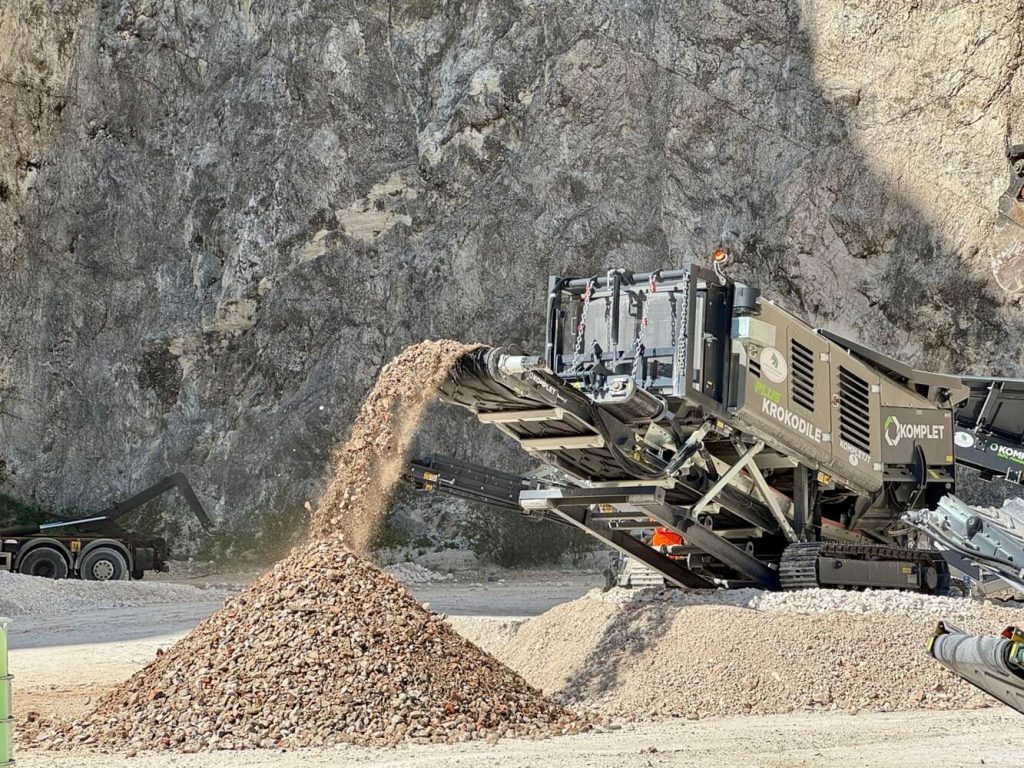
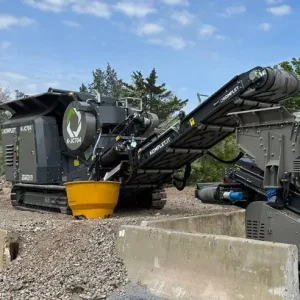
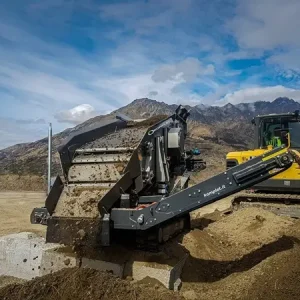
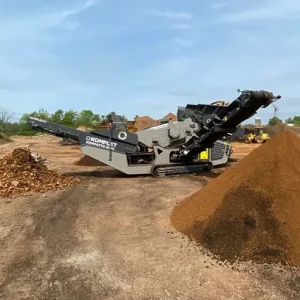
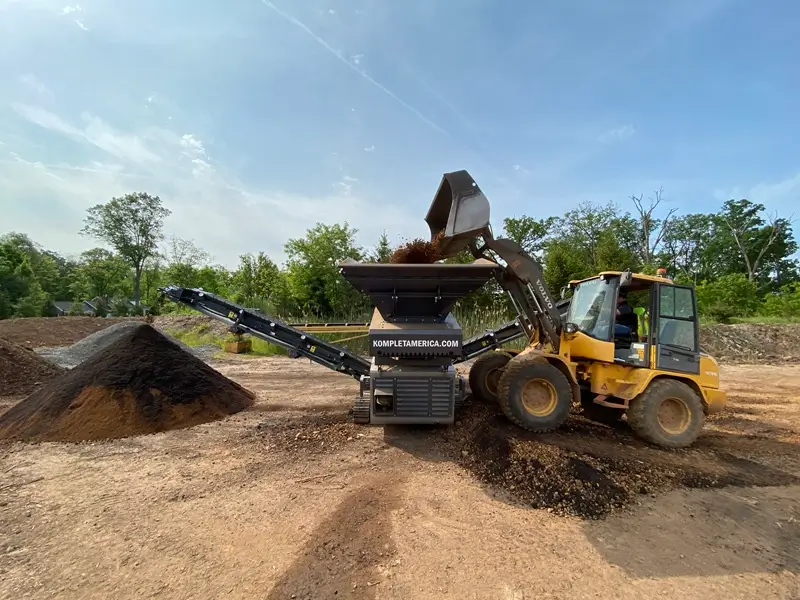
On-site processing — using a compact crusher, a compact screener, and where applicable a slow-speed shredder — converts demolition concrete, brick, asphalt, and rock into specification aggregate at the same point of use. The hauling miles to the landfill go away. The tipping fees go away. The hauling miles for inbound aggregate go away. The aggregate cost goes away or becomes a much smaller line item. Compact, mobile equipment like the Komplet K-JC 704 PLUS, Kompatto 5030, and K-TC 460 can run a full processing line on the project itself — taking demolition rubble in at one end and stacking spec aggregate at the other.
The planning consequence is that material strategy needs to be a separate line in the project plan, with its own decisions, its own equipment requirements, and its own economics. It is not a sub-item of demolition or a sub-item of site work. It is the connective tissue between them, and when planned deliberately it often pays for itself two or three times over within a single project.
Tip 2: Plan for Material Recovery, Not Just Disposal
Material recovery is the close cousin of material strategy but it deserves its own line because the framing matters. Disposal mindset asks: how do we get this off the site at the lowest cost? Recovery mindset asks: how do we capture the value of this material before it leaves the site? Same trucks, same equipment, very different planning outcomes.
Construction and demolition (C&D) material has more economic value than most contractors realize, particularly once it has been processed into a specification product. Crushed concrete sold as recycled concrete aggregate (RCA) commands a real market price in most U.S. metros, particularly for subbase, fill, and pavement applications. Reclaimed asphalt pavement (RAP) processed through a compact impact crusher produces a material that paving contractors will pay for, especially when virgin asphalt prices are high. Wood waste shredded through a slow-speed shredder can become biomass fuel, mulch, or animal bedding feedstock depending on local markets. Mixed C&D processed through the right combination of equipment can yield two or three saleable streams from what would otherwise have been one tipping fee.
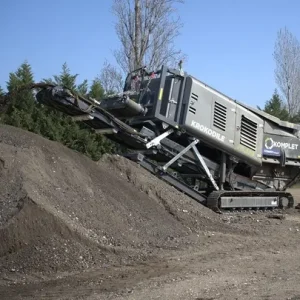
The Krokodile PLUS slow-speed shredder is particularly useful in this context because of its dual-shaft system. The same machine, with a quick-change shaft swap, processes hard C&D (concrete, asphalt, brick, block) on one configuration and lighter waste (wood, drywall, plastics, mixed garbage, green compostable material) on another. For a project with mixed waste streams, that means one piece of equipment captures recovery value across multiple material types instead of needing separate machines for each.
The planning practice that follows: at the project planning stage, identify what material streams the job will generate, in what quantities, and what local markets exist for the recovered products. The economics often justify processing material that would otherwise have been disposed — but only if the equipment, the personnel, and the storage area for processed product are planned in from the start. Trying to bolt material recovery onto a project that wasn’t planned for it almost never works.
Tip 3: Build Crew Performance Visibility Into the Daily Routine
People perform better when they can see how they are performing. This is not a theory; it is one of the most consistent findings in operations management across industries. The construction equivalent is a daily performance scoreboard visible to the crew — not as a punitive measurement tool but as a feedback mechanism that closes the loop between effort and result.
Effective scoreboards track a small number of metrics that the crew controls and that connect directly to project outcomes. On a demolition or earthwork project, that might be cubic yards processed per day, hours of equipment uptime, near-miss safety reports, or tons of material recovered for reuse. On a site work project, it might be linear feet of underground utility installed, soil compaction tests passed, or weather-impacted hours mitigated. The specific metrics matter less than three properties: they are visible to the crew daily, they are within crew control, and they connect to outcomes the project actually cares about.
Two pitfalls to avoid. First, do not turn the scoreboard into a punitive tool. The moment crews believe the scoreboard is being used to identify under-performers for discipline, the data becomes corrupted — people manage the metric instead of the work. Second, do not measure too many things. Three to five metrics is the practical maximum. More than that and the scoreboard becomes background noise. The point is daily visibility on what matters most, not comprehensive measurement of everything that could be measured.
Done well, this practice produces a measurable productivity improvement that compounds over the life of the project. Crews who can see their progress generally produce more progress. Crews who get daily feedback generally make fewer errors that compound into larger errors. The cost of implementation is essentially zero — a whiteboard, a daily five-minute review, and consistent attention from the foreman or superintendent.
Tip 4: Use Construction Management Software with Intent
Construction management software has evolved substantially over the past decade. The market now includes Procore, Buildertrend, CoConstruct, PlanGrid, Fieldwire, Smartsheet construction templates, and many others, ranging from simple project tracking to fully integrated estimating, scheduling, document control, RFI management, and financial reporting. The right tool varies enormously by company size, project type, and existing workflow.
The trap most contractors fall into is selecting software based on feature lists rather than on actual workflow needs. A small contractor running residential remodels does not need the same software stack as a regional general contractor managing twelve concurrent commercial projects. Buying too much software produces an expensive shelf-ware problem; buying too little produces a workflow gap that gets filled with spreadsheets and emails. Both are common failure modes.
The planning practice that produces a useful software outcome:
- Map your actual current workflow before evaluating software — daily routines, document flows, reporting needs, and friction points
- Identify the two or three highest-value problems software could solve, ranked by cost or pain
- Evaluate three to five tools that address those specific problems, not the entire software category
- Pilot the chosen tool on one project before committing to a full rollout — friction shows up only in actual use
- Plan for adoption, not just installation — software fails most often because the team did not actually change how they work
Done well, the right construction management software produces measurable returns through better RFI cycle times, fewer rework events from missed information, and better cash flow visibility. Done poorly, it becomes a $50,000 line item that produces no measurable change in how the work gets done. Plan deliberately, not enthusiastically.
Tip 5: Invest in Equipment That Pays for Itself in Use
The fifth planning practice is the most directly Komplet-relevant and the one with the clearest connection to capital strategy. Some equipment investments are net cost centers — you buy them because the work requires them. Other equipment investments pay for themselves in operational savings — the cost of the equipment is offset by what it eliminates from the project’s cost line. Compact crushing, screening, and shredding equipment generally falls in the second category.
The economic case is straightforward when planned at the project level. A K-JC 704 PLUS portable jaw crusher processes up to 90 US tons per hour of concrete, asphalt, and demolition rubble into specification aggregate. On a project generating, say, 2,000 tons of concrete demolition material that would otherwise be hauled to a landfill at $12 per ton tipping plus $4 per ton hauling, that is $32,000 in disposal cost. The same project may also be importing 1,800 tons of base course aggregate at $18 per ton delivered, or another $32,400 in material cost. Combined: roughly $64,400 in material flow that on-site processing can largely eliminate or convert into a saleable product. On a single project. The equipment doesn’t have to last the full life of the asset to pay for itself; it often pays for itself across two or three projects.
The financial planning that supports this kind of equipment decision involves both financing structure and tax treatment. Komplet Capital — Komplet America’s in-house financing program — offers 100 percent financing for qualified buyers, 24-hour approvals on most applications, and term options of 36, 48, 60, or 72 months. On the tax side, Section 179 of the U.S. Internal Revenue Code allows businesses to deduct the full purchase price of qualifying equipment in the year placed in service. For tax year 2026, the maximum Section 179 deduction is $2,560,000, with phase-out beginning at $4,090,000 in total qualifying purchases — limits raised dramatically by the One Big Beautiful Bill Act of 2025. Combined with 100% bonus depreciation on property placed in service after January 19, 2025, the equipment expensing environment is the most favorable in years. Specific tax outcomes depend on individual circumstances and should be confirmed with a qualified tax advisor.
More on this is covered in the dedicated Section 179 guide at Section 179 guide. For financing options specifically, Komplet Capital financing has the current Komplet Capital terms.
The practical planning takeaway: when scoping a project that involves significant material flow — demolition, civil, recycling, or quarry — model the project economics with and without on-site processing equipment. The break-even is often crossed within a single project, after which the equipment is producing pure margin. For contractors who are not yet sure whether the volume justifies a purchase, certified pre-owned Komplet equipment lowers the entry point by 40–70 percent versus comparable new units, with the same OEM parts and service support. Rental through authorized dealers is another option for short-term projects that don’t justify ownership.
Tip 6: Plan for Site Conditions, Access, and Compliance Early
The sixth planning practice covers the cluster of physical and regulatory factors that, when overlooked at the planning stage, become emergencies during execution. Site access, equipment fit, dust and noise compliance, OSHA and safety planning, environmental permits, traffic management, and neighbor relations all share one property: they are much cheaper to address before mobilization than after.
Equipment Fit and Site Access
Compact construction equipment exists for a reason. Many job sites — urban infill, residential remodels, basement waterproofing, congested commercial sites — cannot accommodate full-size plant equipment. The K-JC 503 mini jaw crusher transports at 7,496 lb behind a standard pickup and works in spaces a 50,000-pound mobile crusher cannot reach. Planning the equipment fit to the site, rather than the other way around, eliminates the late-stage scramble where the wrong equipment shows up at a site it cannot use.
Dust Control
OSHA’s silica standard (29 CFR 1926.1153) imposes specific exposure limits and engineering controls on construction work that generates respirable crystalline silica — including most concrete crushing, demolition, and aggregate work. Compliance is not optional. Compact crushers from the Komplet lineup come with standard dust suppression on most models, which is one component of OSHA-compliant operation. The full compliance picture also includes a written exposure control plan, employee training, and where applicable medical surveillance. Plan the silica compliance program before mobilization, not after the first OSHA inspection.
Noise Restrictions
Many municipalities and most homeowners associations restrict construction noise by hours of operation, decibel levels, or both. Compact equipment is generally quieter than its larger plant counterparts, but no construction equipment is silent. Confirm local noise ordinances before scheduling crushing, screening, or shredding operations, particularly on weekends or in residential-adjacent commercial sites. A schedule that violates a local noise ordinance is a schedule that gets shut down.
Environmental and Stormwater Permits
Projects that disturb more than one acre of land typically require a Stormwater Pollution Prevention Plan (SWPPP) under EPA’s Construction General Permit, plus state-level equivalents in most states. Material processing operations may also trigger air permits depending on quantities and location. Confirm permit requirements at the planning stage, not when the inspector shows up.
Traffic Management and Neighbor Relations
Hauling material on or off a site at scale generates truck traffic, dust, and neighbor irritation in roughly that order. A traffic management plan that addresses entry/exit timing, route restrictions, and dust suppression on access roads turns a continuous neighbor problem into a manageable one. On urban sites in particular, the difference between a project the neighborhood tolerates and one it actively opposes is often a planning decision made months before mobilization.
Frequently Asked Questions
How early should construction project planning start?
Earlier than most contractors think. The planning practices in this guide — material strategy, recovery economics, equipment fit, site compliance — are most effective when they shape the bid itself, not when they are bolted on after the project has been won. For larger projects, plan to invest one to four weeks of dedicated planning time before mobilization. The cost of that time is recovered many times over in execution efficiency.
What is the most important planning decision contractors get wrong?
Treating material as a single category — disposal — rather than as a flow with both inbound and outbound economics. The contractors who plan deliberately for material recovery, on-site processing, and aggregate reuse consistently produce better project margins than those who default to dispose-and-haul-in. The decision is made at planning, not at execution.
Does on-site processing equipment work for small projects?
Yes — the entry points scale to project size. The K-JC 503 mini jaw crusher is designed for small contractors, residential remodelers, basement waterproofing firms, and pool installers. It transports behind a standard pickup, sets up in a tight footprint, and processes up to 34 US tons per hour. For very small projects or contractors not yet ready to own, rental through the Komplet dealer network is also an option.
How does Section 179 affect construction equipment planning?
Section 179 of the U.S. Internal Revenue Code allows businesses to deduct the full cost of qualifying equipment in the year placed in service, rather than depreciating it over five to seven years. For tax year 2026, the maximum deduction is $2,560,000 with phase-out beginning at $4,090,000. The cash flow effect on equipment-purchase decisions is significant — a financed equipment purchase can sometimes generate first-year tax savings that substantially offset the down payment. Confirm specific eligibility and outcomes with your CPA or tax advisor before basing purchase decisions on tax treatment.
How do I evaluate construction management software?
Map your actual current workflow before evaluating software. Identify the two or three highest-value problems software could solve. Evaluate three to five tools that address those specific problems, not the full feature category. Pilot on one project before full rollout. Plan for adoption, not just installation — software fails most often because the team did not actually change how they work, not because the software was wrong.
What is the OSHA silica standard and does it apply to my project?
The OSHA silica standard (29 CFR 1926.1153) applies to construction work that generates respirable crystalline silica — which includes essentially all concrete crushing, demolition involving concrete or masonry, and most aggregate work. Compliance involves engineering controls (such as dust suppression on equipment), a written exposure control plan, employee training, and in some cases medical surveillance. Plan the compliance program before mobilization. The standard is enforceable and the penalties for non-compliance are substantial.
What’s a realistic break-even on a compact crusher purchase?
Highly variable based on project mix and local market conditions, but for an active demolition or civil contractor processing 1,500–3,000 tons of concrete and asphalt rubble per year at typical regional disposal and aggregate prices, a Komplet jaw crusher purchase often pays back inside two to three years before tax treatment. With Section 179 elected and applicable financing, the after-tax break-even is typically faster. Run the numbers on your specific project mix and confirm with your tax advisor.
What if my crew resists new equipment or new software?
Resistance is usually a planning failure, not a personnel failure. Crews resist tools that make their work harder, that were imposed without consultation, or that produce no visible benefit. The fix is involvement — bringing the people who will use the equipment or software into the evaluation process, training them properly, and ensuring the rollout has clear visible wins early. Done well, the same crew that resists a poorly planned change embraces a well-planned one. The variable is planning quality, not crew willingness.
Final Thoughts
Construction project planning is the highest-leverage activity in the construction business. A well-planned project executes its way to predictable margin. A poorly planned project executes its way out of margin one decision at a time. The six practices in this guide — material strategy, material recovery, crew performance visibility, intentional software, equipment that pays for itself, and early site and compliance planning — are not the only planning practices that matter, but they are six that consistently produce measurable difference between profit and breakeven on the kinds of projects Komplet customers actually run.
The Conti family construction legacy that informs Komplet America’s approach to equipment dates to 1906 and runs on a single principle: done once, done right. That principle applies to project planning at least as much as it applies to equipment design. Plan the project once, plan it thoroughly, and execution becomes a question of doing what was already decided rather than deciding what to do under deadline pressure. The contractors who internalize this typically find that the planning investment compounds — the same six practices that produce a profitable project this year produce a more profitable project next year, with less effort, because the planning muscle has been developed.
To explore Komplet equipment that supports the planning practices in this guide, the full lineup is at Komplet equipment lineup. Equipment financing through Komplet Capital is at Komplet Capital financing. Section 179 tax planning context is at Section 179 guide. Pre-owned inventory is at Komplet’s pre-owned inventory. To find a Komplet dealer in your territory, Find Your Komplet Dealer. Or call Komplet America directly at 908-369-3340.
Ready to Plan Your Next Construction Project?
- Map your project’s material flow before bidding — both inbound (aggregate, fill) and outbound (concrete, asphalt, C&D rubble). The economic gap between disposal and recovery is often the difference between margin and break-even.
- Call Komplet America at 908-369-3340 to discuss whether on-site material processing fits your project mix, and what equipment configuration would make the strongest case.
- Review financing structures at Komplet Capital financing — Komplet Capital offers 100 percent financing, 24-hour approvals, and 36/48/60/72-month terms.
- Talk to your CPA about Section 179 eligibility before committing to capital purchases. The 2026 limits ($2,560,000 maximum deduction) are the most favorable in years, but specific outcomes depend on your tax situation.
- Find your local Komplet dealer at Find Your Komplet Dealer if direct contact with a dealer in your territory is easier than calling the New Jersey headquarters.
Never enough.
Disclaimer: All operating, maintenance, and service guidance in this article is general in nature. Always refer to the official Komplet operator’s manual for the specific machine model and serial number, and follow OEM intervals and procedures. For warranty-protected work, contact Komplet America at 908-369-3340 or your authorized Komplet dealer. Improper service or non-OEM parts may void warranty coverage and create safety hazards.
Disclaimer: ROI figures, payback timelines, project economics examples, and savings illustrations shown above are illustrative only. Actual results depend on jobsite material composition, local hauling and tipping rates, fuel and labor costs, equipment utilization, financing terms, regional regulatory requirements, operator skill, and project-specific factors. Komplet America makes no guarantee of specific financial returns. Customers should perform their own analysis based on local market conditions and project specifics before making purchase decisions.
Disclaimer: Section 179 tax deduction limits and bonus depreciation rates referenced are 2026 figures based on the One Big Beautiful Bill Act of 2025 and IRS inflation adjustments as published. These limits adjust annually and are subject to legislative change. Section 179 eligibility, state conformity, and specific tax outcomes depend on individual circumstances, business income, entity structure, prior depreciation positions, and other factors. Komplet America is an equipment distributor, not a tax advisor. Always consult a qualified CPA or tax professional before making purchase decisions based on tax treatment.
Disclaimer: Regulatory references in this article — including OSHA’s silica standard (29 CFR 1926.1153), EPA Construction General Permit requirements, and local noise and traffic ordinances — are general descriptions only and not legal advice. Specific compliance obligations vary by jurisdiction, project type, and current regulatory status. Confirm applicable requirements with qualified safety and environmental consultants and your project’s regulatory authority before proceeding.
Equipment prices and specifications are subject to change. For current pricing and availability, contact Komplet America at 908-369-3340 or visit kompletamerica.com.