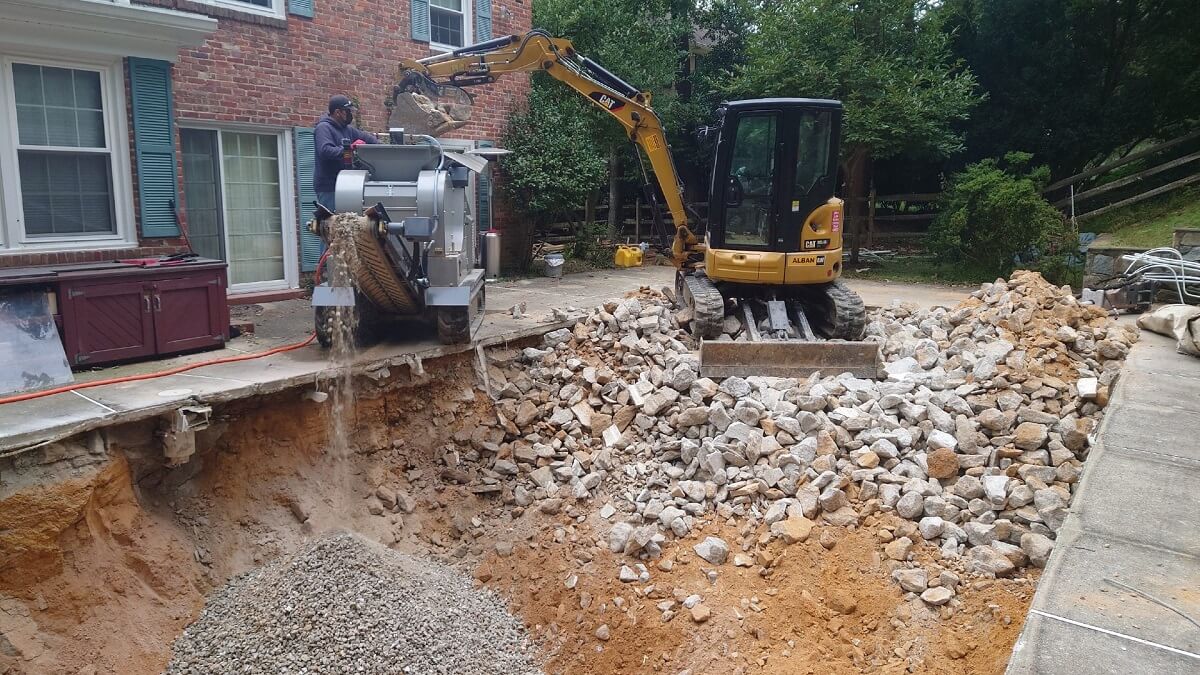

Jaw crusher uptime is what separates profitable concrete recycling, demolition, and aggregate operations from struggling ones. Every hour the crusher sits idle — waiting for parts, jammed by uncrushable material, broken down from skipped maintenance, or running poorly because of mismatched feed — costs money in operator labor, project delays, and missed revenue. Conversely, every hour of consistent productive operation generates RCA, RAP, or aggregate revenue while spreading capital costs across more produced tonnage.
This guide walks through five actionable tips for maximizing jaw crusher uptime — the operational, equipment-feature, training, maintenance, and supply-chain factors that determine whether your jaw crusher runs productively day after day. Each tip is grounded in real-world contractor and aggregate-producer operation with Komplet America’s compact mobile jaw crusher lineup.
Tip 1: Match the Crusher to the Feed Material
The single largest cause of jaw crusher uptime loss isn’t bad maintenance — it’s the wrong machine for the job. A jaw crusher sized for 50 US tph fed material that requires 90 US tph throughput will overheat, jam frequently, wear faster, and spend more time idle than crushing. A crusher with too small a jaw opening for the feed material will either reject oversize pieces or jam when pieces get forced through.
Match Throughput to Feed Volume
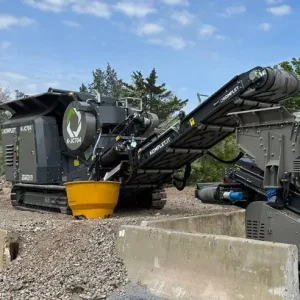
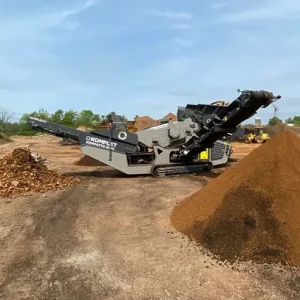
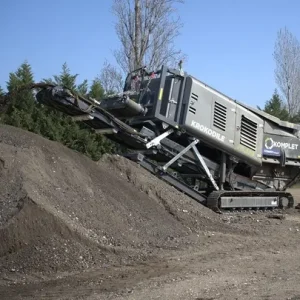
If you’re feeding more tons per hour than the crusher can process, the surplus material backs up at the hopper. Operators slow down feed; production drops; effective uptime falls. Match the crusher’s rated throughput to (or above) your typical feed rate. Komplet’s lineup spans the full contractor-to-aggregate-producer range:
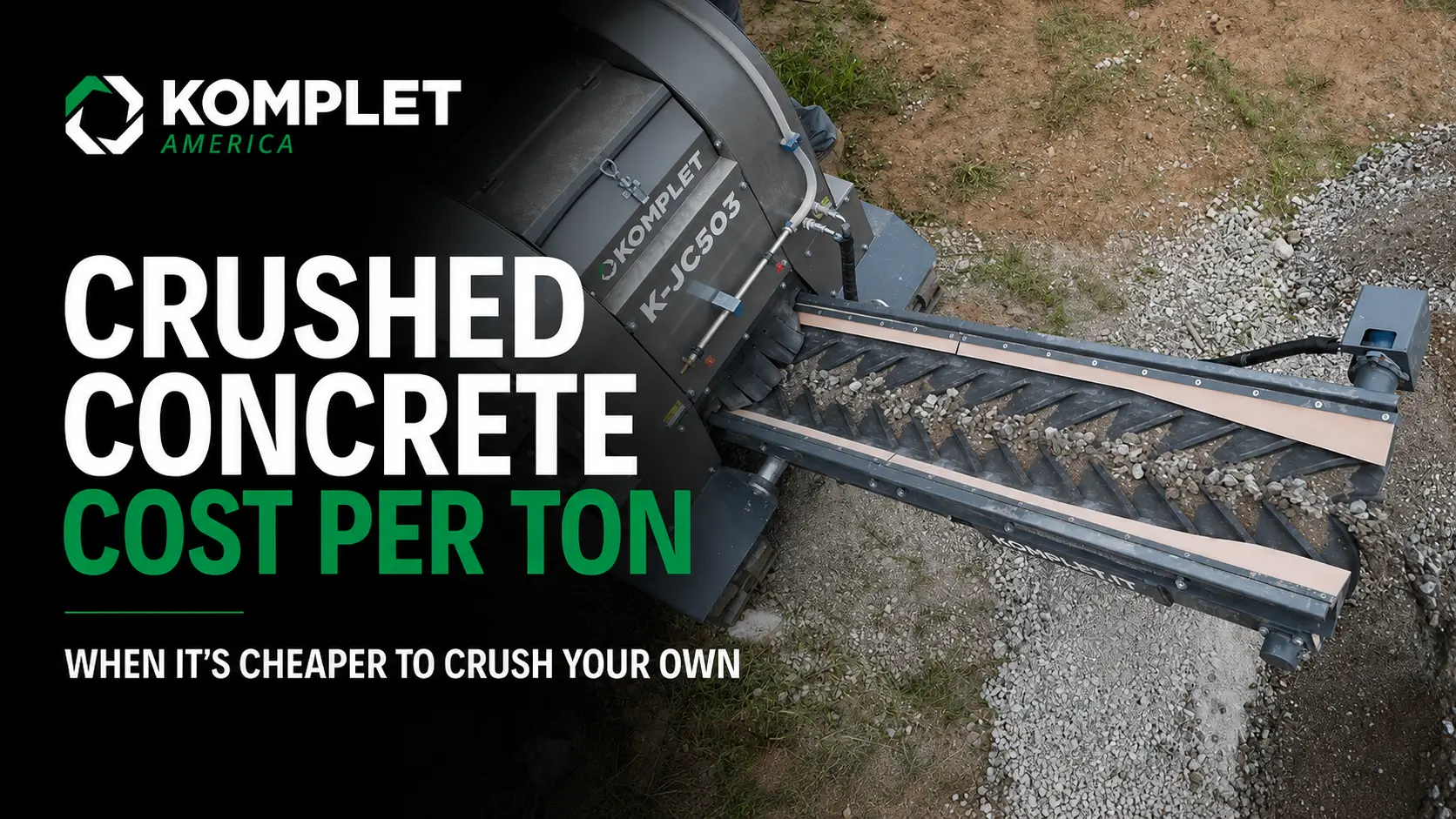
- K-JC 503 — up to 34 US tph, 25 HP, ~7,496 lb. Tight-access urban demolition.
- K-JC 604 — up to 55 US tph, 55 HP, ~19,400 lb. Mid-range demolition.
- K-JC 704 PLUS — up to 90 US tph, 74 HP, ~26,455 lb. Komplet’s best-selling crusher — the workhorse for typical contractor and aggregate operations.
- K-JC 805 — up to 160 US tph, 130 HP, ~49,600 lb. Largest jaw crusher in the lineup, for high-volume aggregate work.
Match Jaw Opening to Maximum Feed Size
Maximum feed size for Komplet’s lineup: K-JC 503 ~9-1/2″; K-JC 604 ~12-3/4″; K-JC 704 PLUS ~12-3/4″; K-JC 805 ~16-3/4″. Pieces larger than these limits need pre-breaking with an excavator-mounted hydraulic breaker before feeding. Forcing oversize material into a smaller jaw causes jams, broken jaw plates, and downtime. Pre-breaking is a 5-minute investment that prevents hours of cleanout.
Match Crusher Type to Material
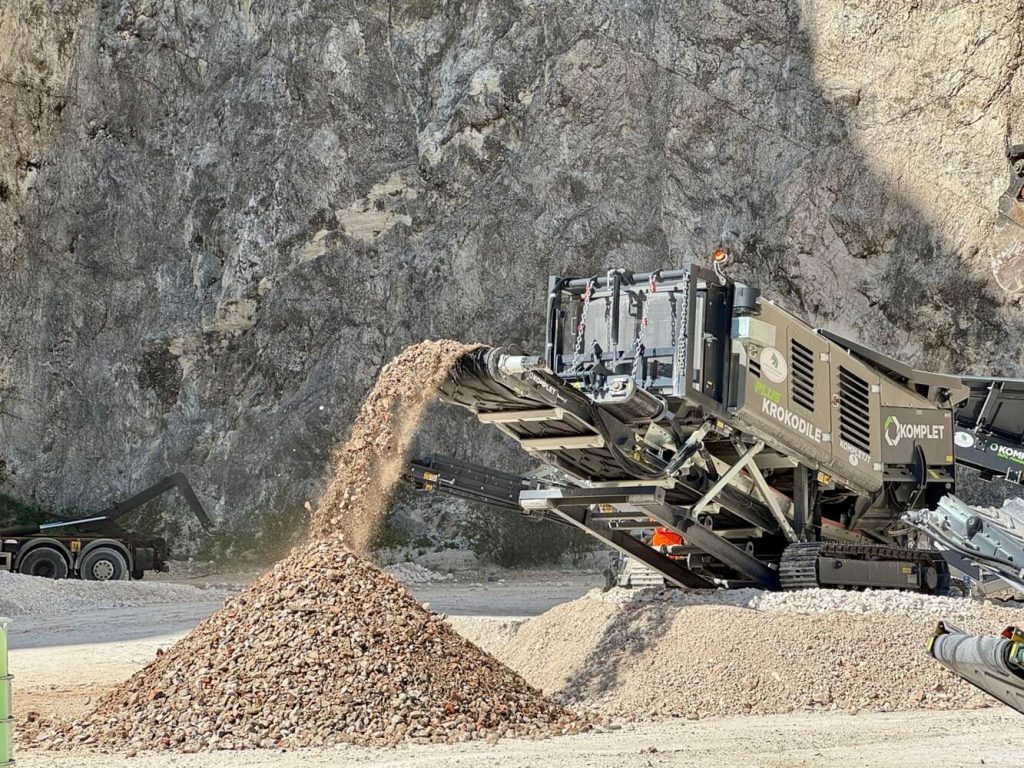
Concrete (with rebar), brick, masonry, hard rock, RCA, RAP: jaw crusher is the right tool. Soft mixed C&D waste (wood, drywall, plastic, light metal): Krokodile PLUS slow-speed shredder is the right tool. Premium cubical aggregate (concrete or asphalt mix designs): add the K-IC 70 impact crusher as a secondary stage. Forcing the wrong material through a jaw crusher reduces uptime regardless of how well-maintained the machine is.
Tip 2: Use Standard Equipment Features That Prevent Downtime
Komplet jaw crushers ship with several standard features specifically engineered to prevent the most common uptime losses. Operators who actually use these features see dramatically better uptime than operators who don’t.
Reverse Jaw Function
Standard on all Komplet jaw crushers. If uncrushable material enters the chamber — an unbroken section of rebar, a steel beam fragment, a foreign object — the operator reverses the jaw via wireless remote and clears the obstruction in seconds. WITHOUT this feature, an uncrushable jam means hours of manual cleanout. With it, the operator pauses, reverses, clears, and continues. This single feature accounts for significant uptime difference between machines that have it and machines that don’t.
Hydraulic Magnetic Belt
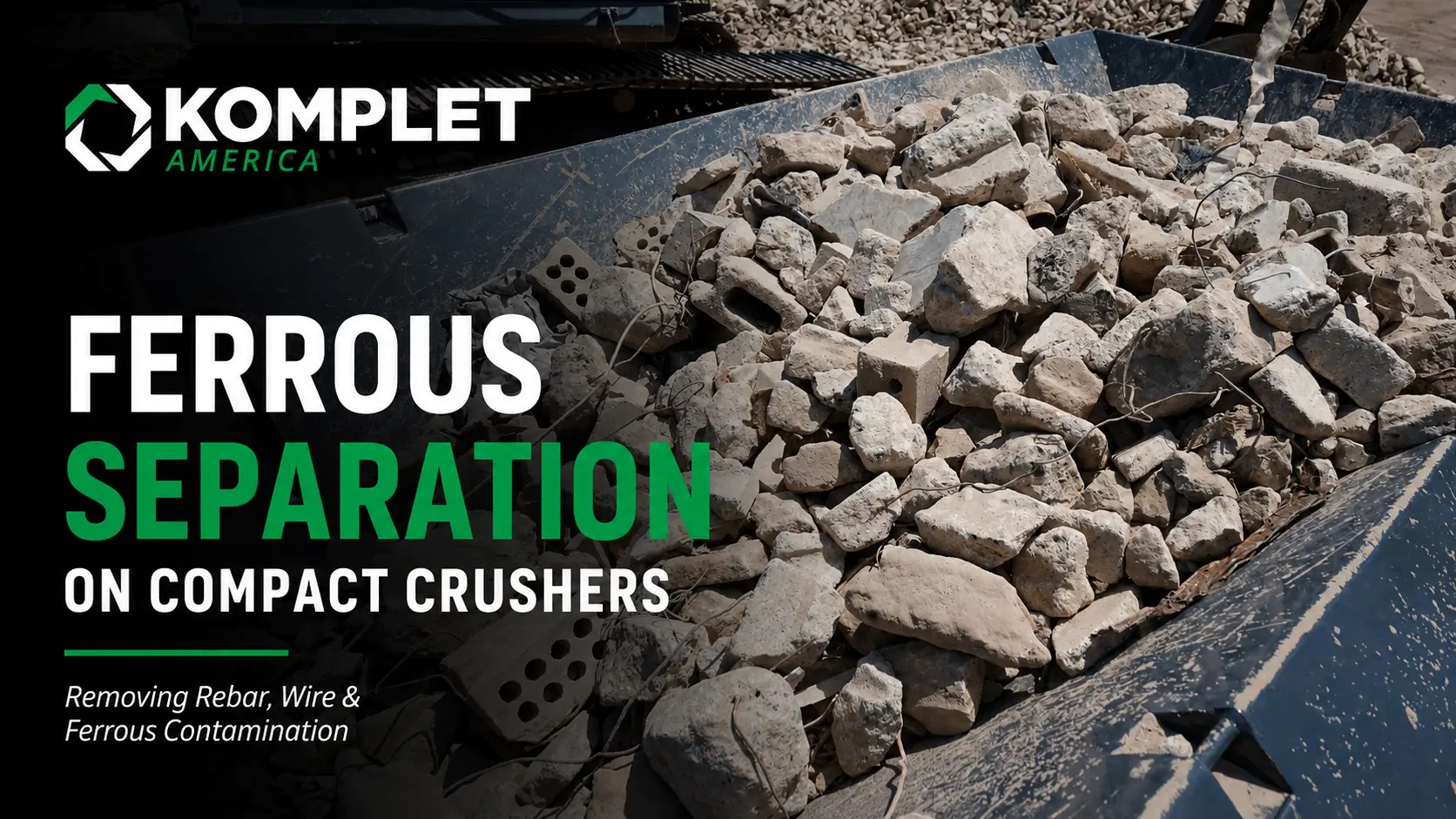
Standard on K-JC 604, K-JC 704 PLUS, and K-JC 805. The integrated magnetic belt sits over the discharge conveyor and lifts ferrous metal — almost always rebar in demolition concrete — into a separate clean pile during crushing. Without the magnetic belt, ferrous metal accumulates in the output stream, complicating downstream screening, contaminating RCA quality, and requiring manual sorting that slows production. With it, the metal lifts out automatically while the operation continues.
Standard Dust Suppression
Water-spray dust suppression is standard on Komplet jaw crushers. Connect a garden-hose water line, the system runs automatically. Beyond OSHA crystalline silica compliance, dust control matters for uptime: heavy dust accumulation on bearings, pivots, and electrical components accelerates wear and causes unscheduled downtime. Active dust suppression keeps moving parts cleaner and components running longer.
Wireless Remote Control
Standard across the lineup. The operator controls the crusher from a position with optimal visibility — typically the loader cab, ground-level near the discharge, or a safe vantage point watching feed quality. Better visibility means earlier detection of feed problems, which means earlier intervention before they become jams. Single-operator setups also reduce labor coordination issues that cause downtime in multi-operator configurations.
Tracked Self-Propelled Mobility
Tracked self-propelled mobility means the crusher repositions on the job site without crane work or specialized rigging. As demolition crews progress through different parts of a site, the crusher follows the material flow rather than forcing the demolition flow to feed a stationary crusher. Reduced material handling means less broken material sitting idle, faster cycle times, and better effective uptime across the project.
Tip 3: Train Operators on Feed Management and Crusher Operation
Operator skill is the second-largest driver of jaw crusher uptime after equipment match. A skilled operator avoids most of the conditions that cause downtime; an untrained operator creates them.
Even Feed Distribution
Feeding material concentrated to one side of the jaw causes uneven jaw plate wear, eventual misalignment, and failure to break material consistently. Trained operators distribute feed evenly across the full width of the jaw chamber. The result: even wear, longer jaw plate life, and consistent output size.
Feed Rate Discipline
Overfeeding (more material than the jaw can process) causes hopper backup, oversize material forcing through, and jam-generating conditions. Underfeeding causes the crusher to run inefficiently with high energy cost per ton. Trained operators feed at a rate that keeps the jaw chamber consistently fed without overflow — typically 80-90% of the rated throughput for the steadiest operation.
Feed Quality Control
Operators should watch for and remove oversized pieces, foreign objects (steel beams, large electrical components, intact concrete with embedded steel that won’t pass), and material that’s clearly outside the crusher’s design range. Sorting at the loader stage is far cheaper than clearing jams from the chamber. Reverse jaw function is the backup, not the primary defense.
Awareness of Sound and Behavior
Trained operators recognize early warning signs: unusual sounds from the engine or hydraulics, vibration changes, unusual material exit patterns, declining throughput at the same feed rate. Catching these signs early enables planned maintenance during scheduled downtime instead of emergency repair after failure.
Tip 4: Maintain a Disciplined Preventive Maintenance Schedule
Preventive maintenance done on schedule prevents most of the failures that cause unscheduled downtime. Maintenance deferred or skipped accumulates as compounding problems that eventually force unscheduled stops at the worst possible time.
Daily Walkarounds
Before each operating day, a brief walkaround inspection catches developing issues. Check oil levels (engine oil, hydraulic fluid). Inspect jaw plates for visible wear or damage. Check belt tension. Look for hydraulic leaks. Verify track tension. Check the dust suppression water connection. The whole inspection takes 10-15 minutes; catching one problem prevents hours of mid-shift downtime.
Weekly Service Items
Weekly inspection of jaw plates (degree of wear; need for replacement), magnetic belt condition, conveyor belt alignment, toggle plate condition, and hydraulic system pressure points. Lubricate fittings per the OEM manual. Address developing wear before it becomes acute.
Scheduled Major Service
Engine service per Tier 4 Final OEM specifications. Hydraulic fluid changes per scheduled intervals. Major component inspection at OEM-specified hours. These services are predictable and budgetable; skipping them in pursuit of short-term production gains creates compounding wear that eventually fails catastrophically.
Wear-Part Replacement Planning
Jaw plates wear as consumables — they’re designed to be replaced periodically. The cost of jaw plates ($2,000-$8,000 depending on machine and material abrasivity) is small compared to the productivity cost of running on worn plates that produce inconsistent output and stress other components. Plan jaw plate replacements at predictable intervals based on tons crushed and material abrasivity.
Tip 5: Establish Reliable Parts and Service Support
Even with perfect operation, jaw crushers need parts and service. The supply chain backing the equipment determines whether a needed part arrives same-day, next-day, or weeks later — which directly determines uptime when service is needed.
Komplet America’s Parts Inventory Forecasting
Komplet America’s parts inventory is forecasted 12 months in advance, supporting fast wear-part availability when service items are needed. Wear parts (jaw plates, mesh, conveyor belts), service consumables (filters, fluids), and major spare components are stocked at the Hillsborough, NJ headquarters and through the authorized dealer network. The crusher and screener parts and support page provides direct contact for parts requests.
Authorized Dealer Network
Komplet America’s authorized dealer network spans North and Central America. Local dealers provide on-site service support, rental loaners during service, and emergency response. Distance from a dealer matters for uptime — operations far from any dealer have longer service response times. Verify dealer proximity before purchasing if uptime is mission-critical for your operation.
Warranty and Service Coverage
All new Komplet equipment comes with a 1-year / 1,000-hour warranty. Coverage during the warranty period addresses defects in materials and workmanship — a meaningful uptime safety net during the critical break-in period of new equipment.
Technical Support Phone Line
Single number — 908-369-3340 — handles both sales and service. When something happens in the field, the support team can typically diagnose by phone in minutes (saving operators a service call) or dispatch the right replacement parts/dealer service immediately.
The Most Common Causes of Jaw Crusher Downtime
Knowing what causes downtime helps prevent it. The most common downtime drivers in real-world contractor operations:
- Jam from uncrushable material — prevented by feed quality control, addressed by reverse jaw function
- Worn jaw plates producing inconsistent output — prevented by scheduled wear-part replacement
- Hydraulic leaks — prevented by daily walkaround inspection, addressed before they become acute
- Engine issues — prevented by OEM-specified service intervals; modern Tier 4 Final engines require disciplined fluid and filter management
- Track wear or damage — prevented by appropriate site conditions and daily inspection
- Operator error or inexperience — prevented by proper training and ongoing skill development
- Wrong equipment for the job — prevented by correct equipment selection at purchase
- Parts availability delays — prevented by sourcing from suppliers with strong inventory forecasting
Frequently Asked Questions
What’s the most common cause of jaw crusher downtime?
Jams from uncrushable material entering the chamber — typically unbroken structural steel, intact rebar that didn’t get separated upstream, or foreign objects. The reverse jaw function (standard on all Komplet jaw crushers) clears most of these in seconds via wireless remote. Without that feature, jams can mean hours of manual cleanout. Operator feed quality control prevents most jams from happening in the first place.
How often should I replace jaw plates?
Highly variable based on material abrasivity and operating volume. Typical ranges: hard abrasive material (granite, basalt, hard concrete) — every 6-12 months at sustained operation. Soft material (limestone, RCA) — every 12-24 months. Track tons crushed since last replacement and visual wear indicators. Replacing on schedule maintains output consistency; running too long on worn plates produces inconsistent product and stresses other components. Refer to the OEM manual for specific replacement criteria.
How can I tell if my jaw crusher is sized correctly for my operation?
Three signs of correct sizing: (1) the crusher operates at 70-90% of rated throughput during normal feed — full capacity utilization without constant overflow, (2) jaw chamber stays consistently fed without backups at the hopper or starvation gaps in the feed, (3) wear-part replacement aligns with predicted service life rather than premature failure. If any of these are off, the crusher may be undersized or oversized for the typical operation.
Does dust suppression really affect uptime?
Yes — beyond the OSHA compliance requirement. Heavy dust accumulation on bearings, pivots, and electrical components accelerates wear, causes unscheduled component failures, and requires more frequent cleaning shutdowns. Active water-spray dust suppression keeps moving parts cleaner and electrical components more reliable, contributing meaningfully to long-term uptime. Komplet jaw crushers ship with dust suppression as standard equipment.
How long should I expect a Komplet jaw crusher to last?
With proper operation, scheduled maintenance, and OEM parts, Komplet jaw crushers routinely operate productively for 10,000+ hours over 10+ years. Wear parts (jaw plates, conveyor belts) are replaced periodically as consumables. Major components (engine, hydraulic system, frame) typically last the working life of the machine with disciplined service per the OEM manual.
How fast can I get replacement parts from Komplet?
Komplet America’s parts inventory is forecasted 12 months in advance — wear parts and common service items typically ship same-day or next-day from the Hillsborough, NJ headquarters or through the authorized dealer network. For specific availability and lead times on parts, call 908-369-3340. The crusher and screener parts and support page is also available for direct parts requests.
Should I do major maintenance myself or use a dealer?
Daily walkarounds, basic inspection, and routine lubrication are owner/operator responsibilities. Major service (engine work, hydraulic system overhaul, structural repair) is typically best handled by an authorized Komplet dealer with the right tools, training, and access to OEM parts. Splitting responsibilities this way preserves warranty coverage while keeping owner labor focused on operating productivity. Always refer to the OEM manual for specific guidance on what’s owner-serviceable vs. dealer-serviceable on your specific machine.
How does rental fit into a high-uptime strategy?
Renting a backup machine during major service on the owned machine maintains operational uptime even when the primary unit is out for service. Many Komplet dealers offer short-term rentals for exactly this purpose. The cost of a few weeks’ rental is typically far less than the revenue lost to a project delay caused by crusher service downtime.
Final Thoughts
Maximum jaw crusher uptime is the result of five aligned practices: matching the equipment to the feed material correctly at purchase, using the standard equipment features (reverse jaw, magnetic belt, dust suppression, wireless remote, tracked mobility) that specifically address common downtime causes, training operators on feed management and crusher operation, maintaining a disciplined preventive maintenance schedule, and establishing reliable parts and service support through the OEM dealer network. Operations doing all five see significantly better uptime — and significantly better operational economics — than operations relying on luck or reactive maintenance.
Komplet America’s compact mobile jaw crusher lineup — K-JC 503, K-JC 604, K-JC 704 PLUS, and K-JC 805 — is engineered specifically for the operating realities of contractor and aggregate-producer scale work. Browse the full crusher lineup or call us and we’ll help you spec the right machine for your feed material, throughput goals, and uptime expectations.
Ready to Talk Jaw Crusher Uptime?
- Call 908-369-3340
- Email [email protected]
- Schedule a demo or request a quote
- Find your local Komplet dealer for service, parts, and rental support
- Ask about our 1-year / 1,000-hour warranty and equipment financing options
Never enough — that’s how we approach service, support, and helping you keep your jaw crusher running productively year-round.
Disclaimer: This article provides general guidance on factors affecting jaw crusher uptime and operations. All operators should refer to the user manual and engine manual specific to their make and model for detailed maintenance procedures, service intervals, lubrication specifications, wear-part replacement criteria, and operating parameters. Engine maintenance must follow Tier 4 Final OEM specifications. Information in this article is intended for general educational purposes and does not replace, supersede, or modify any guidance provided by the original equipment manufacturer (OEM). For specific maintenance, service, or operating questions about your Komplet equipment, contact Komplet America’s service team at 908-369-3340 or your authorized Komplet dealer.