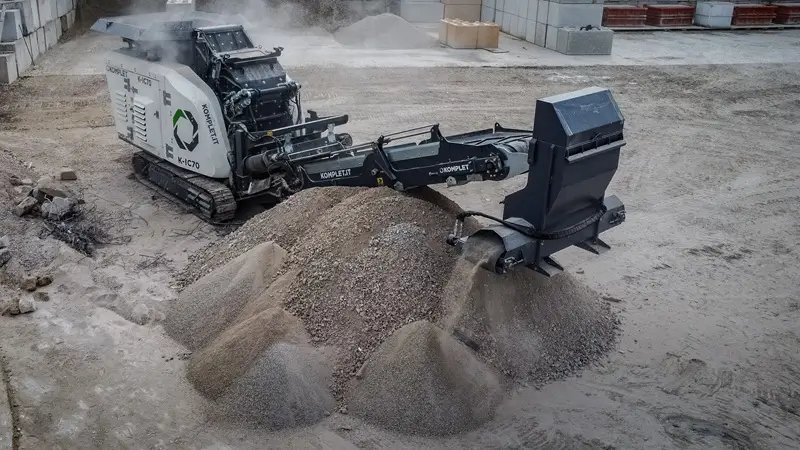

Demolished concrete is one of the most valuable waste streams in construction — and most contractors throw it away. They pay hundreds of thousands of dollars a year in C&D tipping fees to dispose of material that could be turned into a saleable product worth $15-$30 per ton on the open market. The contractors and recyclers who figure out the math turn concrete debris into a serious revenue line.
This guide walks through how to crush concrete and sell it as recycled concrete aggregate (RCA) — the equipment, the spec sizes that customers actually buy, the markets where RCA sells, the pricing, and the regulatory and operational considerations that turn this from “a side hustle” into a real margin business. Whether you’re a demolition contractor wondering if you should add crushing in-house or a recycler looking to expand into RCA production, this is the practical playbook.
The Recycled Concrete Aggregate (RCA) Opportunity
Recycled concrete aggregate is the product you get when you crush demolished concrete to spec-size aggregate. It’s used as base material under roads, parking lots, and foundations; as drainage rock around foundations and septic systems; as backfill in retaining walls and trenches; and as a substitute for virgin gravel in many construction applications.
Three forces drive sustained demand:
- Rising tipping fees — dump fees in major US metros now run $50-$100+/ton, making sourcing recycled material more attractive to contractors who would otherwise pay to dispose of clean concrete or buy virgin aggregate.
- Public-sector mandates — many state DOTs and municipal projects now require or strongly prefer recycled aggregate for environmental and budget reasons. Federal infrastructure spending has accelerated this.
- Tightening virgin aggregate supply — quarry permits are harder to get and existing reserves are depleting in many metros. RCA fills the gap with a domestic, recycled product.
The result: a stable customer base of contractors, builders, municipalities, and DOT projects looking to buy spec RCA at competitive prices. The opportunity is real for anyone with the equipment and the supply.
Quick Terminology: Concrete vs. Cement, RCA vs. Crushed Concrete
Two distinctions matter if you’re going to sell this product professionally.
Concrete vs. Cement
Cement is the powdered binder (typically Portland cement) that hardens when mixed with water. Concrete is the finished material — cement plus aggregate (sand, gravel, crushed stone) plus water, mixed and cured. When you’re crushing demolished slabs, footings, or sidewalks, you’re crushing concrete, not cement. Use the term correctly with customers — sloppy terminology signals you don’t know the industry.
RCA vs. Crushed Concrete
“Crushed concrete” is the generic term for any output from a concrete crusher. “Recycled concrete aggregate” (RCA) is the technical term used in spec documents, DOT specifications, and engineering plans. RCA is what your customers will actually be specifying. Selling “RCA” rather than “crushed concrete” positions your product as a spec-grade construction material — and lets you charge accordingly.
How to Crush Concrete the Right Way
Producing saleable RCA isn’t just running concrete through a crusher. The output has to meet customer expectations on size consistency, contamination level (especially rebar removal), dust control, and reliability of supply. The process below produces a product customers will buy and re-buy.
Step 1: Source Clean Feed Material
The cleaner the feed, the more saleable the product. Best feed sources include:
- Slabs and footings from your own demolition projects — known origin, usually clean concrete with predictable rebar content.
- Concrete from other demolition contractors — accept it at your yard, charge a tip fee (often half of local landfill C&D rate, e.g., $30-$50/ton), and add it to your stockpile.
- Curbs, sidewalks, and street panels — typically clean material with limited rebar, ideal for high-grade RCA production.
- Bridge decks and structural concrete — heavily reinforced but high-quality concrete that produces excellent RCA when properly processed.
Avoid feed that’s contaminated with wood, plastic, asphalt, or significant amounts of soil. Customers will reject loads with visible non-concrete contamination, and once your reputation takes a hit it’s hard to recover.
Step 2: Pre-Break Oversize
Concrete pieces larger than about 80% of the crusher’s jaw gape need to be broken down first. Most demolition contractors use an excavator-mounted hydraulic breaker to fracture large slabs and footings into pieces sized to the crusher: about 12-3/4 inches or smaller for the K-JC 604 and 704 PLUS, and about 16-3/4 inches or smaller for the K-JC 805. Pre-breaking ensures consistent throughput once you start crushing.
Step 3: Primary Crushing With a Mobile Jaw Crusher
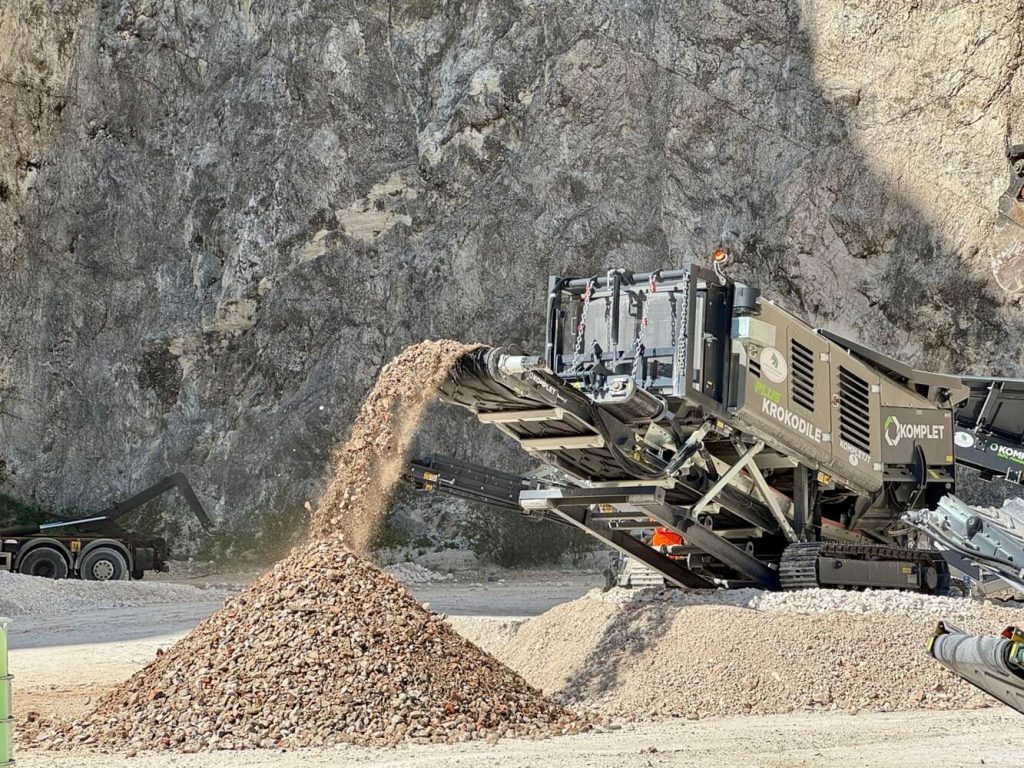
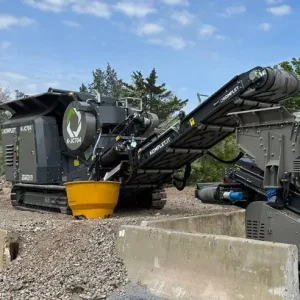
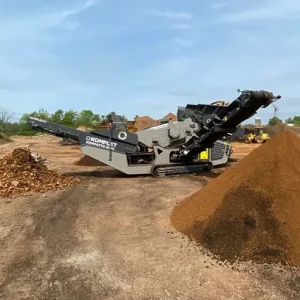
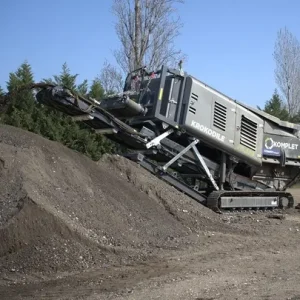
A jaw crusher is the right tool for primary concrete crushing. The compressive force fractures concrete around the rebar without bending or jamming on reinforcement. Komplet’s jaw crusher lineup:
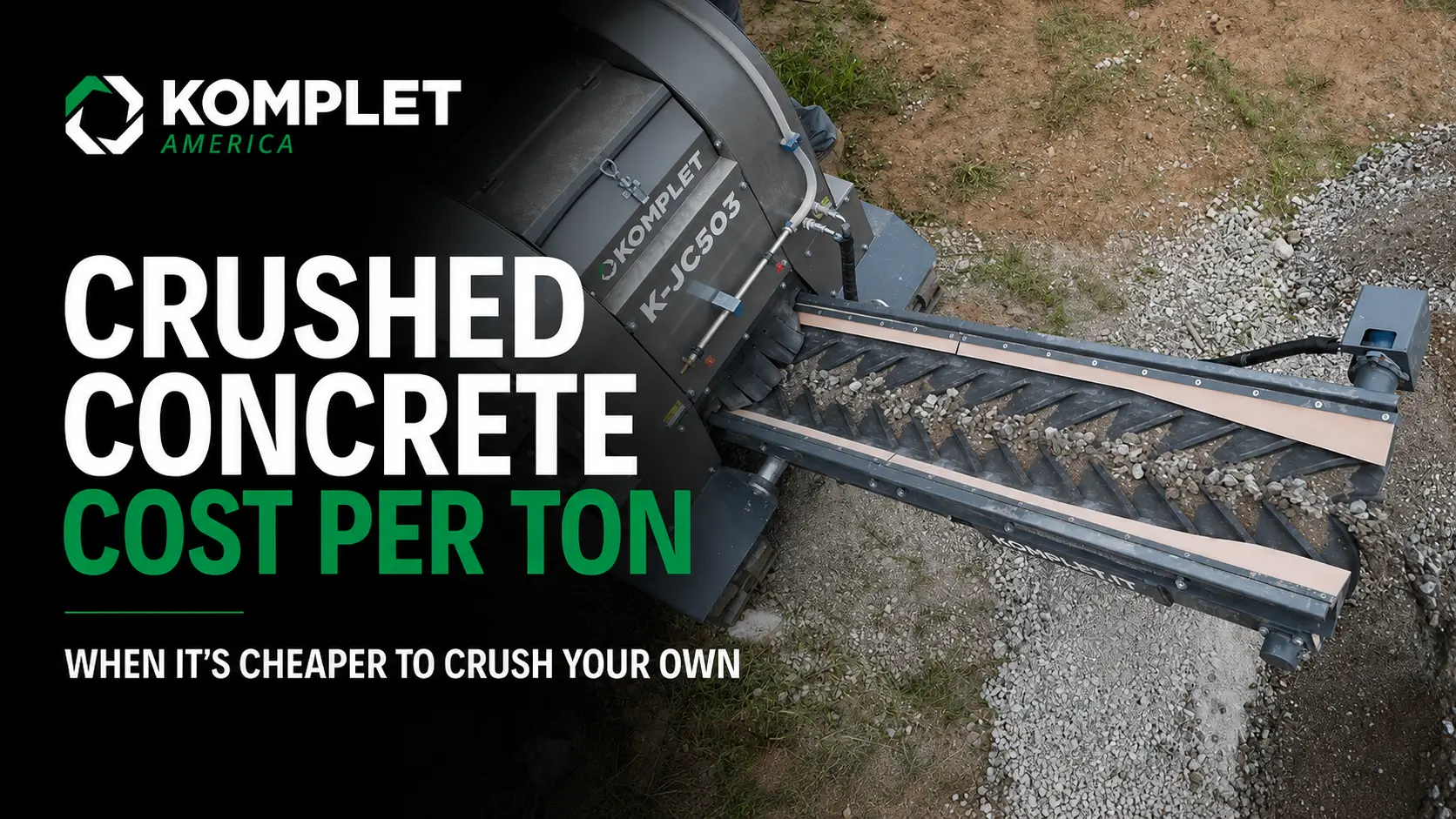
- K-JC 503 — up to 34 US tph, 19″ x 12″ jaw. For small contractors and tight-access urban demo.
- K-JC 604 — up to 55 US tph, 23″ x 16″ jaw. Mid-range volume.
- K-JC 704 PLUS — up to 90 US tph, 27″ x 16″ jaw. Komplet’s best-selling crusher and the typical choice for serious RCA producers — 500-600 tons per shift, fits a standard flatbed trailer.
- K-JC 805 — up to 160 US tph, 31″ x 21″ jaw. For high-volume RCA producers and small recycling yards.
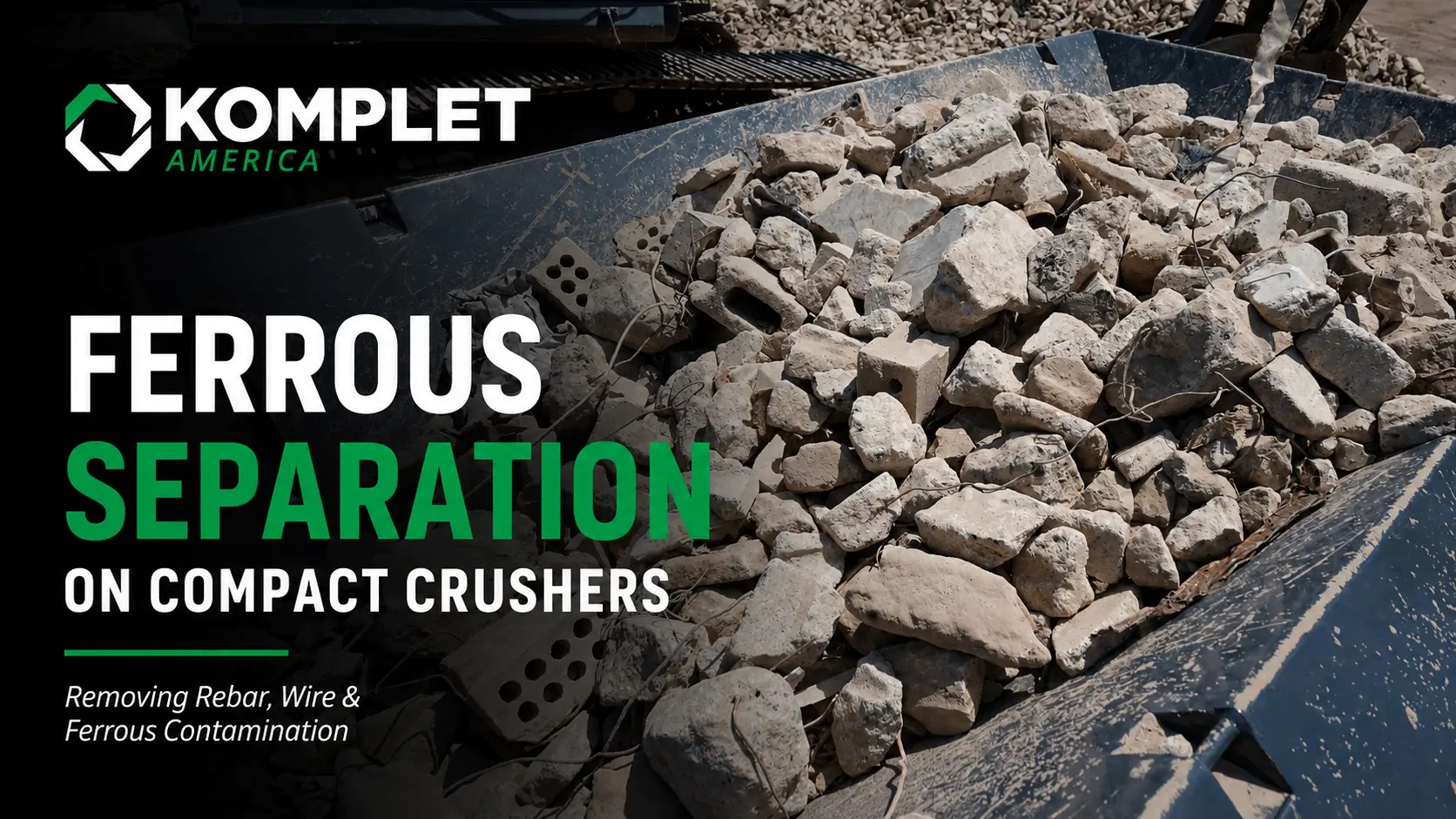
All Komplet jaw crushers include the hydraulic magnetic belt that lifts rebar off the output stream into a separate pile, the reverse jaw function for clearing uncrushable material, and dust suppression as standard equipment for OSHA silica compliance.
Step 4: Screen the Output Into Spec Sizes
This is where most contractors leave money on the table. A jaw crusher alone produces undifferentiated crushed concrete. To sell at premium prices, you need to separate that output into spec sizes that customers actually order:
- 3/4″ minus (DOT base, road base) — the most common RCA spec, used for road and parking lot base under asphalt or concrete.
- 1″ or 1-1/2″ minus (drainage base, foundation backfill) — coarser drainage applications.
- #57 stone (aggregate replacement) — typically 1″ to 1/2″ size, used as a substitute for virgin #57 gravel in concrete mixes and drainage.
- Fines (under 1/4″) — sometimes sold as a low-cost fill or used in compacted base courses.
- Oversize (3-6″) — recirculated through the crusher or sold as ripping rock or shoreline armor.
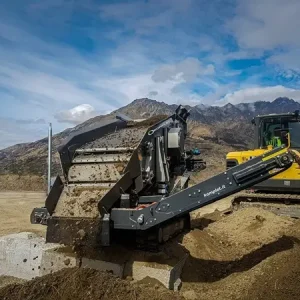
Komplet’s Kompatto vibrating scalping screens pair directly with any jaw crusher to produce two or three spec sizes simultaneously:
- Kompatto 221 — up to 90 US tph, two-deck. Pairs with the K-JC 503 or K-JC 604.
- Kompatto 5030 — Komplet’s best-selling screener, up to 280 US tph. The natural pair for the K-JC 704 PLUS.
- Kompatto 124 — Komplet America’s largest mobile scalping screen, up to 350 tph. For high-volume yards and the K-JC 805.
Step 5: Stockpile Management
Each spec size needs its own stockpile. A K-TC 460 tracked conveyor extends material reach from the screener to multiple stockpiles, builds higher cleaner piles, and reduces the amount of loader work needed to stage finished product. For yards with significant volume, the conveyor pays for itself in reduced labor and cleaner stockpile organization.
Where to Sell Crushed Concrete (And What Customers Pay)
RCA isn’t sold to homeowners. The real customer base is commercial. Here’s where the demand actually is.
Direct Customers for RCA
- General contractors — site work, foundations, utility trenches, parking lots. Your most reliable repeat customers.
- Excavation contractors — backfill, base courses, drainage applications.
- Road builders and paving contractors — DOT projects, municipal road work, private road and driveway construction.
- Site developers — subdivisions, commercial development, solar farms, large infrastructure projects with significant base material needs.
- Municipalities and DOTs — public works projects, especially when local procurement preferences favor recycled materials.
- Landscape and hardscape contractors — base material under pavers, retaining walls, drainage installations.
- Concrete batch plants — some plants now blend RCA into mix designs for non-structural applications.
Typical RCA Pricing
Pricing varies by region, spec size, and current virgin aggregate market. Typical 2026 ranges in the US:
- 3/4″ minus base RCA: $15-$25 per ton
- 1-1/2″ drainage RCA: $18-$30 per ton
- #57 RCA (aggregate replacement): $20-$35 per ton
- Fines: $5-$15 per ton (or sometimes free as a customer favor)
- Oversize/ripping rock: $10-$20 per ton
Pricing in major metros (NYC, Boston, Chicago, Bay Area, Seattle) typically runs at the higher end of these ranges. Pricing in lower-cost regions runs at the lower end. RCA prices generally track virgin aggregate prices, usually at a 20-40% discount.
Regulatory and Spec Considerations
Selling RCA professionally requires understanding the rules. Cutting corners here is how reputations get destroyed.
State and Local Permits
Most states require a recycling facility permit or solid waste handling permit to operate as a commercial concrete recycler accepting outside material. Requirements vary widely. If you’re crushing only your own demolition output for use on your own projects, permitting is usually simpler. If you’re accepting outside concrete and selling finished product to third parties, expect a state DEP/DEQ review and likely an air permit covering dust and emissions. Talk to a local attorney or environmental consultant before launching.
DOT and Engineering Specifications
Selling into DOT, municipal, or large commercial projects often requires meeting specific gradation, contamination, and physical-property standards. Check your state DOT’s recycled aggregate specification (most have one). Common requirements include maximum allowable contamination by foreign material (typically under 1-3% by weight), gradation curves matching specified base materials, and sometimes Los Angeles abrasion testing or freeze-thaw cycling certification.
OSHA Silica Compliance
Crushing concrete generates respirable crystalline silica, which OSHA regulates with a permissible exposure limit of 50 ug/m3 averaged over 8 hours. Your operation must control dust. Every Komplet mobile crusher ships with water-spray dust suppression as standard equipment — connect a garden-hose water line and the system runs automatically. This is OSHA-ready out of the box.
Magnet Separation and Rebar Disposal
All Komplet jaw crushers include the hydraulic magnetic belt that pulls rebar off the output stream. Collected scrap rebar can be sold to a metal recycler — a small additional revenue stream that helps offset operating costs.
The Business Math: Real Revenue From Concrete Crushing
Here’s how the numbers can work for a mid-size demolition contractor adding in-house crushing.
Sample Profile
- Monthly debris volume: 2,000 tons of concrete from own demolition projects
- Plus accepted from other contractors: 500 tons/month at $40/ton tip fee
- Spec splits: 70% 3/4″ base, 20% 1-1/2″ drainage, 10% fines/oversize
- Local C&D dump fee (avoided): $75/ton
- Local virgin base aggregate (avoided): $25/ton
Monthly Revenue Streams
- Avoided dump fees: 2,000 tons x $75 = $150,000
- Tip fees collected: 500 tons x $40 = $20,000
- RCA sales (after own use of ~500 tons): 2,000 tons x ~$20 average = $40,000
- Avoided virgin aggregate purchases: 500 tons x $25 = $12,500
- Scrap rebar sales: approximately $1,500-$3,000
- Total monthly gross benefit: approximately $223,500-$225,500
Monthly Operating Costs
- Equipment finance (K-JC 704 PLUS via Komplet Capital, 5-year): approximately $5,100/month
- Screener finance (Kompatto 5030, 5-year): approximately $4,400/month
- Fuel, operator, wear parts: approximately $7,000-$9,000/month combined
- Total monthly operating cost: approximately $16,500-$18,500
Net monthly benefit: approximately $205,000-$209,000. The K-JC 704 PLUS plus Kompatto 5030 combination pays back in the first month of operation in this scenario, with sustained margin contribution every month thereafter.
In markets with lower tipping fees ($30-$50/ton) the dump-fee savings are smaller but still typically deliver payback in 6-12 months. For your specific volume and local pricing, call (908) 369-3340 and we’ll run the numbers with you.
Frequently Asked Questions
How much does it cost to crush concrete?
Operating cost depends on equipment financing, fuel, operator labor, and wear parts. For a K-JC 704 PLUS running 500-600 tons per shift, total operating cost typically runs $4-$8 per ton produced — including financed machine cost. Compare that to dump fees of $50-$100/ton at most landfills and recycling centers, and the math is obvious. For Komplet pricing and Komplet Capital financing details, call (908) 369-3340.
Do I need a permit to sell crushed concrete?
Most states require some form of recycling facility, solid waste handling, or air-quality permit for commercial concrete recycling operations that accept outside material and sell to third parties. Requirements vary widely by state and by whether you’re processing only your own demolition material or accepting outside concrete. Consult a local environmental attorney or the state DEP/DEQ before launching a commercial operation.
What size concrete pieces can a mobile crusher handle?
Maximum feed size is roughly 80% of the jaw gape opening dimension. K-JC 503: ~9-1/2″. K-JC 604: ~12-3/4″. K-JC 704 PLUS: ~12-3/4″. K-JC 805: ~16-3/4″. Pieces larger than these need to be pre-broken with an excavator-mounted hydraulic breaker before feeding the crusher.
Can a mobile crusher handle reinforced concrete with rebar?
Yes. Komplet jaw crushers fracture concrete around rebar through compressive force, and the hydraulic magnetic belt lifts rebar off the discharge conveyor into a separate pile. The K-JC 604, K-JC 704 PLUS, and K-JC 805 all include the magnetic belt and reverse jaw function as standard equipment.
What’s the difference between RCA and crushed concrete?
Functionally, the same product. “Crushed concrete” is the generic term. “Recycled concrete aggregate” (RCA) is the technical/spec term used in DOT specifications and engineering documents. Sell as “RCA” when targeting commercial customers, contractors, and DOT projects — the spec-grade positioning matters.
Who actually buys crushed concrete?
Commercial buyers: general contractors, excavation contractors, road builders, site developers, municipalities, DOT projects, paving contractors, landscape contractors, and (increasingly) concrete batch plants. Direct-to-homeowner sales are rarely worth the time — commercial volumes deliver better margins with fewer transactions.
How much can I sell crushed concrete for?
Pricing varies by region and spec. Typical 2026 ranges: 3/4″ base RCA $15-$25/ton, 1-1/2″ drainage RCA $18-$30/ton, #57 RCA $20-$35/ton. Major metros run at the higher end. RCA generally sells at a 20-40% discount to virgin aggregate, which is why it’s an attractive product for cost-conscious contractors and DOT projects.
How much volume do I need to make crushing concrete worthwhile?
In moderate-to-high tipping fee markets (above $50/ton), even 500-1,000 tons per month of concrete debris justifies in-house crushing through dump-fee avoidance alone. Selling RCA on top of that is incremental margin. In lower tipping fee markets, you typically need 1,500+ tons per month to justify the equipment, plus an established RCA sales channel.
Can I finance a concrete crusher?
Yes. Komplet Capital — Komplet America’s in-house financing arm — offers 24-hour credit approval, 100% financing, and 3-6 year terms. Bad credit is not an automatic disqualifier. Many customers structure the monthly payment to be fully covered by avoided dump fees alone. New equipment also qualifies for Section 179 tax deduction (up to $1.22M deductible in the year of purchase, 2024 limit).
Final Thoughts
Crushing concrete to sell it is one of the cleanest business expansions a demolition contractor or excavation operator can make. The customers exist, the demand is stable, the pricing is workable, and the operational model is well-established. The biggest mistake most contractors make is starting too small — they buy a crusher but skip the screener, then wonder why they can’t sell the output. The math works when you produce spec sizes customers actually order.
Komplet America’s compact mobile lineup — from the K-JC 503 for urban demo up to the K-JC 805 for quarry-scale RCA production — covers the full range of contractor and recycler-scale concrete crushing operations. Pair the crusher with a Kompatto vibrating scalping screen to produce spec sizes from a single workflow. Browse the full crusher lineup or reach out and we’ll help you spec the right combination for your volume and material.
Ready to Turn Concrete Debris Into a Revenue Stream?
- Call (908) 369-3340
- Email [email protected]
- Schedule a demo or request a quote
- Ask about our 1-year / 1,000-hour warranty and equipment financing options
Never enough — that’s how we approach service, support, and helping you turn demolition debris into a real revenue stream.
Disclaimer: All ROI, payback, revenue, and pricing figures in this article are illustrative examples based on sample assumptions about volume, local pricing, material mix, and operating conditions. Actual results vary significantly by region, market, material type, equipment utilization, operator skill, financing terms, regulatory environment, and many other factors. Dump fees, aggregate pricing, RCA sales prices, fuel costs, hauling rates, and interest rates all change over time and by location. Komplet America makes no guarantee, warranty, or representation of specific financial performance, payback timelines, RCA pricing, or business outcomes for any particular operation. For a payback estimate based on your specific volume, material, and local market, contact us at (908) 369-3340 to speak with our team.