
Two demolition contractors crushing the same concrete with the same equipment can produce dramatically different operational results. One generates $25/ton in net margin from RCA sales plus avoided dump fees; the other barely breaks even after equipment costs, labor, and dump-fee residual. The difference comes down to efficiency — how well the operation matches equipment to feed material, how the crusher and screener integrate into a single workflow, how operators feed material at optimal rate, and how the standard productivity features built into modern equipment actually get used.
This guide walks through what makes concrete crushers and screeners efficient — the operational, equipment, integration, and workflow factors that determine whether a concrete recycling operation is genuinely profitable or just productive on paper. Includes Komplet America’s compact mobile concrete crusher and screener lineup with full specs and the typical contractor combinations that deliver real-world efficiency.
What Concrete Processing Actually Means
“Concrete processing” in the context of compact mobile equipment specifically means concrete RECYCLING — taking demolished concrete (from buildings, slabs, foundations, sidewalks, parking lots, bridge decks) and reducing it to spec-sized recycled aggregate (RCA) that’s saleable as road base, drainage stone, and fill material. This is different from concrete MANUFACTURING (mixing cement, water, sand, and gravel to make new concrete), which is a different industry with different equipment.
Concrete recycling matters because demolition concrete is the largest volume fraction of C&D waste — typically 30-50% of building demolition output. Processing it on-site converts disposal cost into recovered material revenue, eliminates hauling rounds, supports waste-diversion mandates and LEED credits, and turns a project liability into a project asset. The crusher does the size reduction; the screener separates the output into spec sizes.
The Six Factors That Drive Concrete Processing Efficiency
1. Equipment-to-Feed Matching
Efficiency starts with correct equipment selection at purchase. A crusher rated for 50 US tph fed material requiring 90 US tph throughput will overheat, jam more frequently, and underperform; a crusher rated for 160 US tph used for 50 US tph operations runs at low utilization with high cost per ton. Match crusher throughput to your typical feed rate (running at 70-90% of rated capacity is the efficiency sweet spot).
Match the jaw to your largest typical piece, keeping that piece at or under about 80% of the jaw gape, to avoid pre-breaking bottlenecks. Komplet’s lineup spans the full range: K-JC 503 (~9-1/2″ max feed) for tight access, K-JC 604 (~12-3/4″) and K-JC 704 PLUS (~12-3/4″) for typical contractor scale, K-JC 805 (~16-3/4″) for high-volume work.
2. Integrated Crusher-Screener Workflow
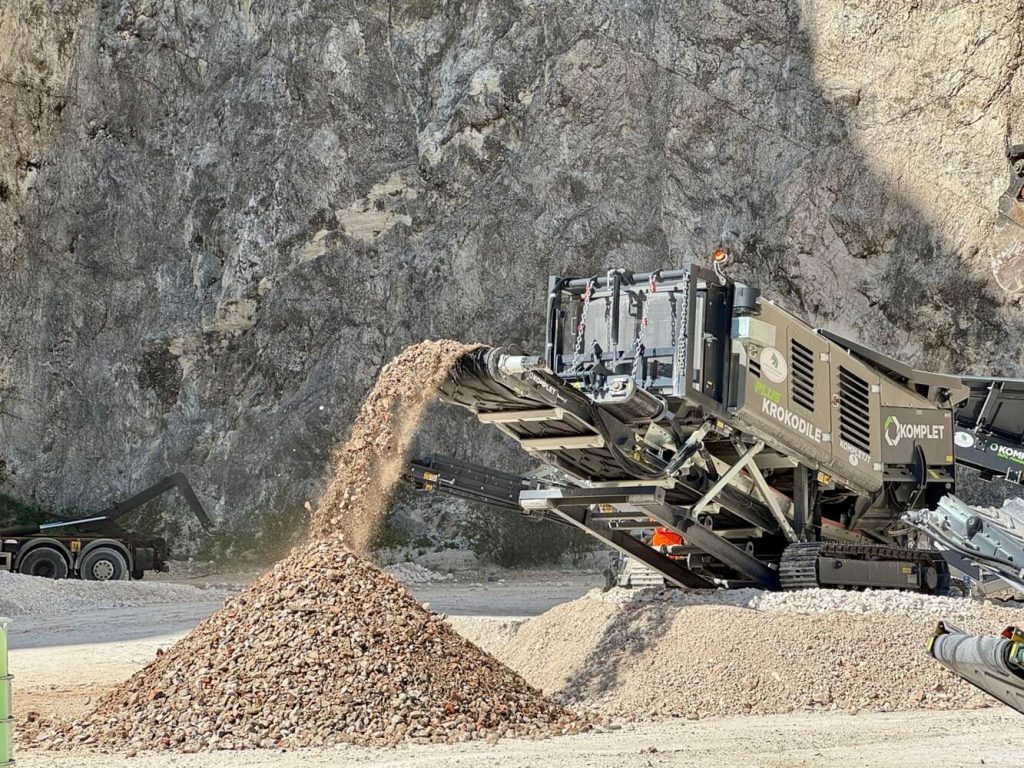
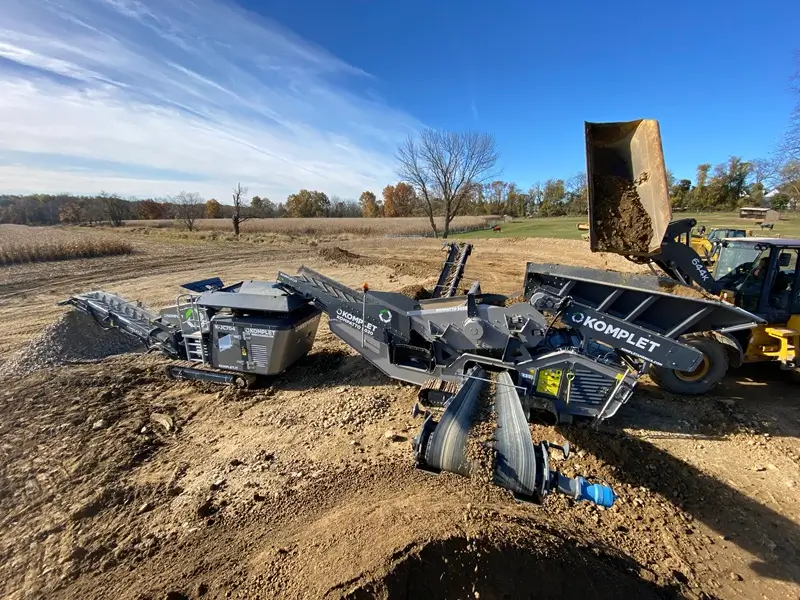
The single largest efficiency multiplier in concrete processing is integrating the crusher and screener into one continuous workflow. Crusher output flows directly to the screener via discharge conveyor; screener separates into multiple spec sizes simultaneously; finished product goes to multiple stockpiles ready for sale. This integration eliminates intermediate handling, doubles up production from the same operator workforce, and produces multiple revenue streams from a single project.
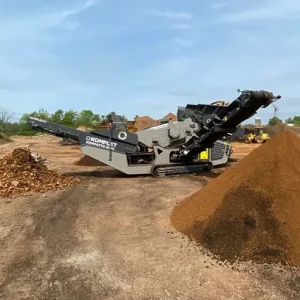
The K-JC 704 PLUS + Kompatto 5030 combination — Komplet’s best-selling pair — is engineered specifically for this integrated workflow. The crusher’s discharge conveyor feeds the screener’s loading hopper; the screener’s hydraulic 2-way / 3-way conversion produces 2 or 3 spec sizes plus oversize from a single pass. The combination is the contractor-scale efficiency benchmark for compact mobile concrete recycling.
3. Standard Productivity Features
Komplet jaw crushers ship with several standard features specifically engineered for productivity that operators in inefficient operations don’t actually use:
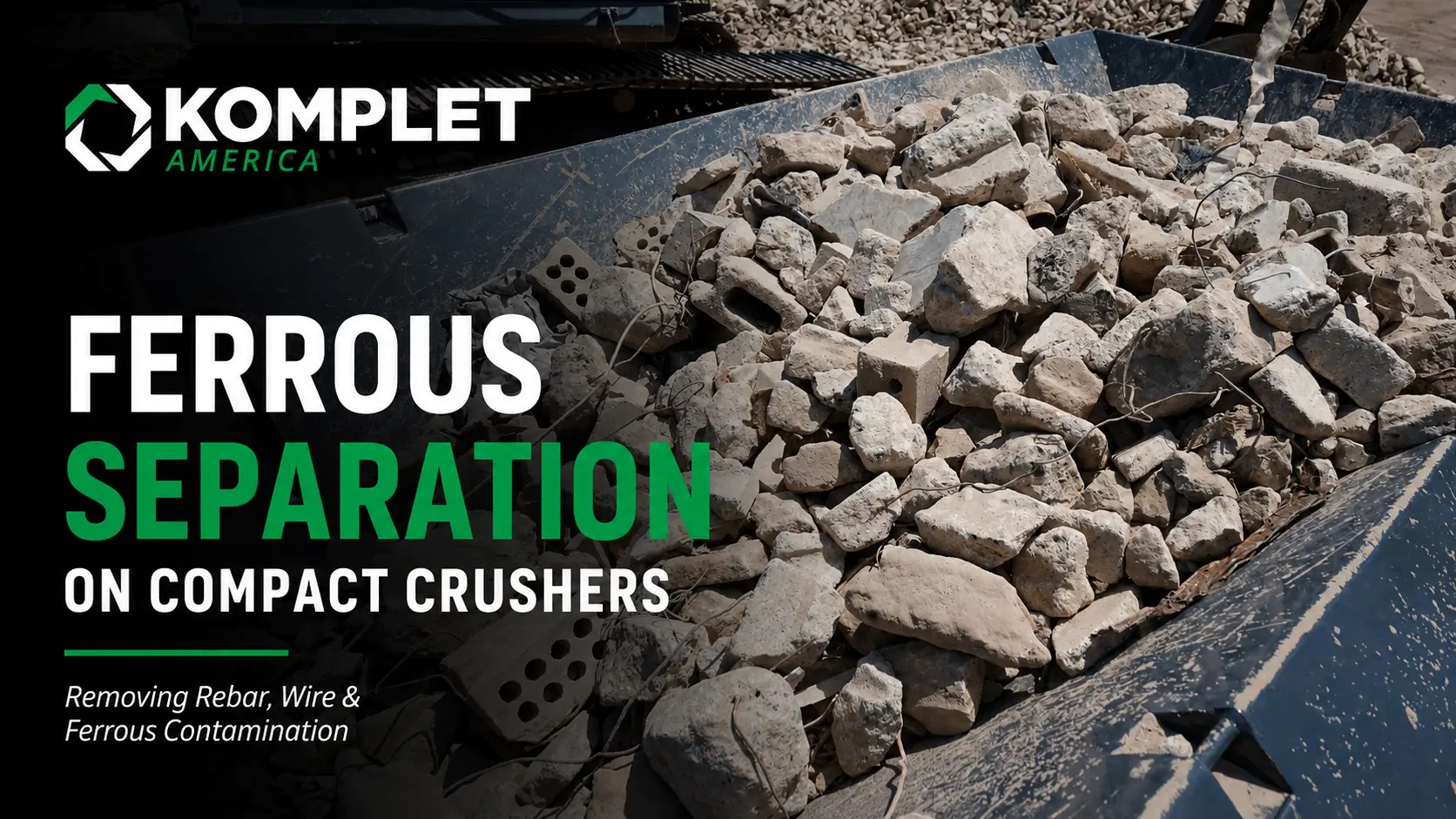
- Hydraulic magnetic belt (standard on K-JC 604, K-JC 704 PLUS, K-JC 805) — lifts rebar off the discharge conveyor automatically. Operations using it produce cleaner RCA at higher throughput; operations skipping it manually sort metal from output.
- Reverse jaw function — clears uncrushable jams in seconds via wireless remote. Operations using it lose minutes per jam; operations without it lose hours.
- Standard dust suppression — water-spray system from a garden-hose connection. Beyond OSHA compliance, dust control reduces wear-part replacement frequency and extends component life.
- Wireless remote control — single operator handles the full machine. Eliminates labor cost of multi-operator setups.
- Hydraulic 2-way / 3-way conversion (Kompatto 5030 and 124) — switches between 2 and 3 output spec sizes in minutes. Operations needing different spec mixes for different customers don’t lose time on configuration changes.
4. Operator Skill and Feed Management
Skilled operators distribute feed evenly across the full jaw width (preventing uneven plate wear), maintain consistent feed rate (preventing both backup and starvation), control feed quality (removing oversized material and foreign objects before they cause jams), and recognize early warning signs (catching problems before unscheduled downtime). Untrained operators do none of these things — and their crushers run inefficient hours where skilled operators run efficient hours on the same equipment.
5. Disciplined Preventive Maintenance
Maintenance done on schedule prevents the failures that cause unscheduled downtime. Daily walkarounds (10-15 minutes), weekly inspection items, and scheduled major service per OEM specifications keep the equipment running productively. Maintenance deferred or skipped accumulates as compounding problems that eventually force unscheduled stops at the worst possible time. Efficiency-focused operations treat maintenance as a productivity investment rather than a cost.
6. Reliable Parts and Service Support
Even with perfect operation, equipment needs parts and service. The supply chain backing the equipment determines whether a needed part arrives same-day or weeks later. Komplet America’s parts inventory is forecasted 12 months in advance — wear parts and common service items typically ship same-day. The authorized dealer network provides local service support. Operations far from any service support typically run lower effective uptime regardless of how good the equipment is.
Komplet America’s Concrete Crushing and Screening Lineup
Compact Mobile Jaw Crushers
- K-JC 503 — up to 34 US tph, 19″ x 12″ jaw, 25 HP Tier 4 Final, ~7,496 lb. Tight-access urban demolition.
- K-JC 604 — up to 55 US tph, 23″ x 16″ jaw, 55 HP, ~19,400 lb. Mid-range mobile crusher with magnetic separation.
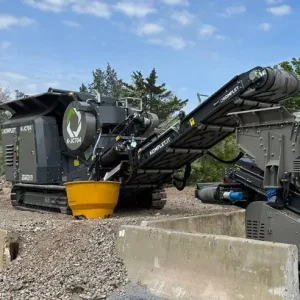
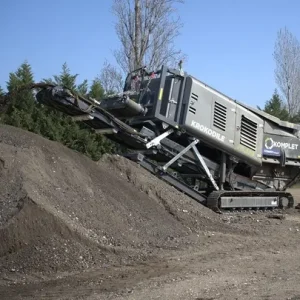
- K-JC 704 PLUS — up to 90 US tph, 27″ x 16″ jaw, 74 HP, ~26,455 lb. Komplet’s best-selling crusher and the workhorse for typical commercial concrete recycling.
- K-JC 805 — up to 160 US tph, 31″ x 21″ jaw, 130 HP, ~49,600 lb. Largest jaw crusher in the lineup, for high-volume demolition recycling and aggregate production.
Compact Mobile Impact Crusher (Premium Cubical Output)
- K-IC 70 — up to 90 US tph, 25″ x 20″ inlet, 100 HP, ~28,600 lb. For operations producing premium cubical aggregate (concrete or asphalt mix), the K-IC 70 sits between the jaw crusher and the screener for cubical particle shaping.
Vibrating Scalping Screeners
- Kompatto 221 — up to 90 US tph, 7′ x 3.5′ two-deck, 25 HP, ~7,275 lb.
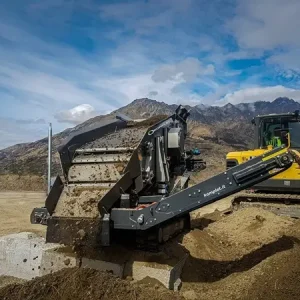
- Kompatto 5030 — up to 280 US tph, heavy-duty double-deck, 45 HP Tier 4 Final, ~26,455 lb, hydraulic 2-way/3-way conversion. Komplet’s best-selling screener and the natural pair for the K-JC 704 PLUS or K-JC 805.
- Kompatto 124 — up to 350 tph, 11.8′ x 3.7′ top deck, 75 HP, ~37,038 lb. Largest mobile scalping screen in the lineup.
The Most Efficient Concrete Processing Combinations
Contractor-Scale: K-JC 704 PLUS + Kompatto 5030
Komplet’s best-selling crusher paired with Komplet’s best-selling screener — the most popular contractor-scale concrete processing combination in the lineup. Up to 90 US tph crushing throughput; up to 280 US tph screening capacity (so the screener never bottlenecks the operation). The Kompatto 5030’s hydraulic 2-way/3-way conversion supports operations producing different spec mixes for different customers without configuration downtime.
Premium Cubical: K-JC 704 PLUS + K-IC 70 + Kompatto 5030
Adds the K-IC 70 impact crusher for cubical particle shape required by concrete batch plants and hot-mix asphalt plants. Workflow: jaw crusher (primary reduction) → impact crusher (cubical shaping) → screener (sizing into spec). The premium-spec output sells at higher prices than standard jaw output, justifying the additional capital investment for operations targeting concrete and asphalt mix-design markets.
High-Volume: K-JC 805 + Kompatto 5030 or 124
Steps up to high-volume crushing while keeping the proven Kompatto 5030 (or upgrading to the larger Kompatto 124) screener. Up to 160 US tph crushing throughput. Pairs well with sustained quarry-scale operations or high-volume demolition recyclers serving regional markets.
Tight-Access Urban: K-JC 503 + Kompatto 221
The most compact tracked-mobile pair Komplet offers. Combined weight under 15,000 lb fits residential demolition, urban renovation, and tight commercial sites where larger equipment can’t operate. Up to 34 US tph crushing throughput; up to 90 US tph screening capacity.
The Economics of Efficient Concrete Processing
Avoided Tipping Fees
Concrete to landfill or C&D recycler typically runs $50-$100+/ton tipping fees in major US metros. A 500-ton demolition project saves $25,000-$50,000+ in dump-fee avoidance from on-site processing. This is usually the largest single economic driver of concrete recycling operations.
Recovered Material Revenue
Sold RCA: typically $15-$30/ton depending on spec size and region. Recovered ferrous metal (rebar): typically $100-$300+/ton. For a 500-ton concrete project, recovered material revenue typically runs $5,000-$15,000+ on top of dump-fee avoidance.
Project Schedule Compression
Efficient on-site processing eliminates haul-out trips, dump waiting time, and post-demolition site cleanup time. Demolition projects with on-site recycling typically complete 10-30% faster than haul-out alternatives. Faster project completion means lower overhead absorption per project and faster crew rotation to the next contract.
Equipment Financing Economics
Komplet Capital offers 24-hour approval, 100% financing, and 3-6 year terms. Many demolition contractors structure equipment financing so monthly payments are fully covered by avoided dump fees alone — meaning the equipment has $0 net operating cost while producing additional revenue from RCA and ferrous metal sales. Section 179 tax deduction up to $1.22M (2024 limit) on new equipment purchases.
Frequently Asked Questions
What’s the most efficient concrete crusher and screener combination?
For typical contractor-scale operations: the K-JC 704 PLUS + Kompatto 5030 combination — Komplet’s best-selling pair. Up to 90 US tph crushing, up to 280 US tph screening, hydraulic 2-way/3-way conversion, multi-material capability for concrete + asphalt + natural rock. The screener’s spare capacity (280 vs. 90 tph) means future operational scale-up doesn’t require immediate equipment replacement.
How does on-site concrete processing compare to off-site disposal?
On-site processing typically eliminates 75-95% of haul-out volume (turning 500 truckloads into 25-100 truckloads), eliminates 100% of tipping fees on processed material, generates recovered material revenue ($5-$30/ton for RCA + $100-$300+/ton for ferrous metal), and compresses project schedule by 10-30%. Off-site disposal pays tipping fees, generates no recovered revenue, and requires hauling rounds. The economic difference is typically $30,000-$65,000+ per typical 500-ton project.
Can the same equipment process concrete AND asphalt?
Yes. Komplet jaw crushers and Kompatto screeners are designed for multi-material flexibility. The same K-JC 704 PLUS + Kompatto 5030 combination that processes demolition concrete also handles full-depth asphalt pavement, asphalt millings, natural stone, brick, masonry, and pit-run gravel. Multi-material capability is one of the main reasons compact mobile combinations outsell single-purpose fixed installations for contractor-scale work.
How much rebar can a concrete crusher handle?
Komplet jaw crushers (K-JC 604, K-JC 704 PLUS, K-JC 805) include integrated hydraulic magnetic belts that lift ferrous metal off the discharge conveyor automatically during crushing. The reverse jaw function clears any uncrushable material that enters the chamber. Together these features handle reinforced concrete with embedded rebar without requiring manual rebar removal — recovered rebar typically sells for $100-$300+/ton as scrap.
What’s the difference between jaw and impact crushers for concrete?
Jaw crushers use compressive force; output is irregular angular shape. Impact crushers use high-speed rotor + impact bars; output is more cubical. For most concrete recycling applications (road base, drainage stone, fill, general aggregate), jaw crusher output is fully spec-acceptable. For premium concrete or asphalt mix-design aggregate where cubical particle shape is required, the K-IC 70 impact crusher serves as a secondary stage after the jaw crusher.
How long does it take to set up a concrete processing operation on a job site?
Under 30 minutes for a typical two-machine combination (crusher + screener). Both machines are self-propelled tracked, hydraulically folding, and operated by wireless remote. One operator drives each machine into position, deploys conveyors, runs brief warm-ups, and connects the workflow. Three-machine setups (jaw + impact + screener) typically add another 10-15 minutes.
Do I need a screener if I just want to crush concrete?
Depends on your end market. Crushed concrete from a jaw crusher (3-6″ pieces with fines) is saleable for some applications — riprap, large drainage stone, oversized fill. But to produce premium spec sizes (3/4″ base, 1-1/2″ drainage, #57 stone) that command higher prices, screening is essential. Most commercial concrete recycling operations integrate both for the higher per-ton revenue.
How fast can I get parts and service support?
Komplet America’s parts inventory is forecasted 12 months in advance — wear parts and common service items typically ship same-day from the Hillsborough, NJ headquarters or through the authorized dealer network. For specific availability, call (908) 369-3340. The authorized Komplet dealer network spans North and Central America for local service support.
Final Thoughts
Efficient concrete processing is not just about having the right equipment — it’s about matching the right equipment to the feed material, integrating crusher and screener into a single workflow, using the standard productivity features the equipment ships with, training operators on feed management, maintaining disciplined preventive maintenance, and establishing reliable parts and service support. Operations doing all six see significantly higher tons-per-hour productivity AND significantly higher per-ton net margin than operations doing some of them. The economics — avoided dump fees, recovered material revenue, project schedule compression, financing math — favor on-site processing across a wide range of operation sizes, but only when the operational efficiency is there to capture the value.
Komplet America’s compact mobile crushing and screening lineup — jaw crushers from K-JC 503 through K-JC 805, the K-IC 70 impact crusher, and the Kompatto 221, 5030, and 124 vibrating scalping screens — covers the full spectrum of contractor and aggregate-producer concrete recycling operations. Browse the complete equipment lineup or call us and we’ll help you spec the right combination for your feed material, throughput goals, and end-product mix.
Ready to Talk Concrete Processing Efficiency?
- Call (908) 369-3340
- Email [email protected]
- Schedule a demo or request a quote
- Find your local Komplet dealer for rental availability
- Ask about our 1-year / 1,000-hour warranty and equipment financing options
Never enough — that’s how we approach service, support, and helping concrete recyclers turn demolition concrete into spec aggregate revenue.
Disclaimer: All cost, ROI, payback, dump fee, scrap pricing, and revenue figures in this article are illustrative examples based on sample assumptions about volume, regional pricing, material specifications, and market conditions. Actual results vary significantly by region, market, material type, equipment utilization, operator skill, financing terms, regulatory environment, and many other factors. Equipment pricing, tipping fees, RCA pricing, scrap metal pricing, fuel costs, and interest rates all change over time and by location. Komplet America makes no guarantee, warranty, or representation of specific financial performance, payback timelines, or business outcomes for any particular operation. For current pricing and a payback estimate based on your specific volume, material, and local market, contact us at (908) 369-3340 to speak with our team.