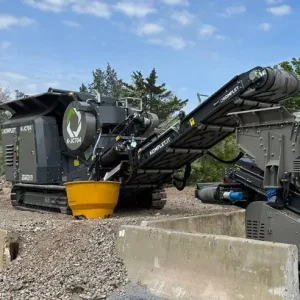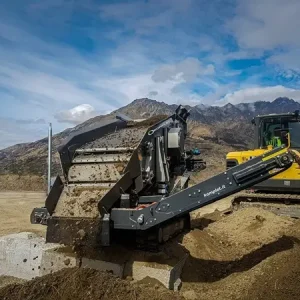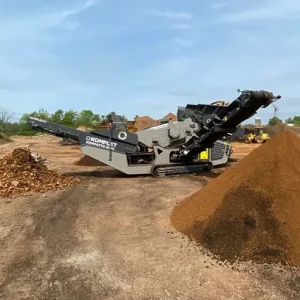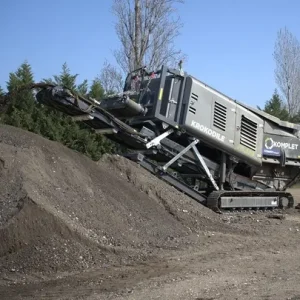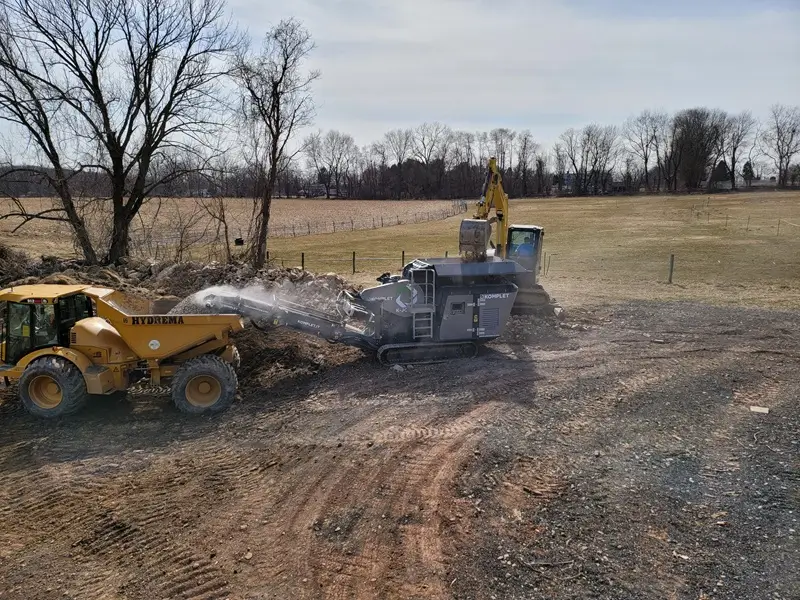

Small (compact mobile) rock crushers fit specific operational scenarios where larger fixed-plant equipment doesn’t make sense — tight-access urban work, multi-site contractor operations, single-project demolition jobs, satellite quarry operations, mobile aggregate production, and other situations where compact size, fast deployment, and reasonable capital outlay are decisive. Knowing WHEN a small rock crusher is the right tool — and equally important, when a larger machine or fixed-plant alternative serves better — is the foundation of sound equipment investment for construction-side operations.
This basic guide walks through specific operational scenarios where small rock crushers fit — substantive guidance on the situations that benefit from compact mobile crushing equipment, the volume thresholds where small crushers stop being the right choice, and how Komplet America’s K-JC 503 and K-JC 604 small jaw crushers serve these scenarios.
What Counts as a ‘Small’ Rock Crusher
In compact mobile equipment terminology, ‘small’ typically refers to crushers under approximately 20,000 lb operating weight processing under approximately 60 US tph. The K-JC 503 (~7,496 lb, up to 34 US tph) sits firmly in the small category; the K-JC 604 (~19,400 lb, up to 55 US tph) sits at the upper end of the small category. Larger compact mobile crushers like the K-JC 704 PLUS (Komplet’s best-selling crusher at ~26,455 lb, up to 90 US tph) and K-JC 805 (largest jaw crusher in Komplet’s lineup at ~49,600 lb, up to 160 US tph) qualify as ‘compact mobile’ but typically not ‘small.’
Small vs. Mid-Size vs. Large Decision
The right size depends on operational scenario: small crushers excel at tight access, intermittent use, and modest annual throughput; mid-size compact mobile crushers (K-JC 704 PLUS) cover the operational sweet spot for typical contractor operations; large compact mobile crushers (K-JC 805) handle high-volume aggregate-producer scale. Match equipment to operational profile rather than buying based on absolute capacity numbers.
Scenario 1: Tight-Access Urban Demolition
Urban demolition projects often involve site access constraints that exclude standard contractor equipment. Narrow streets with limited turn radius for transport vehicles, small lots with no staging area, indoor demolition work in basement levels or interior spaces, alley access only for residential or commercial demolition, downtown areas with overhead obstructions limiting equipment height — these access constraints favor the smallest practical equipment.
Why the K-JC 503 Fits This Scenario
- 5′ transport width fits where standard contractor equipment can’t deploy
- Working dimensions of approximately 15′ x 5′ x 6’6″ operate within tight site footprint
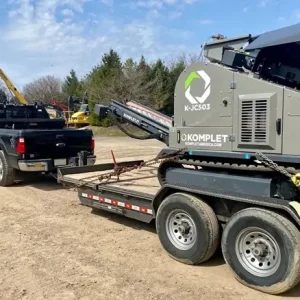
- Transport dimensions of approximately 9’8″ x 5′ x 7’2″ fit standard equipment trailers
- Approximately 7,496 lb supports lighter transport infrastructure
- Self-propelled tracked mobility drives onto and off transport trailers under its own power
- Wireless remote control supports operation from outside the immediate work zone
Typical Tight-Access Operations
Urban commercial building demolition where transport infrastructure can’t handle large equipment; residential lot work where neighbor properties limit operational footprint; indoor demolition projects in basement levels or interior building spaces; downtown commercial demolition with overhead and lateral clearance constraints; site preparation in residential subdivision work with narrow access roads.
Scenario 2: Multi-Site Contractor Operations
Demolition contractors, excavation contractors, and small recyclers operating multiple project sites simultaneously benefit from highly mobile equipment that moves between sites efficiently. The capital cost of fixed-plant equipment can’t be justified for distributed project work; equipment that requires multi-day setup at each site doesn’t fit project-based construction economics.
Why Small Crushers Fit Multi-Site Operations
- Same-day deployment means equipment arrives at site and begins production within hours, not days
- Standard equipment trailer transport eliminates specialized hauling permits and escort vehicles
- Self-contained Tier 4 Final diesel power eliminates grid power coordination at each site
- Single-operator deployment via wireless remote — no specialized setup crew required at each new site
- Equipment trailers vs. heavy haul logistics support multi-site economics
Multi-Site Operational Patterns
Contractor crews completing demolition phases at different sites in sequence; rental fleet operations moving equipment between rental customers; multi-region aggregate operations supporting different markets; project rotation through residential subdivision construction; multi-site disaster recovery operations following major weather events.
Scenario 3: Single-Project Demolition Work
Single-project demolition contractors who don’t have continuous demolition pipeline still face the dump fee + hauling + recovered material economics question on each project. Small rock crushers — particularly through rental rather than purchase — let operations capture on-site processing economics on individual projects without the capital commitment of equipment ownership.
Single-Project Equipment Strategy
- Project-by-project rental from authorized Komplet dealer network — pay only for the project duration, no carrying cost between jobs
- Rent-to-own arrangements (through some dealer partners) where rental payments credit toward eventual purchase if the project pipeline grows
- Project economics calculation per job — compare on-site rental cost vs. haul-out alternative for each specific project
- Avoided dump fees + recovered RCA + recovered scrap typically exceed rental cost on commercial demolition projects with significant concrete volumes
When Single-Project Use Makes Sense
Commercial demolition projects with 500+ tons of crushable material in markets with significant tipping fees ($30-$100+/ton typical for concrete in major US metros) typically deliver strong economics for rental-based small crusher use. Projects below this threshold may fit conventional disposal pathway better. Run the specific project economics: tons of material × (avoided tipping fee + avoided hauling + recovered material revenue) vs. rental cost. Find your local Komplet dealer to discuss rental availability and project-specific economics.
Scenario 4: Mobile and Portable Aggregate Production
Some aggregate production operations — satellite quarry operations, mobile contractor processing, distributed material handling — benefit from compact mobile equipment over fixed-plant alternatives. These operations need equipment that moves with the working face, supports flexible site assignments, and operates with minimal infrastructure.
Mobile Production Operational Profiles
- Satellite quarry operations processing material at advancing working face without fixed-plant infrastructure
- Distributed contractor processing supporting multiple regional projects with shared mobile equipment
- Specialty stone production for landscape supply markets where flexibility matters more than maximum throughput
- Off-grid material processing at remote sites without grid power, fixed plant infrastructure, or established service support
K-JC 604 for Higher-Volume Mobile Production
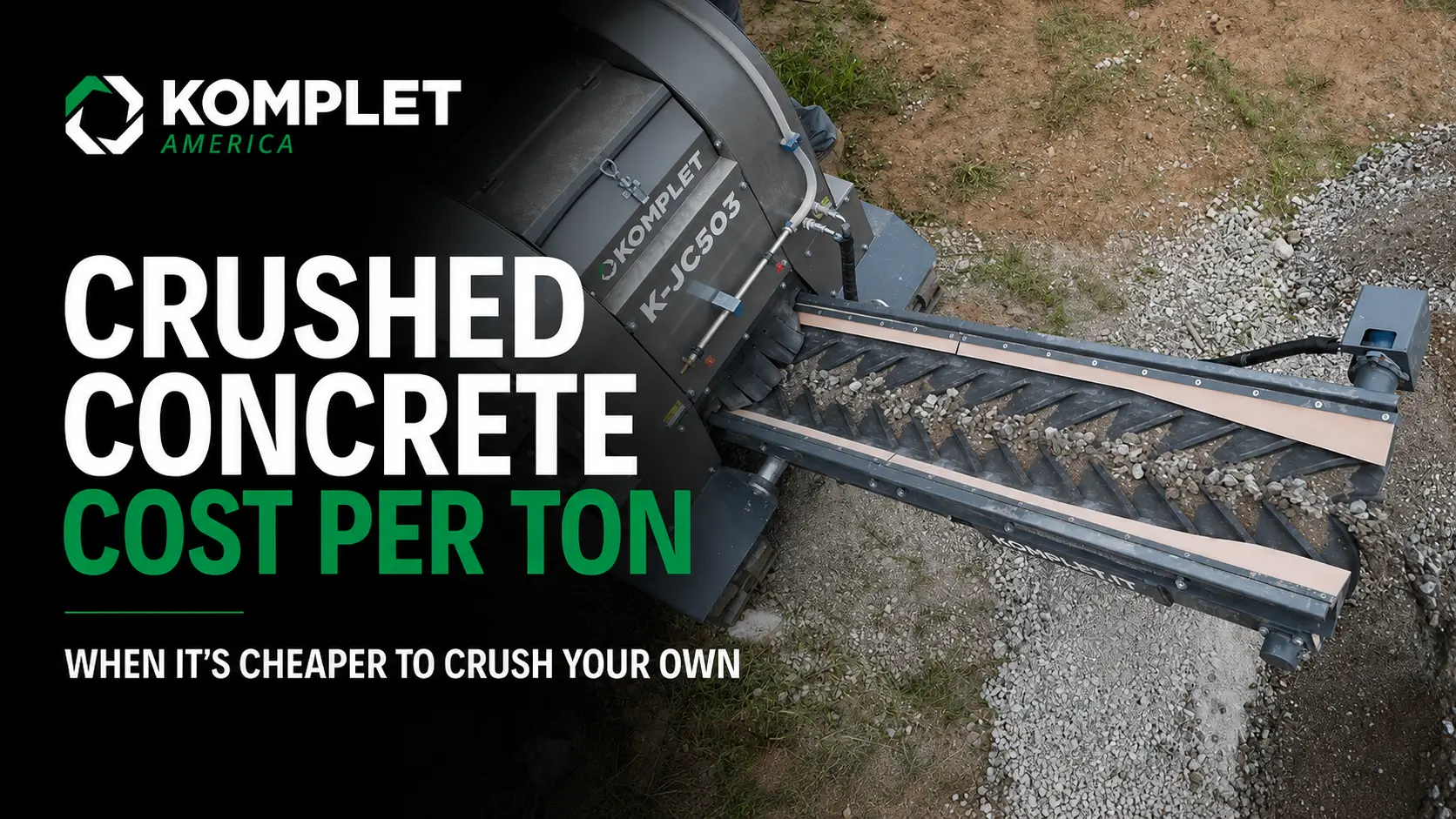
For mobile production operations needing more capacity than the K-JC 503 provides, the K-JC 604 — up to 55 US tph, 23″ x 16″ jaw, 55 HP, ~19,400 lb — provides the upper end of small crusher capacity. Still fits standard equipment trailer transport while delivering meaningful production capacity for satellite operations and mobile production work.
Scenario 5: Excavation Rock Recovery
Site preparation contractors hitting ledge rock during excavation face two options: pay to haul rock off-site as waste, or convert it to useful base aggregate on the project. For projects with 500+ tons of excavated rock, on-site crushing typically delivers strong economics through eliminated disposal cost + recovered base aggregate value.
Excavation Rock Recovery Economics
- Eliminated disposal cost — excavated rock disposal commonly runs $15-$50+/ton depending on regional conditions
- Recovered base aggregate — crushed rock typically becomes road base, structural fill, or drainage stone valued at $15-$40/ton
- Eliminated aggregate purchase — project base material can come from the project’s own crushed rock rather than purchased and hauled aggregate
- Site preparation acceleration — excavation continues without waiting for haul truck cycles
When Small Crushers Fit Excavation Work
Single-project excavation operations with one-time rock recovery needs typically work better with rental than purchase. Sustained excavation contractors with recurring ledge rock encountered across project pipeline may justify ownership. Volume thresholds: under 5,000 tons annually fits K-JC 503 economics; 5,000-30,000 tons annually fits K-JC 604 economics.
When Small Rock Crushers Are NOT the Right Choice
Knowing when small crushers don’t fit is as important as knowing when they do. The wrong size equipment for the operational scenario produces poor economics in either direction.
High-Volume Sustained Operations
Operations consistently processing 30,000+ tons annually outgrow small crusher capacity. The K-JC 704 PLUS (Komplet’s best-selling crusher at up to 90 US tph) handles the operational sweet spot for typical contractor demolition operations and growing aggregate businesses. Operations at 100,000+ tons annually typically fit the K-JC 805 (largest in the lineup at up to 160 US tph).
Mining-Scale Production
Operations processing 300,000+ tons annually per crusher require fixed-plant equipment from manufacturers focused on mining and large quarry segments. Compact mobile crushers — small or large — don’t fit mining-scale economics; they would require running 24/7 at maximum capacity with no headroom, accelerating wear and limiting redundancy. Komplet does not serve mining markets.
Soft Material Processing
Mixed C&D debris (wood, drywall, plastics, light metals) requires slow-speed shredding (Krokodile PLUS) rather than crushing — match equipment to material. Soft minerals requiring fine grinding may need specialty equipment from manufacturers focused on those segments.
Operations Requiring Premium Cubical Output Without Crushing Capacity
Operations targeting concrete batch plants, hot-mix asphalt plants, or decorative aggregate markets that require cubical output may benefit from adding the K-IC 70 impact crusher as a secondary stage after primary jaw crushing. Small crushers alone don’t produce premium cubical output.
Komplet America’s Small Rock Crusher Lineup
K-JC 503 Mini Jaw Crusher
- Up to 34 US tph
- 19″ x 12″ jaw opening
- 25 HP Tier 4 Final diesel
- Approximately 7,496 lb operating weight
- Working dimensions: 15′ x 5′ x 6’6″
- Transport dimensions: 9’8″ x 5′ x 7’2″
- Recommended max feed: 9-1/2″ minus
- Output range: 3/4″ to 3-1/4″ (hydraulically adjustable)
- Standard ultrasonic feed sensor
- Self-propelled tracked mobility, wireless remote, hydraulic jaw setting, reverse jaw function, standard dust suppression
- Optional magnetic attachment (included in base price)
- Optional oversize scalper attachment
K-JC 604 Mobile Jaw Crusher
- Up to 55 US tph
- 23″ x 16″ jaw opening
- 55 HP Tier 4 Final diesel
- Approximately 19,400 lb operating weight
- Recommended max feed: approximately 12-3/4″
- Standard hydraulic magnetic belt for rebar separation
- Self-propelled tracked mobility, wireless remote, hydraulic jaw setting, reverse jaw function, standard dust suppression
Frequently Asked Questions
How small is ‘small’ for a rock crusher?
In compact mobile equipment terminology, ‘small’ typically refers to crushers under approximately 20,000 lb operating weight processing under approximately 60 US tph. The K-JC 503 (~7,496 lb, up to 34 US tph) sits firmly in the small category; the K-JC 604 (~19,400 lb, up to 55 US tph) sits at the upper end. Larger compact mobile crushers like the K-JC 704 PLUS and K-JC 805 qualify as ‘compact mobile’ but typically not ‘small.’
What’s the smallest material volume that justifies a small rock crusher?
Highly variable based on regional tipping fees, hauling costs, and recovered material values. As a general framework: commercial demolition projects with 500+ tons of crushable material in markets with significant tipping fees ($30-$100+/ton typical) often justify rental-based small crusher use; sustained operations processing 1,500-5,000 tons annually often justify K-JC 503 ownership; sustained operations at 5,000-30,000 tons annually fit K-JC 604 ownership. Run the specific project or annual volume economics for your operation.
Can I use a small rock crusher for excavation rock?
Yes — excavation rock recovery is a primary use case for small rock crushers. Match the rock size to the jaw opening: K-JC 503 (19″ x 12″ jaw) handles material to approximately 9-1/2″ minus; K-JC 604 (23″ x 16″ jaw) handles material to approximately 12-3/4″. Pre-process oversized rock with excavator-mounted hydraulic breakers before feeding the crusher.
Is the K-JC 503 too small for serious commercial work?
Depends on the work. For tight-access urban demolition, single-project work, small operations under 5,000 tons annually, multi-site contractor operations with mobility requirements, and excavation rock recovery on residential and small commercial projects — the K-JC 503 is the right tool for serious commercial work. For sustained operations processing 30,000+ tons annually or operations requiring high single-day throughput, the K-JC 604 or larger crushers fit better.
Should I rent or buy a small rock crusher?
Renting is typically the right starting point for first-time operations and single-project work. Komplet’s authorized dealer and rental network includes partners offering rent-to-own arrangements where rental payments credit toward eventual purchase. For operations with recurring project pipeline (3+ projects per year with significant crushing volume), ownership economics typically justify purchase. Find your local Komplet dealer or call (908) 369-3340.
Does a small rock crusher handle reinforced concrete with rebar?
Yes. The K-JC 503 includes magnetic attachment as an option (included in base price); the K-JC 604 includes integrated hydraulic magnetic belt as standard. The compression-based jaw crushing action breaks concrete around embedded rebar without wrapping the steel through moving parts. Recovered rebar typically sells as scrap metal at $100-$300+/ton, adding revenue while keeping crushed RCA output clean.
Can I transport a small rock crusher with a standard equipment trailer?
Yes. The K-JC 503 (~7,496 lb, 5′ transport width) and K-JC 604 (~19,400 lb) both fit standard equipment trailers without specialized hauling permits in most jurisdictions. Transport regulations vary by state and trailer specifications — verify specific requirements for your operation and trailer setup.
Does Komplet offer financing on small rock crushers?
Komplet Capital offers 24-hour approval, 100% financing, 3-6 year terms on the full Komplet equipment lineup including small rock crushers. New equipment qualifies for Section 179 tax deduction up to $1.22M (2024 limit).
Final Thoughts
Small rock crushers fit specific operational scenarios — tight-access urban demolition, multi-site contractor operations, single-project demolition with rental economics, mobile and portable aggregate production, and excavation rock recovery — where compact size, fast deployment, and reasonable capital outlay are decisive. Knowing WHEN a small crusher is the right tool — and equally important, when a larger machine fits better — prevents the equipment-mismatch problems that produce poor economics in either direction. For operations matching the scenarios covered above, Komplet America’s K-JC 503 and K-JC 604 small jaw crushers deliver strong economics through avoided disposal costs, recovered material revenue, and operational flexibility. For operations beyond the small crusher scope, Komplet’s larger compact mobile equipment fits the role better.
Browse Komplet America’s compact mobile crusher lineup or call us to discuss whether a small rock crusher fits your specific operational scenario.
Ready to Talk Small Rock Crushers?
- Call (908) 369-3340
- Email [email protected]
- Schedule a demo or request a quote
- Find your local Komplet dealer for rental availability
- Ask about our 1-year / 1,000-hour warranty and equipment financing options
Never enough — that’s how we approach service, support, and helping operations match the right small rock crusher to their specific operational scenario.
Disclaimer: All cost, ROI, payback, pricing, dump fee, and revenue figures in this article are illustrative examples based on sample assumptions about volume, regional pricing, material specifications, and market conditions. Actual results vary significantly by region, market, material type, equipment utilization, operator skill, financing terms, regulatory environment, and many other factors. Equipment pricing, tipping fees, RCA pricing, scrap metal pricing, fuel costs, and labor rates all change over time and by location. Komplet America makes no guarantee, warranty, or representation of specific financial performance, payback timelines, or business outcomes for any particular operation. For current pricing and a payback estimate based on your specific volume, material, and local market, contact us at (908) 369-3340 to speak with our team.