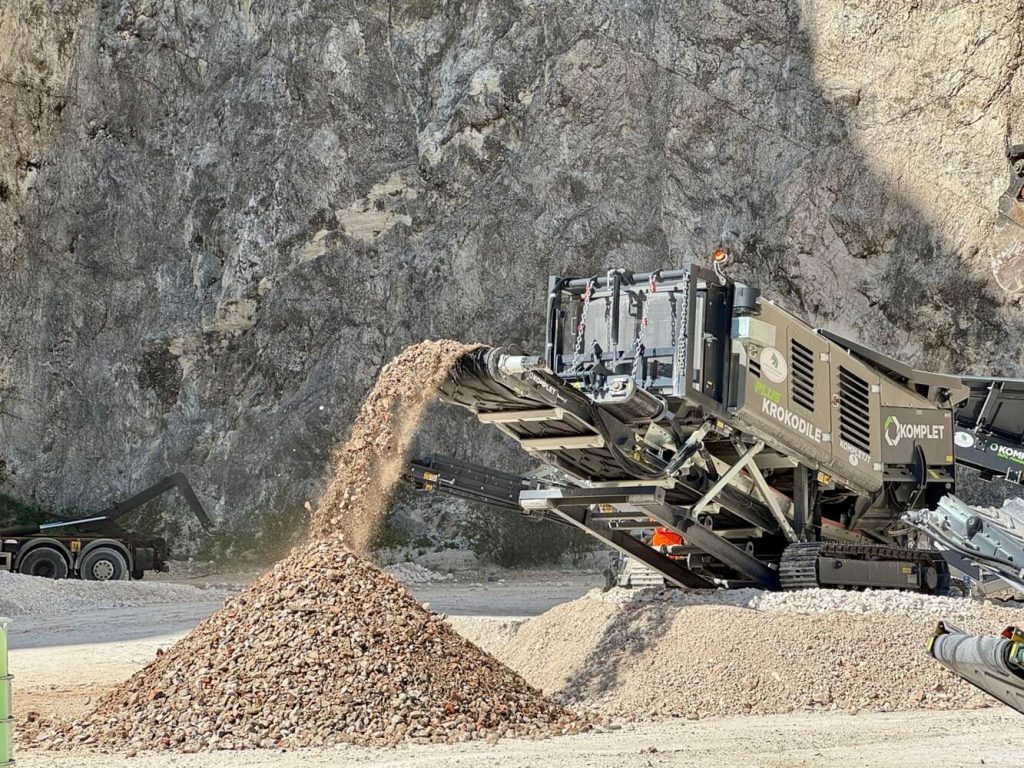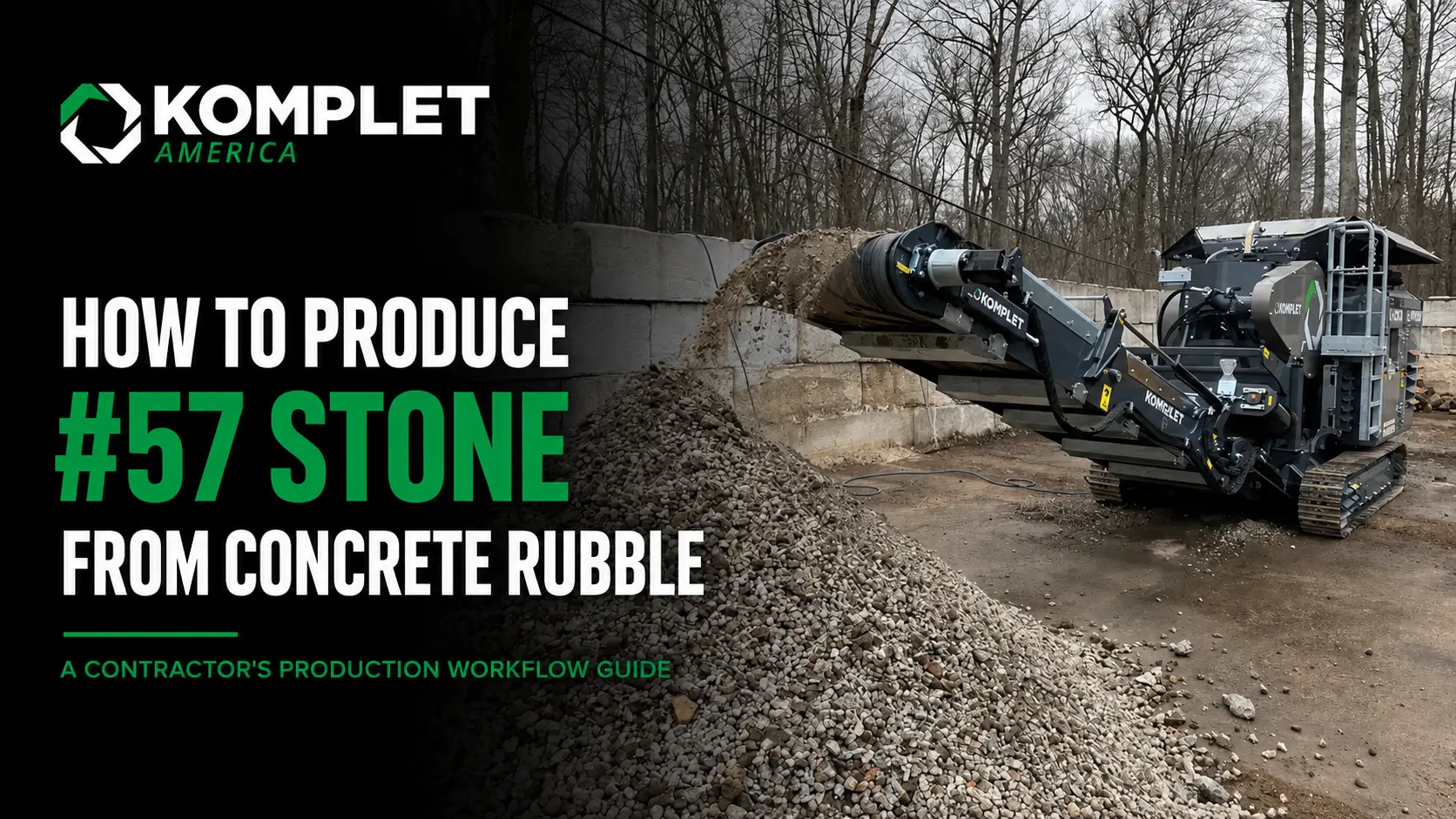

Producing AASHTO #57 stone from concrete demolition rubble is one of the most economically valuable operations a contractor or recycler can run. The product is in demand year-round across nearly every U.S. construction market — used as drainage stone, retaining wall backfill, slab base, French drain aggregate, structural fill, and concrete coarse aggregate in residential and light commercial work. The feed material is concrete rubble that would otherwise be a paid-out dump fee. The conversion from one to the other turns a cost line into a revenue line, doubled when the producer also avoids the virgin aggregate purchase by reusing the output on the same project that generated the demolition.
The work itself is not complicated. A jaw crusher reduces the rubble. A vibrating screener separates the output into target sizes. A few stockpiles hold the finished products. The same workflow that produces #57 also produces #67, #8, stone dust, crusher run-equivalent, and oversize return material — different products from the same feed, separated by screen mesh choice. Done with discipline, the operation produces a clean, marketable #57 stockpile that meets the AASHTO M43 gradation envelope and behaves the way buyers expect clean drainage stone to behave. Done without discipline, the operation produces a contaminated, marginally-graded mix that’s worth less per ton than crusher run and that no professional buyer wants on their project.
The difference between disciplined production and undisciplined production is the difference between a saleable product and a stockpile that sits unused. The technical requirements are not exotic. The economic case is well-established. The variable that determines outcomes is operational discipline applied consistently — clean feed in, controlled crushing, accurate screening, clean stockpiles out. This guide walks through that discipline step by step.
Komplet America has been the U.S. distributor of Komplet S.p.A. compact crushers, screeners, and shredders since 2018, and the Conti family construction legacy behind Komplet America stretches back to 1906. Concrete recycling for sized aggregate is one of the central use cases for compact crushing equipment in our customer base, and the production workflow below is the same workflow our service team walks through with new operators getting their first crushing setup commissioned. The detail in this article reflects what experienced operators do consistently and what new operators most often miss.
The Quick Answer
For contractors who don’t need the full reference, the production workflow looks like this:
- Step 1: Clean and pre-size the feed. Remove trash, soil, wood, drywall, plastic. Pre-break oversized slabs and footings to material that fits the crusher inlet. Identify and segregate any contaminated source material before crushing.
- Step 2: Primary crush through a jaw crusher with closed-side setting (CSS) tuned to the target output. For #57 production, a CSS of 1.25 to 1.5 inches typically produces an output where the majority of material is in the right size range for #57 separation. Magnetic separation removes ferrous metal during crushing.
- Step 3: Screen the crushed output. For AASHTO #57 (1-inch top size, 0–10% passing #4 sieve), use a top deck with 1-inch openings to remove oversize, and a bottom deck with #4 sieve openings (¼-inch / 4-mesh) to drop fines. The middle deck stream is the #57 product.
- Step 4: Stockpile the #57 product separately from oversize, fines, and other sized streams. Maintain stockpile cleanliness through dedicated zones, clean loader practice, and conveyor placement that minimizes cross-contamination.
- Document the gradation. Stockpiles serving state DOT, county, municipal, or engineered projects need current accredited-lab gradation reports. Stockpiles serving residential and light commercial work need at least informal in-house gradation checks.
- Equipment scale matters: K-JC 503 + Kompatto 221 for hardscape contractors and small recyclers; K-JC 604 / 704 PLUS + Kompatto 5030 for medium operations; K-JC 805 + Kompatto 124 for higher-volume in-yard recycling.
Why #57 Stone Is the Highest-Value Production Target
Of the products a compact crushing operation can produce from concrete demolition rubble, AASHTO #57 stone has consistently been the most valuable per ton in most U.S. markets. Several factors converge to make this the case:
- Demand consistency. #57 is used across an unusually wide application range — residential and commercial drainage, slab base, structural fill, retaining wall backfill, French drains, paver base, concrete mix coarse aggregate. Demand is steady through economic cycles and across construction season.
- Specification clarity. AASHTO M43 size designation #57 is a national standard. A producer’s #57 product can be sold to any buyer who specifies #57 without translation between regional product naming. The standardized definition reduces commercial friction and supports premium pricing for spec-compliant material.
- State DOT acceptance. Most U.S. state DOTs accept RCA-produced #57 in base course, subbase, and structural fill applications under defined conditions. We cover the state-by-state framework in detail in our companion piece, State DOT Specs for Recycled Concrete Aggregate: A Contractor’s Reference.
- Production economics. #57 falls in the middle of the screening output for most concrete crushing operations — neither requiring the most aggressive crushing reduction nor the finest screening. The product yield from a typical concrete demolition feed is favorable: 40–55 percent of crushed output typically falls in the #57 envelope when the crusher is tuned for the target.
- Multi-product compatibility. The same primary feed produces #57 alongside #67, #8, stone dust, and oversize return material with appropriate screening. The producer who configures the operation for #57 production is positioned to deliver the rest of the product menu without retooling.
For the broader context on #57 stone applications and specifications, see #57 Stone vs #67 Stone: A Contractor’s Guide and Crusher Run vs #57 Stone for Driveways.
The AASHTO #57 Gradation Envelope: What the Output Has to Hit
Producing #57 stone means producing material that falls within a defined gradation envelope under AASHTO M43 (and the equivalent ASTM D448). The envelope is what determines whether the produced material is actually #57 stone or just material in the general size range. Buyers requiring #57 specifically — state DOT projects, engineered specifications, ready-mix concrete plants — need the produced material to fall within these percent-passing values when tested per AASHTO T 27 sieve analysis:
- 100 percent passing 1½-inch sieve.
- 95–100 percent passing 1-inch sieve.
- 25–60 percent passing ½-inch sieve.
- 0–10 percent passing #4 sieve (4.75 mm / approximately ¼-inch opening).
- 0–5 percent passing #8 sieve (2.36 mm).
The defining characteristics for production purposes: 1-inch top size and the very low fines content (under 10 percent passing #4 sieve, under 5 percent passing #8 sieve). The middle of the envelope — between ½-inch and 1-inch — is intentionally wide, allowing significant variation between producers while still meeting the same specification.
The two failure modes that disqualify a load as #57: oversize particles above 1 inch (more than 5 percent retained on the 1-inch sieve), and excess fines below the #4 sieve (more than 10 percent passing). Production discipline targets both ends of the envelope.
Step 1: Feed Preparation and Pre-Sizing
The single most consequential operational decision in a concrete recycling workflow is the cleanliness and consistency of the feed material. A clean concrete-only feed produces predictable output, minimizes downtime, maximizes wear part life, and produces a stockpile that’s worth its weight at full market price. A contaminated mixed feed produces erratic output, creates regular crusher jams from non-crushable contaminants, accelerates wear part wear, and produces a stockpile that’s worth less per ton than the cost of producing it.
What to Remove Before Crushing
- Wood, vegetation, and organic material. Wood doesn’t crush — it splits, jams, and ends up in the stockpile contaminating the product. Removed at the source by sorting on the demolition site or in the feed yard.
- Drywall, ceiling tile, plaster, and similar interior building materials. These produce gypsum-rich fines that can affect concrete reactivity and create acceptance problems for state DOT and engineered applications.
- Soil, mud, and sub-base material. Topsoil and clay introduce fine contamination that’s difficult to screen out and that affects the cleanliness rating of the stockpile.
- Plastic, insulation, fabric, and other lightweight non-crushable trash. Visible contamination that buyers immediately note when inspecting stockpiles.
- Oversize rebar, structural steel, embedded anchors, and metal that exceeds the magnetic separator’s capacity. Pre-cut or remove with a shear or excavator-mounted attachment before the material reaches the crusher.
- Rubble exceeding the crusher inlet dimensions. Pre-break with an excavator-mounted hydraulic breaker or with a slow-speed shredder.
Pre-Sizing Equipment
Most concrete demolition produces some material that exceeds typical compact jaw crusher inlet dimensions. The K-JC 503’s 19-inch by 12-inch jaw, the K-JC 604’s 23-inch by 16-inch jaw, the K-JC 704 PLUS’s 27-inch by 16-inch jaw, and the K-JC 805’s 31-inch by 21-inch jaw all have practical maximum feed sizes around 80 percent of the gape. Material above those dimensions needs pre-reduction.
- Excavator-mounted hydraulic breaker: the most common pre-reduction tool. The same excavator that loads the crusher hopper handles oversize as part of the loading process.
- Excavator-mounted shear or pulverizer: useful for separating reinforcing steel from concrete during pre-reduction. Common on heavy demolition projects with heavily-reinforced concrete.
- Slow-speed shredder: the Krokodile PLUS slow-speed shredder pre-reduces oversized concrete, asphalt, brick, block, and rubble before the primary crusher. Best suited for mixed C&D feed and consistent oversize streams that justify the dedicated machine.
Source Documentation Discipline
For producers planning to sell into state DOT or engineered projects, source documentation begins at the feed pile. Track:
- Source of incoming concrete demolition: highway, building, slab/foundation, sidewalk and curb work.
- Asbestos clearance documentation, particularly for older building demolition feedstock (pre-1985 source concrete may have asbestos-containing materials in adjacent assemblies).
- Date and quantity of incoming material.
- Any contamination notes or rejected loads.
- Segregation of feed streams where commercially relevant — highway demolition concrete typically commands a premium over mixed C&D feed for state DOT supply.
Step 2: Primary Crushing
The primary jaw crusher reduces concrete demolition rubble to a top size manageable by the downstream screener. The closed-side setting (CSS) — the gap at the bottom of the crushing chamber — determines the top size of the output. Setting the CSS correctly is the most important operational control during production.
Closed-Side Setting (CSS) for #57 Production
For #57 production specifically, the CSS should be set to produce output with a top size that matches the screener’s top deck opening. Practical settings:
- CSS of 1.25 to 1.5 inches: produces output with most material below 1.5 inches and a meaningful percentage in the #57 envelope. Combined with a 1-inch top deck on the screener, this produces a viable #57 stream with modest oversize bypass.
- CSS tighter than 1 inch: pushes more material into the smaller sizes, reducing #57 yield in favor of #67, #8, and fines. Useful when the producer’s market favors smaller sizes; suboptimal when #57 is the primary target.
- CSS wider than 1.5 inches: produces more oversize, higher percentage of material in the #57 envelope per pass through the screener, but requires return-to-crusher recirculation of oversize material. Acceptable for some operations; less common in compact contractor setups.
Throughput Considerations
Compact jaw crushers achieve their rated throughput when fed consistently at the right material size and at the right CSS. Practical throughput numbers from typical Komplet operations:
- K-JC 503 (19″ × 12″ jaw): rated up to 34 US tph. In typical concrete demolition recycling, sustained production of 20–28 US tph is realistic. The K-JC 503 is the entry-level production machine for hardscape contractors and small recyclers. Browse the K-JC 503 product page for full specifications.
- K-JC 604 (23″ × 16″ jaw): rated up to 55 US tph. Sustained production of 35–45 US tph in typical concrete recycling. The K-JC 604 includes integrated hydraulic magnetic belt for rebar separation.
- K-JC 704 PLUS (27″ × 16″ jaw): rated up to 90 US tph. Sustained production of 50–75 US tph in typical concrete recycling. The K-JC 704 PLUS is Komplet America’s best-selling jaw crusher and the workhorse for medium-volume recyclers.
- K-JC 805 (31″ × 21″ jaw): rated up to 160 US tph. Sustained production of 100–135 US tph in typical concrete recycling. The K-JC 805 handles small-quarry-scale operations.
Magnetic Separation
Concrete demolition feed routinely contains rebar, mesh, anchors, and embedded steel. Komplet jaw crushers in the K-JC 604, 704 PLUS, and 805 lines include integrated hydraulic magnetic belts that lift ferrous metal off the discharge conveyor during crushing. The metal lifts to a separate clean pile alongside the operation; the cleaned crushed material continues to the screener. The integrated magnetic belt eliminates the manual rebar removal that used to make RCA production so labor-intensive.
Choke Feeding
A jaw crusher operates most efficiently and produces the most consistent output when the chamber is consistently full — known as choke feeding. Sporadic, partial feeds produce uneven output gradation, accelerate wear part wear in localized zones, and reduce overall throughput. The standard discipline is continuous, controlled feeding from the hopper-and-vibrating-feeder combination (standard equipment on Komplet jaw crushers). The operator who feeds in spurts is paying for that habit in wear parts and throughput.
Step 3: Screening to Hit the AASHTO #57 Envelope
Screening is the operational step that turns crushed output into separated, sized products. The screener is the difference between a producer who sells “crushed concrete” at commodity pricing and a producer who sells “AASHTO #57 stone” at spec-compliant pricing. Configuration of the screener — specifically, the screen mesh openings on each deck — determines what products the operation can deliver.
Screen Mesh Configuration for #57 Production
To produce AASHTO #57 stone, the screener separates material above and below two specific opening sizes:
- Top deck: 1-inch openings. Material above 1 inch goes to oversize. Some operations recirculate oversize back to the crusher; others segregate it as separate product (rip rap, drainage stone, or coarser sized aggregate).
- Bottom deck: #4 sieve equivalent — typically a ¼-inch (4-mesh) opening. Material below this opening drops as fines. Most operations stockpile fines as stone dust or as a component of crusher run-equivalent product.
- Middle deck stream (between top and bottom decks): the #57 envelope material. This is the target product.
Multi-deck screeners can produce additional sized products in the same screening pass:
- To produce #57 and #67 simultaneously: top deck at 1″, middle deck at ¾” (separating #57 above from #67 below), bottom deck at #4 sieve. The two envelope products discharge as separate streams.
- To produce #57 and #8 simultaneously: top deck at 1″, middle deck at #4 sieve (separating #57 above from material that will be further classified), bottom deck at #8 sieve. Requires careful screen selection because the envelopes overlap at the boundaries.
- Most operations standardize on one product as the primary output and produce others in dedicated screening passes when demand calls for it.
Komplet Screener Configuration
- The Kompatto 5030 heavy-duty vibrating screener is Komplet’s best-selling vibrating screener. Three-deck configuration produces three sized products simultaneously, with screen mesh openings adjustable to hit specific gradation envelopes. Pairs naturally with the K-JC 604, 704 PLUS, and 805 jaw crushers.
- The Kompatto 221 is the compact-yard screener — sized for the K-JC 503 paired with smaller-scale hardscape and recycling operations.
- The Kompatto 124 handles the highest-throughput compact screening operations, paired with the K-JC 805 in larger recycler yards.
Screen Mesh Selection: Material Type
- Woven wire mesh: the standard general-purpose option. Lower first cost, easy to source, available in a wide range of opening sizes. Wears from abrasion as material passes across the surface. Typical wear life in concrete recycling: 3–12 months on the working deck depending on tonnage.
- Polyurethane modular panels: longer wear life than wire mesh in many abrasive applications (typically 2–4 times). Each modular panel can be replaced individually, allowing wear-zone targeting on the deck. Higher first cost; quieter in operation; less prone to blinding.
- For more on screen mesh selection and wear economics, see Wear Parts Economics: Jaw Plates, Blow Bars, and Screen Mesh.
Step 4: Stockpile Management and Quality Discipline
Once the crusher and screener are producing sized products, keeping the stockpiles clean and separated is the operational discipline that protects product value. Cross-contaminating a #57 stockpile with crusher run fines turns saleable open-graded stone into reject material. The yard discipline that prevents cross-contamination is the difference between premium-grade aggregate and discount-grade material.
Stockpile Layout
- Dedicated stockpile zones for each product. #57 has its own zone, #67 has its own zone, #8 has its own zone, fines/stone dust has its own zone, oversize has its own zone, and crusher run-equivalent (if produced) has its own zone.
- Spacing between stockpiles sufficient that windborne fines from one pile don’t contaminate adjacent piles. In windy regions, this can mean meaningful spacing between open-graded clean stone piles and crusher run / dense-graded piles.
- Defined paths for loaders to and from each stockpile. Cross-traffic between #57 and crusher run zones tracks fines into the clean stone area on equipment tires and tracks.
- Consideration for receiving area logistics: loadout stations that allow trucks to access each stockpile without driving through other product zones.
Loader Discipline
- Clean buckets between products. The same loader bucket that just moved crusher run-equivalent will deposit fines into the next pile if not cleaned.
- Avoid cross-loading. The shortest path between two stockpiles often crosses a third product zone — find a longer path that avoids contamination.
- Build piles with consistent direction and consistent dump pattern. Piles built with material dumped from inconsistent directions show inconsistent gradation as the operator loads from different sides.
Conveyor Placement
The K-TC 460 portable mobile conveyor extends stockpile reach and reduces the cross-handling that causes most contamination. Built piles can be located further from the crusher and screener, with the conveyor spanning the distance — keeping clean stone piles physically separated from the more dust-generating primary equipment. In tight yards, particularly in the Northeast, the conveyor often pays for itself in product quality alone.
Step 5: Quality Documentation and Gradation Verification
Production discipline plus stockpile discipline produces material that should fall within the AASHTO #57 envelope. Quality documentation confirms that the produced material actually does meet the spec — and is the credentialing step that separates contractor-grade producers from discount-commodity competitors.
Documentation Levels
- Informal in-house gradation check: visual inspection plus simple sieve testing with handheld or shop-grade screens. Adequate for residential and light commercial work without binding gradation requirements.
- Per-stockpile gradation report: accredited-lab AASHTO T 27 sieve analysis on a representative stockpile sample. Required for state DOT and most engineered applications. Frequency depends on stockpile turnover — typically per stockpile build, or per major sales campaign.
- Per-tonnage sampling: sampling at defined intervals (every 500 tons, every 1,000 tons, etc.) per state DOT or engineering specification. The most rigorous level, required for state DOT supply contracts in some states.
Common Failure Modes That Show Up in Gradation Reports
- Excess fines (more than 10 percent passing #4 sieve, or more than 5 percent passing #8 sieve). Causes: contaminated stockpile (cross-contamination from fines or crusher run), worn screen mesh letting fines through, or screen blinding (cohesive fines clogging the screen and bypassing rather than dropping through).
- Excess oversize (more than 5 percent retained on 1-inch sieve). Causes: top deck damaged or tear, top deck mesh too coarse, or oversize material reaching the stockpile from a different production stream.
- Out-of-envelope mid-range gradation. Causes: blended product from two different production runs with different CSS settings, or contamination with a product from a different envelope.
Source Documentation
- Identification of source concrete: highway demolition, building demolition, slab and foundation work.
- Asbestos clearance: documentation that the source concrete is asbestos-free, particularly for older building demolition feedstock.
- Contamination control: documentation of feedstock cleanliness — concrete-only versus mixed C&D feed.
- State DOT contract or PIN identification where the source concrete came from a state DOT project (some states use this as positive identification of acceptable source material).
Equipment Configuration by Operation Scale
Small Operation (Under ~5,000 Tons/Year)
Typical operator: hardscape contractor, small demolition contractor, pool builder adding on-site recycling for the first time. Typical equipment configuration:
- Optional small conveyor for stockpile management on tight sites.
- Total annual production capacity at this scale: 5,000–10,000 tons depending on operating hours and feed quality.
Medium Operation (5,000–25,000 Tons/Year)
Typical operator: medium-volume hardscape contractor, smaller demolition firm, in-yard recycler producing for own use and limited resale. Typical equipment configuration:
- Total annual production capacity: 15,000–35,000 tons depending on operating hours, feed quality, and product mix.
Larger Operation (25,000+ Tons/Year)
Typical operator: dedicated recycler, in-yard production for state DOT supply, larger demolition contractor with sustained rubble volume. Typical equipment configuration:
- Optional K-IC 70 compact impact crusher for cubical aggregate production where state DOT or engineering specifications require particle shape control.
- Multiple K-TC 460 conveyors for product separation.
- Optional Krokodile PLUS slow-speed shredder for pre-reduction of mixed C&D feed.
- Total annual production capacity: 50,000–100,000+ tons depending on operating hours, feed quality, and product mix.
Common Production Mistakes
Setting CSS Too Tight or Too Wide
CSS tighter than necessary produces excess fines and reduces #57 yield. CSS wider than necessary produces excess oversize that requires recirculation or separate stockpiling. The right CSS for #57 production is typically 1.25 to 1.5 inches — wide enough to maximize #57 yield while keeping oversize manageable. Setting CSS without measuring product gradation is a common new-operator mistake.
Skipping Pre-Sizing on Borderline-Oversize Material
Material that’s borderline oversize — slabs and chunks at the upper end of the crusher inlet — bridges the chamber, takes longer to crush, increases shock loading on jaw plates and bearings, and risks toggle plate failure if uncrushable contaminants are present. Pre-breaking this material with a hydraulic breaker or shredder takes extra time at the front of the workflow but pays back in throughput, wear, and downtime avoided.
Letting Fines Cross-Contaminate the #57 Stockpile
The single most common preventable cause of off-spec #57. The screener does its job and produces material in the envelope; the stockpile loader picks up fines from a nearby stone-dust pile and dumps them into the #57 zone with the next bucket of clean #57. The remediation cost is typically rescreening the entire stockpile — an expensive operation that doesn’t always recover the original product class. Yard discipline prevents the problem at zero marginal cost.
Skipping Gradation Documentation
RCA without a current gradation report can be sold for non-spec’d uses but cannot be sold to state DOT, municipal, or engineered projects requiring documented gradation. The cost of accredited-lab gradation testing is small compared to the price premium for spec-compliant RCA. Producers who skip documentation are choosing the lower-margin commodity market over the higher-margin spec’d market.
Overproducing One Product
A producer focused entirely on #57 production may neglect the other product streams that come out of the same screening operation. Stone dust, oversize, #67, and #8 all have markets and all command per-ton revenue. The producer who treats them as waste streams loses revenue on every screening pass. The disciplined operation manages all stockpiles and sells across the product menu.
Frequently Asked Questions
Can concrete rubble be crushed into #57 stone?
Yes. Clean concrete demolition rubble is excellent feedstock for AASHTO #57 stone production. The crushing reduces the rubble to a manageable size; screening separates the output into the #57 envelope (95–100% passing 1-inch sieve, 0–10% passing #4 sieve). State DOTs broadly accept RCA-produced #57 in base course, subbase, and structural fill applications under defined conditions; the producer needs gradation documentation and source documentation to qualify for state DOT supply.
What jaw crusher CSS produces #57 stone?
For #57 production specifically, a closed-side setting (CSS) of 1.25 to 1.5 inches typically produces output with most material below 1.5 inches and a meaningful percentage in the #57 envelope. Combined with a 1-inch top deck on the screener, this produces a viable #57 stream with manageable oversize. CSS settings tighter than 1 inch reduce #57 yield in favor of smaller sizes; wider settings increase oversize.
What screen mesh produces #57 stone?
AASHTO #57 stone has a 1-inch top size with the bottom of the envelope at the #4 sieve. Screen mesh configuration: top deck with 1-inch openings (separating oversize from #57); bottom deck with #4 sieve openings (¼-inch / 4-mesh, separating #57 from fines). The middle deck stream is the #57 product. For two-product simultaneous production (#57 and #67), use a three-deck screener with 1″, ¾”, and #4 sieve openings.
Do I need both a crusher and a screener?
For clean spec-compliant #57 production, yes. The crusher reduces the material to manageable size; the screener separates the crushed output into the AASHTO #57 envelope. A crusher alone produces a wide-spread output with oversize, mid-range, and fines all mixed — that material can be sold as crusher run-equivalent or general fill, but it doesn’t meet the AASHTO #57 specification. A screener alone can’t reduce demolition rubble to the size range #57 requires; the crusher does the reduction work.
Can one machine make finished #57 stone?
Some compact crushers can be paired with screen attachments that perform basic separation, and these can produce material in the general #57 size range for non-spec’d applications. For spec-compliant #57 — material that meets AASHTO M43 with documented gradation — a dedicated screener provides better control, more accurate separation, and easier multi-product output. The dedicated crusher-plus-screener configuration is the standard for production operations.
What happens to the fines that don’t make it into #57?
Fines (material passing the #4 sieve) typically become stone dust as a separate stockpile. Stone dust has its own market — mason’s sand, paver setting bed material in some applications, asphalt mix component, and base material for certain non-permeable applications. Some operations blend fines back with crushed material to produce crusher run-equivalent (dense-graded base aggregate). Either approach turns the fines into a saleable product rather than a waste stream.
Does Komplet equipment include rebar separation?
The K-JC 604, K-JC 704 PLUS, and K-JC 805 include integrated hydraulic magnetic belts as standard equipment. The magnetic belt lifts ferrous metal off the discharge conveyor during crushing, separating rebar and embedded steel into a separate clean pile alongside the operation. The K-IC 70 compact impact crusher also includes an integrated magnetic belt. Magnetic separation eliminates the manual rebar removal that used to make RCA production so labor-intensive. The K-JC 503 does not include integrated magnetic separation; rebar control is managed at the feed pile and through manual sorting on the discharge conveyor.
What’s the production yield from concrete demolition feed?
Yield depends on feed quality, CSS setting, screening configuration, and operator discipline. As an industry rule of thumb for typical concrete demolition feed crushed for #57 production: 40–55% of crushed output falls in the #57 envelope, 15–25% falls in the #67 envelope (or #8 depending on screening), 15–25% becomes fines/stone dust, and the remainder is oversize. Specific yields vary substantially; operations targeting maximum #57 yield through CSS and screening optimization can achieve 50–60% in the target envelope, while operations targeting multiple products simultaneously typically see lower per-product yields.
What’s the payback period on equipment for #57 production?
Specific payback varies dramatically by region, operation, and discipline — there is no universal answer. As a directional reference: small operations (under 5,000 tons/year) in high-cost regions can frequently justify a K-JC 503 in 18–36 months on dump fee savings alone, before counting aggregate cost avoidance or aggregate sales revenue. Medium operations (15,000+ tons/year) running a K-JC 604 or K-JC 704 PLUS plus a Kompatto 5030 generally see meaningfully shorter payback periods. The economics are most favorable in the highest-cost regions (Northeast, Pacific) per EREF 2024 tipping fee data. We cover the broader economic context in our companion piece, Recycled Concrete Aggregate vs Virgin Stone.
Final Thoughts
Producing AASHTO #57 stone from concrete demolition rubble is one of the highest-value operations a contractor or recycler can run — and it’s also one of the most discipline-sensitive. The technical requirements are not exotic. The economic case is well-established. The variable that determines whether the operation produces a marketable spec-compliant stockpile or a marginal commodity-grade pile is operational discipline applied consistently at every step: clean feed in, controlled CSS, accurate screening, clean stockpiles, documented gradation.
The contractor or recycler who treats #57 production as a precision operation — selecting feed quality, tuning CSS, configuring screen mesh, managing stockpiles, documenting gradation — produces a stockpile that’s worth virgin equivalent or close to it in the regional market. The same operation done without discipline produces a stockpile that’s worth a fraction of its potential value. The equipment is the same. The labor input is the same. The economics are completely different.
Komplet America’s compact crusher and screener lineup is sized for this kind of work — from the smallest K-JC 503 in a hardscape contractor’s yard to a K-JC 805 plus Kompatto 124 plus K-IC 70 plus K-TC 460 production train in a mid-volume recycling facility. The right configuration depends on annual tonnage, target product mix, and the regional economic environment. Our specialists work through that match in detail with every customer, including the production discipline below the equipment specifications.
For broader context across the cluster, see our companion articles: Crushed Stone Grades: A Komplet Basic Guide to Aggregate Size and Use Cases, The Hardscape Contractor’s Guide to On-Site Stone Production, State DOT Specs for Recycled Concrete Aggregate, Construction & Demolition Tipping Fees by Region, Wear Parts Economics: Jaw Plates, Blow Bars, and Screen Mesh, OSHA Silica Compliance for Crushing Operations, Permit Guide: Starting a Small-Scale Concrete Recycling Operation, Crusher Run vs #57 Stone for Driveways, #57 Stone vs #67 Stone, Recycled Concrete Aggregate vs Virgin Stone, and Best Stone for a French Drain.
Ready to Set Up Your #57 Production Operation?
- Talk to a Komplet specialist about pairing the right crusher and screener configuration for #57 production at your operation scale. Call 908-369-3340 or visit com/contact-us.
- Browse the full Komplet equipment lineup — crushers, impact crushers, screeners, conveyors, and shredders sized for compact contractor and recycling operations.
- Explore equipment financing through Komplet Capital — 24-hour approvals, terms from 36 to 72 months, 100% financing available.
- Consider a pre-owned Komplet machine — typical capital savings of 40 to 70 percent versus new, factory-supported by the same Komplet America service network.
Never enough.
Disclaimer: AASHTO M43 size designations, ASTM D448 size designations, AASHTO T 27 sieve analysis, state DOT acceptance frameworks, and product gradation specifications vary by jurisdiction and by project. Confirm current published versions against any specific project or sales requirement. Throughput numbers, CSS settings, yield estimates, and equipment scale recommendations are illustrative and based on industry patterns; actual results vary significantly by feed material, operator skill, equipment condition, and many other factors. Cost ranges, payback timelines, and economic comparisons are illustrative and based on industry patterns; actual results vary significantly by region, market, project specifications, equipment utilization, financing terms, and many other factors. Operating, maintenance, and service guidance is general in nature. Always refer to the official Komplet operator’s manual for the specific machine model and serial number, and follow OEM intervals and procedures. For warranty-protected work, contact Komplet America at 908-369-3340 or your authorized Komplet dealer. Improper service or non-OEM parts may void warranty coverage and create safety hazards.