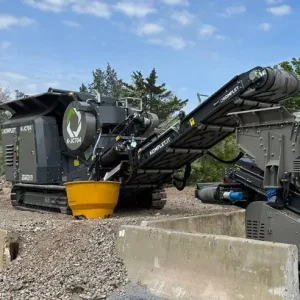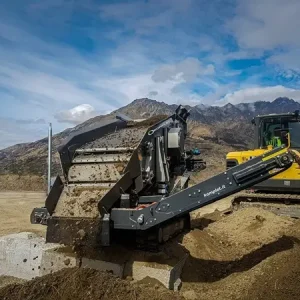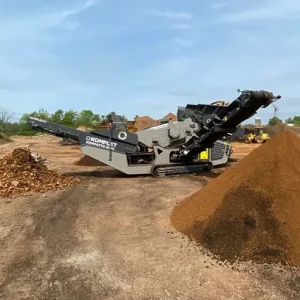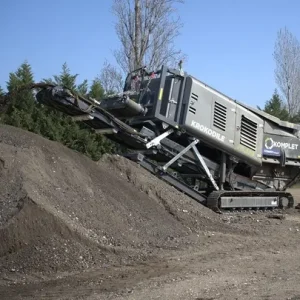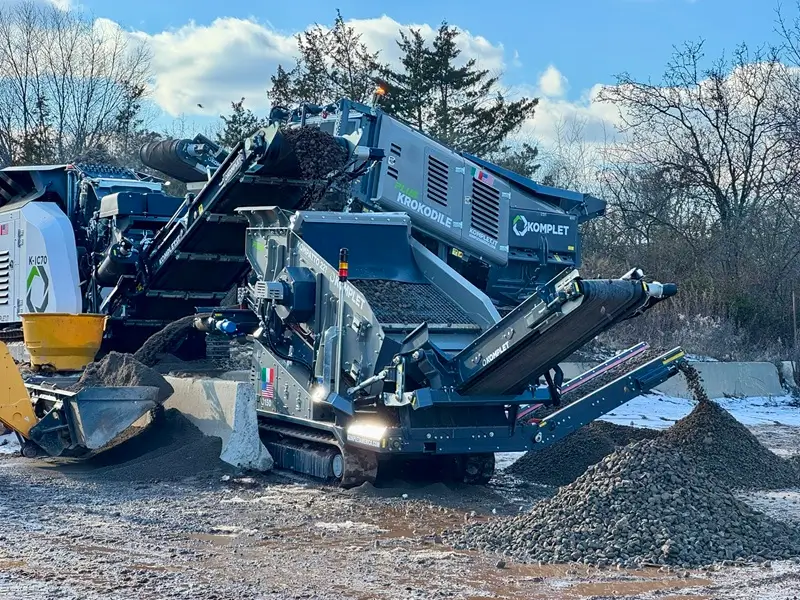

After natural disasters — hurricanes, tornadoes, severe storms, earthquakes, floods, wildfires — the cleanup phase generates enormous volumes of construction and demolition debris that must be moved, sorted, processed, and disposed of or recycled. Compact mobile crushing, screening, and shredding equipment plays a specific and useful role in this phase: contractors and municipal yards can process recoverable concrete, asphalt, masonry, and clean wood debris on-site or at temporary debris management sites (TDMS) rather than hauling all of it to overwhelmed landfills. The Komplet equipment lineup — compact jaw crushers, the K-IC 70 impact crusher, Kompatto vibrating screeners, K-TS trommels, the Krokodile PLUS slow-speed shredder, and the K-TC 460 tracked mobile conveyor — fits this work because the equipment is engineered for transport flexibility, single-operator deployment, and material-stream variety that disaster debris typically presents.
This guide is for contractors, municipal public works officials, debris management contractors, and emergency-management professionals making practical equipment decisions in the recovery phase of disaster response. It focuses on the operational role of compact mobile equipment in debris management workflows — not on the immediate emergency response phase, which involves life-safety operations and is the responsibility of dedicated emergency response services.
Where Debris Management Fits in Disaster Recovery
Disaster response operates in phases. The immediate response phase — search and rescue, medical response, evacuation, life-safety operations — is the responsibility of dedicated emergency response services and is outside the scope of equipment used by recycling and demolition contractors. The recovery phase, which begins once life-safety operations are stabilized, includes debris removal, infrastructure restoration, and the long process of rebuilding affected communities.
Debris management is part of the recovery phase. After a hurricane, tornado, severe storm, earthquake, or wildfire, affected jurisdictions face debris volumes that may be measured in millions of cubic yards. The Federal Emergency Management Agency (FEMA) recognizes debris management as a distinct disaster recovery function and publishes guidance on debris management planning, including the use of temporary debris management sites (TDMS) where waste is staged, sorted, and processed before final disposal or recycling.
The equipment that processes that debris — primarily compact mobile crushers, screeners, shredders, and conveyors operated by contractors, municipal yards, or specialized debris-management firms under contract — is what this guide focuses on. The equipment is the technical infrastructure of recovery, not the human emergency response.
What Disaster Debris Actually Looks Like
Disaster debris is heterogeneous. Different events produce different debris streams, and the equipment needed varies accordingly. Common categories:
Mineral Construction Debris
Concrete, asphalt, brick, masonry block, foundations, and rubble from damaged buildings and infrastructure. This is the same material stream a Komplet jaw crusher (K-JC 503, K-JC 604, K-JC 704 PLUS, K-JC 805) or the K-IC 70 impact crusher handles in routine demolition work. Recoverable as recycled aggregate for road base, drainage, fill, and infrastructure restoration.
Mixed Construction and Demolition Waste
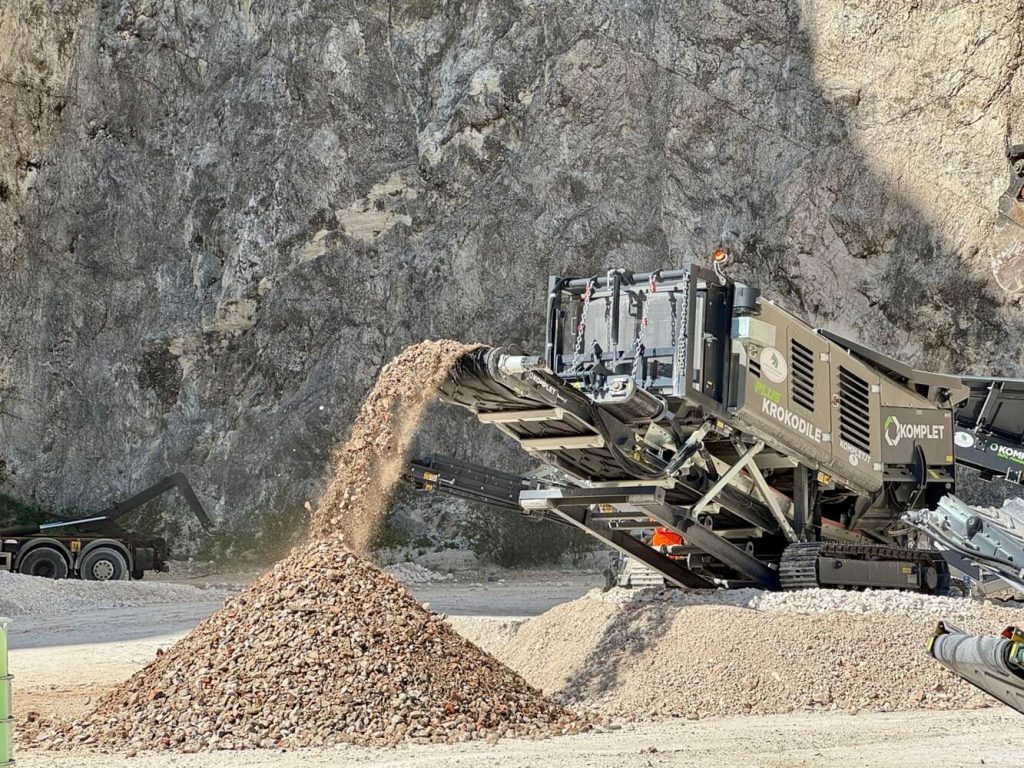
Wood framing (clean and treated), drywall, plastics, insulation, roofing material, and general C&D waste from damaged structures. The Krokodile PLUS slow-speed shredder with the wood / lightweight waste shaft handles this fraction at up to 19 US tph on mixed waste. Significant volume reduction for landfill-bound waste; recoverable wood goes to mulch or biomass markets.
Vegetative Debris
Trees, branches, palm fronds, and yard waste from storms — typically a large fraction of hurricane and tornado debris in particular. Vegetative debris processing is typically handled by tub grinders or horizontal grinders rather than slow-speed shredders, though the K-TS 30 and K-TS 40 trommel screeners can produce sized mulch and finished compost from already-shredded vegetative material.
Soil and Sediment
Flooding events deposit soil and sediment that needs to be moved, screened, and either disposed of or restored to use. K-TS trommel screeners handle damp and cohesive material that vibrating screens cannot, separating screened soil from rocks, debris, and oversize material.
Hazardous and Specialty Waste
Disaster debris may include hazardous materials (white goods with refrigerants, asbestos, lead-painted material, fuel and chemical contamination) that require specialized handling outside the scope of standard mineral or wood waste processing. Komplet equipment is engineered for standard mineral and C&D waste streams, not for hazardous waste processing. Hazardous fractions must be separated and handled by appropriately permitted specialty contractors before any standard processing occurs.
Why Compact Mobile Equipment Fits Disaster Debris Work
Disaster debris management presents specific operational challenges that compact mobile equipment is engineered for:
Transport Flexibility to Affected Areas
Disaster zones often have damaged or restricted infrastructure — closed bridges, weight-restricted roads, debris-blocked routes, fuel and freight constraints. Equipment that travels under standard trailer rules with standard work trucks reaches affected areas without the permit-and-escort logistics of heavy-haul equipment. The K-JC 503 mini jaw crusher (7,496 lb) and K-TC 460 tracked mobile conveyor (7,000 lb) both tow behind standard pickups; the larger Komplet machines transport on standard heavy-duty trailers.
Fast Setup at Temporary Debris Management Sites
FEMA-style temporary debris management sites (TDMS) are typically stood up quickly on staging areas — parking lots, undeveloped land, fairgrounds — that have no permanent infrastructure. Tracked, self-propelled equipment that walks itself off a trailer and into position by wireless remote sets up in hours rather than days. Komplet jaw crushers, screeners, the Krokodile PLUS, and the K-TC 460 are all engineered for this fast-setup deployment model.
Single-Operator Workflows for Stretched Crews
Disaster recovery typically pulls operators and equipment from across a region; experienced crews are stretched thin across multiple jobsites and projects. Wireless remote operation across the Komplet lineup lets a single operator coordinate a complete processing spread (crusher, conveyor, screener) from one position. For municipal yards and contractors operating with reduced crew availability, that single-operator capability is the difference between running the equipment and idling it.
Standard Dust Suppression on Crushers and the Krokodile PLUS
Affected residents living near temporary debris management sites or active processing zones are entitled to reasonable air-quality protection during recovery work. Factory-integrated water-spray dust suppression — standard on every Komplet crusher (K-JC 503, K-JC 604, K-JC 704 PLUS, K-JC 805, K-IC 70) and on the Krokodile PLUS slow-speed shredder — controls fugitive dust at the source. (Note: standard dust suppression is not included on Komplet screeners or the K-TC 460 conveyor; site-level controls supplement these where local conditions warrant.) For OSHA silica compliance and neighbor air-quality management during disaster work, source-level dust suppression is one of the most leveraged engineering controls available.
Material-Stream Variety from One Equipment Set
Disaster debris is heterogeneous. The same operation may handle concrete, asphalt, brick, mixed C&D, and damaged-wood waste in the same week. The Krokodile PLUS slow-speed shredder’s quick-change shaft system handles both the C&D / asphalt fraction (175 US tph on concrete, asphalt, brick, block, rubble) and the wood / lightweight waste fraction (19 US tph on wood, drywall, plastics, garbage, mixed waste). Combined with a Komplet jaw crusher for primary mineral reduction and a Kompatto screener for product cuts, a small equipment fleet handles the variety of material streams disaster debris actually presents.
The Komplet Lineup in the Debris Management Context
Specific Komplet machines, sized for the typical debris-management deployment:
K-JC 704 PLUS Portable Jaw Crusher
- Production: up to 90 US tph
- Jaw opening: 27″ × 16″; recommended max feed size approximately 12-3/4″
- Engine: 74 hp Tier 4 Final diesel
- Standard dust suppression, Komplet Connect remote monitoring, wireless remote operation
- Komplet’s best-selling crusher; the standard size for contractor- and municipal-yard-scale debris management
K-JC 805 Mobile Jaw Crusher
- Production: up to 160 US tph
- Jaw opening: 31″ × 21″; recommended max feed size approximately 16-3/4″
- Engine: 130 hp Tier 4 Final diesel
- The largest jaw in the Komplet lineup; appropriate for high-volume regional debris management at temporary debris management sites
K-JC 503 and K-JC 604 Compact Jaw Crushers
For smaller-scale recovery operations or for contractors deploying to specific project sites within a recovery zone, the K-JC 503 mini jaw crusher (up to 34 US tph, 7,496 lb pickup-towable transport weight) and K-JC 604 mobile jaw crusher (up to 55 US tph) provide compact and portable options for tight-access work or smaller jurisdictions.
K-IC 70 Compact Impact Crusher
The K-IC 70 compact impact crusher (up to 90 US tph) produces cubical-shape recycled aggregate suited for hot-mix asphalt and concrete batch plant feed — relevant when the recovery effort includes infrastructure restoration that will consume large volumes of recycled material in spec-graded applications.
Krokodile PLUS Slow-Speed Shredder
- C&D / asphalt shaft: up to 175 US tph for concrete, asphalt, brick, block, rubble
- Wood / lightweight waste shaft: up to 19 US tph for wood, drywall, plastics, garbage, mixed waste, green compost
- 220 hp Volvo Penta Tier 4 Final, standard dust suppression, Komplet Connect remote monitoring
- The most-versatile single piece of equipment for debris work spanning multiple waste streams
Kompatto Vibrating Screeners and K-TS Trommels
Vibrating Kompatto screeners (Kompatto 221 at 90 tph, Kompatto 5030 at 280 tph, Kompatto 124 at 350 tph) separate crushed mineral debris into spec-graded recycled aggregate cuts. K-TS 30 and K-TS 40 trommels handle damp and cohesive material — flood sediment, screened topsoil from staging areas, and finished compost from vegetative debris — that vibrating screens cannot process.
K-TC 460 Tracked Mobile Conveyor
The K-TC 460 tracked mobile conveyor (up to 132 US tph, 15-foot pile height, 7,000 lb pickup-towable transport weight) clears crusher and screener discharge to stockpiles, eliminating the dedicated loader cycles that would otherwise be required and reducing crew headcount needs in stretched-crew recovery operations.
A Typical Disaster Debris Management Workflow
On a temporary debris management site or contractor staging area, a typical processing workflow:
Step 1: Material Sorting
Inbound debris is sorted by material stream — mineral fraction (concrete, asphalt, brick, masonry), wood and mixed C&D, vegetative debris, soil and sediment, hazardous and specialty waste. Hazardous fractions go to permitted specialty contractors. Standard fractions move to processing.
Step 2: Primary Reduction
Mineral material to a Komplet jaw crusher (or K-IC 70 impact crusher for cubical aggregate output). Mixed C&D and oversized concrete to the Krokodile PLUS slow-speed shredder with the appropriate shaft configuration. Vegetative debris typically to a tub grinder or horizontal grinder operated by a separate contractor (outside the Komplet equipment scope).
Step 3: Screening to Product Cuts
Crushed mineral output to a Kompatto vibrating screener for product cuts (2-inch minus, 3/4-inch minus, oversize for return). Soil and sediment streams to a K-TS trommel for screened-soil product cuts. Already-shredded vegetative material to a K-TS trommel for sized mulch products.
Step 4: Stockpile Management
K-TC 460 tracked mobile conveyors move screened products to stockpiles, with separate stockpiles for separate product cuts. Single-operator wireless control lets the conveyor be redeployed across the site to clear different machines at different times.
Step 5: End Use
Recycled concrete aggregate (RCA) goes to road base, drainage, fill, and infrastructure restoration projects within the recovery zone — often as a key input to post-disaster construction. Mulch and finished compost go to landscape supply, erosion control, and revegetation work. Mixed C&D shred goes to volume-reduced disposal at remaining-capacity landfills. Hazardous fractions go to permitted disposal under separate workflows.
This workflow is the mechanical core of post-disaster debris management. The contractors, municipal yards, and debris management firms operating it are the technical infrastructure of recovery.
Honest Framing: What Compact Crushing Equipment Doesn’t Do
Equipment marketing in disaster contexts has a tendency toward hyperbole. Honest framing matters more in this context than most. Three points to be clear about:
- Compact crushing equipment is not emergency response equipment. Search and rescue, medical response, evacuation, fire suppression, and life-safety operations are the responsibility of dedicated emergency response services. Crushing, screening, and shredding equipment fits the recovery phase that follows life-safety operations — not the immediate emergency phase. Equipment companies should not represent their equipment as life-saving in disaster contexts.
- Compact mobile equipment is not a complete debris management system by itself. FEMA-style debris management requires planning, contracting, permitting, environmental review, hazardous-fraction separation, and documentation — most of which the equipment doesn’t address. The equipment processes the material once the broader management system has staged it. Jurisdictions and contractors should plan accordingly, not assume equipment alone solves the management problem.
- Komplet equipment is engineered for standard C&D waste streams. Hazardous materials, asbestos, lead-contaminated material, refrigerants, fuel-contaminated soil, and other specialty waste must be handled by appropriately permitted specialty contractors before any standard processing. Forcing hazardous fractions through compact mobile crushers creates regulatory, environmental, and worker-safety problems the equipment is not designed to address.
Within its actual scope — compact mobile processing of standard C&D, mineral, and wood waste streams in the recovery phase of disaster response — Komplet equipment supports the work that contractors and municipal yards do every day, including in recovery contexts. Outside that scope, the right answer is appropriate professional resources, not stretching equipment past its design envelope.
Frequently Asked Questions
Is compact crushing equipment suitable for disaster debris management?
Yes — for the standard C&D, mineral, and wood waste streams that most disaster debris contains, compact mobile crushers, screeners, shredders, and conveyors are engineered for the work. The equipment fits because of transport flexibility (towable behind work trucks), fast setup at temporary debris management sites, single-operator wireless control that helps stretched crews, and material-stream variety (especially the Krokodile PLUS slow-speed shredder’s quick-change shaft system). The equipment is for the recovery phase that follows life-safety operations, not for the immediate emergency response phase.
What kinds of disaster debris can compact crushers process?
Concrete (with or without rebar), asphalt, brick, masonry block, and natural stone in the standard mineral C&D fraction. Mixed C&D waste (wood, drywall, plastics, garbage, mixed waste) goes through the Krokodile PLUS slow-speed shredder with the wood / lightweight waste shaft. Damp soil, sediment, and finished compost go through K-TS trommel screeners. Hazardous, asbestos-containing, lead-contaminated, refrigerant-bearing, or other specialty waste streams must be separated and handled by appropriately permitted specialty contractors before any standard processing.
How quickly can compact crushing equipment be set up at a temporary debris management site?
Tracked, self-propelled Komplet equipment is engineered for fast setup. Most units are operational within hours of arriving at a new site — walking off the trailer and into position by wireless remote, without requiring a second machine to position them. The actual deployment timeline depends on transport distance, infrastructure conditions in the affected area, and site-preparation requirements at the temporary debris management site.
Does Komplet equipment include dust suppression for disaster recovery work?
Standard dust suppression is included on every Komplet crusher (K-JC 503, K-JC 604, K-JC 704 PLUS, K-JC 805, K-IC 70) and on the Krokodile PLUS slow-speed shredder. It is not standard on Komplet screeners (Kompatto 221, 5030, 124, K-TS 30, K-TS 40) or the K-TC 460 conveyor. For neighbor air-quality protection at temporary debris management sites near affected residential areas, source-level dust suppression on the crushing and shredding equipment is one of the most leveraged engineering controls available; site-level controls (water trucks, perimeter misting) supplement the equipment.
Where does processed disaster debris end up?
Recycled concrete aggregate (RCA) goes to road base, drainage, fill, and infrastructure restoration projects within the recovery zone — often as a direct input to post-disaster construction. Sized mulch and finished compost go to landscape supply, erosion control, and revegetation work. Mixed C&D shred goes to volume-reduced disposal at remaining-capacity landfills. Hazardous fractions go to permitted disposal under separate workflows. The specific end uses for any specific debris stream depend on local material specifications, regulatory acceptance, and project requirements.
What is FEMA’s role in disaster debris management?
The Federal Emergency Management Agency (FEMA) recognizes debris management as a distinct disaster recovery function and publishes guidance on debris management planning, including the use of temporary debris management sites (TDMS), debris monitoring, debris contractor selection, and reimbursement programs through the Public Assistance program. State and local jurisdictions typically lead actual debris management operations under FEMA-recognized frameworks. Komplet America does not provide FEMA debris management consulting; jurisdictions and contractors should consult FEMA’s published guidance and qualified disaster-recovery professionals for project-specific planning.
Can municipal yards rent or purchase Komplet equipment for disaster preparedness?
Yes. Municipal yards, public works departments, and debris management contractors can purchase new Komplet equipment, purchase certified pre-owned units (typically 40 to 70 percent capital savings versus new), or rent through the authorized Komplet dealer network. Note that Komplet America does not rent directly to end-users; rentals are handled through the dealer network. For municipal disaster preparedness planning, Komplet Capital offers financing options that may align with municipal capital budgeting cycles.
How does equipment financing work for disaster preparedness purchases?
Komplet Capital offers 100 percent financing on new and pre-owned equipment with 24-hour approvals and 36/48/60/72-month term options. Section 179 tax deduction may apply for qualifying purchases by private contractors. Municipal entities typically have separate procurement and capital budgeting processes; consult your finance department on appropriate financing structures for municipal acquisitions.
Final Thoughts
Disaster recovery is hard, slow, and important work. The contractors and municipal yards that handle debris management in the months and years after a major event — under stretched conditions, with constrained resources, often in coordination with state and federal frameworks — are the technical infrastructure of recovery. Compact mobile crushing, screening, and shredding equipment is part of that infrastructure when matched honestly to the material streams it can handle, used safely under appropriate planning and permitting, and deployed alongside the broader workflow that disaster debris management requires.
Komplet equipment fits this work because it’s engineered for the operational profile that recovery demands: transport flexibility, fast setup, single-operator workflows, standard dust suppression on the crushing and shredding equipment, and material-stream variety across the lineup. The right answer for any specific recovery deployment depends on the actual material conditions, the actual site logistics, and the actual planning framework — not on equipment marketing. Contractors, municipal officials, and emergency-management professionals should consult FEMA’s published guidance and qualified disaster-recovery professionals for project-specific planning.
Komplet America builds compact crushers, screeners, the Krokodile PLUS slow-speed shredder, and the K-TC 460 tracked mobile conveyor for contractors who need real production in tight footprints — including the recovery and debris management work that follows natural disasters. To see the full lineup, explore the crusher, screener, shredder, and conveyor categories. To talk financing or pricing, contact Komplet Capital, visit the contact page, or call (908) 369-3340.
Ready to talk debris management equipment?
- Browse the full Komplet equipment lineup — crushers, screeners, the Krokodile PLUS shredder, and the K-TC 460 conveyor.
- Talk to Komplet Capital about 100 percent financing, 24-hour approvals, and Section 179 tax deduction eligibility.
- Save 40–70 percent with certified pre-owned Komplet equipment — verified history, OEM parts support.
- Find your local Komplet dealer for rental availability or pre-purchase inspection.
- Consult FEMA’s debris management guidance and qualified disaster-recovery professionals for project-specific planning before deploying equipment in any disaster recovery context.
Never enough.
Disclaimer: All operating, maintenance, and service guidance in this article is general in nature. Always refer to the official Komplet operator’s manual for the specific machine model and serial number, and follow OEM intervals and procedures. For warranty-protected work, contact Komplet America at (908) 369-3340 or your authorized Komplet dealer. Improper service or non-OEM parts may void warranty coverage and create safety hazards.
Disclaimer: This article provides general information about the role of compact mobile crushing equipment in disaster debris management. It is not legal, regulatory, or disaster-recovery advice. Disaster recovery is governed by federal, state, and local regulations; FEMA frameworks for Public Assistance, debris monitoring, and temporary debris management sites; permitting and environmental review requirements; and contractor licensing and bonding rules. Hazardous materials handling is subject to additional federal and state regulations. Jurisdictions and contractors should consult FEMA’s published guidance, state and local emergency management authorities, qualified environmental engineers, and qualified disaster-recovery professionals for project-specific planning. Komplet America does not represent that any specific equipment configuration or operating practice will achieve compliance with any specific regulatory or programmatic requirement.
Disclaimer: Production figures (“up to” tph), feed size recommendations, dust suppression coverage, and equipment specifications described above are general guidance based on current Komplet product configurations. Actual production rates depend on material composition, operator efficiency, and feed conditions; “up to” production figures describe best-case throughput on optimal feed material. Disaster debris is heterogeneous and unpredictable; actual processing rates in disaster contexts may vary substantially from nominal figures. Komplet America makes no guarantee of specific production rates, processing volumes, or financial outcomes in any specific disaster recovery context.
Equipment prices are subject to change based on dealer location, availability, and any additional features or customizations. Prices do not include taxes, shipping, or installation fees, which may apply depending on your region. Contact Komplet America at (908) 369-3340 or visit kompletamerica.com for current pricing.