
Contractors who move a lot of material eventually ask the same question: instead of hauling rubble off and buying aggregate back, what would it cost to just produce the material myself? It is the right question — on-site production can be dramatically cheaper for the right operation — but it only pays off if you go in with a clear-eyed number for what production actually costs per ton. This guide builds that number from the ground up, line by line, so you can run the buy-versus-produce comparison against real figures rather than a sales pitch.
There is no single universal cost per ton, because it depends on your machine, your material, and how heavily you run the equipment. But the components are always the same, and once you understand each one you can build an estimate specific to your operation. As a working planning figure, on-site aggregate production commonly lands somewhere in the range of $5 to $15 or more per ton in operating cost — but that range is wide for good reasons, and this article explains what pushes you toward the low end or the high end.
This is a contractor-facing analysis. If you are evaluating whether compact crushing equipment makes sense for your business, understanding the cost model is step one; matching a machine to your volume is step two. Komplet America distributes the compact crushers and screeners that make on-site production practical, and the cost structure below applies directly to that class of equipment.
Two Kinds of Cost: Fixed and Operating
Before breaking down the per-ton number, it helps to separate two categories that behave very differently. Getting these confused is the most common mistake in a produce-versus-buy analysis.
Fixed Costs
Fixed costs are what you pay to own the machine regardless of how much you run it — the purchase price, or if financed, the monthly payment. These costs are spread across every ton you produce. The critical implication: fixed cost per ton is entirely a function of utilization. Produce a lot of tons and the fixed cost per ton is small; produce a few and it is large. This is why the same machine can be wildly economical for one contractor and a money-loser for another.
Operating Costs
Operating costs are what you pay each time the machine runs — fuel, wear parts, maintenance, labor. These scale with tonnage: double the production and you roughly double these costs. Operating cost per ton is relatively stable regardless of how much you produce, which makes it the cleaner number to estimate and the one most people mean when they ask “what does it cost per ton.”
Your true all-in cost per ton is fixed cost per ton plus operating cost per ton. The rest of this article breaks down the operating side in detail, then shows how to layer the fixed side on top for your specific situation.
The Operating Cost Stack, Line by Line
Every honest per-ton figure is the sum of these components. No responsible analysis leaves any of them out or claims on-site crushing is “free” — a machine that runs consumes real inputs. Here is the full stack.
1. Diesel Fuel
Fuel is almost always the largest single operating cost. Compact crushers run Tier 4 Final diesel engines, and consumption scales with how hard the machine works — a crusher chewing through dense, hard concrete burns more than one processing softer material, and higher production rates burn more per hour but often less per ton. Fuel price is also the most volatile input, so a fuel-cost estimate built on today’s price may not hold six months out. When you build your own number, use current local diesel pricing and your machine’s rated consumption as the starting point.
2. DEF and Emissions-System Maintenance
Tier 4 Final engines meet emissions standards using diesel exhaust fluid (DEF) and a diesel particulate filter (DPF). DEF is an ongoing consumable — you top it up as you run — and the DPF requires periodic maintenance and eventual service. These are real, recurring costs that are easy to forget when estimating, but they belong in the stack. They are modest relative to fuel, but they are not zero.
3. Wear Parts
Wear parts are the components that physically contact and reduce the material, and they wear out on a cycle driven by tonnage and material abrasiveness. This is the cost line that varies most with what you are crushing:
- Jaw plates (jaw crushers). On a jaw crusher, the jaw plates are the primary wear item. Abrasive material — hard rock, heavily reinforced concrete — wears them faster; cleaner, softer material stretches their life. Replacement is a scheduled event, and the cost per ton depends on how many tons a set lasts.
- Blow bars (impact crushers). On an impact crusher such as the K-IC 70, the equivalent wear parts are blow bars. Impact crushers produce a more cubical, spec-friendly product but tend to consume wear parts faster on abrasive material, which is why jaw crushers are often the better first-stage choice on heavily reinforced or abrasive concrete.
- Screens, belts, and other components. If you run a screener, screen media wears and gets replaced on its own cycle. Conveyor belts, bearings, and other high-wear components add incrementally to the stack.
Wear-part economics are worth studying closely because they are the line most contractors underestimate. Budgeting a realistic wear-part cost per ton — based on your material’s abrasiveness and your machine’s part life — is essential to an accurate estimate. Komplet stocks jaw plates, blow bars, belts, screens, and other critical wear parts for all current models through parts and support, which also helps you plan replacement intervals.
4. Routine Maintenance
Beyond wear parts, the machine needs scheduled service: filters, fluids, greasing, and inspections at the intervals the manufacturer specifies. This is not optional and it is not a place to economize — deferred maintenance shortens machine life, risks unplanned downtime, and can jeopardize warranty coverage. Build routine maintenance into your per-ton number as a standing cost, and always follow the OEM interval for your specific model and serial number.
5. Operator Labor
A trained operator runs the machine, and their time is a real cost per ton. This is an area where compact equipment has a structural advantage: Komplet crushers are designed for single-operator use with full wireless remote control, so one person can feed, monitor, and reposition the machine. Equipment that requires a larger crew carries proportionally higher labor cost per ton. Still, even single-operator labor is a genuine line in the stack, and it scales with the hours the machine runs.
What Pushes You to the Low End or the High End
The $5 to $15 or more per ton range is wide because a handful of variables move the number substantially. Understanding them lets you predict where your operation will land:
Factor | Pushes Cost DOWN | Pushes Cost UP |
Material hardness | Softer concrete, less abrasive | Hard rock, heavily reinforced concrete |
Production rate | Running at rated capacity | Frequent stops, underfeeding |
Wear-part life | Clean, consistent feed material | Abrasive or contaminated material |
Operator skill | Experienced, efficient operator | Untrained, inconsistent operation |
Maintenance discipline | On-schedule OEM service | Deferred maintenance, breakdowns |
Fuel price | Lower local diesel cost | Higher local diesel cost |
The pattern is clear: consistent, disciplined operation on reasonable material lands you toward the low end, while abrasive material run inconsistently by an untrained operator with deferred maintenance lands you at the high end — or beyond it. Much of the per-ton cost is within your control.
How Production Cost Changes by Material
The same crusher costs a different amount per ton depending on what you feed it, because material properties drive fuel burn and wear-part life — the two most variable lines in the stack. Knowing where your material falls helps you predict your number:
Recycled Concrete
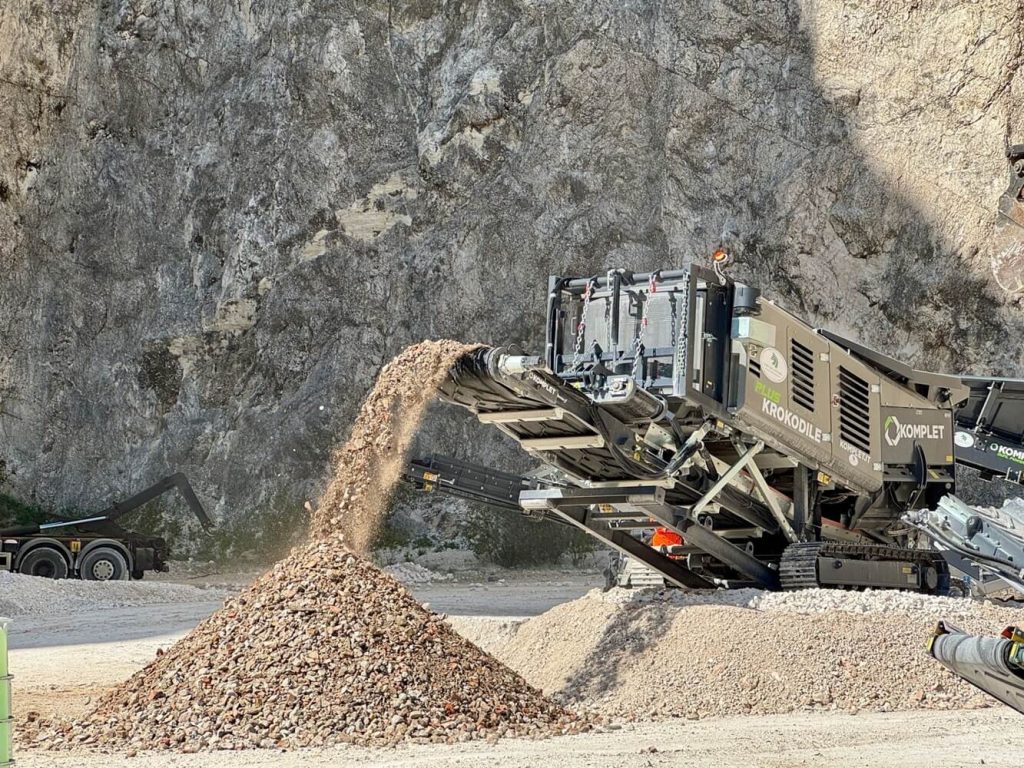
The bread-and-butter feedstock for most compact-crusher owners. Clean demolition concrete without heavy reinforcement is relatively kind to wear parts and lands toward the lower-to-middle of the cost range. Heavily reinforced concrete is harder on the machine — the rebar itself is separated magnetically, but dense, high-strength concrete wears jaw plates faster and burns more fuel. Contamination (dirt, wood, asphalt mixed in) can also slow production and raise cost.
Natural Rock and Bedrock
Hard virgin rock is the most demanding material for wear and fuel. Abrasive stone wears jaw plates faster than concrete does, pushing the wear-part line up and the whole per-ton cost toward the high end. Compact crushers handle rock, but the economics differ from recycling concrete, and material hardness should be factored realistically into any rock-crushing cost estimate.
Asphalt and RAP
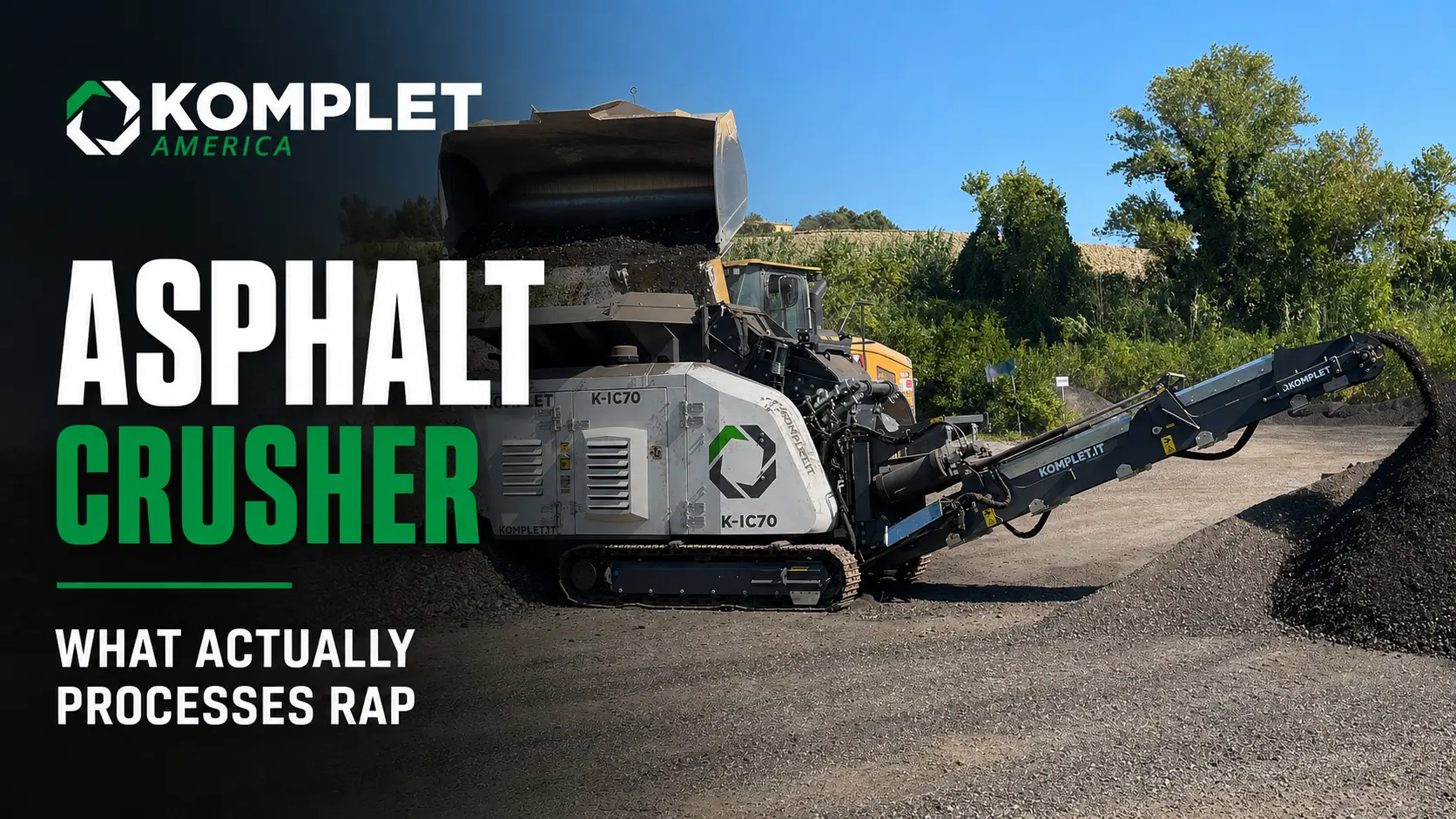
Reclaimed asphalt pavement (RAP) behaves differently again. It is generally less abrasive than hard rock, but it can be sticky in warm conditions. For producing a fine, cubical RAP product suitable for reincorporation, an impact crusher such as the K-IC 70 is often the right tool — it is specifically suited to reducing RAP to fine material and to producing DOT-spec cubical aggregate. The wear-part profile of an impact crusher differs from a jaw, so the cost stack shifts accordingly.
The point across all three: there is no single “cost to crush” — there is a cost to crush your material, and material hardness and abrasiveness are the biggest swing factors. Estimate wear-part life against your actual feedstock, not a generic assumption.
Layering In the Fixed Cost: The Utilization Question
Operating cost is only part of your all-in number. To get the full picture, you layer the fixed cost — the purchase or financing payment — spread across your annual tonnage. And this is where the produce-versus-buy decision is really made.
Consider the same machine at two very different utilization levels. A contractor who runs it across a heavy, steady stream of demolition and site work processes a large annual tonnage, so the fixed payment divides across many tons and the fixed cost per ton shrinks toward the marginal operating cost. A contractor who runs it on a handful of small jobs processes far fewer tons, so the same fixed payment lands heavily on each one and the all-in cost per ton can climb well above what buying material would have cost.
This is the single most important insight in the entire buy-versus-produce analysis: the machine’s economics live or die on utilization. Before committing to equipment, the honest questions are how many tons you will realistically process per year and for how many years — because those two numbers determine whether the fixed cost per ton is trivial or crushing.
The Break-Even Against Buying
On-site production makes financial sense when your all-in cost per ton (fixed plus operating) comes in below what it costs to buy and deliver equivalent material — and, for contractors generating rubble, when it also lets you avoid hauling and tipping fees on the material you would otherwise dispose of. We work through the full four-way savings picture in our companion guide on crushed concrete cost per ton. The headline: for a recurring-volume contractor who generates rubble, on-site production frequently wins by a wide margin. For an occasional user with little rubble, buying delivered material usually wins.
The Value That Doesn’t Show Up in Cost Per Ton
A pure cost-per-ton comparison captures the money, but it misses several real advantages of on-site production that also belong in the decision. These do not reduce your per-ton number, but they add value that a spreadsheet comparing dollars alone will undercount:
- Schedule control. When you produce your own material, you are not waiting on a supplier’s delivery window or a truck that is running late. The base you need is stockpiled on-site, ready when the crew is. On a tight schedule, that independence has real value.
- No haul-off logistics. Every load of rubble that leaves a jobsite is a truck to schedule, a route to manage, and a disposal site to coordinate with. Crushing on-site eliminates that entire logistical burden, which frees up management attention as well as money.
- Reduced site congestion and disruption. Fewer trucks in and out means less traffic disruption, less wear on access roads, and a quieter footprint — which matters on urban and constrained sites where truck access is difficult in the first place.
- Sustainability and diversion. Producing recycled aggregate on-site diverts material from landfill and reduces demand for newly quarried stone. For contractors bidding work with green requirements, or municipalities with diversion targets, that has value beyond the direct cost savings.
- A new revenue line. Some contractors who invest in crushing equipment go a step further and sell surplus recycled aggregate to others, turning a cost center into a profit center. That possibility does not factor into a buy-versus-produce comparison at all, but it is a real upside for the right operation.
None of these change the per-ton math directly, but they tilt the decision toward production for operations where schedule certainty, site constraints, or sustainability commitments carry weight. Weigh them alongside the cost comparison rather than instead of it.
Matching the Machine to Your Volume
Because utilization drives everything, choosing a machine sized to your actual throughput matters. Too small and you bottleneck; too large and you carry fixed cost you cannot fill. Komplet’s compact crusher lineup spans a range of production capacities:
Model | Production | Best Fit |
K-JC 503 Mini Jaw | up to 34 US tph | Lowest volume; smallest footprint; pulls behind a pickup |
K-JC 604 Mobile Jaw | up to 55 US tph | Mid volume; larger jaw, low operating cost |
K-JC 704 PLUS Portable Jaw | up to 90 US tph | Best-selling; higher volume, yard and recycling operations |
K-JC 805 Mobile Jaw | up to 160 US tph | Largest jaw; semi-pro; pre-processor for screening |
K-IC 70 Compact Impact | up to 90 US tph | Cubical spec product; ideal for RAP and DOT-spec material |
Magnetic separation is standard across the crusher line for rebar removal — the extraction hardware itself varies by model, from a magnetic roller on the smallest machine to hydraulically adjustable crossband belts on the larger ones — and all models run on rubber tracks with wireless remote control. The best-selling K-JC 704 PLUS hits the sweet spot for many recurring-volume contractors, while the K-JC 503 serves the smallest operations and the K-JC 805 handles the highest throughput. If your product needs to hit a specific grade, pairing a crusher with a screener sorts the output into clean size fractions rather than a single mixed pile.
Financing Against the Savings
The way most contractors bridge the fixed cost is financing. Komplet Capital offers 36- to 72-month terms with 100% financing available and fast approval, so the practical test becomes whether the monthly payment is less than the monthly savings the machine generates. See the equipment financing page for options — and qualified equipment purchases may also be eligible for Section 179 tax treatment, which can improve the first-year economics. A pre-owned machine is another route to a lower fixed cost and a faster payback.
Frequently Asked Questions
How much does it cost to produce aggregate on-site?
As a realistic planning figure, on-site aggregate production commonly runs $5 to $15 or more per ton in operating cost — fuel, DEF and filter maintenance, wear parts, routine maintenance, and operator labor. Your all-in cost also includes the fixed cost of the equipment spread across your annual tonnage, which depends heavily on how much you produce.
What is the biggest cost in running a crusher?
Diesel fuel is almost always the largest single operating cost, followed by wear parts (jaw plates on a jaw crusher, blow bars on an impact crusher). Fuel scales with how hard and how long the machine runs, and it is the most volatile input because diesel prices move.
Why is the cost-per-ton range so wide?
Because several variables move it substantially: material hardness and abrasiveness, production rate, wear-part life, operator skill, maintenance discipline, and local fuel price. Consistent, disciplined operation on reasonable material lands you toward the low end; abrasive material run inconsistently lands you at the high end.
Does utilization really matter that much?
Yes — it is the single biggest factor in whether on-site production pays. The fixed cost of the equipment is spread across every ton you produce, so high annual tonnage drives the fixed cost per ton toward the marginal operating cost, while low tonnage leaves the fixed cost landing heavily on each ton. The buy-versus-produce decision is essentially a utilization decision.
Is it cheaper to produce aggregate or buy it?
It depends on utilization and whether you generate rubble. For a contractor who processes steady volume and generates concrete rubble, on-site production frequently wins because it also avoids hauling and tipping fees. For an occasional user with little rubble, buying delivered material usually wins. The dividing line is recurring volume, not company size.
What wear parts does a crusher need and how often?
Jaw crushers wear jaw plates; impact crushers wear blow bars. Replacement frequency is driven by tonnage and material abrasiveness — harder, more reinforced material wears parts faster. Screens and belts wear on their own cycles if you run a screener or conveyor. Budgeting realistic wear-part life for your specific material is essential to an accurate cost estimate.
Can one person run a compact crusher?
Yes. Komplet compact crushers are designed for single-operator use with full wireless remote control, so one trained person can feed, monitor, and reposition the machine. This keeps operator labor cost per ton lower than equipment that requires a larger crew.
How do I estimate the cost for my specific operation?
Start with the operating cost stack — current local diesel price and your machine’s rated consumption for fuel, realistic wear-part life for your material, DEF and maintenance costs, and operator labor. Add the fixed cost (purchase or financing payment) divided by your realistic annual tonnage. The sum is your all-in cost per ton, which you then compare against the delivered cost of buying equivalent material.
Final Thoughts
Producing your own aggregate is not free, and any analysis that pretends otherwise is doing you a disservice. The honest number — commonly $5 to $15 or more per ton in operating cost, plus a fixed cost that depends entirely on how much you produce — is what you should carry into the decision. But for the right operation, that honest number is still well below the cost of hauling rubble off, paying to dispose of it, and buying finished aggregate back. The whole calculation turns on utilization: run the machine hard across steady volume and the economics are compelling; run it occasionally and they are not. Build your own per-ton estimate from the components in this guide, compare it honestly against what buying costs, and let the numbers make the decision.
Komplet America distributes the compact crushers and screeners that make on-site aggregate production practical — sized from the K-JC 503 for the smallest operations up to the high-throughput K-JC 805. If you are trying to work out whether producing your own aggregate beats buying it, talk through your material volume and jobsite mix with the team at 908-369-3340, or contact Komplet America.
Ready to Run Your Own Numbers?
- Explore the compact crusher lineup to match a machine to your realistic annual tonnage.
- Review equipment financing options and test whether the monthly payment beats your monthly savings.
- Consider a pre-owned machine to lower the fixed cost and shorten the payback.
- Check parts and support to budget wear-part and maintenance costs accurately.
- Find your local Komplet dealer for demo scheduling and rental availability.
Never enough.
Disclaimer: Any ROI figures, payback timelines, cost-per-ton estimates, or dollar-amount savings shown above are illustrative examples only. Actual results depend on jobsite material composition, machine selection, local fuel and labor costs, wear-part life, equipment utilization, financing terms, regional regulatory requirements, and operator efficiency. Komplet America makes no guarantee of specific financial returns. Customers should perform their own analysis based on local market conditions before making purchase decisions.
Disclaimer: All operating, maintenance, and service guidance in this article is general in nature. Always refer to the official Komplet operator’s manual for the specific machine model and serial number, and follow OEM intervals and procedures. For warranty-protected work, contact Komplet America at 908-369-3340 or your authorized Komplet dealer. Improper service or non-OEM parts may void warranty coverage and create safety hazards.