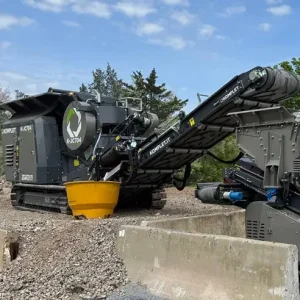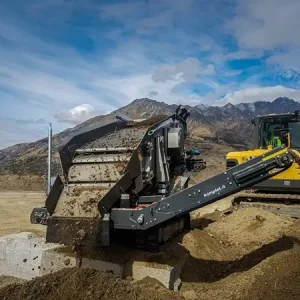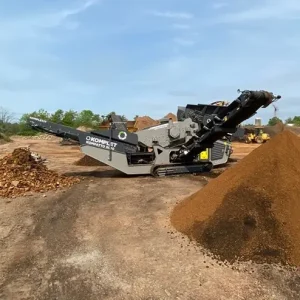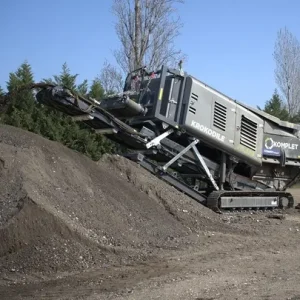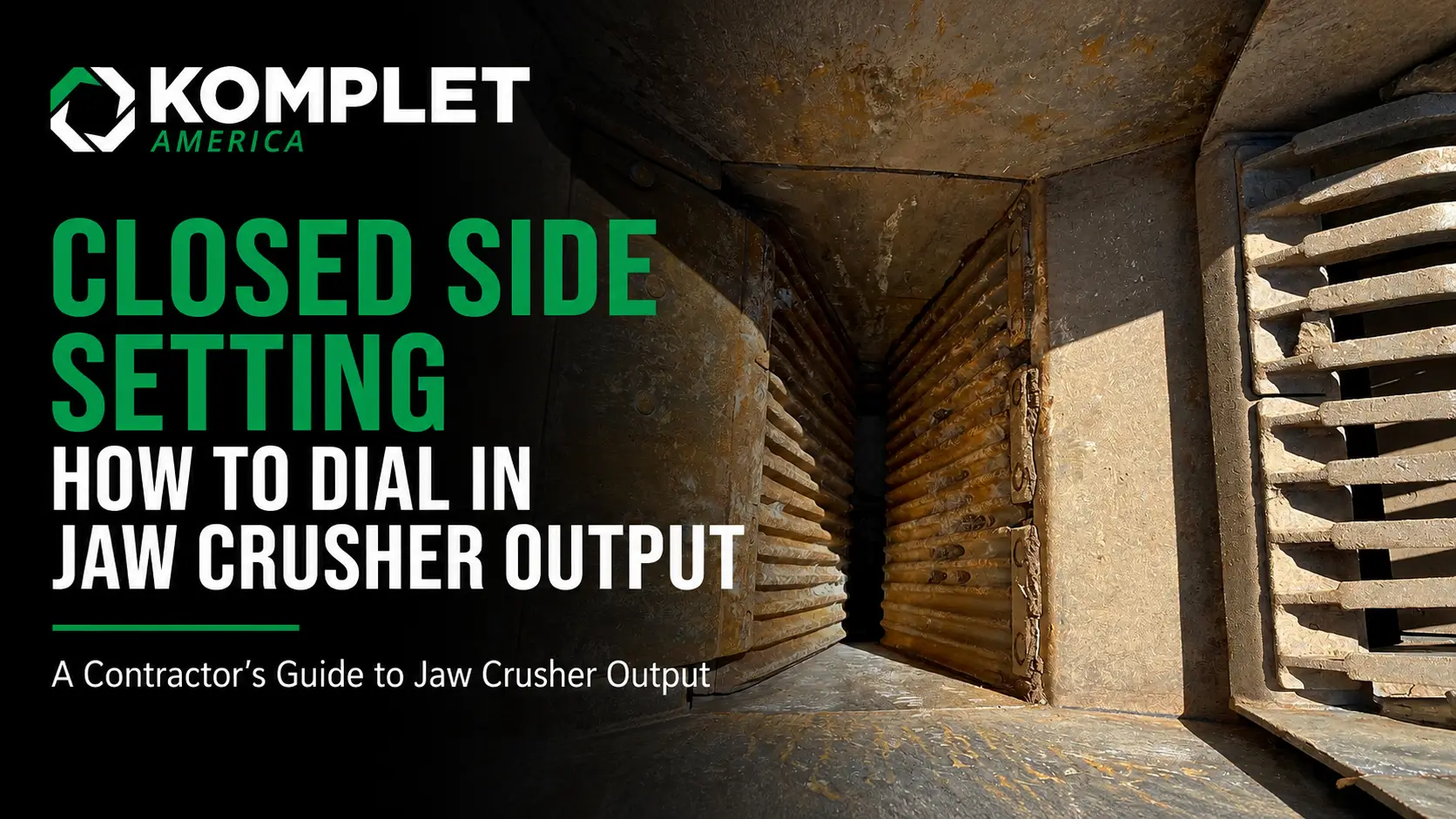

Every jaw crusher on a jobsite has one control that matters more than any other. It is not the feed rate, the track speed, or the conveyor angle. It is the closed side setting, and it decides two things at once: the size of the material coming off the discharge belt and how much of it you make in a shift.
Most operators learn the setting by feel. They run a pile, look at the stockpile, tighten or open the jaw, and run it again. That works, and there is nothing wrong with an operator who knows the machine that well. What it does not do is transfer. When a new operator steps on, when the material changes from clean concrete to reinforced footings to millings, or when a customer shows up with a spec sheet instead of a general idea, guesswork gets expensive fast.
This article covers what closed side setting is mechanically, why the product coming off the belt is always a range of sizes rather than a single number, and how to work backward from the product you have to sell or place to the setting that gets you there. It is written for contractors, recyclers and yard operators running compact crushers, not for plant engineers designing fixed circuits.
Refer to the operator’s manual prior to operating any Komplet machinery. Setting adjustment procedures, safe access points and lockout steps differ by model and by serial number, and the manual for your specific machine governs.
What Closed Side Setting Actually Is
A single-toggle jaw crusher has two crushing surfaces: a fixed jaw plate and a swing jaw plate. The swing jaw does not swing like a gate. It moves through a small elliptical path driven by an eccentric shaft, closing against the fixed jaw and opening again, many times per second. Material entering at the top gets squeezed, fractured, and drops a little lower in the chamber on each open stroke until it passes out the bottom.
The gap at the bottom of that chamber is what you are adjusting when you change the setting. Because the swing jaw is always moving, that gap is never one number.
Closed side setting and open side setting
The closed side setting, usually written CSS, is the discharge gap measured at the point in the cycle where the swing jaw is closest to the fixed jaw. The open side setting, or OSS, is the same gap measured when the swing jaw is at its furthest point. The difference between the two is the throw, sometimes called the stroke, at the discharge end.
Put simply, CSS is the open side setting minus the stroke. The two settings describe the same machine at two moments in the same rotation, and both are real. That distinction is not academic. It is the single most common reason an operator measures a setting, runs the machine, and finds product coming off the belt that is bigger than what was measured.
Why the stroke matters to your stockpile
Material does not wait for the tightest moment in the cycle to fall through. A piece sitting at the bottom of the chamber will drop through whenever the gap in front of it is wide enough, and for part of every rotation that gap is the open side setting, not the closed side setting. That is why a portion of the product commonly reports above the number you set.
The practical consequence is that the closed side setting behaves like the lower boundary on the coarse end of your gradation, not like a ceiling. Operators who treat it as a ceiling end up frustrated. Operators who treat it as one input into a curve get repeatable results.
Nip angle and why material has to be gripped
The nip angle is the angle formed between the fixed and swing jaw plates. It determines whether a piece of rock entering the chamber gets gripped and drawn down or squeezed back up and out. When the angle is too open for the material, pieces bounce and ride at the top of the chamber instead of feeding down. Operators usually describe this as the machine spitting material back, and it is a chamber geometry issue rather than a setting error.
Nip angle is a design characteristic of the crusher, not something adjusted in the field. It matters here because it explains why the same setting behaves differently on rounded river gravel than on angular broken concrete. Angular material presents corners the jaw can grip. Round material presents nothing to grip and tends to rise.
Your Output Is a Gradation, Not a Number
The most useful mental shift an operator can make is to stop thinking about the crusher as producing a size and start thinking about it as producing a distribution. Feed a jaw crusher a bucket of broken concrete at a given setting and what comes off the belt is a spread of material running from dust to a top size somewhere above the setting, with the bulk of the tonnage sitting between those ends.
Aggregate people describe that spread as a gradation, expressed as the percentage of material passing each sieve size. Contractors describe it less formally, usually by what it looks like on the pile and whether it compacts. Either way, the shape of that curve is what you are actually controlling.
What tightening the setting does to the curve
Narrowing the closed side setting shifts the entire curve toward the fine end. Top size comes down, more of the tonnage lands in the middle and lower fractions, and the amount of dust and fines increases. Opening the setting does the reverse: top size climbs, the middle of the curve coarsens, and fines drop off.
Both directions have a cost. Tighter settings produce lower production and more wear per ton, since material spends more time in the chamber and more energy goes into fracturing it further. Wider settings produce more tonnage per hour but a coarser product that may not meet the spec you need. Narrower closed side setting means smaller product and lower production, and there is no setting that avoids that tradeoff.
Near-size material and why it complicates screening
Material close to your target size, on either side of it, is called near-size. A tight crusher setting increases the amount of near-size material in the product, and near-size is the hardest material for any screen to separate cleanly. If your circuit includes a screen after the crusher, a setting change on the crusher will change how well that screen performs, sometimes more than a media change would.
This is why a crusher setting and a screen media choice should be selected together rather than separately. Dialing in the jaw and then fighting the screen is a common sequence and usually means the two were chosen in isolation.
Start With the Product, Not the Setting
The reliable way to dial in a crusher is backward from the material you need to produce. Most setting problems trace back to starting at the machine instead of starting at the end product.
Define the product in writing before you touch the machine
A product definition needs three things: a top size, an acceptable amount of fines, and an end use. Base material for a driveway, pipe bedding, structural backfill and material headed to a state specification are four different products, and the same crusher setting will not serve all four.
If the material is going into a specified application, get the specification itself rather than a description of it. If the material is going into a general fill or driveway application on your own site, define it anyway. Writing down that you need a nominal three-quarter-inch minus with limited fines gives you something to test against.
Work back to a starting setting
With a target product in hand, pick a starting setting somewhere at or slightly below your target top size, then expect the product to report above it. This is where most operators want a formula, and a formula would be misleading. The relationship between setting and product curve moves with material hardness, shape, moisture, feed gradation and jaw plate condition, and none of those are constant across a working day.
What is reliable is the direction of the response. Tighter moves the curve finer and slows production. Wider moves it coarser and speeds production. Starting near the target and adjusting from observed results beats starting at an extreme and hunting.
Test with the material you will actually run
A setting proven on clean crushed concrete will not hold when the same machine moves to reinforced slab, brick and block rubble, or millings. Test on representative material, from the same source, at the moisture it will have when you run it in production. A test on dry stockpiled material in August tells you very little about the same feed in March.
Run enough material to fill a belt and build a small pile before judging. The first few minutes after a setting change reflect what was already in the chamber, not the new setting.
Feed Size, the Gape, and Bridging
The setting controls the bottom of the chamber. The gape, meaning the feed opening at the top, controls what can get into it in the first place. These two constraints are independent, and an operator working on the wrong one will make no progress.
What the feed opening will and will not accept
Published jaw dimensions describe the opening, not the largest piece the machine will comfortably run. A common working guideline across crushing applications is to keep feed material well inside the inlet dimension rather than at it, since material at the full width of the opening feeds intermittently and stalls flow. A piece that technically fits can still stop the machine.
Shape matters as much as measurement. A long slab of concrete may pass a tape measure test across one dimension and bridge the moment it lands sideways across the opening. Operators loading with an excavator have more control over presentation than operators loading with a wheel loader, and that control is worth using.
Bridging and how to respond to it
Bridging happens when pieces wedge against each other across the chamber and stop feeding down. The machine keeps running, the chamber stops emptying, and production drops to nothing while fuel burn continues. It is one of the most common causes of lost hours on a compact crusher, and it is usually a feed problem rather than a setting problem.
The response depends on where the bridge formed. A bridge at the top of the chamber points to oversize or awkwardly shaped feed. A bridge lower in the chamber, particularly with sticky material, points more often to moisture and a setting that is tight for the conditions. Several Komplet jaw crushers include a reverse jaw function specifically for clearing blockages and running sticky material, and chamber level sensors that manage the feed belt to keep the chamber from being overfilled in the first place.
Never attempt to clear a bridge by hand while the machine is running. Follow the lockout and blockage clearing procedure in the operator’s manual for your model.
Reduction Ratio: What One Pass Can Realistically Do
Reduction ratio expresses how much size reduction a crusher performs, calculated as feed size divided by product size. A machine taking twelve inch feed down to a two inch product is running at roughly six to one.
Jaw crushers are generally worked to about six to one, meaning a six inch piece reduced to roughly one inch. The machine can be pushed past that, but doing so lowers efficiency rather than producing a finer product, which is why a second stage usually beats forcing the first one. Impact crushers, which fracture material with kinetic energy rather than squeezing it, achieve considerably more, with figures commonly cited between ten and fifteen to one. That difference is the single most important fact when an operator asks why a jaw crusher will not produce a fine product from large feed in one pass.
When one pass is not enough
If the arithmetic between your feed size and your target product calls for a reduction beyond what a compression crusher does, no setting will get you there. Tightening the jaw past its practical range produces packing, higher wear and lost production rather than a finer product.
The two honest answers at that point are a second pass through the same machine at a tighter setting, or a different crushing action entirely. Recirculating material through a jaw crusher is a normal and effective approach on compact equipment, particularly in a yard setting where the material is already stockpiled and a loader is on hand.
Where the impact crusher fits
For work that needs a fine, cubical product, particularly reclaimed asphalt pavement being reduced for reuse or concrete being brought down to a DOT specification, the K-IC 70 compact impact crusher is the machine built for it. An impactor achieves the higher reduction ratio in a single pass and produces better particle shape than a compression machine does, at the cost of more fines and higher wear part consumption.
It is worth being clear that an impact crusher does not have a closed side setting in the jaw crusher sense. Product size on an impactor is controlled primarily by the apron settings and rotor speed rather than by a discharge gap, which is covered further down.
What Material Does to the Curve
Two machines set identically will produce different products from different feeds. Understanding which material properties move the curve, and in which direction, is what separates an operator who can hit a spec on unfamiliar material from one who can only hit it on material they know.
Hardness and crushability
Harder material resists fracture and generally produces a coarser product at a given setting, because more material passes through the chamber without being reduced as far. Softer, more friable material fractures readily and produces more fines. Concrete is generally an easy crushing material with relatively low abrasion. Granite and basalt sit further up the hardness scale and behave accordingly.
Abrasiveness and what it costs you
Abrasiveness is a separate property from hardness and drives wear rather than product size. It is largely a function of silica content in the material: the more silica, the faster the wear on jaw plates and chamber components.
Reclaimed asphalt pavement is a case worth calling out, because it is commonly assumed to be gentle on a crusher. Asphalt is low in hardness, which makes it easy to fracture, but it is abrasive. On jaw plates, RAP wears faster than concrete does. Crews moving between concrete recycling and millings work should expect a shorter interval between jaw plate flips or changes on the asphalt work, and should plan wear part inventory around it rather than being surprised by it.
Particle shape and feed gradation
Angular, previously crushed material feeds and grips well. Rounded material such as river gravel resists nip and tends to ride high in the chamber. Feed that arrives all at one size, which is common with material prepared by a hydraulic hammer, behaves differently from a well distributed feed, because there is no smaller material present to fill voids and help the jaw grip larger pieces.
This is the reason a small amount of fine material in the feed is useful rather than a nuisance. Scalping every last fine out ahead of the crusher can make the chamber work less efficiently.
Moisture and sticky conditions
Wet material clings to chamber surfaces and reduces flow, and the effect gets worse as the setting gets tighter and as clay content rises. Damp feed can cut effective capacity meaningfully. In practice this means a setting that ran well on dry stockpiled material in the summer may pack and bridge on the same material in the spring.
Wet weather operating usually calls for opening the setting slightly rather than fighting the material at the setting that worked when it was dry. On models equipped with it, the reverse jaw function is the intended tool for clearing sticky buildup.
Scalping Ahead of the Jaw
A crusher setting cannot fix a feed problem, and a large share of setting complaints are actually feed preparation complaints. Scalping means removing material ahead of the crusher that does not need to be crushed, and it changes both what the setting has to accomplish and how long the wear parts last.
Why bypassing fines helps
Material already smaller than your target size gains nothing from a trip through the chamber. It consumes capacity, adds wear, and in wet conditions contributes to packing. Removing it ahead of the crusher raises effective throughput without any setting change at all.
A useful guideline when sizing a grizzly or scalping aperture is to keep it no larger than the crusher’s closed side setting. That keeps some small material in the feed, which helps the jaw grip and crush larger pieces, while still bypassing the material that is already finished.
What Komplet crushers do at the feed end
Feed management differs across the lineup. The K-JC 604 carries a vibrating grizzly feeder with variable speed and an integrated hopper. The K-JC 805 uses a pan feeder with load sensing. The K-JC 503 uses an ultrasonic sensor above the crusher inlet to control the feed belt automatically and reduce the risk of jamming, along with a jaw chamber level sensor. These are different approaches to the same problem, which is presenting material to the chamber at a rate the chamber can take.
Screening as a separate decision
Where a job calls for finished, sized product rather than a single crushed stream, a screener earns its place in the circuit. The Kompatto 221 vibrating screener pairs with the smaller jaw crushers, and the Kompatto 5030 handles both scalping ahead of a crusher and sizing after it. Deciding the crusher setting and the screen media together, rather than in sequence, avoids a common cycle of adjusting one to compensate for the other.
Jaw Plate Wear Moves the Setting Under You
A setting is not a permanent state. Jaw plates wear, and as they wear the effective gap opens even though nothing on the adjustment has changed. An operator who set a machine correctly in March and finds coarser product in July has usually not lost their touch. The plates have worn.
How wear shows up in the product
The first sign is normally a gradual coarsening of the product at a setting that used to be right, followed by an operator compensating by tightening. That compensation is correct up to a point. When the tightening required to hold a familiar product becomes substantial, or when the wear pattern on the plates becomes uneven, the plates are telling you they are near the end of their life on that face.
Uneven wear is worth reading rather than ignoring. Wear concentrated in one area usually points to feed being delivered to one side of the chamber rather than across its width, which is a loading practice issue that will repeat on the next set of plates.
Reversible plates and planning around them
Jaw plates on several Komplet models, including the K-JC 503, K-JC 604 and K-JC 704 PLUS, are reversible, meaning each set has two working lives. Flipping plates at the right time is straightforward planned maintenance. Running past that point is not, because a worn plate face crushes less efficiently and can accelerate wear on components that cost considerably more than plates.
Re-checking and recording the setting after any plate flip or change is a small habit that pays for itself. Jaw plates and other high wear items are stocked at Komplet America’s Hillsborough facility, and are covered on the parts and support page. Follow the OEM procedure and intervals in your operator’s manual for plate inspection, flipping and replacement.
How This Plays Out Across the Komplet Jaw Lineup
Four jaw crushers sit in the Komplet lineup, and the setting conversation looks slightly different on each. All four use a hydraulically adjustable jaw setting operated through the wireless remote control, so adjustment does not require a crew standing at the machine with tools.
K-JC 503
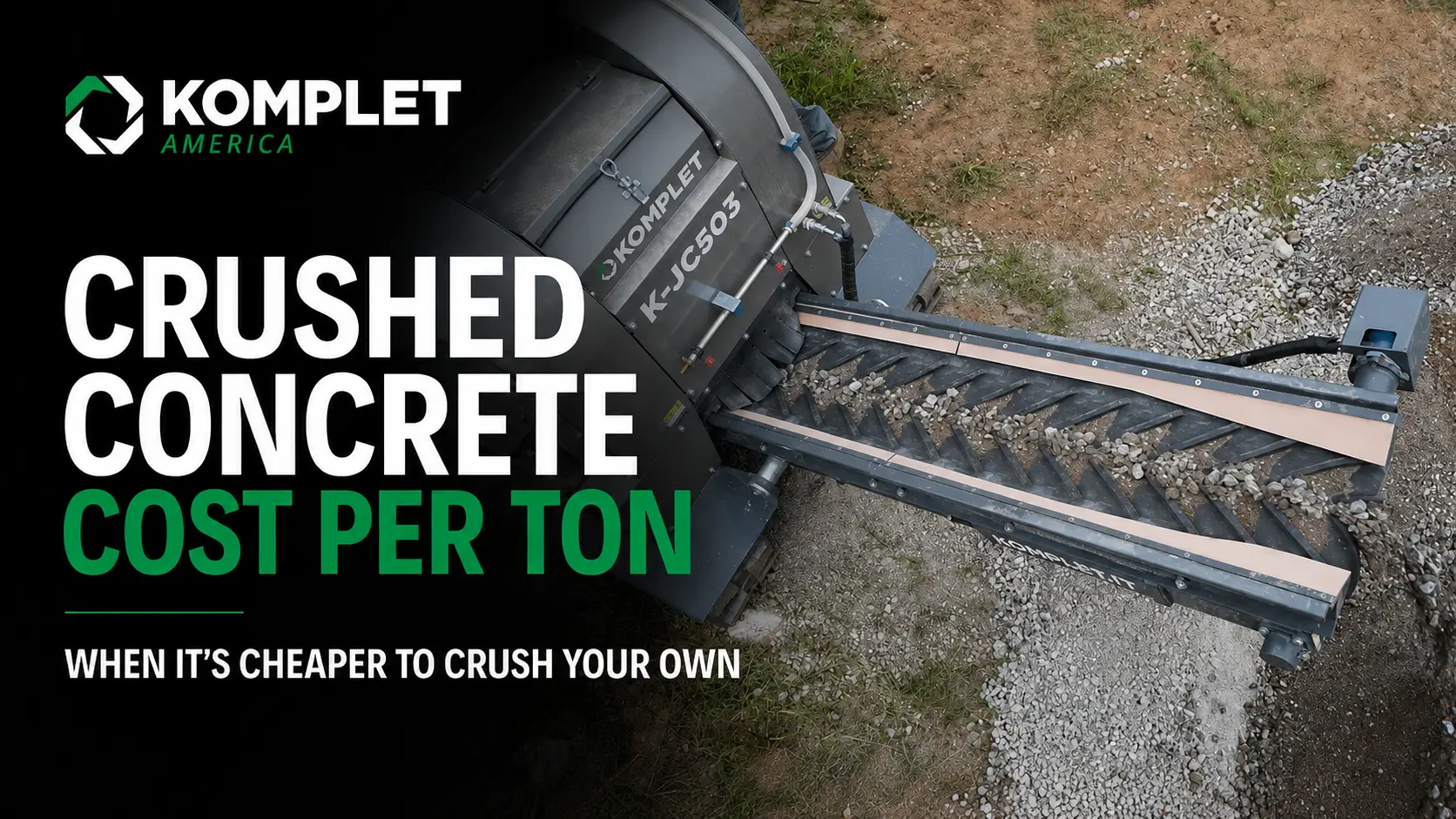
The K-JC 503 mini jaw crusher runs a 19 inch by 12 inch single toggle jaw, adjustable across a closed side setting range of three-quarters of an inch to three and a quarter inches, with production up to 34 US tph. It is the machine for limited access work: pool, masonry, waterproofing, hardscape and driveway contractors working in places larger equipment cannot reach. With the smallest chamber in the lineup, feed preparation discipline matters more here than anywhere else, because there is less room for an awkward piece to find its way through.
K-JC 604
The K-JC 604 mobile jaw crusher runs a 23 inch by 16 inch jaw across the same closed side setting range of three-quarters of an inch to three and a quarter inches, with production up to 55 US tph. The closed side setting is hydraulically adjustable from the remote, which allows an operator to fine tune output size without stopping production. Paired with the vibrating grizzly feeder, it gives an operator two levers, feed rate and setting, that can be worked independently.
K-JC 704 PLUS
The K-JC 704 PLUS portable jaw crusher is the best selling crusher in the lineup, running a 27 inch by 16 inch jaw across a closed side setting range of three-quarters of an inch to three and a quarter inches, with production up to 90 US tph. The larger chamber tolerates a wider range of feed than the smaller machines, which in practice means fewer bridges on mixed demolition material and less time spent sorting feed before it goes in.
K-JC 805
The K-JC 805 mobile jaw crusher is the largest jaw crusher Komplet America offers, with a 31 inch by 21 inch jaw, a closed side setting range running from roughly one and three-eighths inches to roughly four and three-quarter inches, and production up to 160 US tph. It is the only jaw crusher in the lineup that cannot be closed down to three-quarters of an inch, and the coarser range reflects what the machine is for: medium to hard rock, reinforced concrete and asphalt, often as a pre-processor feeding a screening operation rather than as the final sizing step.
What the setting range means in practice
Two things follow from those ranges. The first is that they describe the settings available on the machine, not the sizes coming off the belt. A crusher set at three-quarters of an inch produces material with a top size above three-quarters of an inch, for the stroke reasons covered earlier. The second is that the bottom of the range is a hard floor. Three of the four jaw crushers close to three-quarters of an inch and no further, so a job calling for a finer product needs a second pass, a screen, or an impact crusher rather than a tighter jaw.
When the Setting Is Not the Right Control
Not every sizing problem is a jaw crusher problem, and one of the more useful things an operator can learn is when to stop adjusting.
The K-IC 70 and apron settings
The K-IC 70 compact impact crusher does not have a closed side setting. It has a hydraulically adjustable apron setting, and product size is governed by the gap between the blow bars and the aprons together with rotor speed. It handles a 25 inch by 20 inch inlet, adjusts across a published range of three-quarters of an inch to three and a quarter inches, and produces up to 90 US tph.
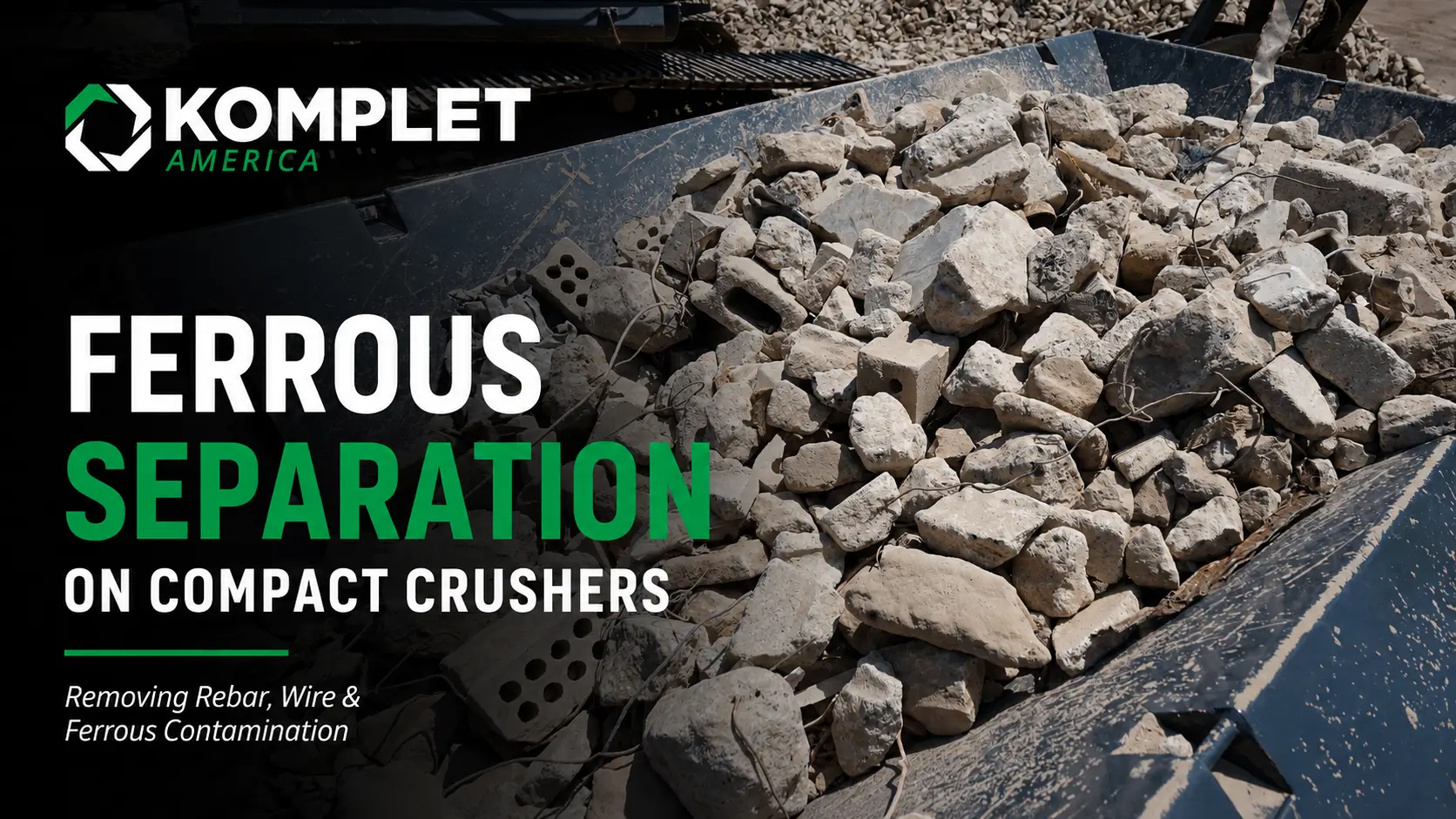
The practical difference for an operator is that an impactor gets you a finer, more cubical product in one pass, which matters for RAP reduction and for DOT specification material. The tradeoff is wear. Blow bars are the largest wear item on an impact crusher, and matching the bar to the application is the main lever on wear cost. High chrome bars offer much better wear resistance in abrasive material such as RAP, but they are brittle and will not tolerate steel in the feed, which puts a premium on removing rebar and tramp metal before the material goes in.
The shredder as a pre-processing step
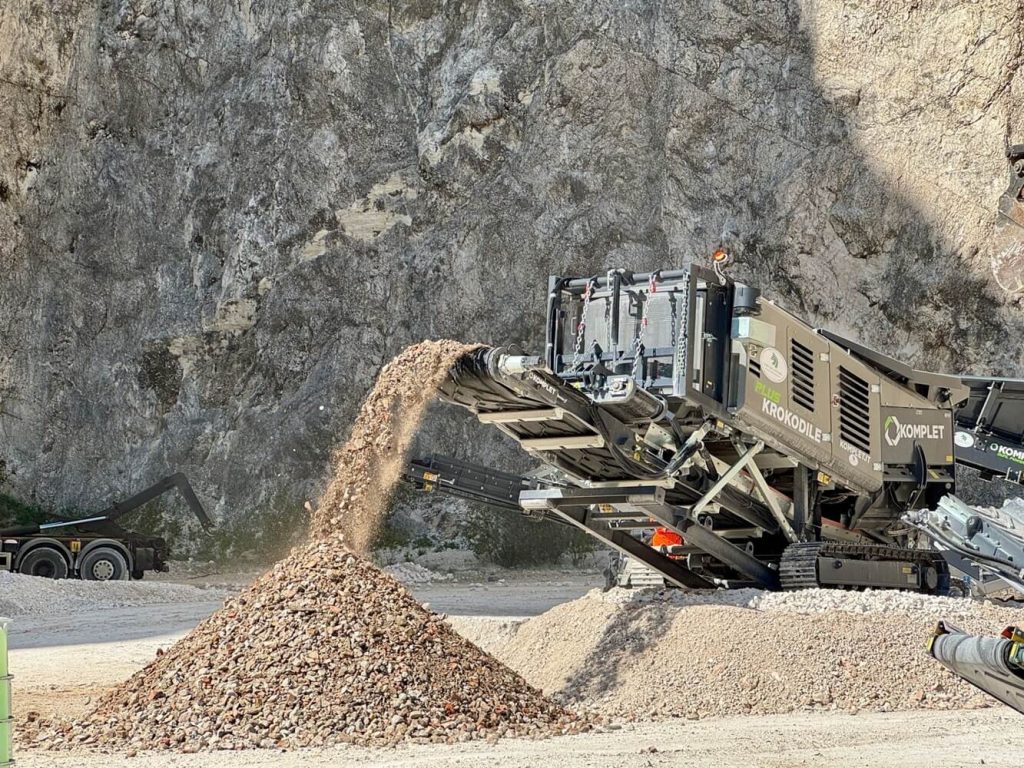
Material that is too large, too mixed or too awkward for a jaw crusher to accept does not always need a bigger crusher. The Krokodile PLUS slow-speed shredder uses dual-shaft shredding technology with a quick-change shaft system, and with the C&D and asphalt shaft configuration it reduces concrete, asphalt, brick, block and rubble to a size a crusher can take cleanly. On sites where the feed is the constraint rather than the crusher, that is often the missing piece.
A Repeatable Way to Dial In a Setting
The following sequence is a general working method rather than a procedure specific to any model. Always follow the setting adjustment, guarding and lockout procedures in the operator’s manual for your machine.
- Write down the target product: top size, tolerance on fines, and end use. Get the actual specification if the material is going into a specified application.
- Confirm the feed. Check that the largest pieces going in sit comfortably inside the feed opening and that oversize is being broken down or set aside before it reaches the hopper.
- Decide whether to scalp. If a meaningful share of the feed is already at or below target size, remove it ahead of the crusher rather than running it through.
- Set a starting point at or slightly below the target top size, understanding that product will report above the setting.
- Run a representative sample of real material at working moisture, long enough to clear whatever was already in the chamber and build a small pile.
- Look at the pile, not the belt. Judge top size and the amount of fines against the written target.
- Adjust in small increments in one direction at a time, and give the machine time to stabilize between changes.
- Record the setting alongside the material type, source, moisture condition and approximate jaw plate condition. That record is what makes the result repeatable next season.
- Re-check the setting after any jaw plate flip or replacement, and periodically through a long run as plates wear.
The record in step eight is the step most often skipped and the one that returns the most. A crew that can look up what setting produced acceptable base material from a particular source last year starts the next job an hour ahead instead of a day behind.
Frequently Asked Questions
What is closed side setting on a jaw crusher?
Closed side setting is the gap at the discharge end of the crushing chamber measured at the point where the swing jaw is closest to the fixed jaw. It is the primary control over both product size and production rate on a jaw crusher.
What is the difference between closed side setting and open side setting?
Closed side setting is measured with the swing jaw at its closest point, open side setting with the swing jaw at its furthest point. The difference between the two is the stroke, or throw, at the discharge. Closed side setting equals the open side setting minus the stroke.
Why is my crusher product bigger than the setting I measured?
Because the swing jaw is always moving, the discharge gap is only at the closed side setting for part of each rotation. Material discharges during the open portion of the stroke as well, so a portion of the product commonly reports above the measured setting. The setting shapes the coarse end of the gradation rather than capping it.
Does tightening the setting reduce production?
Yes. A narrower closed side setting produces a smaller product but lower production, since material spends more time in the chamber and more energy goes into further reduction. Increased wear per ton comes with it. That tradeoff is inherent to compression crushing and cannot be tuned away.
How much size reduction can a jaw crusher do in one pass?
Jaw crushers are generally worked to about six to one, meaning feed size divided by product size. Pushing past that is possible but costs efficiency rather than delivering a finer product. If the reduction required exceeds that range, the practical options are a second pass at a tighter setting or a different crushing action such as an impact crusher, which reaches considerably higher ratios.
Does asphalt or RAP wear jaw plates faster than concrete?
Yes. Asphalt is low in hardness and fractures easily, but it is abrasive, and abrasion rather than hardness drives wear part life. Crews moving between concrete recycling and reclaimed asphalt work should expect shorter jaw plate life on the asphalt material and plan wear part inventory accordingly.
Do I need to change the setting when the material gets wet?
Often, yes. Wet and sticky material clings to chamber surfaces and reduces flow, and the effect worsens as the setting gets tighter and as clay content rises. Opening the setting slightly is usually more productive than fighting packing at a setting that worked in dry conditions.
How tight can a compact jaw crusher be set?
Every jaw crusher has a mechanical floor on its setting range. On the K-JC 503, K-JC 604 and K-JC 704 PLUS that floor is three-quarters of an inch. The K-JC 805 closes to roughly one and three-eighths inches. Below those points the answer is not a tighter setting but a second pass, a screen, or an impact crusher.
Does the K-IC 70 impact crusher have a closed side setting?
No. Product size on the K-IC 70 is controlled by the hydraulically adjustable apron setting and rotor speed rather than by a discharge gap. The concept is related but the adjustment and the wear economics are different, since blow bars rather than jaw plates are the primary wear item.
Final Thoughts
Closed side setting rewards operators who treat it as one input into a product rather than as a dial that produces a size. The setting establishes where the coarse end of your gradation sits, the material decides how the rest of the curve falls, the feed decides whether the chamber can work at all, and jaw plate wear quietly moves the whole relationship over the course of a season.
The crews who hit specs consistently are rarely the ones with the most sensitive touch on the remote. They are the ones who define the product before they start, prepare the feed, test on real material, and write down what worked. None of that requires new equipment. It requires treating the setting as a decision rather than a habit.
Komplet America is the official North and Central American distributor of Komplet compact crushing, screening, shredding and conveying equipment. The jaw crusher lineup spans the K-JC 503, K-JC 604, K-JC 704 PLUS and K-JC 805, with the K-IC 70 compact impact crusher covering applications that need higher reduction and better particle shape. The full range is on the crushers page, with equipment financing through Komplet Capital, pre-owned equipment for operators building a first crushing spread, and parts and post-sale support for wear parts and service.
Ready to Dial In Your Crushing Operation?
- Call Komplet America at 908-369-3340 to talk through your material and your target product
- Compare the jaw crusher lineup on the crushers page
- Stock wear parts before you need them through parts and support
- Explore terms through Komplet Capital on the equipment financing page
- Find your local Komplet dealer for demo and rental availability at find a dealer
Never enough.
Disclaimer: All operating, maintenance, and service guidance in this article is general in nature. Always refer to the official Komplet operator’s manual for the specific machine model and serial number, and follow OEM intervals and procedures. For warranty-protected work, contact Komplet America at 908-369-3340 or your authorized Komplet dealer. Improper service or non-OEM parts may void warranty coverage and create safety hazards.