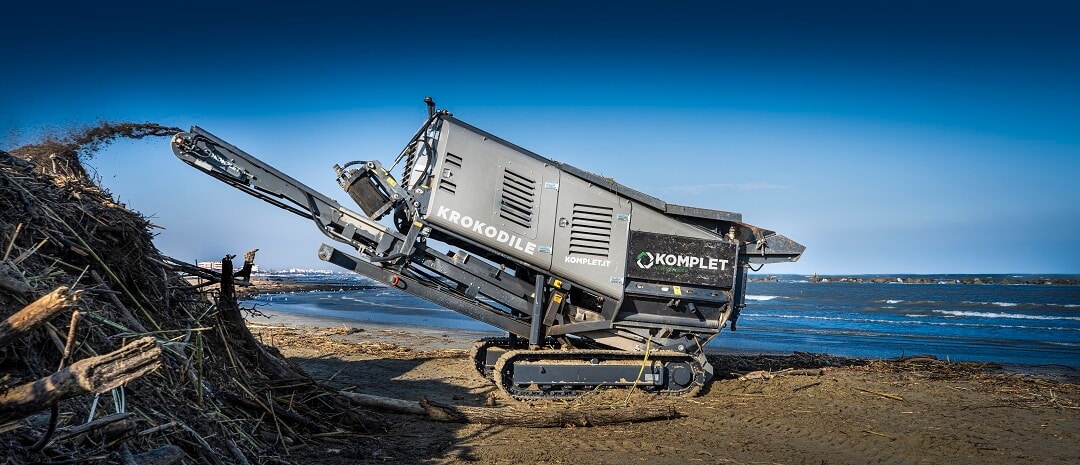

Construction and demolition projects generate enormous volumes of concrete waste — slabs, foundations, footings, walls, and bulky rubble that traditionally ends up in a landfill or at a distant recycling facility. Hauling that concrete away is expensive, slow, and forfeits the recovery value of the material itself. Circular construction takes the opposite approach: keep the material on-site, process it where it is generated, and reuse it as recycled base for the same project or the next one.
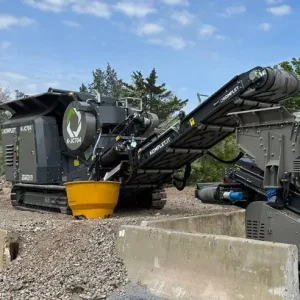
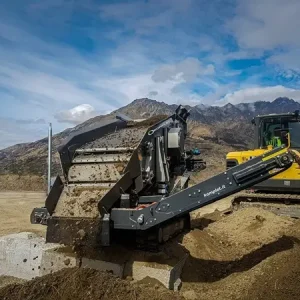
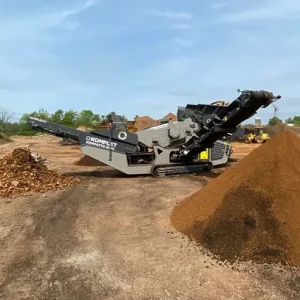
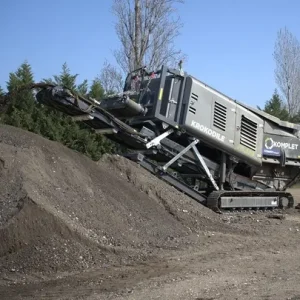
The Krokodile PLUS — Komplet America’s slow-speed mobile shredder — is built for that workflow. With its 60-inch dual-shaft system, quick-change C&D tooth configuration, and integrated magnetic separator, the Krokodile PLUS handles concrete rubble (with light rebar contamination), reduces it to volume-controlled output, and recovers ferrous metal in a single pass. This article walks through how it works, where it fits in a full circular construction equipment workflow, and what contractors need to know before deploying one.
Why On-Site Concrete Recycling Matters in Circular Construction
Circular construction is the principle that materials should stay in productive use as long as possible — reused, repurposed, or recycled rather than landfilled at end of life. Concrete is one of the most-produced and most-consumed construction materials worldwide, and one of the most resource-intensive to manufacture. Recycling concrete on-site reduces demand for virgin aggregate, lowers transport emissions, keeps material out of landfills, and cuts contractor cost on both the disposal and material-purchase sides of the project.
For contractors, the case extends beyond sustainability into cost efficiency: hauling unprocessed concrete is expensive, tipping fees continue to rise, and waiting for trucks creates jobsite bottlenecks. As LEED, Envision, and contract-required diversion targets have spread, on-site concrete recycling has shifted from a nice-to-have to a competitive bid advantage.
How the Krokodile PLUS Processes Concrete Rubble
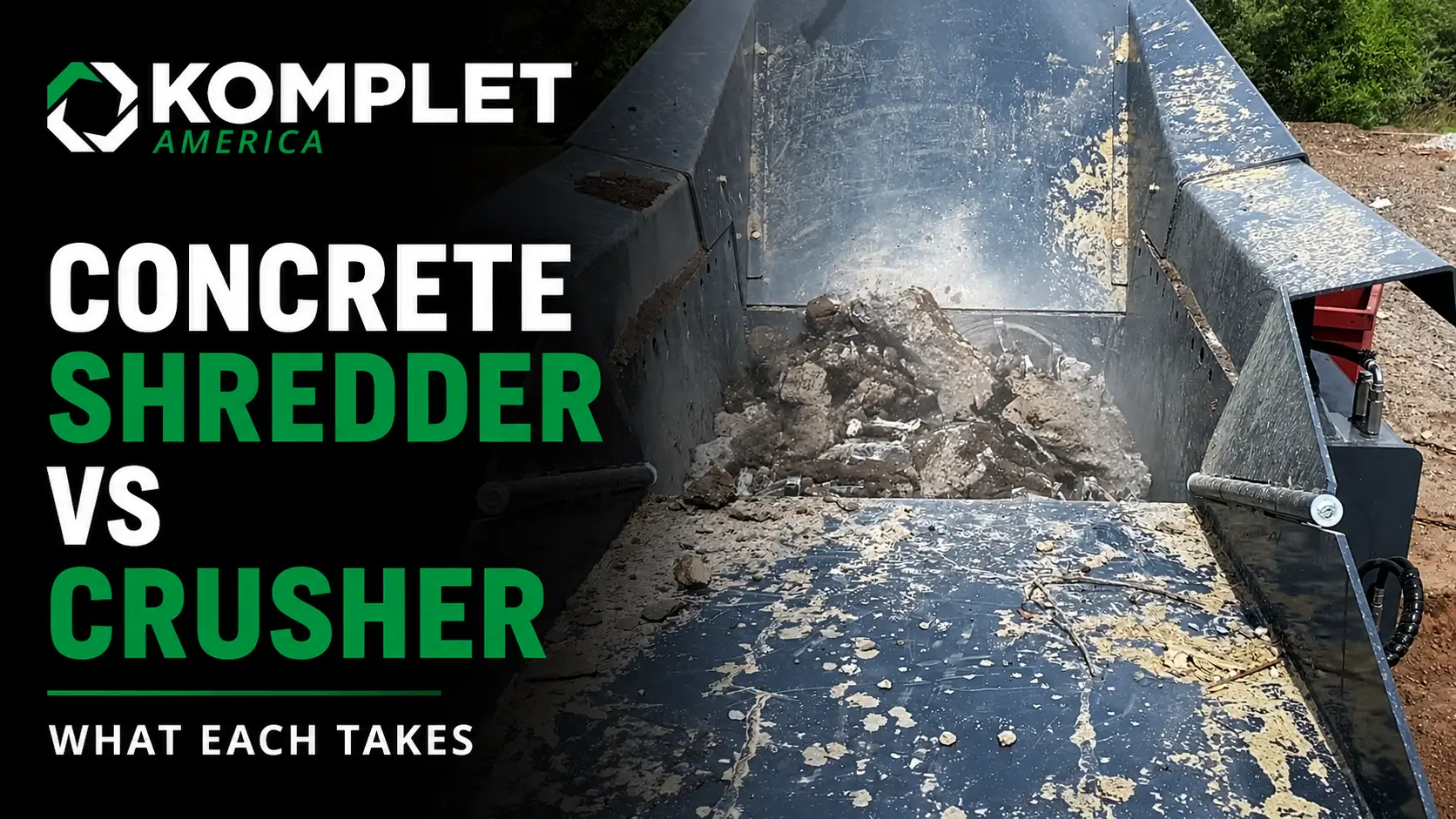
The Krokodile PLUS is a slow-speed mobile shredder powered by a 220-horsepower Volvo Penta Tier 4 Final diesel engine. The slow-speed designation matters: the dual shafts run at low RPM (0–35 range) with very high torque, which is exactly the right physics for tough, dense, and contaminated material like demolition concrete. High-torque slow shafts grip and tear material through controlled shear — they do not rely on impact velocity. That is why the Krokodile PLUS handles concrete with light rebar contamination without overheating, throwing dust clouds, or destroying its cutting components.
The Quick-Change Shaft System
The Krokodile PLUS supports two distinct shaft and tooth configurations:
- C&D / Asphalt teeth and shafts — engineered for concrete, asphalt, brick, block, rubble, and other heavy aggregate-based debris.
- Wood / Lightweight Waste teeth and shafts — engineered for wood, drywall, plastics, mixed waste, and lighter C&D debris.
For concrete recycling, the C&D / Asphalt shaft is the right choice. The shafts are designed to be swapped to match the day’s feed, which means a single Krokodile PLUS supports concrete-heavy demolition days as well as wood-heavy land clearing or municipal waste reduction days. Contractors do not buy two specialized machines — they change the shafts.
Output Capacity for Concrete and Asphalt
On the C&D shaft, published output is up to 175 US tons per hour for concrete and asphalt under ideal conditions. “Up to” reflects ideal feed consistency, skilled operator, dry material, and minimal contamination — actual jobsite output will vary based on what is in the load that day.
Integrated Magnetic Separator for Rebar Recovery
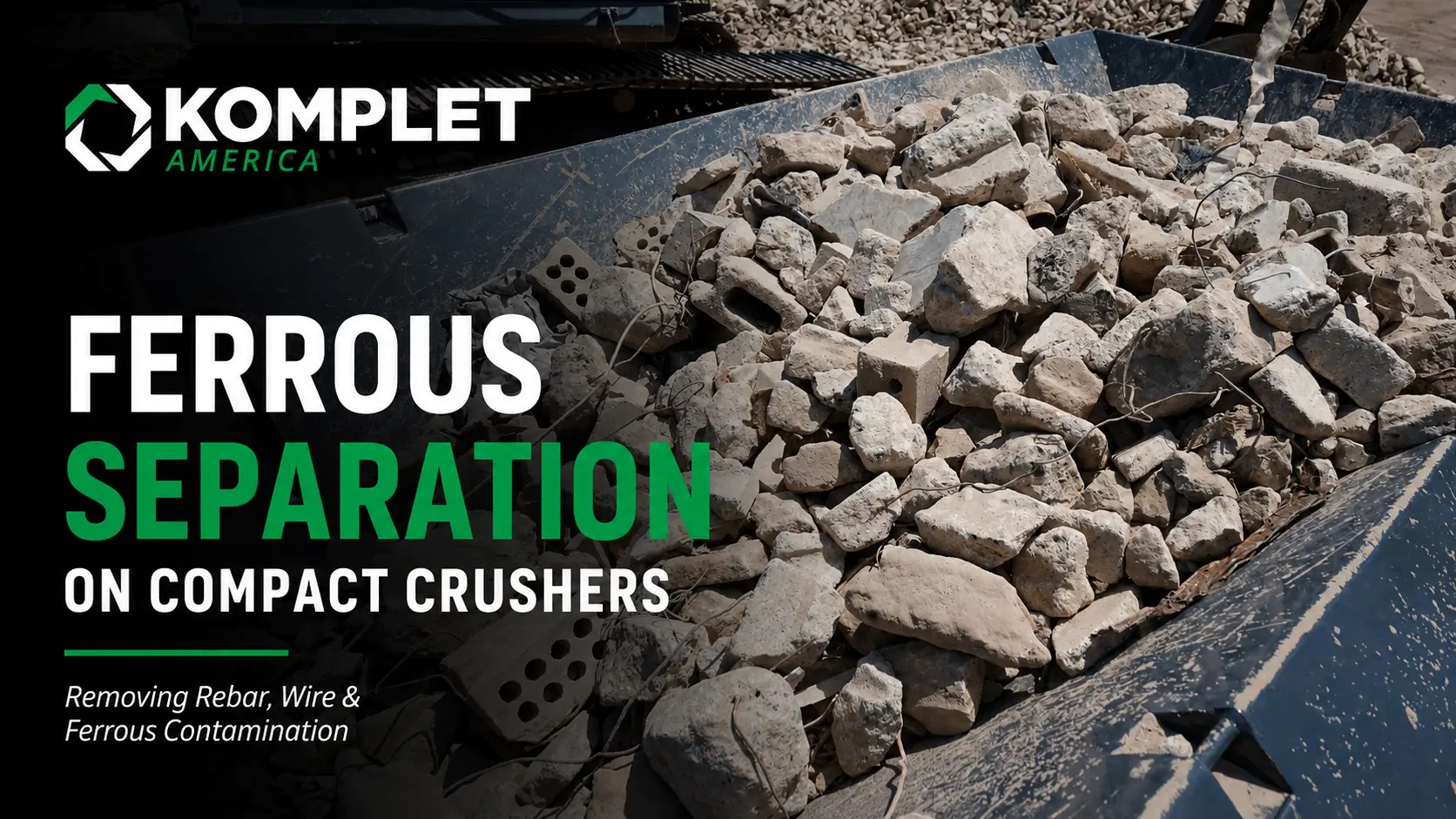
Reinforced concrete almost always contains rebar fragments, ties, embedded nails, or other ferrous content. The Krokodile PLUS includes an integrated magnetic separator that extracts ferrous metal from the discharge stream as the material exits the machine. Captured ferrous content is collected separately and can be sold to scrap metal recyclers, recovering value rather than landfilling steel. The cleaned concrete output continues forward — ready for downstream processing into spec-grade aggregate.
The Full Circular Construction Workflow with Komplet Equipment
The Krokodile PLUS handles the volume-reduction and pre-processing step in a circular construction workflow. To produce sub-inch spec-grade recycled aggregate suitable for road base, structural fill, or non-structural applications, the workflow continues with Komplet’s compact crushers and screeners.
Step 1: Krokodile PLUS — Volume Reduction and Ferrous Recovery
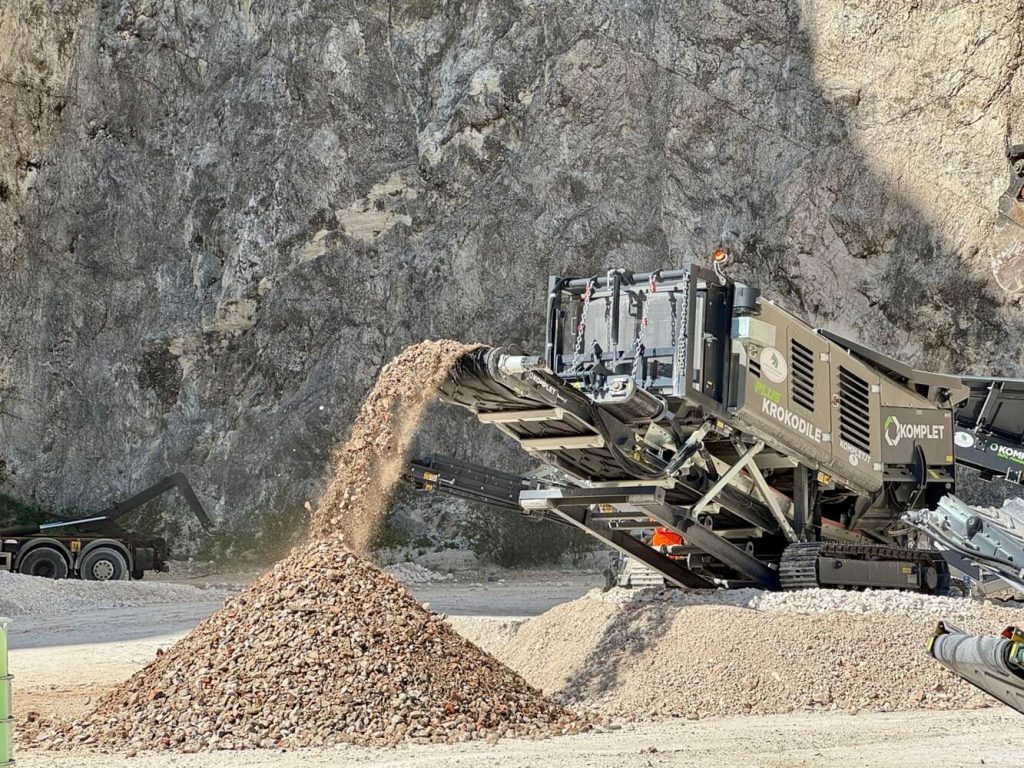
Demolition concrete is fed directly into the Krokodile PLUS hopper at the jobsite — no hauling, no staging at a distant facility. The slow-speed shafts reduce the rubble to a coarser intermediate output, the magnetic separator extracts ferrous metal, and the discharge belt delivers cleaned material to a stockpile.
Step 2: Komplet Compact Crusher — Sized Aggregate Production
The intermediate Krokodile PLUS output feeds into a Komplet compact jaw crusher (the K-JC 503, K-JC 604, K-JC 704 PLUS, or K-JC 805) sized to the operation’s expected throughput. The jaw crusher reduces the cleaned concrete to a sized aggregate output controllable through the closed-side setting (CSS). For applications that require finer or more cubical aggregate, the K-IC 70 compact impact crusher can run as primary or secondary in this workflow.
Step 3: Komplet Screener — Spec-Grade Material Classification
Crushed output then runs through a Komplet screener — the Kompatto 221, Kompatto 5030, or Kompatto 124 — to separate the crushed concrete into spec-graded fractions. The output is now Recycled Concrete Aggregate (RCA) suitable for road base, structural fill, sub-base, or non-structural backfill applications, with documented gradation appropriate to the project specification.
The full workflow — Krokodile PLUS, then crusher, then screener — operates entirely on the jobsite. No hauling, no off-site processing, no waiting on third-party facilities. The crew demolishes, the equipment processes, and the recovered material flows directly back into the project as recycled base.
The Benefits of Producing Recycled Base On-Site
Reduced Hauling and Transport Costs
On-site processing eliminates round-trip hauling for unprocessed concrete and the return trip for fresh aggregate. Fewer trucks, lower fuel cost, fewer billable hauling hours, and lower Scope 3 emissions on the project. For projects with long haul distances to landfill or to a virgin aggregate source, the savings compound quickly.
Lower Material Purchase Costs
Recycled concrete aggregate produced on-site replaces virgin aggregate that would otherwise be purchased, hauled, and stockpiled. The contractor turns a disposal cost line item into a material supply line item — same project, opposite ledger entry.
Faster Project Schedule
On-site processing decouples the demolition crew from the hauling and supply schedule. The crew does not wait for trucks to return from the dump or for aggregate deliveries to arrive. The Krokodile PLUS can be moved between active demolition zones throughout the day to keep the workflow continuous.
Documented Sustainability Performance
On-site recycling is straightforward to document for LEED Materials & Resources credits, Envision sustainability ratings, or contract-required diversion thresholds. The contractor maintains direct chain-of-custody on the recovered material rather than relying on third-party recycler reporting.
Krokodile PLUS vs. Traditional Concrete Recycling Approaches
Traditional concrete recycling typically takes one of two forms: hauling to a stationary recycling facility, or bringing in a fixed-location processing setup. Both have real downsides for a contractor.
Hauling to a stationary facility means trucks, fuel, time, scheduling, and tipping or processing fees on every load. The contractor pays for transportation in both directions if recycled aggregate is then trucked back to the project.
A fixed processing setup reduces hauling but requires foundation work, electrical or hydraulic infrastructure, and dedicated staging space — none of which are available on most active jobsites. Once installed, it stays installed.
The Krokodile PLUS is a tracked mobile machine. It moves to the waste, sets up on a level work area, processes, and moves on. No foundation, no infrastructure, no permanent footprint. Combined with the Komplet compact crusher and screener lineup, the entire concrete recycling workflow is mobile and self-contained.
How Contractors Use the Krokodile PLUS in Real Projects
Contractors use the Krokodile PLUS in concrete-recycling workflows on:
- Building demolition projects where structural concrete must be removed and the site graded for redevelopment
- Road and infrastructure projects where existing concrete pavement is removed and recycled into the new road base
- Site preparation projects on brownfield or previously-developed land where existing concrete foundations and slabs must be processed
- Utility and underground work where existing concrete encasement, manholes, and structures are demolished and the recovered material is reused as backfill
- Remediation projects where contaminated concrete must be size-reduced for disposal at a treatment facility
In each case, the operating principle is the same: process where the material is generated, recover what can be recovered, reduce what must leave the site, and put recycled output back to work in the same project where possible.
Frequently Asked Questions
Can the Krokodile PLUS process concrete with rebar?
Yes. The Krokodile PLUS handles concrete with light rebar contamination using the C&D shaft configuration. The high-torque slow-speed shafts tear through the concrete and discharge rebar fragments along with the cleaned material. The integrated magnetic separator extracts the ferrous fragments from the discharge stream. Heavy structural rebar bundles or large steel members should still be removed before feeding.
How much concrete can the Krokodile PLUS process per hour?
Up to 175 US tons per hour of concrete and asphalt under ideal conditions on the C&D shaft. Actual jobsite output varies with material composition, contamination level, moisture content, operator experience, and feed consistency.
What size output does the Krokodile PLUS produce on concrete?
Output sizing is determined by the tooth and shaft configuration and the spacing between the shafts — not by a screen at the bottom of the chamber. The Krokodile PLUS produces a coarser intermediate output well-suited for downstream processing through a Komplet compact jaw crusher and screener. For sub-inch spec-grade aggregate, the Krokodile PLUS output should feed into a crusher and then a screener to finish the gradation.
Can the Krokodile PLUS produce finished spec-grade aggregate by itself?
No. The Krokodile PLUS is the volume-reduction and pre-processing step in a circular construction workflow. To produce spec-grade Recycled Concrete Aggregate (RCA) for road base, structural fill, or other applications, the Krokodile PLUS output should feed downstream into a Komplet compact crusher (jaw or impact) and then a Komplet screener for final gradation.
Does the Krokodile PLUS need a foundation or special site preparation?
No. The Krokodile PLUS is a tracked mobile machine that operates on a level, prepared work area on its own chassis. No fixed foundation, anchor pad, electrical hookup, or stationary infrastructure required.
Is recycled concrete aggregate (RCA) accepted for structural use?
RCA acceptance depends on the application, the local building code, the project specification, and the documented gradation and properties of the recycled material. Many DOTs and municipal specifications allow RCA in road base, sub-base, fill, and non-structural applications. Structural concrete reuse is more restricted and typically requires testing per project specification. Always confirm acceptance with the project engineer or local DOT before using recycled material in a structural application.
Can the Krokodile PLUS contribute to LEED or sustainability credits?
On-site C&D recycling supports landfill diversion, which is a measurable component of LEED Materials & Resources credits and other green building rating systems (Envision, etc.). Specific credit eligibility depends on the project’s rating system version and how recovered material is documented and used. Consult the project’s sustainability consultant or LEED-AP for specific credit calculations.
How is the Krokodile PLUS operated?
By wireless remote control. All shredding modes, shaft direction, hopper position, and discharge belt operation are controlled wirelessly. Operators stand outside the active zone of the machine.
Final Thoughts
Circular construction is not a marketing term — it is a practical workflow that turns demolition output into the next project’s input. The Krokodile PLUS is the right tool for the volume-reduction and ferrous-recovery step of that workflow on concrete-heavy projects. Combined with Komplet’s compact crusher and screener lineup, the full chain is mobile, self-contained, and operates on the jobsite where the material is generated.
Komplet America stocks the Krokodile PLUS in the Hillsborough, NJ yard and supports it through a Komplet-certified service network across North and Central America. For specific application questions — concrete volumes, rebar density, downstream equipment configuration, financing through Komplet Capital, or pre-owned availability — contact Komplet America directly or work with your local Komplet dealer.
Learn more about the Krokodile PLUS slow-speed mobile shredder, explore Komplet’s compact jaw crushers, screeners, or review equipment financing options through Komplet Capital.
Ready to Build a Circular Construction Workflow?
- Call Komplet America at 908-369-3340 to discuss your concrete volumes and downstream equipment needs
- Request a yard demonstration in Hillsborough, NJ — see the Krokodile PLUS process concrete rubble before you buy
- Review Krokodile PLUS specifications and pricing
- Explore equipment financing through Komplet Capital — Section 179 eligible for U.S. tax purposes
- Find your local Komplet dealer for rental availability and regional support
Never enough.
Disclaimer: All operating, maintenance, and service guidance in this article is general in nature. Always refer to the official Komplet operator’s manual for the specific machine model and serial number, and follow OEM intervals and procedures. For warranty-protected work, contact Komplet America at 908-369-3340 or your authorized Komplet dealer.
Disclaimer: Production rates and throughput figures shown above (“up to” tons per hour) reflect maximum potential output under ideal conditions — consistent feed material, dry conditions, skilled operator, proper setup, and minimal downtime. Actual results on any specific jobsite will vary based on material composition, moisture content, contamination level, operator experience, and other site conditions. Recycled Concrete Aggregate (RCA) properties depend on source material, processing, and gradation — confirm RCA acceptance with the project engineer or local DOT before structural use. Komplet America makes no guarantee of specific throughput, RCA spec compliance, or financial returns.