
Anyone crushing reinforced concrete deals with steel. Rebar, welded wire mesh, tie wire, the occasional anchor bolt or piece of formwork hardware. It arrives in the feed whether or not the pile was supposed to be clean, and it has to come out before the material is worth anything.
The part most equipment literature covers is that a magnet pulls the steel out of the stream. That is the easy half, and it is largely automatic. The half that decides how your day goes is where that steel lands after it leaves the belt, because that determines your pad layout, how often the loader has to stop, and whether the scrap pile ends up mixed back into the product it was pulled out of.
Every Komplet crusher includes magnetic separation as part of the machine, not as an option to price separately. The hardware differs across the lineup in ways that matter on a working site, and this article covers what each configuration does, why the differences exist, and how to set up around them.
Refer to the operator’s manual prior to operating any Komplet machinery. Adjustment procedures, guarding and safe access points for magnetic separation hardware differ by model and by serial number.
Why Steel Has to Come Out
There are two separate reasons to take ferrous material out of the stream, and they push in the same direction for different audiences.
The product reason
Recycled aggregate with steel in it is not a saleable product and often not a usable one. Protruding wire in base material punctures tires and injures crews handling it. Steel in material going under a slab or into structural backfill is a contamination issue that a receiving inspector will flag. Material headed to a specified application is subject to the contamination limits in that specification, and a visible piece of rebar in the stockpile is enough to have a load rejected regardless of what the rest of the pile looks like.
Even for material staying on your own site, clean product is what makes on-site crushing pay. The value of the operation comes from turning demolition debris into something you place instead of haul, and material a crew will not place has not been recycled, only relocated.
The machine reason
Steel is uncrushable, and uncrushable material in a crushing chamber is where damage comes from. On a jaw crusher, rebar and mesh are tolerated better than on most other crusher types because compression crushing squeezes rather than strikes, but tolerated is not the same as harmless. Long pieces wrap and bind, plate wear accelerates at the points where steel passes, and a large enough piece stops the machine.
Downstream of the chamber, steel is also a belt problem. A piece of rebar dropping onto a conveyor belt point first, from height, can cut or tear it, and a torn extraction belt is a longer repair than most operators expect from something that looks minor.
What a Magnet Catches and What It Does Not
Magnetic separation catches ferrous metal. That covers rebar, welded wire mesh, tie wire, nails, structural steel offcuts and most jobsite hardware, which is the large majority of what shows up in concrete and demolition debris.
It does not catch non-ferrous material. Aluminum, copper wire, brass fittings, stainless hardware and similar material passes straight through with the product. On mixed demolition feed this matters, and the practical answer is picking that material out ahead of the crusher rather than expecting the machine to sort it.
Size and position affect what gets pulled
A magnet has to be close enough to the material to act on it and the steel has to be near enough to the top of the material bed to be lifted clear. A short piece of tie wire buried under a full belt of crushed concrete is a harder catch than a length of rebar riding on top. Feed depth on the extraction belt therefore has an effect on separation performance, which is one more reason a chamber running at a steady, managed feed rate outperforms one being fed in surges.
Very long pieces present the opposite problem. A magnet may grip one end of a long bar while the rest stays buried in the product, and the result is a bar that hangs up rather than transferring cleanly. Cutting long rebar down before it goes in the hopper solves this at the source.
The Configurations Across the Komplet Lineup
Three different arrangements are used across the crusher range, matched to machine size and to how the material comes off each one. Directions below are given as seen from behind the machine looking toward the discharge end, which is the only way left and right mean anything consistent on a jobsite.
K-JC 503: magnetic roller on the extraction belt
The K-JC 503 mini jaw crusher uses a magnetic roller on the extraction belt rather than a crossband belt. Steel is held to the belt past the point where the crushed product releases and falls, then discharges underneath the main extraction belt, away from the end product pile.
The arrangement suits the machine. The 503 is built for limited access work where there may not be room for a crossband belt hanging off the side, and it produces two separate piles without adding width to a machine chosen specifically for being narrow. What it asks of the operator is awareness that the metal is accumulating under the discharge, which is a place easy to forget about until there is a pile there.
K-JC 604: manually adjustable crossband, discharging left
The K-JC 604 mobile jaw crusher carries a crossband magnetic belt running across the product stream. Steel is lifted off the material and carried out to the left side of the machine, while clean product continues off the front. Two piles, well separated, in a layout that keeps the loader working the front of the machine without driving through scrap.
Adjustment on the 604 is manual, done with a few bolts rather than hydraulically. The factory setting accommodates most output sizes, leaving enough gap between the two belts, so in normal operation this is a set and leave arrangement rather than something adjusted between materials. Crews moving between very different product sizes are the ones most likely to touch it.
K-JC 704 PLUS, K-JC 805 and K-IC 70: hydraulic crossband, discharging right
The K-JC 704 PLUS, K-JC 805 and K-IC 70 use hydraulically adjustable crossband magnetic belts discharging off the right side of the machine. Hydraulic adjustment means the gap between the magnet and the product stream can be changed from the machine’s controls rather than with hand tools, which is what makes it practical to optimize separation for the material actually running.
On the K-JC 805 the magnetic belt also raises hydraulically for clearance, which matters when moving the machine or working around it. The larger machines earn the hydraulic arrangement because they see the widest range of feed, from clean concrete to heavily reinforced structural material, and because the operator adjusting them is usually further from the machine.
The K-JC 805 chamber deflector
The K-JC 805 includes a deflector at the bottom of the jaw chamber that keeps steel from dropping directly onto the extraction belt. Metal leaving the chamber is deflected rather than landing point first on the belt, which addresses the belt tearing problem described earlier before the magnet ever gets involved.
It is worth understanding what this does and does not do. The deflector protects the belt. It does not separate anything. The steel it deflects still has to be lifted out by the magnet further along, and the two components are doing different jobs on the same problem.
Manual Versus Hydraulic Adjustment
The gap between the magnet and the material stream is the variable that governs separation. Too far away and the magnet does not reliably lift steel out of a loaded belt. Too close and product rides up into the magnet belt or the two belts interfere with each other.
What changes the ideal gap
Product size is the main driver. A coarse product presents a deeper, more open bed than a fine one, and the steel in it sits at different heights. Feed depth matters for the same reason. Material moisture has an effect as well, since damp material packs together and holds smaller steel more tightly than dry material does.
On manually adjusted machines the factory gap is set to accommodate most output sizes, and most operators never need to change it. On hydraulically adjusted machines the practical advice is different: if separation looks poor on a particular material, adjust the gap and observe the result before assuming the magnet or the feed is at fault.
Reading the two piles
The fastest diagnostic on any of these machines is looking at both piles rather than one. Product with visible steel in it means the magnet is not reaching the material, most often because the bed is too deep or the gap is too wide. A metal pile with a meaningful amount of crushed product mixed into it means the opposite, that the magnet is too close or is pulling product along with the steel, and that is losing you saleable material into a scrap pile.
Laying Out the Pad Around the Metal
Discharge direction is a site planning input, and this is the part that gets discovered on the first day of a job rather than planned for.
A crossband discharging left and one discharging right want mirror image setups. Put the loader route, the product stockpile and the scrap bin on the wrong sides and the loader crosses the metal discharge every cycle, which means either driving through scrap or stopping the machine to clear it. Neither is a small cost across a full day.
Practical setup points
- Know which side your machine discharges metal before the machine arrives, and lay out product stockpile, loader path and scrap container accordingly
- Leave room for the metal to accumulate rather than assuming it will be picked up continuously, because it will not be on a busy day
- On the K-JC 503, remember the metal is discharging underneath the extraction belt and plan access to that area
- Keep the scrap collection point far enough from the product pile that a loader bucket cannot take a bite of both
- Account for the crossband belt in your working footprint, since the machine is wider in operation than in transport
Where a conveyor is in the circuit, this planning gets easier rather than harder. Moving the product pile further from the machine with a conveyor creates natural separation between the clean stockpile and the metal discharge, and reduces how often the loader has to work close to the crusher at all.
Managing Rebar Before It Reaches the Machine
Every piece of steel handled at the feed end is one that does not have to be caught, deflected or picked out later. Feed preparation is the cheapest ferrous separation available.
Encapsulated versus loose steel
Steel still encapsulated in concrete behaves differently from loose steel lying in the pile. Guidance from crushing practice is to keep encapsulated rebar relatively light, generally under about half an inch in thickness, and to keep loose rebar short. Long loose pieces are the ones that cause trouble, wrapping and binding rather than passing through.
The general principle applies here as much as anywhere in crushing: if in doubt, leave it out. A piece of structural steel set aside at the pile costs a minute. The same piece in the chamber can cost a day.
Practical feed habits
- Cut long rebar down at the pile rather than feeding full lengths
- Pick out obvious structural steel, formwork hardware and non-ferrous material before it reaches the hopper
- Load with an even, managed feed rather than in surges, since a deep bed hides steel from the magnet
- Feed across the width of the chamber rather than to one side
- Watch the first material off a new pile closely, because the reinforcement in it is usually consistent and tells you what the rest of the pile will bring
The Impact Crusher Case Is Different
Everything above applies to the K-IC 70 compact impact crusher, which carries the same hydraulically adjustable crossband arrangement discharging right. What changes is how much steel the machine upstream of that magnet will tolerate.
An impact crusher fractures material by striking it, and the striking components are blow bars. Blow bar metallurgy involves a direct tradeoff. Martensitic bars are tougher and tolerate steel in the feed, but wear faster in abrasive material. Chrome and high chrome bars offer far better wear resistance and are the better choice in abrasive material such as reclaimed asphalt, but they are brittle and will not tolerate steel or rebar in the feed.
The consequence is that feed cleanliness is not optional on an impactor in the way it is merely advisable on a jaw crusher. If the wear economics of a job push you toward chrome bars, the feed has to be genuinely clean before it goes in, and that is a materials handling decision made before the machine ever starts.
Long loose rebar deserves particular attention on an impactor, because long pieces can wrap the rotor. That is a different class of problem from a bar passing through a jaw chamber.
Where the Krokodile PLUS Fits
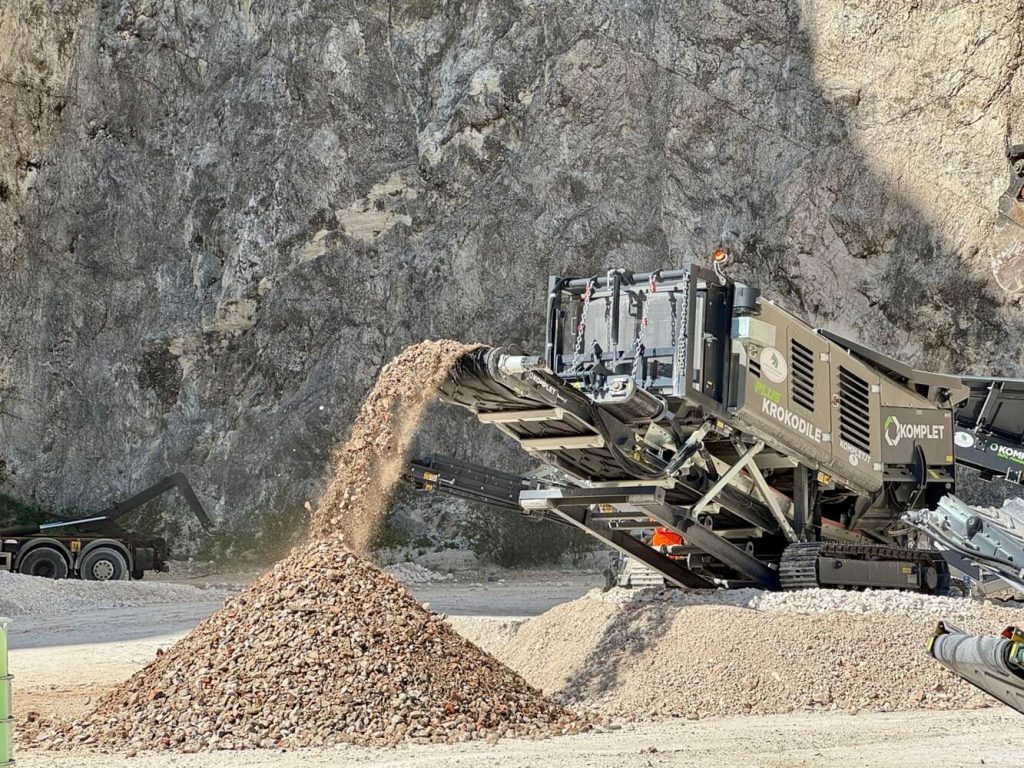
The Krokodile PLUS slow-speed shredder uses dual-shaft shredding technology with a quick-change shaft system, and with the C&D and asphalt shaft configuration it processes concrete, asphalt, brick, block and rubble. Magnetic separation is part of the standard Krokodile PLUS configuration alongside the hydraulic hopper.
Its role in a ferrous separation conversation is as a pre-processing step rather than as a replacement for the crusher magnet. Material arriving in pieces too large or too awkward for a crusher to accept cleanly can be reduced first, and reducing it exposes reinforcement that was buried inside intact sections. Slow-speed shredding also runs at controlled speed and high torque rather than by striking, which is a different way of handling contaminated material than an impactor uses.
For operators running a shredder and a crusher together, the sequence is worth thinking through deliberately: what the shredder liberates, the crusher’s magnet sees, and the cleaner the material arriving at the crusher, the better both machines behave.
What to Do With the Steel You Recover
Recovered rebar and mesh is scrap steel, and scrap steel has value. That value moves with the market and varies by region and by yard, so the useful planning assumption is that the pile is worth handling properly rather than that it will fund the job.
Handling the pile
Steel coming off a crusher magnet is usually dirty, meaning it has concrete still attached. Scrap buyers price on that condition, and material with a lot of concrete still bonded to it is worth less than clean steel. The output from a well set magnet on well prepared feed is generally cleaner than material picked out of a stockpile by hand, which is a secondary argument for getting the separation right at the machine.
Practical handling comes down to containing it. A dedicated bin or a defined area, sited on the correct side of the machine, keeps the pile from spreading into working areas and keeps it in a form a scrap hauler can actually load.
Keeping the Separation Working
Magnetic separation on these machines is not maintenance intensive, but it is not maintenance free either.
- Inspect the crossband belt and the extraction belt for cuts, tears and wear as part of routine daily checks
- Watch for steel accumulating on the magnet belt rather than discharging cleanly, which usually points to a bar hung up or to buildup on the belt surface
- Keep the discharge area clear so recovered metal has somewhere to go
- Follow the OEM inspection intervals and procedures in the operator’s manual for your model rather than a general schedule
- Never reach into a running machine to free a hung piece of steel; follow the lockout procedure first
Wear parts, belts and other high wear items for current Komplet models are stocked in Hillsborough. Details are on the parts and post-sale support page, and the support line is 908-369-3340 for both sales and service.
Frequently Asked Questions
Do all Komplet crushers include magnetic separation?
Yes. Magnetic separation is standard across the Komplet crusher lineup and is included in the machine rather than priced as an option. The hardware differs by model, using a magnetic roller on the K-JC 503 and crossband magnetic belts on the larger machines.
Which side does the magnet discharge metal on?
It depends on the machine. The K-JC 604 discharges metal off the left side while clean product goes off the front. The K-JC 704 PLUS, K-JC 805 and K-IC 70 discharge off the right side. The K-JC 503 discharges metal underneath the main extraction belt rather than to either side. Directions are given looking from behind the machine toward the discharge end.
What is the difference between a magnetic roller and a crossband magnet?
A magnetic roller works within the extraction belt itself, holding ferrous material to the belt past the point where product falls away so the steel discharges separately underneath. A crossband magnet is a separate belt running across the product stream that lifts steel off it and carries it out to the side of the machine.
Does a crusher magnet catch wire mesh and tie wire?
Ferrous mesh and tie wire are magnetic and are generally caught, though smaller pieces buried deep in a heavily loaded belt are harder to lift out than material riding near the surface. Managing feed depth improves separation of small ferrous items more than any other single adjustment.
Will the magnet remove aluminum or copper?
No. Magnetic separation acts on ferrous metal only. Aluminum, copper, brass and stainless hardware pass through with the product and need to be removed from the feed by hand before crushing.
Can you crush reinforced concrete in a jaw crusher?
Yes, and it is one of the common applications for compact jaw crushers. Compression crushing tolerates encapsulated reinforcement better than crushing types that work by striking. Long loose rebar should still be cut down before feeding, and oversize structural steel should be set aside rather than fed.
Why does steel matter more on an impact crusher than a jaw crusher?
Because of blow bar metallurgy. Chrome and high chrome blow bars offer much better wear resistance in abrasive material but are brittle and will not tolerate steel in the feed. Martensitic bars tolerate steel but wear faster in abrasives. That tradeoff makes feed cleanliness a harder requirement on an impactor.
How do I know if my magnet is set correctly?
Look at both piles rather than one. Visible steel remaining in the product suggests the magnet is not reaching the material, usually from a bed that is too deep or a gap that is too wide. Crushed product mixed into the metal pile suggests the opposite. On hydraulically adjustable machines the gap can be changed from the controls and the result observed directly.
Final Thoughts
Ferrous separation is one of the few things on a compact crusher that works largely on its own, which is exactly why it gets ignored until something goes wrong. The magnet does its job. What it cannot do is decide where your loader drives, how deep your feed bed runs, how long the rebar is when it reaches the hopper, or what happens to the scrap pile once it builds up.
Those are all operator decisions, and they are the difference between a machine that produces clean, saleable material with two well separated piles and one that produces a mess someone has to sort out later. Knowing which configuration your machine has, and setting the pad up around it before the first bucket goes in, is a short conversation that pays for itself in the first week.
Komplet America is the official North and Central American distributor of Komplet compact crushing, screening, shredding and conveying equipment, with magnetic separation included across the crusher lineup. That lineup runs from the K-JC 503 through the K-JC 604, K-JC 704 PLUS and K-JC 805, alongside the K-IC 70 compact impact crusher and the Krokodile PLUS slow-speed shredder. The full range is on the crushers page, with equipment financing through Komplet Capital and pre-owned equipment for operators building a first spread.
Ready to Get Clean Material Off Your Pile?
- Call Komplet America at 908-369-3340 to talk through your material and how much reinforcement it carries
- Compare configurations across the lineup on the crushers page
- Keep belts and wear parts on hand through parts and support
- Explore terms through Komplet Capital on the equipment financing page
- Find your local Komplet dealer for demo and rental availability at find a dealer
Never enough.
Disclaimer: All operating, maintenance, and service guidance in this article is general in nature. Always refer to the official Komplet operator’s manual for the specific machine model and serial number, and follow OEM intervals and procedures. For warranty-protected work, contact Komplet America at 908-369-3340 or your authorized Komplet dealer. Improper service or non-OEM parts may void warranty coverage and create safety hazards.