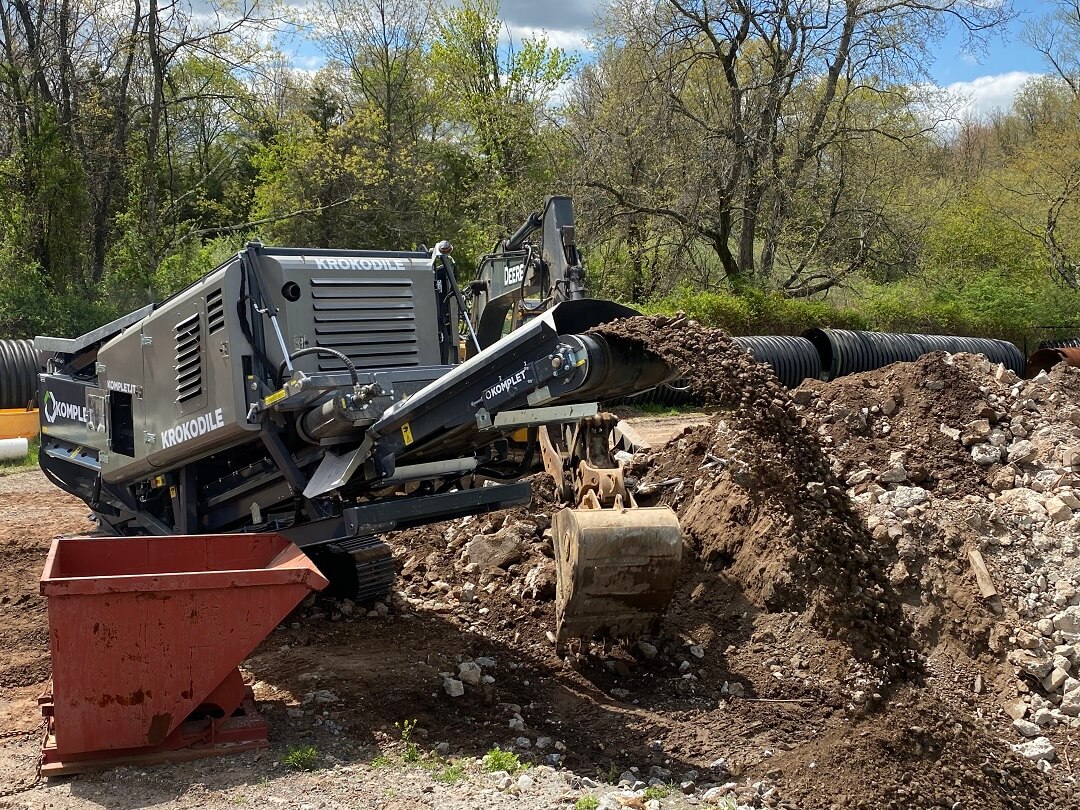

A fixed concrete shredder is the right choice for a permanent recycling facility processing high tonnage from a single location. A mobile concrete shredder — specifically a slow-speed, tracked, dual-shaft machine like the Komplet Krokodile PLUS — is the right choice for contractors, demolition specialists, and recyclers who process concrete at multiple jobsites or whose operation needs to reposition during the workday. The decision turns on three factors: how often the equipment moves, what other materials it processes, and whether on-site processing or transfer-station hauling delivers the better economics for your project mix.
This guide explains both equipment categories in operating terms — what each is engineered to do, where each fits, the trade-offs that actually matter, and where the Krokodile PLUS slow-speed shredder fits in the Komplet lineup as the mobile answer for contractors processing concrete, asphalt, brick, block, rubble, and the soft mixed C&D waste stream.
Important up front: a slow-speed dual-shaft shredder like the Krokodile PLUS does shred concrete and asphalt — at up to 175 US tph with the C&D/asphalt shaft configuration. Older content describing slow-speed shredders as “soft waste only” reflects an outdated understanding of the technology. Modern slow-speed shredders with the right shaft tooling handle hard mineral material as readily as wood, drywall, plastics, and mixed waste.
What a Concrete Shredder Actually Does
“Concrete shredder” is a market term, not a precise machine category. Two technologies compete for the work, and choosing well requires understanding which you actually have:
Slow-Speed Dual-Shaft Shredders
Slow-speed shredders use two parallel shafts turning at low RPM with high torque, fitted with interchangeable teeth sized for the material stream. The shafts pull material between them and tear it apart — concrete fractures along its weak planes, asphalt breaks at the binder-aggregate interface, wood splinters, drywall pulverizes, and embedded ferrous metals (rebar, nails, brackets) get separated and recovered with downstream magnetic separation. The Krokodile PLUS is a slow-speed dual-shaft machine.
High-Speed Hammer Mills and Impactors
High-speed machines spin a rotor at high RPM with hammers or blow bars that strike the material. They produce finer output sizes faster on clean concrete but are unforgiving with embedded metal, mixed waste, or cohesive material. They also generate substantially more dust and noise than slow-speed equipment. For Komplet’s compact mobile lineup, the equivalent technology category is the impact crusher (the K-IC 70 compact impact crusher), which handles cubical aggregate production, RAP reduction, and DOT-spec material — different from a shredder but in the same productivity conversation for some applications.
Fixed Concrete Shredders: When They Make Sense
A fixed shredder lives at one address. It is bolted to a foundation, fed by conveyors and grizzly screens, integrated with permanent dust suppression, and supported by stationary downstream sorting and stockpiling. The economics make sense when:
- The facility handles consistent, high tonnage from a single location — typically a permanent C&D recycling facility, a quarry, or a high-volume concrete recycling yard.
- Inbound material arrives by truck, so the shredder doesn’t need to move to the material.
- Throughput requirements exceed what compact mobile equipment can deliver.
- The capital cost of a permanent installation can be amortized over many years of single-location operation.
Fixed installations win on raw throughput and on integration with downstream sorting. They lose on flexibility — once installed, they don’t move. They also lose on capital efficiency for any operation where the alternative is paying tipping fees instead of running owned equipment.
Mobile Concrete Shredders: When They Make Sense
A mobile shredder travels to the work. It is tracked, self-propelled, and engineered for setup in hours rather than weeks. It is the right answer when:
- The operator is a contractor processing material at multiple jobsites — demolition, civil, road and bridge, or recycling.
- The material stream changes between jobs (concrete on one project, mixed C&D on the next, wood and green waste on a third).
- On-site processing eliminates the round-trip hauling and tipping fees that would otherwise consume project margin.
- The yard or jobsite footprint is too small for permanent installation.
- The operation is contractor-scale or demolition-scale, not industrial-recycling-facility scale.
Mobile shredders win on flexibility, capital efficiency, and on-site processing economics. They lose on absolute peak throughput compared to large fixed installations — but for the contractor segment, peak throughput is rarely the binding constraint.
The Krokodile PLUS: Komplet’s Mobile Concrete Shredder
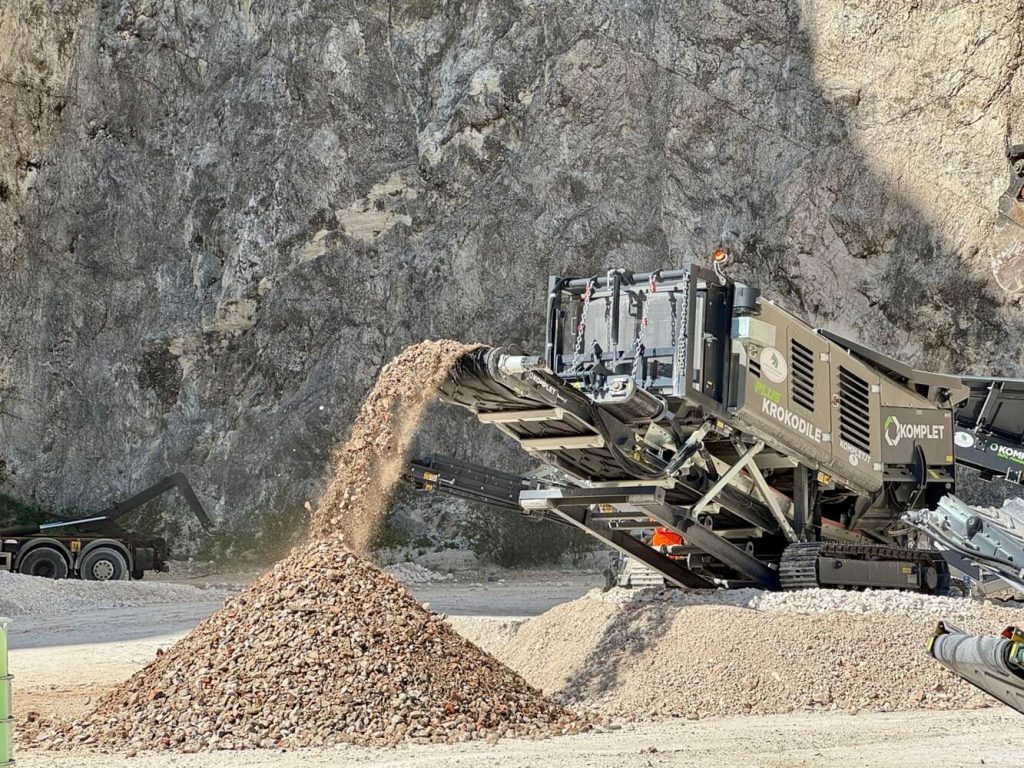
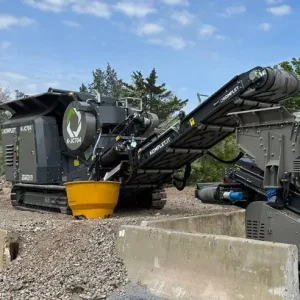
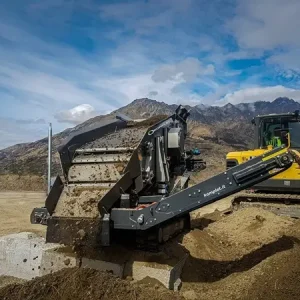
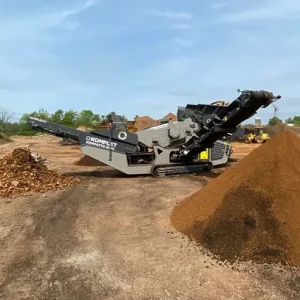
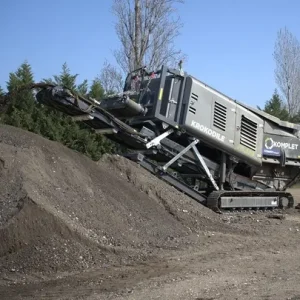
The Krokodile PLUS slow-speed shredder is Komplet’s mobile shredder. It is tracked, self-propelled, wireless-remote-controlled, and engineered with a quick-change shaft system that lets a single machine handle both the hard mineral and soft mixed-waste sides of the C&D stream.
Specifications
- Engine: 220 hp Volvo Penta Tier 4 Final diesel
- Shaft: 60-inch (1,500 mm), 0–35 rpm, 160,000 Nm torque
- Production (C&D / Asphalt): up to 175 US tph
- Production (mixed waste): up to 19 US tph
- Production (waste plastic): up to 18 US tph
- Output (C&D / Asphalt): 0 to 3-1/4 inches
- Output (waste plastic): 0 to 12 inches
- Weight: 34,171 lb
- Drive: Self-propelled on rubber tracks
- Control: Wireless remote
- Komplet Connect remote monitoring: standard
Two Shafts, One Machine
The Krokodile PLUS uses interchangeable shafts. The shaft change is engineered as a quick-change operation, not a factory rebuild. Two shaft options:
- C&D / Asphalt shaft — for concrete, asphalt, brick, block, and rubble. This is the configuration that processes concrete at up to 175 US tph. Output sizes from 0 to 3-1/4 inches.
- Wood / Lightweight Waste shaft — for wood, drywall, plastics, garbage, mixed waste, and green compost material. The same machine, different teeth, different material profile.
That dual-capability matters because most demolition and C&D recycling operations encounter both streams in the same project. A demolished building produces a hard fraction (concrete, masonry, asphalt) and a soft fraction (wood framing, drywall, plastic, packaging, fixtures). One Krokodile PLUS, two shaft configurations, both fractions handled.
Shredding Modes
The Krokodile PLUS offers C&D, Wood, Waste, Customized, and Synchronized/Asynchronized shredding modes. Mode selection affects shaft rotation behavior — synchronized rotation for clean cuts on uniform material, asynchronized for mixed feeds, asphalt mode for thermoplastic asphalt behavior, and so on. Operators dial in the mode for the actual material being processed rather than running every job in a single setting.
What the Krokodile PLUS Doesn’t Do
Honest framing: the Krokodile PLUS is built for C&D and waste streams, not virgin rock or thick metal. It does not replace a jaw crusher or impact crusher for primary rock reduction, and it is not engineered to shred large solid metal.
- Virgin rock (stone) — not the right tool. For natural rock reduction, use a jaw crusher (K-JC 503, K-JC 604, K-JC 704 PLUS, or K-JC 805) or an impact crusher (K-IC 70).
- Thick solid metal — not the right tool. The Krokodile PLUS handles embedded ferrous metal in C&D streams (rebar in concrete, nails in wood, brackets in framing) — but solid steel beams, vehicle bodies, and similar thick metal stock are outside its design envelope.
- Hazardous materials — not the right tool. Komplet equipment is for inert and standard C&D waste streams, not regulated hazardous material.
For everything else — concrete (with or without rebar), asphalt, brick, block, rubble, wood (clean, painted, treated, with embedded fasteners), drywall, plastics, garbage, mixed C&D, green waste, tree roots, and white goods — the Krokodile PLUS is the answer.
Choosing Between Fixed and Mobile: The Decision Framework
Question 1: Where Does the Material Originate?
If the material always arrives at one address (a recycling facility accepting outside C&D), a fixed installation is on the table. If the material is generated at jobsites that change every few weeks, mobile is the only practical answer.
Question 2: How Much Volume Per Year?
Permanent fixed installations are sized for hundreds of thousands of tons per year. The Krokodile PLUS sized at up to 175 US tph delivers contractor-scale to small-recycler-scale annual volume — typically tens of thousands of tons per year per machine, depending on hours run. The crossover point depends on hours, but operations running below 50,000 to 100,000 tons per year almost always favor mobile.
Question 3: What Mix of Materials?
Single-stream operations (e.g., a dedicated concrete recycling yard) can justify equipment specialized for that one material. Mixed-stream operations (general C&D, demolition, civil) need flexibility — and the Krokodile PLUS’s quick-change shaft system is engineered exactly for that mixed-stream profile.
Question 4: What’s the Capital Profile?
Komplet Capital offers 100% financing, 24-hour approvals, and 36/48/60/72-month terms.
Question 5: How Important is Setup Speed?
Fixed installation setup is measured in months. Krokodile PLUS setup at a new yard is measured in hours. For contractors who need processing capability online before the next quarter, that timing difference is itself the answer.
Where Each Type Wins
Fixed Shredders Win For
- Permanent C&D recycling facilities accepting outside material with tipping-fee revenue
- Large concrete-only recycling yards with consistent inbound supply
- Industrial-scale operations beyond compact-mobile-equipment scale
- Operators with the capital, permits, and real estate to support a permanent installation
Mobile Shredders (Krokodile PLUS) Win For
- Demolition contractors processing material on the active project site
- Civil, road, and bridge contractors recycling concrete and RAP in place
- Recycling facilities that need flexible processing capacity inside a fixed yard
- Wood waste recyclers, composting facilities, and municipal yards handling mixed organic streams
- Concrete and asphalt quarries needing on-site reduction capability without a fixed plant
- Operations that move equipment between yard locations or active projects
Pairing the Krokodile PLUS With the Rest of the Komplet Lineup
The Krokodile PLUS rarely runs alone on a real jobsite. Standard pairings:
Krokodile PLUS + Jaw Crusher (Two-Stage Hard Material)
For very large-feed concrete or mixed C&D, the Krokodile PLUS reduces the input to manageable size, then a jaw crusher (typically the K-JC 704 PLUS or K-JC 805) finishes it down to spec aggregate. Two-stage processing handles oversize input that would jam a single jaw crusher.
Krokodile PLUS + Screener
Krokodile PLUS output goes to a Kompatto 5030 or Kompatto 124 vibrating screener to separate product cuts. The screener attachment is also available as an integrated add-on for the Krokodile PLUS itself, turning the shredder into a one-pass production solution.
Krokodile PLUS + Tracked Conveyor
A K-TC 460 tracked mobile conveyor clears Krokodile PLUS output to a 15-foot stockpile, eliminating loader cycles for the discharge move and freeing the loader for hopper feeding or truck loading.
Frequently Asked Questions
Can the Krokodile PLUS shred concrete?
Yes. With the C&D / Asphalt shaft configuration, the Krokodile PLUS shreds concrete (with or without rebar), asphalt, brick, block, and rubble at up to 175 US tph. The dual-shaft slow-speed design generates the torque required for hard mineral material — that’s a defining capability of the machine, not an exception.
What materials can’t the Krokodile PLUS handle?
Virgin rock (stone) and thick solid metal are outside the Krokodile PLUS’s design envelope. For natural rock reduction, use a Komplet jaw crusher (K-JC 503 through K-JC 805) or the K-IC 70 impact crusher. For everything else — C&D, asphalt, wood (including treated and metal-embedded), drywall, plastics, garbage, mixed waste, green compost — the Krokodile PLUS is the right tool.
How is a slow-speed shredder different from a fast-speed grinder?
Slow-speed shredders run two shafts at low RPM with high torque, tearing material apart between the shafts. Fast-speed grinders spin a single rotor at high RPM with hammers that strike the material. Slow-speed shredders tolerate embedded metal and mixed waste, generate less dust and noise, and are more energy-efficient per ton on heavy material. Fast-speed grinders produce finer output faster on clean, uniform material but are unforgiving with metal, cohesive material, or mixed streams.
Should I get a fixed or a mobile concrete shredder?
A fixed shredder is the right choice for permanent recycling facilities processing high tonnage from one location. A mobile shredder like the Krokodile PLUS is the right choice for contractors, demolition operators, and recyclers who process material at multiple jobsites or whose operation needs to reposition during the day. Most non-industrial-scale operations favor mobile on capital efficiency, setup speed, and on-site processing economics.
How heavy is the Krokodile PLUS?
The Krokodile PLUS weighs 34,171 lb. It is tracked and self-propelled, transported on a heavy trailer between jobsites, and walks on its own rubber tracks once on site.
Does the Krokodile PLUS have remote monitoring?
Yes. Komplet Connect remote monitoring is standard on the Krokodile PLUS, giving operators and dealers visibility into operating hours, fault codes, fluid levels, and service intervals from a connected app. The same capability is standard on the K-JC 704 PLUS and K-JC 805.
What’s the typical financing for a Krokodile PLUS?
Komplet Capital offers 100% financing, 24-hour approvals, and 36/48/60/72-month term options. Section 179 tax deduction may apply for qualifying purchases. Many contractors structure the monthly payment to be fully covered by the tipping fees they would otherwise pay to haul concrete and C&D off-site.
Can I rent a Krokodile PLUS before buying?
Komplet America does not rent directly to end-users, but the authorized Komplet dealer network handles rentals across most of North and Central America. Renting before buying is a sound way to validate the productivity and economics on your own jobsite before committing capital.
Final Thoughts
The fixed-vs-mobile choice is rarely close once the operating context is clear. Permanent recycling facilities at industrial scale need fixed installations. Contractors, demolition specialists, civil and road operators, and yard-based recyclers at compact scale need mobile equipment. The Krokodile PLUS is the mobile answer in the Komplet lineup — built specifically to handle the full C&D waste stream including concrete and asphalt at production rates, paired with quick-change shafts that let the same machine pivot to wood, drywall, plastics, and mixed waste when the project changes.
For most contractors weighing the question, the operative comparison is not fixed-vs-mobile but rather Krokodile PLUS vs. tipping fees and hauling miles. That comparison is usually decisive.
Komplet America builds compact crushers, screeners, the Krokodile PLUS slow-speed shredder, and the K-TC 460 tracked mobile conveyor for contractors who need real production in tight footprints. To see the full lineup, explore the crusher, screener, shredder, and conveyor categories. To talk financing or pricing, contact Komplet Capital, visit the contact page, or call (908) 369-3340.
Ready to add a mobile concrete shredder to your operation?
- Review the Krokodile PLUS specs, shaft options, and pricing.
- Explore the full shredder lineup alongside Komplet crushers, screeners, and the K-TC 460 conveyor.
- Talk to Komplet Capital about 100 percent financing and Section 179 tax deduction eligibility.
- Save 40–70 percent with a pre-owned Krokodile or paired Komplet machine.
- Find your local Komplet dealer for rental availability.
Never enough.
Disclaimer: All operating, maintenance, and service guidance in this article is general in nature. Always refer to the official Komplet operator’s manual for the specific machine model and serial number, and follow OEM intervals and procedures. For warranty-protected work, contact Komplet America at (908) 369-3340 or your authorized Komplet dealer. Improper service or non-OEM parts may void warranty coverage and create safety hazards.
Equipment prices are subject to change based on dealer location, availability, and any additional features or customizations. Prices do not include taxes, shipping, or installation fees, which may apply depending on your region. Contact Komplet America at (908) 369-3340 or visit kompletamerica.com for current pricing.