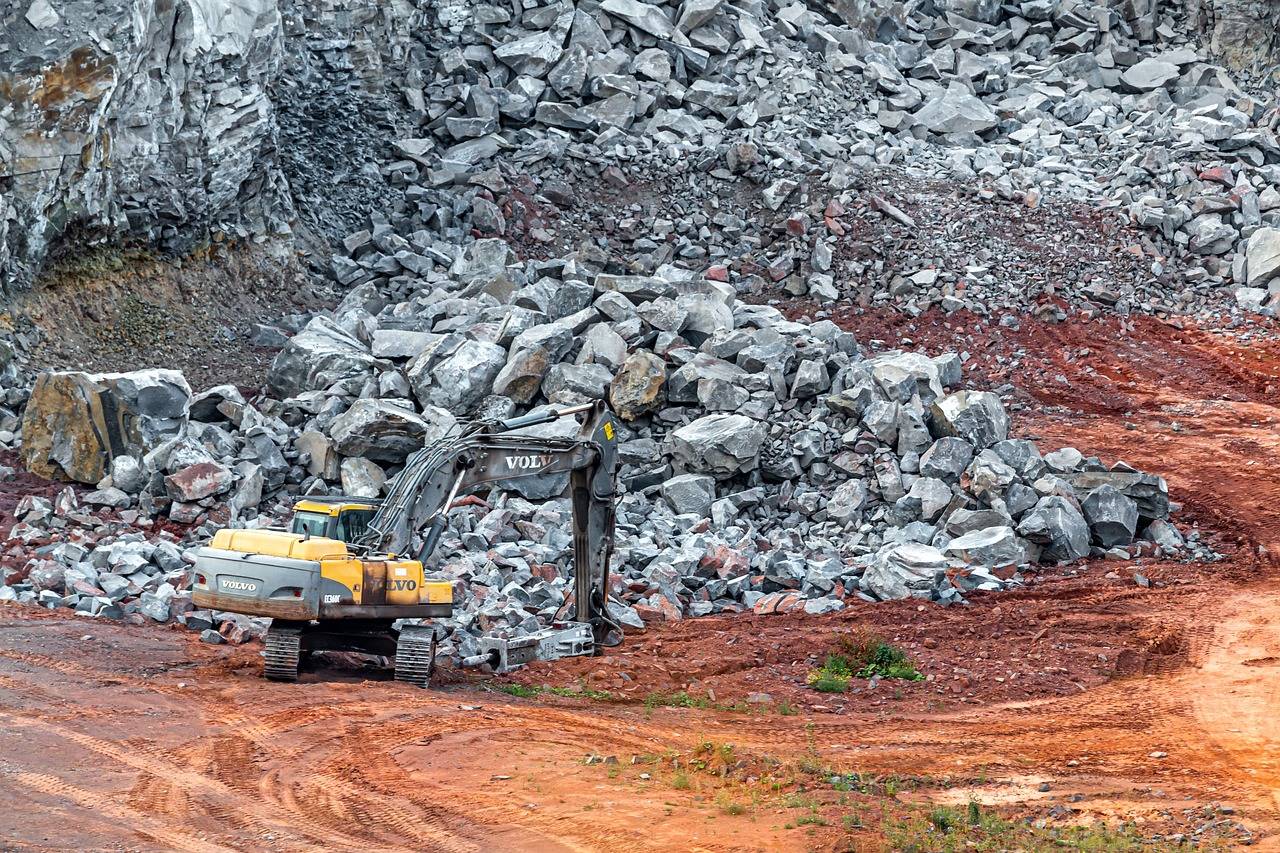

Crushing stone is how raw rock becomes saleable product. Done right, it turns boulders, quarry run, demolition debris, or excavated material into spec-sized aggregate you can use on-site, sell to other contractors, or deliver to builders and municipalities. Done wrong, you burn fuel, destroy wear parts, and end up with piles of off-spec material that nobody wants.
This guide walks through the actual process of crushing stone — how to match the crusher to the rock, size the machine to your volume, feed it correctly, control dust, and screen the output into finished product. If you’re new to on-site crushing or evaluating a first crusher purchase, this is written to give you a realistic picture of how the work gets done and what equipment actually fits.
Step 1: Know Your Stone
Before you pick a crusher, you need to know what you’re crushing. Rock varies enormously in hardness, abrasiveness, and structure — and the right machine depends on what’s in front of you.
Soft to Medium Rock
Sandstone, shale, softer limestone, weathered concrete, brick, and clay-based material. These crush relatively easily and don’t punish wear parts. Impact crushers and jaw crushers both work, but impact crushers typically deliver a better cubical product for asphalt and concrete mix applications.
Medium to Hard Rock
Harder limestone, bluestone, trap rock, quartzite, and most reinforced concrete. This is where jaw crushers earn their keep — the compressive crushing action handles abrasive, high-strength material without the rapid wear that blow bar/hammer-style crushers suffer.
Hard Rock
Granite, basalt, gabbro, and the hardest virgin stone. These materials demand a serious jaw crusher with heavy jaw plates, a reinforced frame, and a proven drivetrain. Undersized equipment will not survive hard-rock production — plan for a larger machine than you think you need.
Mixed C&D Debris
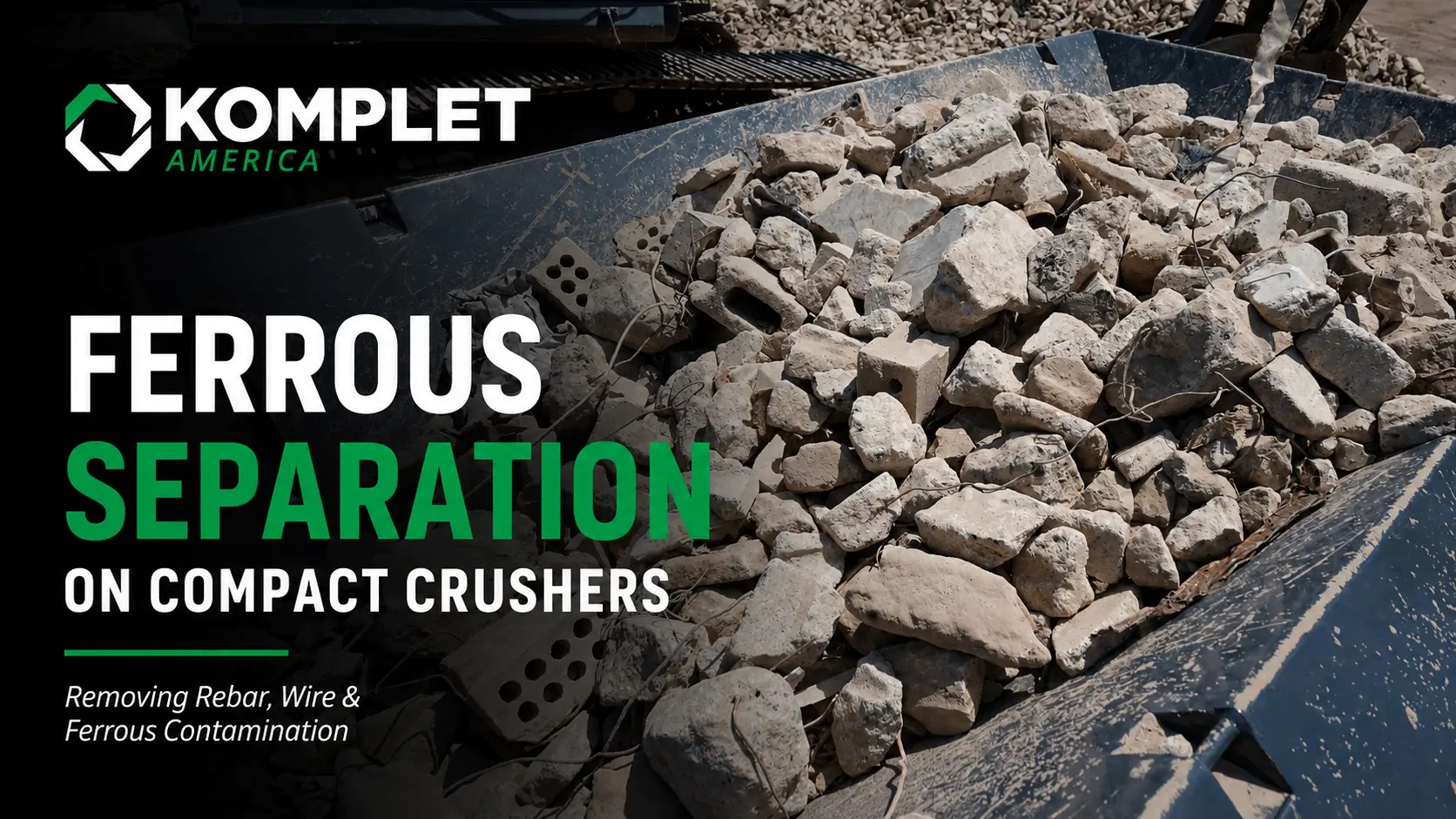
Concrete with rebar, brick, block, asphalt millings, and mixed demolition debris. A jaw crusher with a hydraulic reverse jaw function (to clear sticky material or uncrushables) plus a hydraulic magnetic belt to separate rebar is the right tool. Komplet’s K-JC 604, K-JC 704 PLUS, and K-JC 805 all include both features as standard.
Step 2: Match the Crusher to the Job
Once you know your material, the next decision is which crusher type handles it best. There are four common crusher types in mobile compact equipment — and each has a specific job.
Jaw Crushers: The Primary Workhorse
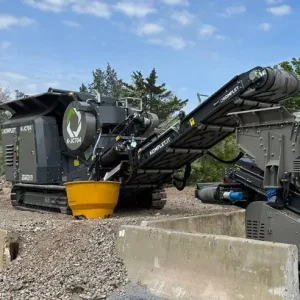
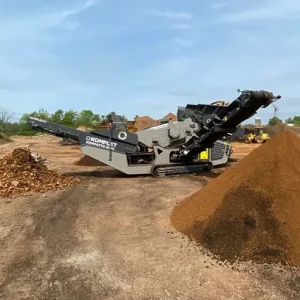
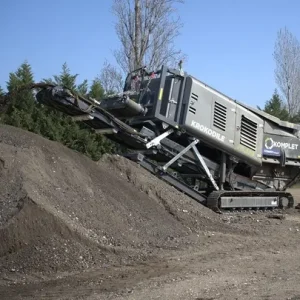
A jaw crusher uses two heavy steel plates (one fixed, one moving) to compress and fracture rock inside a V-shaped chamber. Jaw crushers are built for primary crushing: they take the biggest, hardest, roughest feed material and reduce it to a manageable size for further processing or finished product.
Best for: Hard rock, reinforced concrete, large feed material, and abrasive stone. This is the default choice for most contractor and recycler operations.
Komplet’s jaw crusher lineup:
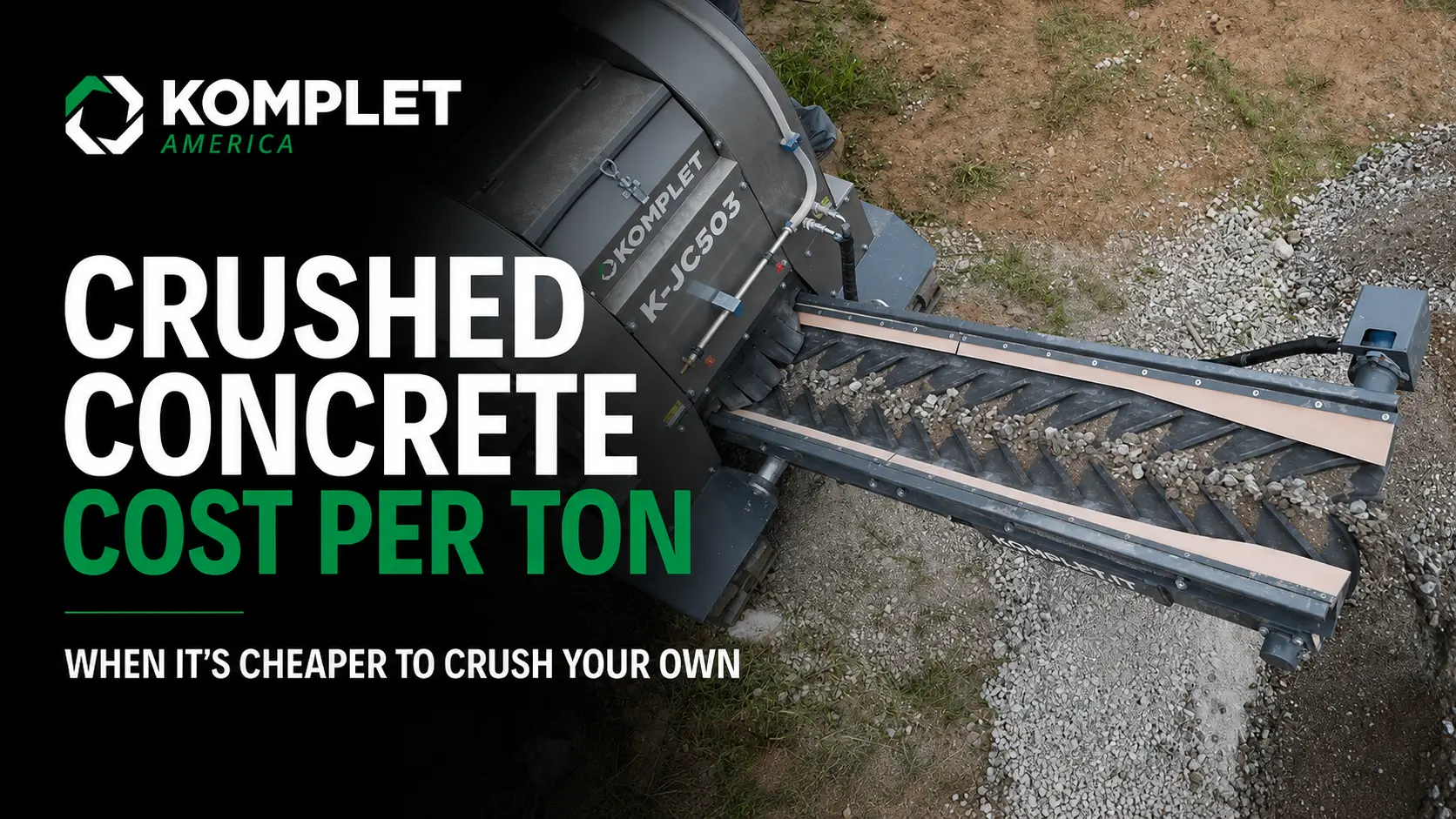
- K-JC 503 — up to 34 US tph, 19″ x 12″ jaw. The most compact tracked jaw crusher on the market for urban demo and tight-access sites.
- K-JC 604 — up to 55 US tph, 23″ x 16″ jaw. Mid-range contractor machine.
- K-JC 704 PLUS — up to 90 US tph, 27″ x 16″ jaw. Komplet’s best-selling crusher and the universal workhorse for C&D recycling and demolition.
- K-JC 805 — up to 160 US tph, 31″ x 21″ jaw. Komplet America’s largest mobile jaw for high-volume stone producers and quarry-scale operations.
Impact Crushers: Cubical Product and Secondary Crushing
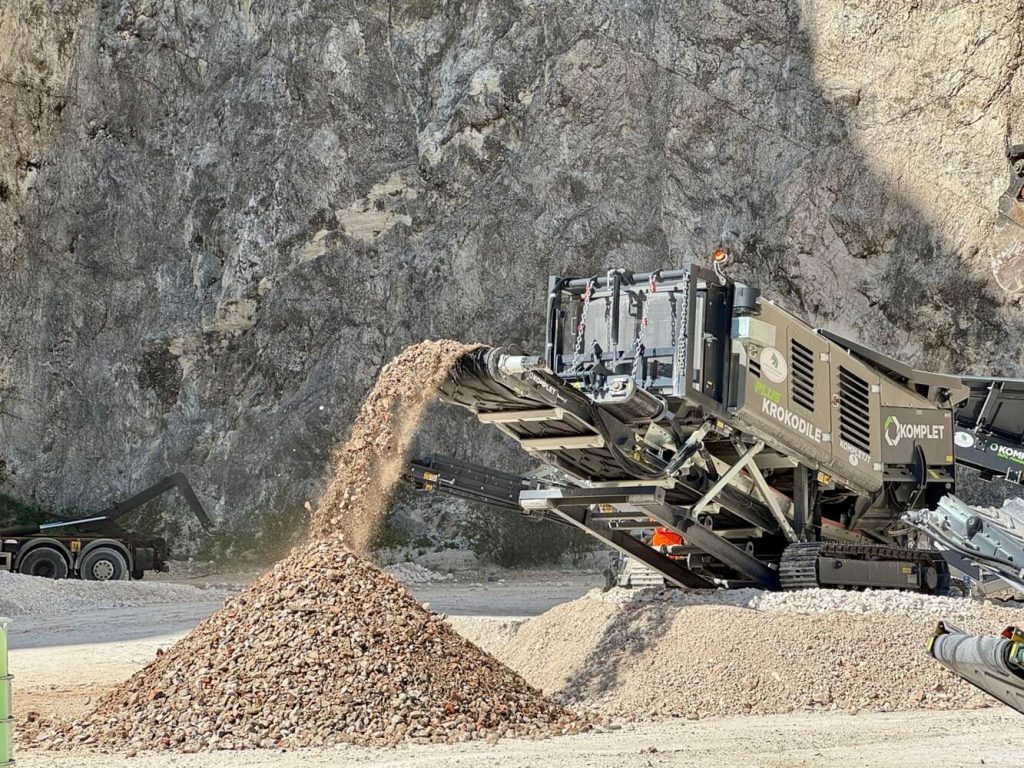
Impact crushers use high-speed rotating blow bars to shatter stone against impact aprons. The result is a more cubical, spec-friendly product than a jaw produces. Impact crushers handle soft-to-medium rock well, excel at asphalt recycling, and are often used as a secondary crusher after a primary jaw.
Best for: Softer-to-medium stone, asphalt recycling, secondary crushing, cubical aggregate where spec shape matters.
Komplet’s K-IC 70 Compact Impact Crusher — up to 90 US tph, 25″ x 20″ feed opening, 100 HP — is Komplet’s only impact crusher. It delivers the cubical output shape that jaw crushers cannot, and dust suppression is standard.
Cone Crushers: Secondary and Tertiary Only
Cone crushers compress already-crushed material between a rotating mantle and a stationary concave bowl. They produce excellent gradation on medium-to-hard rock — but they require closely sized feed. Cone crushers are not primary crushers; they run downstream of a jaw or impact in a multi-stage plant.
Best for: Secondary or tertiary crushing in multi-stage quarry plants. Fine aggregate production from pre-crushed feed.
Komplet does not manufacture cone crushers. For most mobile contractor and small-quarry applications, a properly sized jaw crusher followed by screening delivers the spec aggregate needed without the complexity and expense of a cone stage.
Hammer Crushers (Hammer Mills): Limited Use
Hammer crushers use a high-speed rotor with swinging hammers to shatter stone on contact. They are fast and relatively inexpensive but generate significant fines and dust, and wear rates on the hammers are high with abrasive rock. Limited use in modern virgin-stone production due to wear economics — jaw and impact crushers are more cost-effective choices for most operations.
Step 3: Size the Machine to Your Volume and Feed
Sizing is where most contractors make mistakes. Oversizing costs you capital you don’t need. Undersizing costs you production every day you own the machine. Three numbers matter:
- Maximum feed size. The largest chunk of material that can enter the crusher without binding. Match this to the biggest piece you realistically produce. For a jaw crusher, max feed is roughly 80% of the jaw gape opening. On Komplet’s lineup that works out to about 9-1/2″ for the K-JC 503, 12-3/4″ for the K-JC 604 and 704 PLUS, and 16-3/4″ for the K-JC 805.
- Target output size. The finished product you need (3/4″ base, #57 stone, 2″ minus, etc.). Jaw crushers hit 20-80mm (3/4″ to 3-1/4″) on most Komplet models. If you need finer output, plan for a secondary impact crusher or screening stage.
- Tons per hour needed. Your actual daily volume divided by operating hours. Most contractors overestimate — 90 US tph on a K-JC 704 PLUS running six hours a day is 540 tons per day, which covers almost every contractor and mid-size recycler operation.
A reliable rule of thumb: if you’re doing demolition or concrete recycling, start with the K-JC 704 PLUS unless your volume clearly justifies more. If you’re quarry-scale or running multiple crews, step up to the K-JC 805. If you’re in tight-access urban work, drop down to the K-JC 503 or 604.
Step 4: Run the Crushing Process
The actual on-site crushing workflow is straightforward when equipment is set up correctly. Here’s the typical sequence:
4.1 Set Up the Machine
Track the crusher into position using the wireless remote. Komplet machines set up in under 15 minutes — unfold the output conveyor, unfold the hopper extensions, connect the water supply for dust suppression, and run a brief warm-up. Check the CSS (closed-side setting) on the jaw and confirm the target output size using the hydraulic adjustment from the remote.
4.2 Feed Consistently
Material is loaded into the crusher’s hopper using an excavator or wheel loader. Consistency matters: a steady feed rate produces consistent output, protects the crusher from shock loading, and maximizes throughput. Avoid dumping massive single loads — meter the material steadily. Komplet’s integrated feeder and grizzly (on the K-JC 604, 704 PLUS, and 805) pre-screens fines out of the circuit before they hit the jaw, improving efficiency.
4.3 Monitor Output and Wear
Watch the output stream. Consistent sizing means your jaw plates are in good condition and the CSS is right. If you see excessive fines or oversize, adjust the CSS on the fly using the wireless remote. Monitor wear plates — reversible jaw plates (standard on Komplet jaws) double the life of the plates because both sides can be flipped and reused.
4.4 Handle Rebar and Uncrushables
Reinforced concrete contains rebar. The hydraulic magnetic belt on Komplet jaw crushers lifts rebar off the output stream. For stubborn uncrushable material (piece of metal, oversized chunk), use the reverse jaw function via the wireless remote to back the material out — no operator needs to enter the crushing chamber.
4.5 Control Dust
Dust suppression is standard on every Komplet crusher — water spray nozzles positioned at the feed hopper and discharge conveyor capture airborne silica before it drifts. This is critical for OSHA silica PEL compliance (50 ug/m3) on virgin stone and C&D jobs. With Komplet, dust suppression ships standard — no retrofit, no add-on cost, no extra-cost option.
Step 5: Screen the Output Into Spec Sizes
Crushing reduces size. Screening separates the crushed material into spec-sized fractions you can sell or use. Any serious stone operation needs both.
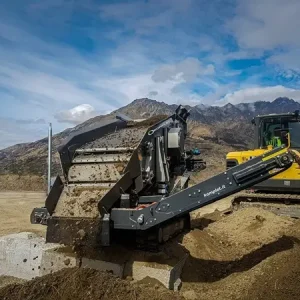
Komplet America’s mobile scalping screeners pair directly with any Komplet crusher to produce two or three spec sizes in a single workflow:
- Kompatto 221 — up to 90 US tph, 7′ x 3.5′ two-deck. Compact and ideal for tight-access sites paired with the K-JC 503 or K-JC 704 PLUS.
- Kompatto 5030 — Komplet’s best-selling screener, up to 280 US tph. Heavy-duty double-deck with 3-way split for producing three spec sizes simultaneously.
- Kompatto 124 — Komplet America’s largest mobile scalping screen, up to 350 tph. 11.8′ x 3.7′ top deck, 75 HP. For serious daily throughput and rental fleets.
A K-TC 460 tracked conveyor — up to 132 US tph, 25″ x 393″ Chevron 3-ply belt — extends material reach from the crusher or screener, reduces loader dependency, and builds cleaner, higher stockpiles.
Step 6: Turn Crushed Stone Into Revenue
Crushing stone isn’t just about producing material — it’s about controlling margin. Every ton you crush on-site is a ton you didn’t pay to haul away, didn’t pay to import, and didn’t pay someone else to produce. For active contractors, the math is fast.
Example: K-JC 704 PLUS on a Mid-Size Operation
Mid-size demolition contractor producing 2,000 tons of concrete debris per month. Local dump fee: $75/ton. Virgin aggregate cost: $20/ton. Truck hauling: $300 per 25-ton load.
- Old workflow: Dump fees = $150,000/month. Hauling = $24,000/month. Aggregate purchases = $20,000/month. Total monthly outflow approx. $194,000.
- New workflow with K-JC 704 PLUS: Gross monthly benefit = $194,000. Finance payment (~$5,100/month on 5-year term via Komplet Capital). Operating costs (~$4,000/month). Net monthly benefit approx. $185,000.
- Payback: First month. The machine pays for itself before the second payment.
In markets with tipping fees above $50/ton, the K-JC 704 PLUS typically pays back in 3 to 8 months of full-use operation. For your specific volume and local aggregate pricing, call 908-369-3340 and we’ll run the numbers with you.
Frequently Asked Questions
What’s the easiest way to crush large rocks?
For soft rock (sandstone, weathered limestone), an excavator-mounted hydraulic breaker can handle smaller jobs. For medium to hard rock at any volume, a jaw crusher is faster, produces consistent spec product, and pays for itself through dump fee savings and aggregate revenue. Hydraulic breakers are cheap on day one but slow and expensive on day 365.
What types of stone can you crush with a mobile jaw crusher?
Most natural stone: granite, basalt, limestone, quartzite, bluestone, trap rock, sandstone, and river rock. Mobile jaw crushers also handle C&D debris (concrete, brick, block), asphalt, and reinforced concrete. Komplet’s K-JC 704 PLUS handles all of these with its 27″ x 16″ jaw and hydraulic CSS adjustment.
How much stone can a mobile crusher process per day?
Production depends on the model and operating conditions. A K-JC 503 produces up to 34 US tph — roughly 200 tons per 6-hour day. A K-JC 704 PLUS at up to 90 US tph can produce 500-600 tons per day. A K-JC 805 at up to 160 US tph can produce 900+ tons per day. All figures are maximums under ideal conditions with consistent feed, skilled operator, and proper material.
What’s the difference between a jaw crusher and an impact crusher for stone?
A jaw crusher uses compression between two plates — best for hard, abrasive rock and large feed material. An impact crusher uses high-speed blow bars — best for softer-to-medium rock and producing cubical aggregate for asphalt and concrete mixes. Many operations run both in sequence: jaw for primary reduction, impact for secondary shaping.
Do I need dust suppression on a stone crusher?
Yes — OSHA silica regulations (PEL of 50 ug/m3) require dust control on any operation producing respirable crystalline silica, which includes all stone and concrete crushing. The good news: every Komplet crusher ships with dust suppression water spray nozzles as standard equipment. That means OSHA-ready out of the box with no retrofit or add-on cost. (Note: on Komplet’s Kompatto screeners, dust suppression is available as an option at order time — specify it if you’re screening dusty material.)
How long does setup take on a mobile stone crusher?
Under 15 minutes from transport to production on most Komplet crushers. Tracked mobility, hydraulically folding conveyors, and wireless remote control make setup a one-operator job. Arrive on site, drop the tracks, unfold the conveyors, connect water for dust suppression, and start feeding.
Can I finance a stone crusher?
Yes. Komplet Capital — Komplet America’s in-house financing arm — offers 24-hour credit approval, 100% financing, 3-6 year terms, and bad credit is not an automatic disqualifier. Many customers structure their monthly payment so it’s fully covered by dump-fee savings alone. New equipment is also Section 179 tax deductible — up to $1.22M of equipment purchases fully deductible in the year of purchase (2024 limit).
Final Thoughts
The right stone-crushing process pays for itself in three ways at once: it eliminates dump fees, replaces purchased aggregate, and creates a new product line to sell. Getting it right is mostly about matching the crusher type to your rock, sizing the machine to your actual throughput, and pairing the crusher with enough screening capacity to turn output into spec sizes.
Komplet America’s compact mobile crushers — from the K-JC 503 for urban demo up to the K-JC 805 for quarry-scale production, plus the K-IC 70 impact crusher for asphalt and cubical aggregate — are engineered for the contractor-scale operator who needs real production without the footprint of a stationary plant. Browse our full crusher lineup and screeners to see the combinations that fit your material and throughput, or reach out and we’ll help you spec it.
Ready to Start Crushing Stone?
- Call 908-369-3340
- Email [email protected]
- Schedule a demo or request a quote
- Ask about our 1-year / 1,000-hour warranty and equipment financing options
Never enough — that’s how we approach service, support, and helping you turn raw rock into spec-sized product.
Disclaimer: All ROI, payback, and revenue figures in this article are illustrative examples based on sample assumptions about volume, local pricing, material mix, and operating conditions. Actual results vary significantly by region, market, material type, equipment utilization, operator skill, financing terms, and many other factors. Dump fees, aggregate pricing, fuel costs, hauling rates, and interest rates all change over time and by location. Komplet America makes no guarantee, warranty, or representation of specific financial performance or payback timelines for any particular operation. For a payback estimate based on your specific volume, material, and local market, contact us at 908-369-3340 to speak with our team.