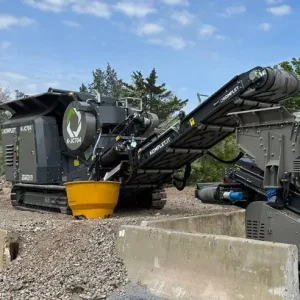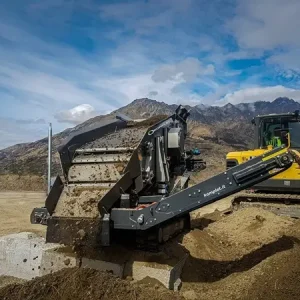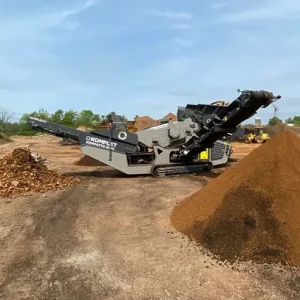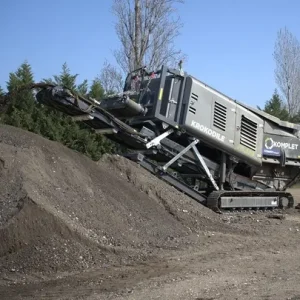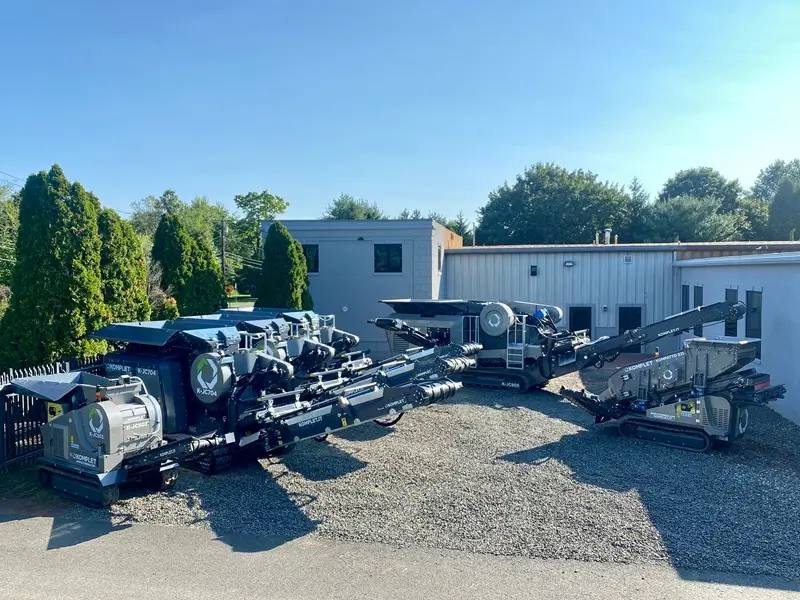

Choosing the right jaw crusher is one of the more consequential equipment decisions a contractor, recycler, or rental house makes. The wrong machine costs you in fuel burn, bottlenecked throughput, missed feed-size targets, and underused capital. The right machine pays you back through tighter project timelines, lower hauling and tipping costs, and the ability to turn demolition debris into usable aggregate on the same site that produced it.
Komplet America carries a full lineup of compact jaw and impact crushers built specifically for on-site concrete and aggregate processing in North America. Each machine in the Komplet crusher range is engineered around a different sweet spot — from the smallest tracked unit small enough to fit on a deck-over trailer, up to the largest model rated for heavy demolition flow rates. This guide walks through every current Komplet jaw and impact crusher with verified specs, the materials each handles, recommended feed sizing, and how to match a machine to the work in front of you.
Why Choosing the Right Jaw Crusher Matters
A jaw crusher’s job is to take large, irregular hard material and reduce it through compressive force into smaller, more uniform pieces — typically aggregate ranging from sub-inch product up to a few inches. The constraints that matter on every jobsite are simple: how big is the feed material, how much volume comes through per day, how much room do you have to set up, and how often does the machine need to move?
Buying a crusher that’s too small means production becomes the bottleneck of your job. Buying one that’s too large means you’re hauling, fueling, and financing more machine than the work justifies. The Komplet lineup is structured precisely so contractors can step up or step down without leaving the brand — every machine shares the same core philosophy of compact size, tracked mobility, single-operator remote control, and a feature set built for North American demolition and recycling.
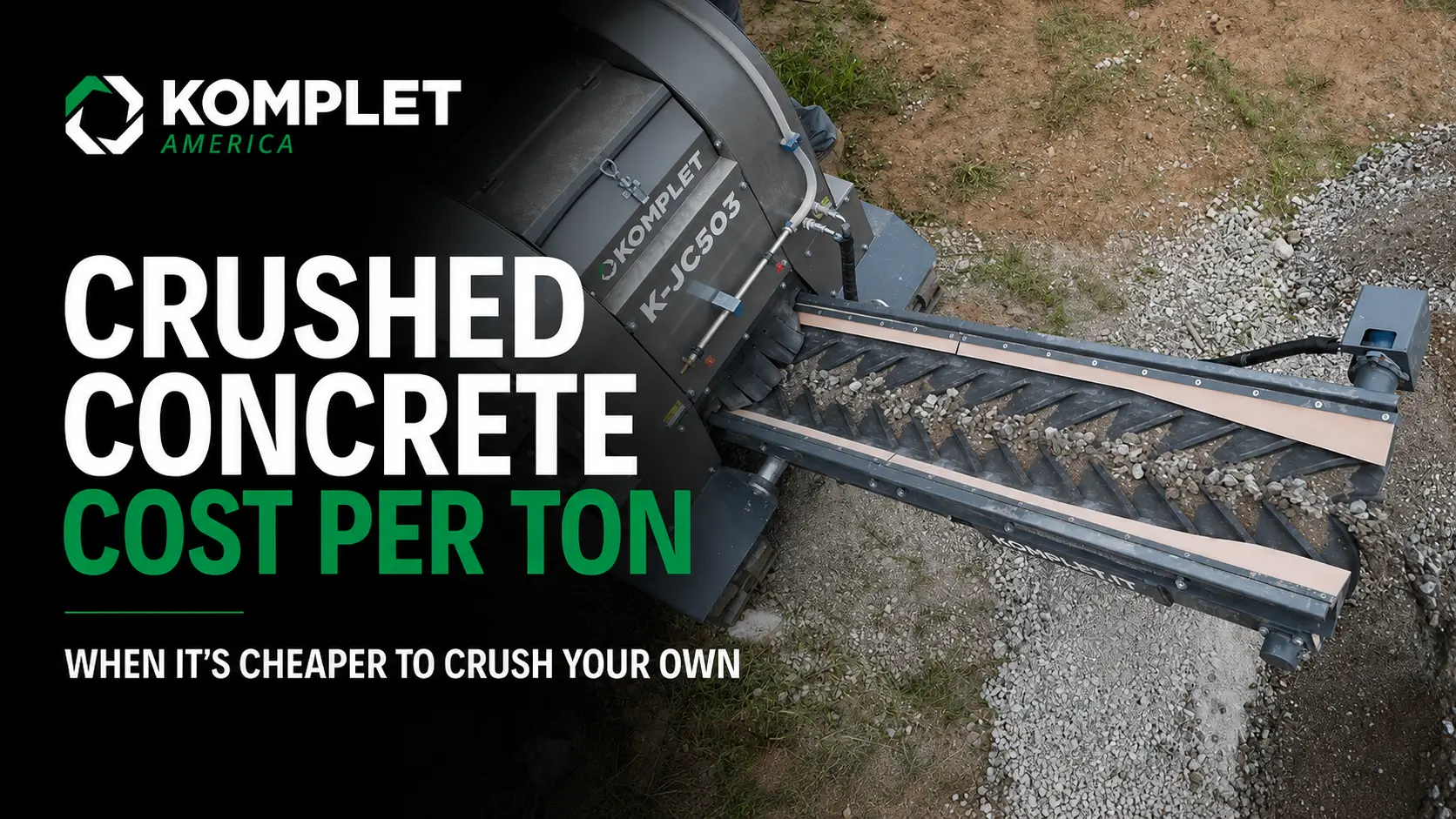
K-JC 503 — The Compact Mini Jaw Crusher
The K-JC 503 mini jaw crusher is the smallest tracked jaw crusher in the Komplet lineup. It is the entry point for contractors, landscapers, and rental houses that need on-site crushing capability without the footprint or transport requirements of a larger machine.
K-JC 503 Verified Specs
- Engine: Tier 4 Final diesel, approximately 25 horsepower
- Jaw inlet: 19″ × 12″ single-toggle, hydraulically adjustable
- Output capacity: up to 34 US tons per hour
- Recommended feed size: roughly 9-1/2″ minus (80% of the jaw inlet opening dimension)
- Mobility: rubber tracks, fully remote-controlled by a single operator
The 503 is purpose-built for the smaller end of the contractor market — paving repairs, foundation work, residential demolition, small site cleanups, and the kind of in-and-out jobs where transport simplicity matters as much as throughput. Its weight and footprint mean it can be moved between sites on a standard equipment trailer without specialized permits.
K-JC 604 — The Step-Up Mobile Jaw Crusher
The K-JC 604 mobile jaw crusher sits squarely in the middle of the Komplet jaw crusher range. It carries a larger jaw than the 503 with a more substantial engine, making it a strong fit for contractors whose project mix includes regular concrete and asphalt demolition work but who don’t need the production volume of the largest models.
K-JC 604 Verified Specs
- Engine: Tier 4 Final diesel, approximately 55 horsepower
- Jaw inlet: 23″ × 16″ single-toggle, hydraulically adjustable
- Recommended feed size: roughly 12-3/4″ minus
- Reverse jaw function for sticky or jammed material clearance
- Tracked mobility, remote operation, compact transport profile
The 604 is the practical choice for contractors who outgrow the 503 but don’t yet have demolition flow rates that justify a 704 PLUS or 805. It handles full-size concrete chunks, broken slab work, and mixed C&D rubble at production rates that match most municipal and mid-tier commercial demolition jobs.
K-JC 704 PLUS — The Versatile Workhorse
The K-JC 704 PLUS portable jaw crusher is the most widely sold jaw crusher in the Komplet lineup in North America. The PLUS designation reflects the latest generation of the platform — with refined hydraulics, an improved control interface, and a track configuration matched to U.S. jobsite conditions. It is the machine most contractors land on when they want a single crusher that handles the full range of typical demolition and recycling work.
K-JC 704 PLUS Verified Specs
- Engine: Tier 4 Final diesel, approximately 74 horsepower
- Jaw inlet: 27″ × 16″ single-toggle, hydraulically adjustable
- Output capacity: up to 90 US tons per hour
- Recommended feed size: roughly 12-3/4″ minus
- Track options: steel tracks with rubber pads OR full rubber tracks (selectable at order)
- Vibrating hopper with pre-jaw inlet sensor that turns the feeder on and off to prevent jams
- Reverse jaw function for sticky materials and clearing
The 704 PLUS sits in the volume-production zone where most U.S. demolition contractors operate — reinforced concrete, asphalt slabs, brick rubble, and mixed C&D debris at rates that keep up with a single excavator feeding the hopper. The two track options are a meaningful detail: steel tracks with rubber pads handle harder, more abrasive sites; full rubber tracks suit road moves and asphalt-sensitive surfaces.
K-JC 805 — The Largest Jaw Crusher
The K-JC 805 mobile jaw crusher is the largest jaw crusher in the Komplet range. It is built for contractors and recyclers whose daily production requirements exceed what a 704 PLUS can sustain, or who routinely process feed larger than the 704 PLUS’s recommended 12-3/4″ maximum. Despite the size, it retains the same compact, single-operator, remote-controlled approach that defines the rest of the Komplet lineup.
K-JC 805 Verified Specs
- Engine: Tier 4 Final diesel, approximately 130 horsepower
- Jaw inlet: 31″ × 21″ single-toggle, hydraulically adjustable
- Output capacity: up to 160 US tons per hour
- Recommended feed size: roughly 16-3/4″ minus
- Reverse jaw function for sticky applications and blockage clearance
- Anti-dust suppression system, jaw level sensor, integrated control panel
- Remote control with GPS positioning
The 805 is the right answer for contractors running steady demolition flow, larger commercial site cleanups, quarry-adjacent work, or rental fleets where one machine needs to cover the largest job size customers will bring. Its inlet handles slab and column sections that smaller machines would have to be pre-broken to feed.
K-IC 70 — The Compact Impact Crusher Alternative
The K-IC 70 compact impact crusher is not a jaw crusher — it’s an impact crusher. The reason it belongs in this comparison is that for many demolition contractors, the choice isn’t between two jaws but between a jaw and an impactor. The K-IC 70 is included here so the comparison can be made on the same page.
K-IC 70 Verified Specs
- Engine: Tier 4 Final diesel, approximately 100 horsepower
- Crushing chamber inlet: 25″ × 20″
- Recommended feed size: roughly 16″ minus
- Vibrating feeder with load sensing
- Hydraulic blockage release mechanism on crusher
- Dust suppression system
Jaw Crusher vs. Impact Crusher — The Practical Difference
A jaw crusher reduces material through compressive force — squeezing it between a fixed plate and a moving plate. An impact crusher reduces material by hammering it against breaker bars and a steel anvil. In practice, that difference matters for two reasons:
- Jaw crushers are stronger on hard, abrasive material like reinforced concrete, granite, and natural rock. They produce more angular, less rounded output. Wear costs are typically lower on hard feed.
- Impact crushers are stronger on softer, less abrasive material like clean concrete, asphalt, and lightly reinforced demolition rubble. They tend to produce more cubical, well-shaped aggregate. Wear costs are higher on hard feed.
Most demolition contractors with mixed feed lean toward jaw crushers; recyclers producing clean spec aggregate sometimes prefer impactors. The K-IC 70 gives Komplet America customers a compact impact option in the same general production class as the larger jaws.
How to Read the Recommended Feed Size
Every spec sheet shows a maximum jaw inlet dimension. The maximum is what the machine will physically accept — it is not what the machine will reliably crush at full production rate. The practical rule that Komplet America uses with customers is:
Recommended maximum feed size = roughly 20% smaller than the smallest dimension of the jaw opening.
Why? Material at the absolute maximum opening size can wedge, bridge, or stall the jaw, especially with irregular demolition rubble that has rebar, embedded fasteners, or odd geometry. Sizing your typical feed about 20% under the smallest opening dimension keeps throughput steady and prevents the operator from chasing blockages.
Recommended Feed Sizes Across the Komplet Lineup
- K-JC 503 (19″ × 12″ jaw): about 9-1/2″ minus
- K-JC 604 (23″ × 16″ jaw): about 12-3/4″ minus
- K-JC 704 PLUS (27″ × 16″ jaw): about 12-3/4″ minus
- K-JC 805 (31″ × 21″ jaw): about 16-3/4″ minus
- K-IC 70 (25″ × 20″ inlet): about 16″ minus
Material larger than these sizes may physically enter the jaw, but it bridges and stalls production and should be pre-broken first. If your typical feed is consistently larger than the recommended size for a given machine, you should be considering the next size up.
Matching the Right Crusher to the Work
The right Komplet jaw or impact crusher is the smallest one that comfortably handles your largest typical feed and your highest typical daily production target. Buying smaller saves capital but creates a bottleneck; buying larger ties up capital and adds transport complexity. A practical way to think through it:
- What is the largest piece of material that will routinely show up at your hopper? Apply the 20% rule to find the minimum jaw size you need.
- What is your highest typical daily production target in tons per hour? Match it against each machine’s rated output capacity — leaving headroom, not running at the absolute spec ceiling.
- How often will the machine move between sites? More frequent moves favor smaller, lighter machines that travel on standard trailers without permits.
- What’s the proportion of hard, abrasive, reinforced material vs. softer concrete and asphalt? Hard and abrasive favors jaw; softer and clean favors impact.
- Is the work primarily one-time site cleanups, or steady production demolition? Variable utilization may favor a smaller machine plus rental capacity for peak weeks; steady production favors right-sizing the owned machine.
Illustrative ROI: How a Mid-Range Jaw Crusher Pays Back
To make the financial case concrete, consider an illustrative scenario for a contractor running a K-JC 704 PLUS through a year of demolition work. The numbers below are example figures only — actual results depend on local conditions — but the structure of the math holds across most U.S. markets.
Example Annual Cost Scenario — Without On-Site Crushing
- Demolition output produced: 5,000 tons/year of concrete and asphalt rubble
- Hauling cost: $8–$15 per ton (regional)
- Tipping fees: $40–$85 per ton (regional, EREF/national averages)
- Replacement aggregate purchased: 4,000 tons at $12–$25 per ton
- Annual exposure: roughly $290,000–$575,000 in hauling, tipping, and replacement aggregate combined
Example Annual Cost Scenario — With On-Site Crushing
- Hauling reduced by 70–85% (only oversize and unprocessed material leaves site)
- Tipping reduced by similar amount
- Replacement aggregate purchases reduced by 60–80% (own crushed product replaces purchased aggregate)
- Operating cost added: fuel, wear parts, and operator time on the crusher
- Net annual savings range: roughly $180,000–$400,000 depending on regional rates and utilization
Against a list price for a current K-JC 704 PLUS, the illustrative payback in this scenario lands inside the first 12–18 months for many contractors with steady demolition flow. Customers in higher-cost regions (Northeast, Pacific) typically see faster payback because tipping fees there can exceed $80 per ton; lower-cost regions (South Central, Southeast) typically see longer paybacks because tipping is cheaper.
Pre-Owned and Financing Considerations
Not every customer needs a new machine to start crushing on-site. Komplet America maintains a pre-owned equipment inventory of returned and traded units, often at meaningful savings off new pricing. Pre-owned can be the right choice for contractors testing a new service line, rental houses adding utilization-driven units, or buyers who want a faster path to break-even.
On the financing side, Komplet America’s equipment financing options include traditional purchase financing, lease structures, and rent-to-own paths. The right structure depends on your business’s tax and balance-sheet position; talk to your accountant about Section 179 and bonus depreciation in conjunction with any financing decision.
Frequently Asked Questions
What is the best Komplet jaw crusher for a small demolition contractor?
For most small contractors, the K-JC 503 mini jaw crusher is the practical entry point. It handles foundation work, paving repairs, and small site cleanups without the transport complexity of a larger machine. If your typical feed is consistently larger than 9-1/2″, or if you produce more than about 30 tons per hour of demolition rubble, step up to the K-JC 604.
What is the difference between the K-JC 704 and the K-JC 704 PLUS?
The K-JC 704 PLUS is the current production version of the K-JC 704 platform, with refined hydraulics, an improved control interface, updated emissions compliance, and a track configuration matched to U.S. jobsite conditions. The base “K-JC 704” name without the PLUS designation refers to earlier generations no longer in current Komplet America offering.
Is the K-JC 805 too big for most contractors?
For typical small-to-mid-tier demolition contractors, yes — the K-JC 805 is more machine than the work justifies, and the K-JC 704 PLUS is usually the right answer. The 805 makes sense for contractors with steady high-volume demolition flow, larger commercial site cleanups, or rental fleets where a single machine has to cover the largest jobs customers bring.
When should I choose an impact crusher over a jaw crusher?
Choose an impact crusher (K-IC 70) when your feed is predominantly clean concrete, asphalt, or lightly reinforced material, and when you want more cubical, well-shaped aggregate output. Stay with a jaw crusher when your feed includes hard, abrasive material such as natural rock or heavily reinforced concrete, or when you want lower wear-part cost on hard feed.
What is the recommended maximum feed size for a Komplet jaw crusher?
The practical rule is roughly 20% smaller than the smallest dimension of the jaw opening. For the K-JC 704 PLUS with a 27″ × 16″ jaw, that means about 12-3/4″ minus. Material at the absolute maximum opening size can wedge or stall the jaw; sizing about 20% under keeps production steady.
Can a Komplet jaw crusher handle reinforced concrete with rebar?
Yes. All Komplet jaw crushers in the lineup are engineered to process reinforced concrete with normal demolition-grade rebar contamination. The reverse jaw function on the larger models allows operators to clear sticky or jammed material without manual intervention. Heavily reinforced material (closely spaced or oversized rebar bundles) processes more reliably with a slow-speed shredder ahead of the crusher.
How much does a Komplet jaw crusher cost?
Pricing varies by model, configuration, and dealer location. Pre-owned options and financing structures can change the effective cost meaningfully. Contact Komplet America or your local dealer for current pricing on a specific configuration.
What kind of warranty and parts support comes with a Komplet jaw crusher?
Komplet America provides a standard new-machine warranty plus a stocked U.S. parts inventory and a service-provider network for setup and repair. See the Komplet America parts and support page for current warranty terms and service availability in your region.
Final Thoughts
The right Komplet jaw or impact crusher is the smallest machine that comfortably handles your largest typical feed and your highest typical production target — with a little headroom for the days when both run high at once. The lineup is structured so contractors can step up or step down without leaving the brand, and so rental houses can stock a meaningful range without redundant capacity.
If you’re unsure which machine fits your operation, the most useful next step is a conversation with someone who has placed each model into similar work. Komplet America’s team and dealer network can walk through your typical feed mix, daily production targets, and transport patterns to recommend a fit — not a sale. Start with a look at the full Komplet equipment lineup or the Komplet crushers category for current configurations.
Komplet America is the official U.S. distributor of Komplet SpA crushing, screening, and shredding equipment. The full lineup includes the K-JC 503, K-JC 604, K-JC 704 PLUS, K-JC 805, and K-IC 70, supported by U.S.-based parts inventory, service network, and financing options. Reach out via the contact page or find your local Komplet dealer to start a conversation.
Ready to Find the Right Komplet Jaw Crusher?
- Browse the full crusher lineup to compare specs side by side
- Check pre-owned inventory for cost-effective entry options
- Explore financing structures that match your tax and balance-sheet position
- Contact Komplet America for a quote tailored to your operation
- Find your local Komplet dealer for rental availability and demo opportunities
Never enough — that’s how we approach service, support, and helping operations get the most from their compact crushing, screening, and shredding equipment.
Disclaimer: Any ROI figures, payback timelines, or dollar-amount savings shown above are illustrative examples only. Actual results depend on jobsite material composition, local hauling and tipping rates, fuel and labor costs, equipment utilization, financing terms, regional regulatory requirements, and operator efficiency. Komplet America makes no guarantee of specific financial returns. Customers should perform their own analysis based on local market conditions before making purchase decisions.
Equipment prices are subject to change based on dealer location, availability, and any additional features or customizations. Prices do not include taxes, shipping, or installation fees, which may apply depending on your region. Contact Komplet America for current pricing.
Disclaimer: All operating, maintenance, and service guidance in this article is general in nature. Always refer to the official Komplet operator’s manual for the specific machine model and serial number, and follow OEM intervals and procedures. For warranty-protected work, contact Komplet America or your authorized Komplet dealer. Improper service or non-OEM parts may void warranty coverage and create safety hazards.