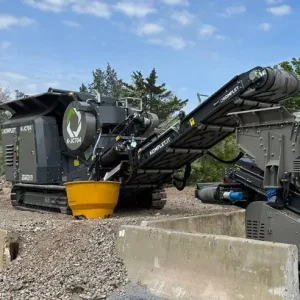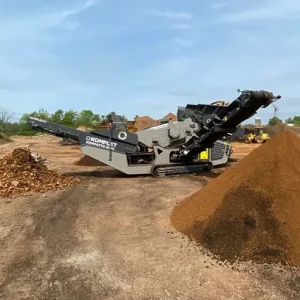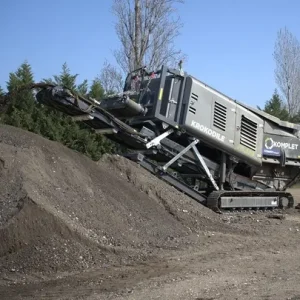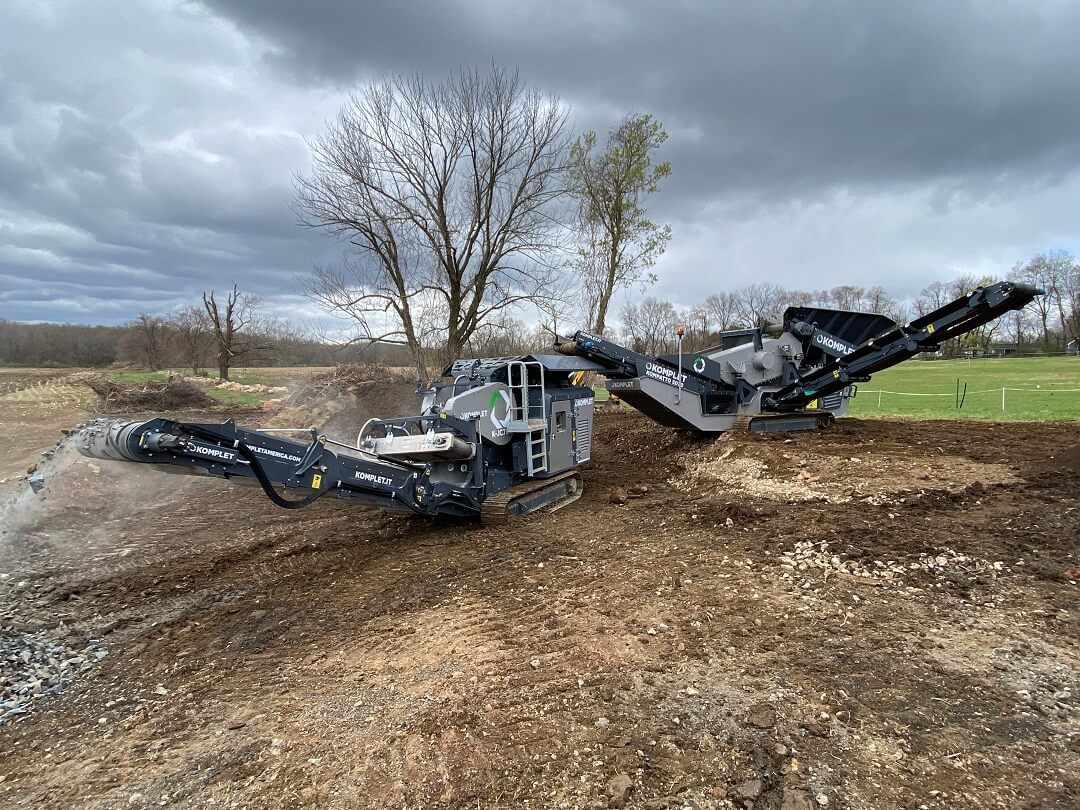

Excavation and site preparation contractors hitting bedrock during foundation work, processing excavated soil for project base material, or recovering aggregate from excavated rock face an operational decision: pay to haul excavated material off-site as waste, or convert it to useful project material on-site. For projects with significant bedrock or excavated soil volumes, on-site mobile crushing and screening typically delivers strong economics through eliminated disposal cost, recovered base aggregate value, and project schedule compression. The right equipment configuration depends on material characteristics — hard bedrock requires jaw crushing; excavated soil with mixed content requires trommel screening; aggregate sizing requires vibrating scalping screening. Operations matching equipment to material produce strong economics; operations using wrong equipment produce equipment damage and operational disruption.
This basic guide walks through mobile crusher and screener equipment for bedrock and excavated soil processing — bedrock crushing economics, soil screening with trommel screeners, vibrating scalping screening for aggregate sizing, equipment selection by project profile, and how Komplet America’s compact mobile equipment lineup supports excavation and site preparation contractors across N&C America.
Bedrock vs. Excavated Soil: Different Materials, Different Equipment
Excavation projects generate two materially different waste streams that require different processing approaches:
Bedrock and Hard Mineral Material
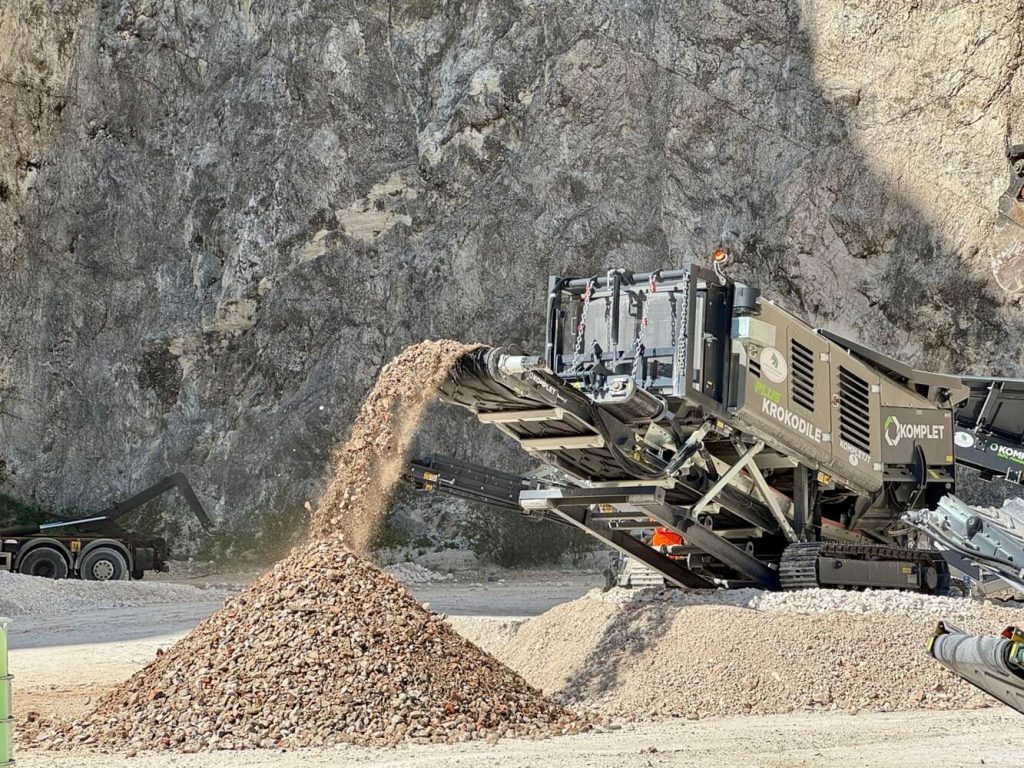
Bedrock — solid rock encountered during excavation — requires compression-based crushing equipment (jaw crushers, impact crushers). Bedrock characteristics:
- Hardness varies by region — soft sedimentary rock (sandstone, limestone, shale) crushes easier than hard igneous rock (granite, basalt)
- Larger feed pieces typical from blasting or hydraulic breaking — may exceed compact mobile crusher feed size limits
- Cleaner material (fewer contaminants than demolition concrete) — typically no rebar, less foreign material
- Output applications — project base material, structural fill, drainage stone, or bulk aggregate for sale
Excavated Soil and Mixed Material
Excavated soil — earth removed during site preparation — typically requires trommel screening (rotating drum screening) rather than crushing. Soil characteristics:
- Variable moisture content — soil at field moisture (typically 5-30%) doesn’t process well on vibrating scalping screens (blinding, clumping)
- Mixed content — rocks, roots, debris, soft material all present in raw excavated soil
- Output applications — sized topsoil for landscape supply, structural fill backfill, drainage soil
- No crushing required for soil itself — the goal is separation by size, not particle reduction
Mixed Bedrock + Soil Operations
Many excavation projects involve both materials simultaneously — bedrock encountered during foundation excavation generates rock requiring crushing; surrounding earth requires soil screening. Operations handling both streams need both equipment types working in parallel or sequence based on operational profile.
Bedrock Crushing: Equipment Selection and Operations
Hardness and Crusher Selection
Bedrock hardness varies dramatically by geographic region and rock type. Common bedrock encountered in excavation work:
- Soft sedimentary rock (sandstone, limestone, shale) — readily handled by all Komplet jaw crushers
- Medium-hard rock (diabase, marble, dolomite) — handled by Komplet jaw crushers; may require slightly larger settings for efficient throughput
- Hard igneous and metamorphic rock (granite, basalt, gneiss) — handled by Komplet jaw crushers; requires careful operator setting and may benefit from larger jaw opening models
- Very hard quartzite and similar — limited application for compact mobile crushing; may require specialty equipment from manufacturers focused on hard rock
Match crusher size to bedrock hardness and operational throughput requirements. For unusually hard bedrock, contact Komplet America at (908) 369-3340 or your local authorized dealer to discuss specific application questions.
Feed Size Management for Bedrock
Bedrock from excavation often arrives in oversized pieces (from blasting or hydraulic breaking) that exceed crusher feed limits. Pre-processing options:
- Excavator-mounted hydraulic breakers — most common pre-processing approach; reduces oversized rock to crusher feed size
- Drop ball — for very large rock; less common in modern operations but still used
- Sorting and stockpiling — oversize material stockpiled separately for delayed processing or alternative use
Match feed size to crusher capacity:
- K-JC 503 (19″ x 12″ jaw): max feed approximately 9-1/2″ minus
- K-JC 604 (23″ x 16″ jaw): max feed approximately 12-3/4″
- K-JC 704 PLUS (27″ x 16″ jaw): max feed approximately 12-3/4″
- K-JC 805 (31″ x 21″ jaw): max feed approximately 16-3/4″
Bedrock Output Products
Crushed bedrock produces multiple product applications:
- Project base material — directly back onto the project under foundations, parking areas, drives
- Structural fill — backfill for retaining walls, foundation excavations, utility trenches
- Drainage stone — foundation drainage, French drain applications, septic stone
- Sold aggregate — surplus material sold to nearby projects or aggregate buyers
- Riprap (larger sizes) — erosion control, slope stabilization, shoreline protection
Excavated Soil Screening: Trommel Screeners
Why Trommels for Soil
Vibrating scalping screens (Kompatto lineup) excel at dry mineral aggregate sorting (concrete, asphalt, sand, gravel). Trommel screeners (K-TS lineup) excel at wet, sticky, variable-moisture material (compost, topsoil, mulch, mixed C&D fines) including excavated soil. Soil characteristics that drive trommel selection:
- Variable moisture (typical 5-30% at field conditions) blinds vibrating scalping screens; trommels handle moisture without blinding
- Compacted clumps typical in excavated soil bridge vibrating screen openings without separating; tumbling drum action breaks clumps
- Mixed content (roots, debris, rocks, soft material) tumbles through trommel drum allowing oversize separation
- Self-cleaning rotation prevents screen blinding from sticky soil
Komplet K-TS Trommel Screener Options
- K-TS 30 Compact Trommel Screener — up to 80 tph, 68″ x 51″ or 103″ x 51″ drum, 23 kW genset, ~8,818 lb. Smaller-volume soil screening.
- K-TS 40 Portable Trommel Screener — up to 120 tph, 126″ x 55″ or 171″ x 43″ drum, 40 kW genset, ~25,353 lb. Higher-volume soil screening.
Soil Mesh Selection
Different finished soil products require different screen mesh configurations:
- Premium topsoil for landscape supply: 1/4″ to 3/8″ mesh produces fine landscape-grade topsoil
- Structural fill: 3/4″ to 1″ mesh produces sized fill material with rocks larger than mesh removed
- Backfill material: 1″ to 2″ mesh produces general backfill with major debris removed
- Mixed product operations: Mesh changes (typically 30-60 minute service) support switching between product configurations based on market demand
Soil Output Products
Screened soil produces multiple product applications:
- Premium topsoil for landscape supply, garden centers, residential customers
- Structural fill for project backfill applications
- Drainage soil for septic systems, foundation drainage
- Bulk fill for general construction backfill
- Recovered rocks (separated as oversize) — feed to jaw crusher for additional processing
Combined Operations: Bedrock + Soil Processing
Workflow Integration
Excavation contractors handling both bedrock and excavated soil benefit from integrated equipment configuration:
- Initial separation: Bedrock and clean rock material separated from excavated soil during excavation by operator/loader judgment
- Bedrock processing: Hard rock material flows to jaw crusher (K-JC 503 through K-JC 805 based on volume)
- Soil processing: Excavated soil flows to trommel screener (K-TS 30 or K-TS 40 based on volume)
- Recovery loop: Trommel-rejected oversize rocks feed the jaw crusher for additional processing
- Aggregate sizing (when needed): Crushed bedrock output to vibrating scalping screen (Kompatto lineup) for spec-sized aggregate production
- Stockpile management: Multiple finished products stockpiled separately for project use or sales
Equipment Sizing for Combined Operations
Match equipment configurations to project profiles:
- Smaller residential and commercial projects: K-JC 503 + K-TS 30 — compact mobile combination for tight access and lower volume
- Mid-range commercial projects: K-JC 604 + K-TS 30 or K-TS 40 — moderate volume capacity
- Larger excavation projects: K-JC 704 PLUS (Komplet’s best-seller) + K-TS 40 — operational sweet spot for typical contractor work
- Major site preparation: K-JC 805 (largest jaw crusher in lineup) + K-TS 40 + Kompatto vibrating scalping screening for spec-sized output
Workflow Material Handling
For continuous-production excavation operations, the K-TC 460 portable mobile conveyor — up to 132 US tph, 25″ Chevron 3-ply belt, 25 HP Tier 4 Final, ~7,000 lb — provides material transfer between processing stages and to stockpiles for workflow integration.
Excavation On-Site Processing Economics
Cost Avoidance for Excavation Operations
On-site processing of bedrock and excavated soil typically delivers strong project economics through:
- Eliminated disposal cost — excavated rock disposal commonly runs $15-$50+/ton; soil disposal varies by region
- Eliminated hauling cost — hauling cycles to disposal sites add significant per-ton cost
- Avoided aggregate purchase — project base material can come from project’s own crushed bedrock rather than purchased and hauled aggregate ($15-$40+/ton typical)
- Recovered base aggregate value — $10-$25+/ton typical for crushed bedrock as road base, parking lot base, structural fill
- Recovered topsoil value — premium screened topsoil sells $15-$40+/yard depending on regional landscape supply markets
- Schedule compression — eliminates haul truck cycles, supporting faster project completion
When On-Site Processing Pencils
On-site processing typically pencils for:
- Excavation projects with 500+ tons of bedrock recovery — rental crushing economics work
- Site preparation projects with significant excavated soil — soil screening for landscape supply or project backfill
- Operations with recurring excavation pipeline — ownership economics typically justify equipment purchase
- Projects in markets with high disposal costs — urban projects with limited disposal access)
- Operations selling recovered material — aggregate or topsoil markets with active demand
Komplet Capital Financing
Komplet Capital offers 24-hour approval, 100% financing, 3-6 year terms on Komplet equipment. New equipment qualifies for Section 179 tax deduction up to $1.22M (2024 limit). Combined K-JC 704 PLUS + K-TS 40 equipment investment fits within Section 179 limits with significant headroom.
Komplet America’s Excavation-Relevant Equipment Lineup
Compact Mobile Jaw Crushers for Bedrock
- K-JC 503 — up to 34 US tph, 19″ x 12″ jaw, 25 HP Tier 4 Final, ~7,496 lb. Smaller projects and tight-access work.
- K-JC 604 — up to 55 US tph, 23″ x 16″ jaw, 55 HP, ~19,400 lb. Mid-range excavation.
- K-JC 704 PLUS — up to 90 US tph, 27″ x 16″ jaw, 74 HP, ~26,455 lb. Komplet’s best-selling crusher.
- K-JC 805 — up to 160 US tph, 31″ x 21″ jaw, 130 HP, ~49,600 lb. Largest jaw crusher in the lineup.
Compact Mobile Trommel Screeners for Excavated Soil
- K-TS 30 — up to 80 tph, 68″ x 51″ or 103″ x 51″ drum, 23 kW genset, ~8,818 lb. Smaller-volume soil screening.
- K-TS 40 — up to 120 tph, 126″ x 55″ or 171″ x 43″ drum, 40 kW genset, ~25,353 lb. Higher-volume soil screening.
Vibrating Scalping Screeners for Aggregate Sizing
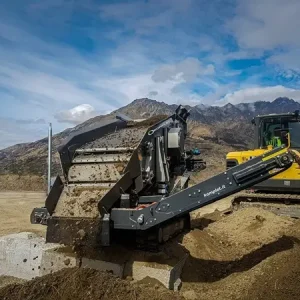
- Kompatto 221 — up to 90 US tph.
- Kompatto 5030 — up to 280 US tph, hydraulic 2-way / 3-way conversion. Komplet’s best-selling screener.
Mobile Conveyor for Material Handling
- K-TC 460 — up to 132 US tph, 25″ Chevron 3-ply belt, 25 HP Tier 4 Final, ~7,000 lb. Workflow integration between processing stages and stockpiles.
Frequently Asked Questions
Can compact mobile jaw crushers handle bedrock?
Yes — Komplet jaw crushers handle most bedrock encountered in excavation work, including soft sedimentary rock (sandstone, limestone, shale), medium-hard rock (diabase, marble, dolomite), and hard igneous/metamorphic rock (granite, basalt, gneiss). Very hard quartzite and similar may have limited application for compact mobile crushing — contact Komplet America to discuss specific application questions for unusually hard rock.
Why use a trommel screener for excavated soil?
Excavated soil has variable moisture content, compacted clumps, mixed content (rocks, roots, debris), and characteristics that blind vibrating scalping screens. Trommel screeners (rotating drum design) handle these characteristics through tumbling action that breaks clumps, exposes new screen surface continuously, and supports separation of mixed content. Trommels are the right tool for soil; vibrating scalping screens are the right tool for crushed dry mineral aggregate.
How large can bedrock pieces be for Komplet jaw crushers?
Match feed size to jaw opening: K-JC 503 (19″ x 12″ jaw) handles material to approximately 9-1/2″ minus; K-JC 604 (23″ x 16″ jaw) handles to approximately 12-3/4″; K-JC 704 PLUS (27″ x 16″ jaw) handles to approximately 12-3/4″; K-JC 805 (31″ x 21″ jaw) handles to approximately 16-3/4″. Pre-process oversized bedrock with excavator-mounted hydraulic breakers before feeding the crusher.
Can I use the same crusher for bedrock and demolition concrete?
Yes — Komplet jaw crushers handle both bedrock and demolition concrete. Bedrock typically has fewer contaminants (no rebar, less foreign material) than demolition concrete, but the same compression-based crushing action works for both. Magnetic separation (standard on K-JC 604+; optional on K-JC 503 included in base price) handles rebar in demolition concrete; not needed for clean bedrock.
What’s the smallest project that justifies on-site crushing?
Highly variable based on regional conditions. Excavation projects with 500+ tons of bedrock recovery in markets with significant disposal fees typically justify rental-based on-site crushing. Smaller projects may not pencil. Sustained excavation operations with recurring project pipeline typically justify equipment ownership. Run the specific project economics: tons of material × (avoided disposal + avoided hauling + recovered material value) vs. equipment rental or operating cost. Find your local Komplet dealer to discuss project-specific economics.
Can I sell crushed bedrock as aggregate?
Yes — crushed bedrock typically commands $10-$25+/ton for road base, parking lot base, structural fill, drainage stone, and similar applications. Premium spec aggregate (after secondary impact crushing through K-IC 70 for cubical shape) commands higher pricing for concrete batch plants and HMA plants. State DOT acceptance of bedrock aggregate is well-established — verify specific requirements for project locations.
Does Komplet have rental options for excavation projects?
Yes — Komplet America’s authorized dealer network includes rental partners across N&C America. Rental availability varies by region and equipment model. Single-project rental of crusher and trommel screener combination typically pencils for excavation projects with 500+ tons of bedrock or significant excavated soil volume. Call (908) 369-3340 to discuss rental availability.
How do I match equipment to my excavation project?
Match equipment to project profile: smaller residential/commercial (K-JC 503 + K-TS 30); mid-range commercial (K-JC 604 + K-TS 30/40); larger excavation (K-JC 704 PLUS + K-TS 40 + Kompatto 5030 for spec-sized output); major site preparation (K-JC 805 + K-TS 40 + Kompatto 5030/124). Discuss specific project requirements with your local authorized Komplet dealer or call Komplet America at (908) 369-3340.
Final Thoughts
Excavation and site preparation contractors processing bedrock and excavated soil benefit substantially from on-site mobile crushing and screening — eliminated disposal costs, avoided aggregate purchase, recovered base aggregate and topsoil value, and project schedule compression all stack up. The right equipment configuration depends on material characteristics: bedrock requires jaw crushing (K-JC lineup); excavated soil requires trommel screening (K-TS lineup); spec-sized aggregate requires vibrating scalping screening (Kompatto lineup). Komplet America’s compact mobile equipment lineup spans all three equipment types, supporting excavation contractors across the operational range from smaller residential projects through major site preparation work. For operations matching equipment to material across the project portfolio, on-site processing delivers materially better project economics than off-site disposal pathways.
Browse Komplet America’s compact mobile equipment lineup or call us to discuss equipment selection for your specific excavation project.
Ready to Talk Bedrock and Soil Processing?
- Call (908) 369-3340
- Email [email protected]
- Schedule a demo or request a quote
- Find your local Komplet dealer for rental availability
- Ask about our 1-year / 1,000-hour warranty and equipment financing options
Never enough — that’s how we approach service, support, and helping excavation operations capture the on-site processing economics that make project work pencil.
Disclaimer: All cost, ROI, payback, pricing, disposal fee, and revenue figures in this article are illustrative examples based on sample assumptions about volume, regional pricing, material specifications, and market conditions. Actual results vary significantly by region, market, material type (bedrock hardness varies dramatically by geographic region and rock type), equipment utilization, operator skill, financing terms, regulatory environment, and many other factors. Equipment pricing, disposal fees, aggregate market pricing, topsoil pricing, fuel costs, and labor rates all change over time and by location. Komplet America makes no guarantee, warranty, or representation of specific financial performance, payback timelines, or business outcomes for any particular operation. State DOT specifications for bedrock aggregate utilization vary by jurisdiction and project type; verify specific requirements before bidding work. For current pricing and a payback estimate based on your specific volume, material, and local market, contact us at (908) 369-3340 to speak with our team.