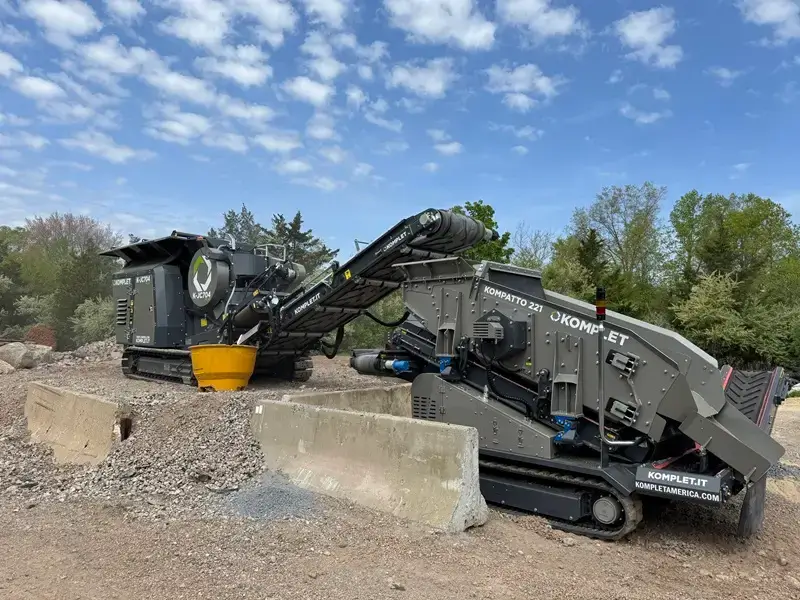

Concrete and asphalt are two of the largest waste streams in heavy construction — and two of the most valuable when processed correctly. Demolition contractors, paving operations, road builders, and recyclers all face the same opportunity: convert hundreds or thousands of tons of debris into spec-sized recycled aggregate that customers actually pay for. The right combination of crushing and screening equipment turns disposal cost into revenue.
This guide covers the equipment and workflow for processing both concrete and asphalt on a single mobile setup. We walk through the differences between the two materials, the right Komplet machines for each (and the combinations that handle both), the major end markets for RCA (recycled concrete aggregate) and RAP (reclaimed asphalt pavement), and the operational considerations that turn a contractor or recycler into a dual-material aggregate supplier.
Two Materials, One Equipment Platform
Concrete and asphalt look similar to non-specialists — both are gray-to-black aggregate-bound surfacing materials. But mechanically, they’re very different, and the differences matter for processing.
Concrete (and RCA Production)
Concrete is a hard, brittle composite of aggregate, sand, and Portland cement binder. When fractured, it breaks cleanly along grain boundaries, producing angular spec aggregate. Demolished concrete commonly contains rebar reinforcement (residential to bridge-deck levels), which adds the requirement for magnetic metal separation during crushing. The recycled product — recycled concrete aggregate (RCA) — is sold as base material under roads, parking lots, and foundations, as drainage rock, and as backfill.
Asphalt (and RAP Recycling)
Asphalt is a flexible composite of aggregate bound by petroleum-based asphalt cement (bitumen). Unlike concrete, asphalt deforms slightly under load and softens in heat. When crushed, it can produce angular pieces, but warm asphalt tends to clump and re-bind in the chamber if not handled properly. The recycled product — reclaimed asphalt pavement (RAP) — is mainly used as feedstock for new asphalt mix designs (cold patch and hot mix), with secondary uses as base material and shoulder rock.
Why It Matters for Equipment
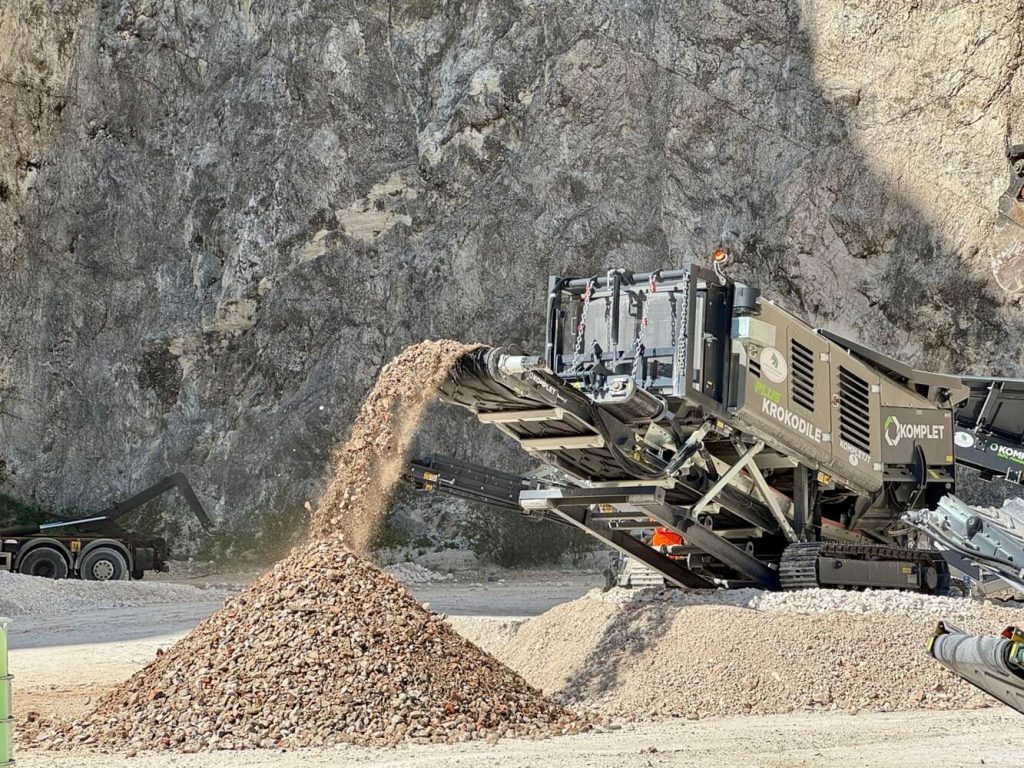
The same compact mobile jaw crusher and vibrating screener can process both materials, but operating practices differ. Asphalt requires attention to material temperature, feed rate, and chamber clearance to prevent gumming and bridging. Concrete with rebar requires confirming the magnetic separation system is engaged before each load. Operators trained on both materials handle the transition seamlessly — but new operators benefit from understanding the differences upfront.
The Best-Selling Setup: K-JC 704 PLUS + Kompatto 5030
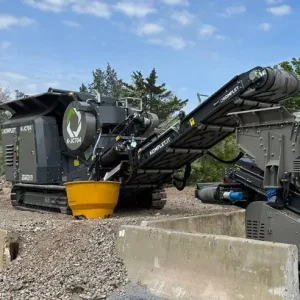
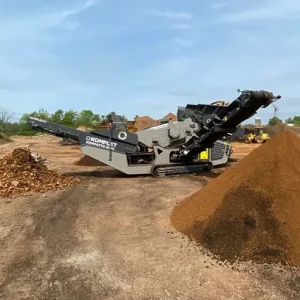
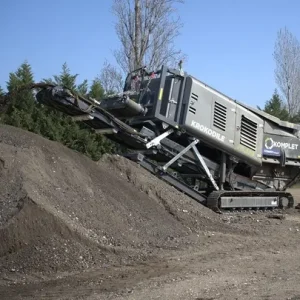
Komplet America’s most popular contractor-scale combination for processing concrete and asphalt is the K-JC 704 PLUS jaw crusher paired with the Kompatto 5030 vibrating scalping screen. This combination handles both materials, fits standard heavy-haul trailers for transport between job sites, sets up in under 30 minutes, and produces multiple spec sizes from a single workflow.
K-JC 704 PLUS Crusher Specifications
- Jaw size: 27″ x 16″ — accepts oversize concrete and asphalt up to roughly 12-3/4″ feed
- Production rate: Up to 90 US tph
- Engine: 74 HP
- Weight: Approximately 26,455 lb — fits a standard flatbed trailer
- Standard equipment: Hydraulic magnetic belt for rebar separation, reverse jaw function for clearing uncrushable material, dust suppression for OSHA silica compliance
- Best-seller: Komplet’s most-popular crusher across North and Central America
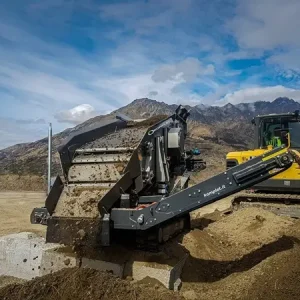
Kompatto 5030 Screener Specifications
- Production rate: Up to 280 US tph
- Configuration: Heavy-duty double-deck vibrating scalping screen
- Top deck: 8′ x 3′
- Bottom deck: 7′ x 3′
- Engine: 45 HP
- Weight: Approximately 26,455 lb
- Hydraulic conversion: Fast switching between 2-way and 3-way split configurations
- Mesh range: 1/4″ topsoil fines up to 5″ oversize
- Best-seller: Komplet’s most-popular screener and the natural pair for the K-JC 704 PLUS
Why This Combination Works for Both Materials
The K-JC 704 PLUS crushes both concrete and asphalt effectively. The Kompatto 5030 screens both into spec sizes. Throughput is balanced — the screener has more capacity than the crusher feeds it, which means the screener can handle the crusher’s output PLUS additional pit-run feed bypassing the crusher when no primary crushing is needed. This flexibility lets a single equipment setup serve concrete demolition jobs, asphalt millings recycling, AND straight gravel/aggregate screening from a single capital investment.
Asphalt-Specific Equipment Considerations
Where the K-IC 70 Impact Crusher Fits
For paving operations producing premium RAP for hot-mix asphalt designs, particle shape matters. Hot-mix asphalt designers prefer cubical aggregate — pieces with three roughly equal dimensions — for optimal pavement performance. Jaw crushers tend to produce somewhat flatter, more elongated particles. For cubical RAP output, the K-IC 70 compact impact crusher — up to 90 US tph, 100 HP, launched at WOC 2024 — delivers the rounded cubical shape that high-end asphalt mix designs require.
A typical premium-RAP setup runs three machines in series: K-JC 704 PLUS for primary jaw crushing of millings or full-depth asphalt → K-IC 70 for secondary cubical shaping → Kompatto 5030 for spec-size screening into hot-mix-ready feedstock.
Operating Concrete and Asphalt Through the Same Crusher
Many contractors use the same K-JC 704 PLUS for both materials. Best practices when switching:
- Verify magnetic belt operation — the magnetic belt is essential for concrete with rebar; less critical for asphalt millings (which typically don’t contain rebar) but should be left engaged regardless.
- Watch chamber temperature with asphalt — particularly in hot weather, asphalt can warm and become tacky. Maintain consistent feed rate; avoid letting material sit in the chamber.
- Adjust feed rate for asphalt — asphalt can build up on jaw plates and bridge faster than concrete. A slightly slower feed rate gives the chamber time to clear.
- Use water spray dust suppression — Komplet jaws have this standard. Helps with both concrete dust (silica compliance) and warm asphalt.
- Periodic cleanout — between concrete and asphalt batches, run the crusher empty briefly to clear residual material from the chamber. This prevents cross-contamination of output streams.
Applications: Who Uses Concrete + Asphalt Processing Equipment?
Demolition Contractors
Tearing down buildings, roads, and parking lots produces a mixed waste stream of concrete, asphalt, masonry, and reinforcing steel. A K-JC 704 PLUS + Kompatto 5030 combination handles the entire stream on-site, eliminating hauling for both material types and producing two distinct revenue streams (RCA + RAP).
Paving Contractors
Asphalt paving operations generate two reclaimable streams: cold milling output (asphalt millings) from pre-paving surface preparation, and full-depth removal from major rehabilitation projects. Both streams crush and screen into RAP that can either be sold to asphalt plants OR re-used in the contractor’s own paving operations.
Road Builders
Highway and road construction projects produce concrete debris (from bridge work, barrier removal, structural demo) AND asphalt debris (from milling and full-depth pavement removal). Mobile crushing on-site eliminates hauling for both material types and produces base aggregate for the same project’s foundation work.
Asphalt Mix Plants
Plants producing hot-mix asphalt increasingly incorporate RAP into their mix designs (10-30% RAP blending is common; some specialty mixes go higher). Mix plants either accept RAP from contractors or operate their own crushing and screening equipment to produce in-house RAP feedstock.
Recyclers and Aggregate Producers
C&D recycling facilities accept both concrete and asphalt from third-party contractors, charge tipping fees on the inbound material, then process and sell the output as RCA and RAP. Volume operations often run dedicated equipment for each material rather than switching a single setup between batches.
Municipalities and DOTs
Public-sector projects increasingly require recycled material content in road base, fill, and even asphalt mix designs. Municipalities with their own road maintenance operations sometimes operate mobile crushing equipment for in-house RCA and RAP production.
End Markets for RCA and RAP
Recycled Concrete Aggregate (RCA) Markets
- Road and parking lot base material — typically 3/4″ minus or 1-1/2″ minus
- Drainage applications — typically #57 or larger drainage stone
- Foundation backfill — variable spec depending on engineer
- Trench backfill for utility installation
- DOT-spec applications where local DOT specifications permit RCA
- Concrete mix aggregate (limited) — some mix designs allow partial RCA replacement of virgin aggregate
Reclaimed Asphalt Pavement (RAP) Markets
- Hot-mix asphalt feedstock — typically 10-30% RAP blended into new mix designs
- Cold patch material — bagged or stockpiled cold patch for pothole repair, typically using RAP plus emulsified asphalt rejuvenator
- Driveway and rural road base — when compacted, fine RAP self-cements somewhat in warm weather, producing a semi-bound surface
- Shoulder rock and unpaved road grade
- Landscape and erosion control applications
Typical Pricing Ranges
Pricing varies regionally and seasonally. Typical 2026 ranges in the US:
- RCA (recycled concrete aggregate): approximately $15-$30 per ton depending on spec size
- RAP (reclaimed asphalt pavement): approximately $5-$15 per ton when sold as raw millings; up to $20+/ton for processed cubical RAP suitable for hot-mix designs
- Avoided dump fees (the savings side): C&D dump fees of $50-$100/ton are common in major US metros — often the larger economic driver than RCA/RAP sales themselves
Frequently Asked Questions
Can the same crusher process both concrete and asphalt?
Yes — the K-JC 704 PLUS and other Komplet jaw crushers handle both materials effectively. Operating practices differ slightly (asphalt benefits from a slightly slower feed rate, especially in warm weather), but the same machine processes both. Many contractors switch between concrete and asphalt jobs daily without equipment changes.
What is RAP and why is it valuable?
RAP (reclaimed asphalt pavement) is recycled asphalt produced from milling, demolition, or full-depth removal of existing asphalt pavement. It’s valuable because (1) hot-mix asphalt plants increasingly blend 10-30%+ RAP into new mix designs, reducing virgin aggregate and asphalt cement consumption; (2) it makes excellent base material; (3) it self-cements somewhat when compacted warm; and (4) it diverts asphalt waste from landfills. The US recycles over 80 million tons of RAP annually — one of the most-recycled materials in the country.
What’s the difference between asphalt millings and full-depth RAP?
Asphalt millings are the small (typically 1/4″ to 2″) fragments produced by cold milling machines that grind off the top layer of asphalt for resurfacing. They’re already in a usable size range and often need only screening, not crushing. Full-depth RAP is larger chunks of asphalt removed during full pavement reconstruction — these typically need primary crushing through a jaw crusher before screening, which is exactly what the K-JC 704 PLUS handles.
Do I need an impact crusher for asphalt recycling?
Depends on your end market. For RAP sold as base material, road shoulder, or general aggregate, a jaw crusher alone (K-JC 704 PLUS) produces saleable product. For RAP sold to hot-mix asphalt plants, particle shape matters — asphalt mix designs prefer cubical aggregate, which the K-IC 70 impact crusher delivers. A premium-RAP setup typically runs jaw → impact → screener for cubical sized output.
How do I avoid asphalt clumping or gumming the crusher?
Three practices prevent asphalt buildup: (1) maintain consistent feed rate — don’t let material sit in the chamber, (2) use the standard water-spray dust suppression to keep things cool in warm weather, (3) periodically run the chamber empty between batches to clear residual material. In very hot weather, schedule asphalt processing for early morning or evening when ambient temperatures are lower.
Can the Kompatto 5030 screen both concrete and asphalt?
Yes. The Kompatto 5030 screens both materials effectively across the full mesh range from 1/4″ topsoil fines up to 5″ oversize. The 3-way split capability lets you produce, for example, fines + 3/4″ base + 1-1/2″ drainage from a single pass — useful for both RCA and RAP production. Mesh changes for different spec sizes are accomplished during scheduled service.
What are typical 2026 prices for RCA and RAP?
Pricing varies by region and spec size. Typical ranges: RCA $15-$30 per ton (3/4″ minus base ~$15-$25, 1-1/2″ drainage ~$18-$30, #57 stone ~$20-$35); RAP $5-$15 per ton for raw millings, up to $20+/ton for processed cubical RAP suitable for hot-mix asphalt designs. Often the larger economic driver is avoided dump fees — major metro C&D tipping fees commonly run $50-$100/ton, so eliminating hauling produces dramatic savings independent of resale revenue.
Can I rent equipment to test asphalt and concrete recycling?
Yes. Komplet America works through a dealer and rental network across North and Central America. Find your local Komplet dealer or call (908) 369-3340 and we’ll connect you with the right rental partner. Many rental partners offer rent-to-own arrangements where rental payments can credit toward eventual purchase — useful for operations that want to test the economics before committing to ownership.
Can I finance asphalt and concrete crushing equipment?
Yes. Komplet Capital offers 24-hour credit approval, 100% financing, and 3-6 year terms. Bad credit is not an automatic disqualifier. Many demolition and paving contractors structure equipment financing so monthly payments are covered by avoided dump fees alone — meaning the machine costs $0 net once the dump-fee savings are netted out. New equipment also qualifies for Section 179 tax deduction (up to $1.22M deductible in the year of purchase, 2024 limit).
Final Thoughts
Concrete and asphalt are the two largest recyclable waste streams in heavy construction. Processed correctly, they become two distinct revenue streams (RCA and RAP) plus dramatic dump-fee savings. The same compact mobile equipment platform handles both materials, switches between them with minimal operational adjustment, and turns demolition contractors and paving operations into dual-material aggregate suppliers.
Komplet America’s K-JC 704 PLUS jaw crusher plus Kompatto 5030 vibrating scalping screen — our best-selling crusher and best-selling screener — is the most popular contractor-scale combination for processing both materials. Add the K-IC 70 impact crusher when premium cubical RAP for hot-mix asphalt designs is the target market. Browse the full equipment lineup or reach out and we’ll help you spec the right combination for your concrete-and-asphalt operation.
Ready to Talk Concrete and Asphalt Recycling?
- Call (908) 369-3340
- Email [email protected]
- Schedule a demo or request a quote
- Find your local Komplet dealer for rental availability
- Ask about our 1-year / 1,000-hour warranty and equipment financing options
Never enough — that’s how we approach service, support, and helping you turn concrete and asphalt debris into multiple revenue streams.
Disclaimer: All ROI, payback, pricing, and revenue figures in this article are illustrative examples based on sample assumptions about volume, regional pricing, material specifications, and market conditions. Actual results vary significantly by region, market, material type, equipment utilization, operator skill, financing terms, regulatory environment, and many other factors. RCA pricing, RAP pricing, dump fees, fuel costs, and interest rates all change over time and by location. Komplet America makes no guarantee, warranty, or representation of specific financial performance, payback timelines, RCA or RAP sales prices, or business outcomes for any particular operation. For pricing and a payback estimate based on your specific volume, material, and local market, contact us at (908) 369-3340 to speak with our team.