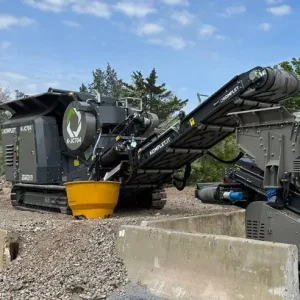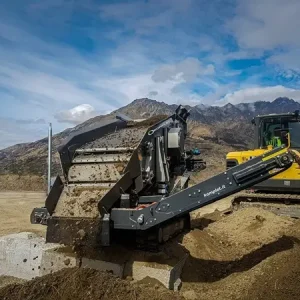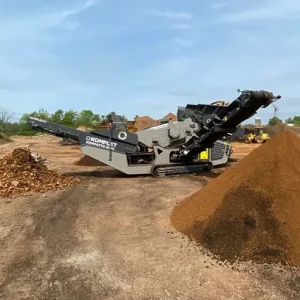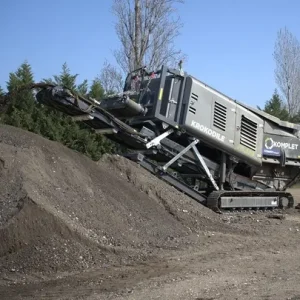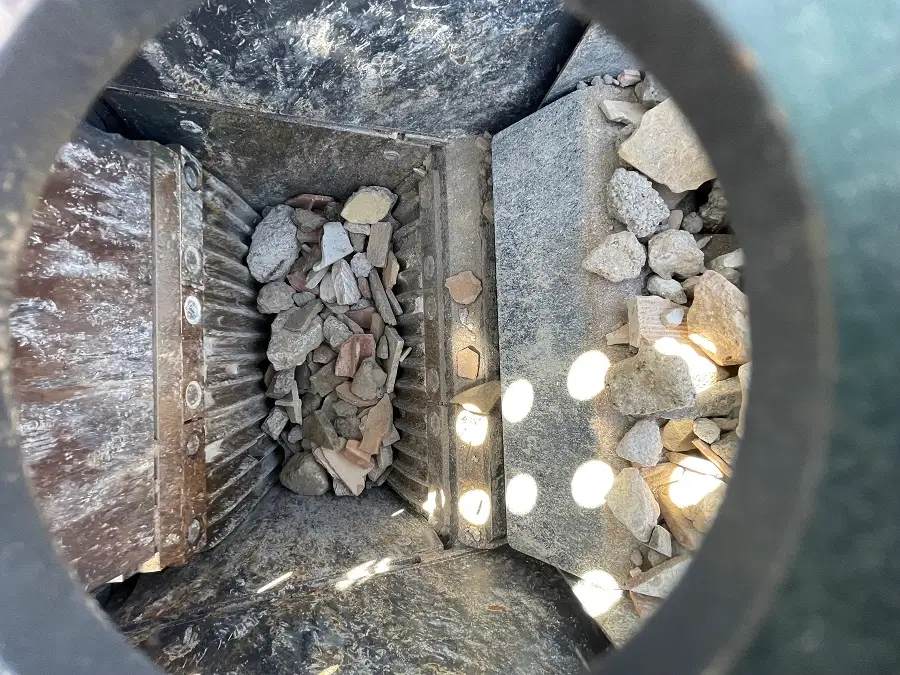

Compact mobile crushers reduce large rocks and demolition material to construction-aggregate sizes — typically 3/4-inch to 3-1/2-inch output, depending on the machine and the operator-set hydraulic closed-side-setting. Komplet’s lineup covers this work with five compact mobile crushers: the K-JC 503 mini jaw crusher (up to 34 US tph), K-JC 604 mobile jaw crusher (up to 55 US tph), K-JC 704 PLUS portable jaw crusher (up to 90 US tph; Komplet’s best-seller), K-JC 805 mobile jaw crusher (up to 160 US tph), and the K-IC 70 compact impact crusher (up to 90 US tph; engineered for cubical-shape aggregate). For genuinely fine crushing — sub-3/4-inch specialty product at sustained production — specialty cone or vertical-shaft impact (VSI) equipment outside Komplet’s lineup is typically the right answer. This guide is honest about what compact mobile equipment actually produces, what it doesn’t, and how to match the right machine to the rock-to-aggregate work in front of you.
What Construction Aggregate Actually Gets Used For
Crushed stone, recycled concrete aggregate (RCA), and reclaimed asphalt pavement (RAP) — the products that come out of compact mobile crushing operations — go to specific construction applications with specific size and quality specifications. Understanding the end use clarifies what the crusher needs to produce.
Building and Civil Construction
The largest single market for construction aggregate. Road base under pavements, drainage stone in trenches and bioswales, structural fill behind retaining walls, foundation backfill, drainage layers under floor slabs, parking lot construction, and similar civil applications consume the bulk of crushed stone production. Most of this work uses 3/4-inch minus to 1-1/2-inch minus product cuts — well within the operating envelope of Komplet jaw and impact crushers.
Concrete and Asphalt Production
Coarse aggregate for ready-mix concrete batch plants and asphalt mix plants typically falls in the 3/8-inch to 1-1/2-inch range. The K-IC 70 compact impact crusher is engineered specifically for cubical-shape aggregate output — preferred for hot-mix asphalt and concrete batch plant feed because cubical particles bond and lock differently than the elongated particles a jaw crusher produces. For specialty fine sand and very fine aggregate (#4 sieve and finer), additional specialty equipment beyond compact mobile primary/secondary crushing is typically required.
Landscape and Decorative Aggregate
Decorative gravel, walkway base, garden bed edging, and ground cover applications use a mix of natural-rock and crushed-stone product cuts. Komplet jaw crushers produce the appropriate sizes (1-inch to 3-inch decorative product) through hydraulic CSS adjustment. Recycled concrete aggregate also serves landscape applications where structural performance isn’t the primary criterion and recycled-content procurement is preferred.
Drainage and Stormwater Infrastructure
French drains, perimeter drainage, retention basin construction, and modern green stormwater infrastructure (bioswales, rain gardens, permeable pavements) all consume crushed stone in specific size ranges (typically 3/4-inch minus to #57 stone). Komplet equipment produces these cuts at contractor- and recycler-scale through standard configurations.
What Compact Mobile Crushers Don’t Typically Produce
Some specialty applications require very fine output, very specific gradations, or material properties beyond what compact mobile primary/secondary crushing produces:
- Fine sand for masonry mortar and specialty concrete (typically requires VSI equipment for cubical fine output).
- Agricultural lime (Aglime) at very fine particle sizes (typically requires specialty fine-crushing equipment beyond compact mobile primary crushers).
- Specialty industrial mineral processing (glass cullet, ceramic feedstock, specialty stone for engineered surfaces) — different equipment categories entirely.
- Mining-scale primary crushing (industrial ore reduction at million-ton-per-year throughput) — fixed-plant industrial-mining equipment outside compact mobile.
Primary and Secondary Crushing: How the Reduction Actually Works
Rock crushing happens in stages. Primary crushing reduces the largest feed material (boulders, demolition slabs) to manageable sizes. Secondary crushing reduces primary output to spec-graded product sizes. Tertiary and quaternary crushing — fourth-stage fine reduction at high specification — uses specialty equipment outside Komplet’s compact mobile lineup. Within the primary-and-secondary range, two crusher technologies do the work:
Jaw Crushers
Jaw crushers reduce rock through compression — material is fed into the chamber from above, the swing jaw closes against the fixed jaw, and the rock fractures along its natural weakness lines. Output material drops out the bottom of the chamber. Jaw crushers excel at:
- Hard, abrasive rock (granite, basalt, traprock, hard limestone)
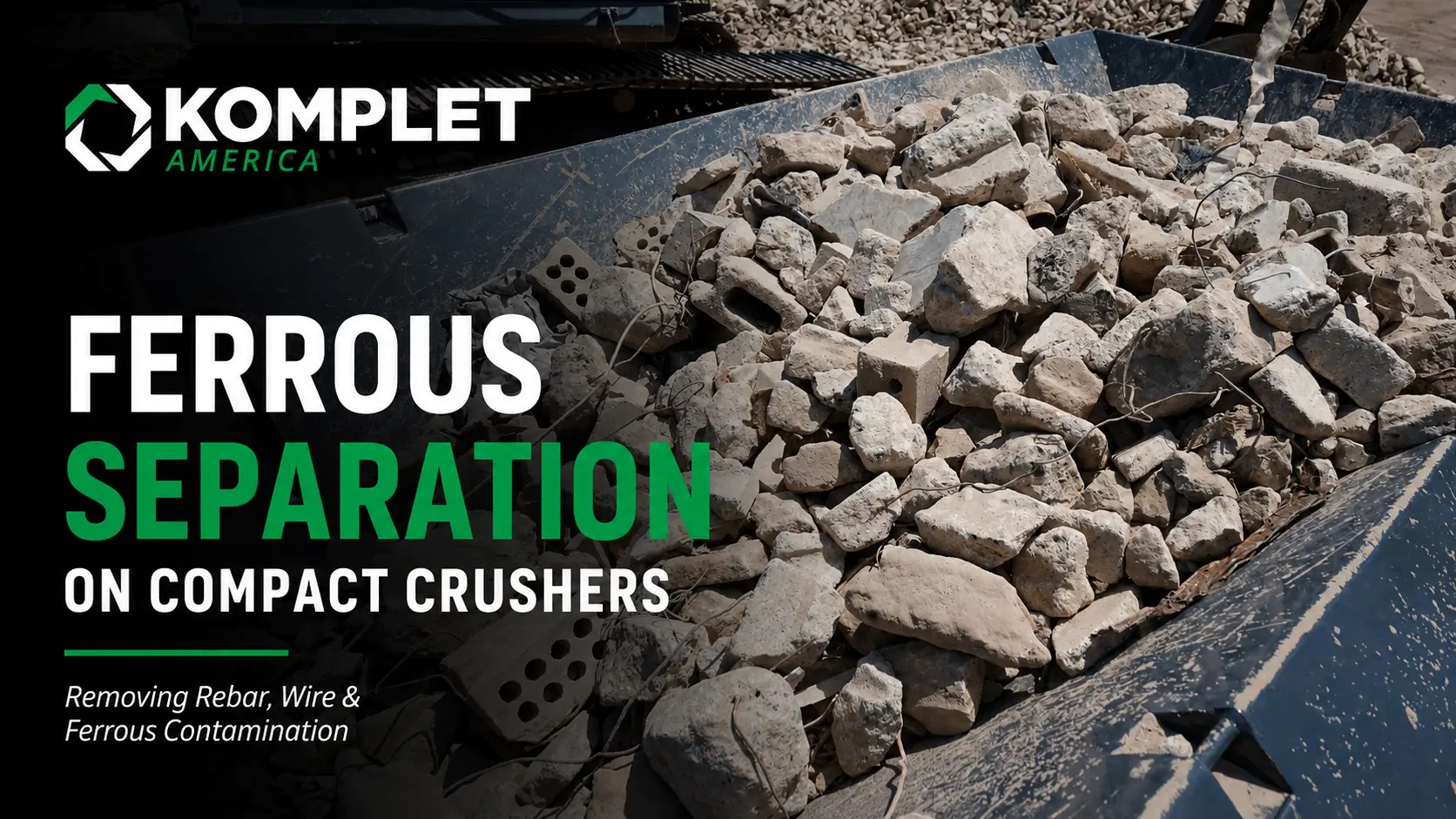
- Demolition concrete (with or without rebar)
- Asphalt, brick, masonry block, and rubble
- Primary reduction of large feed material (Komplet jaw crushers handle feed sizes up to ~25 inches at the K-JC 805 scale)
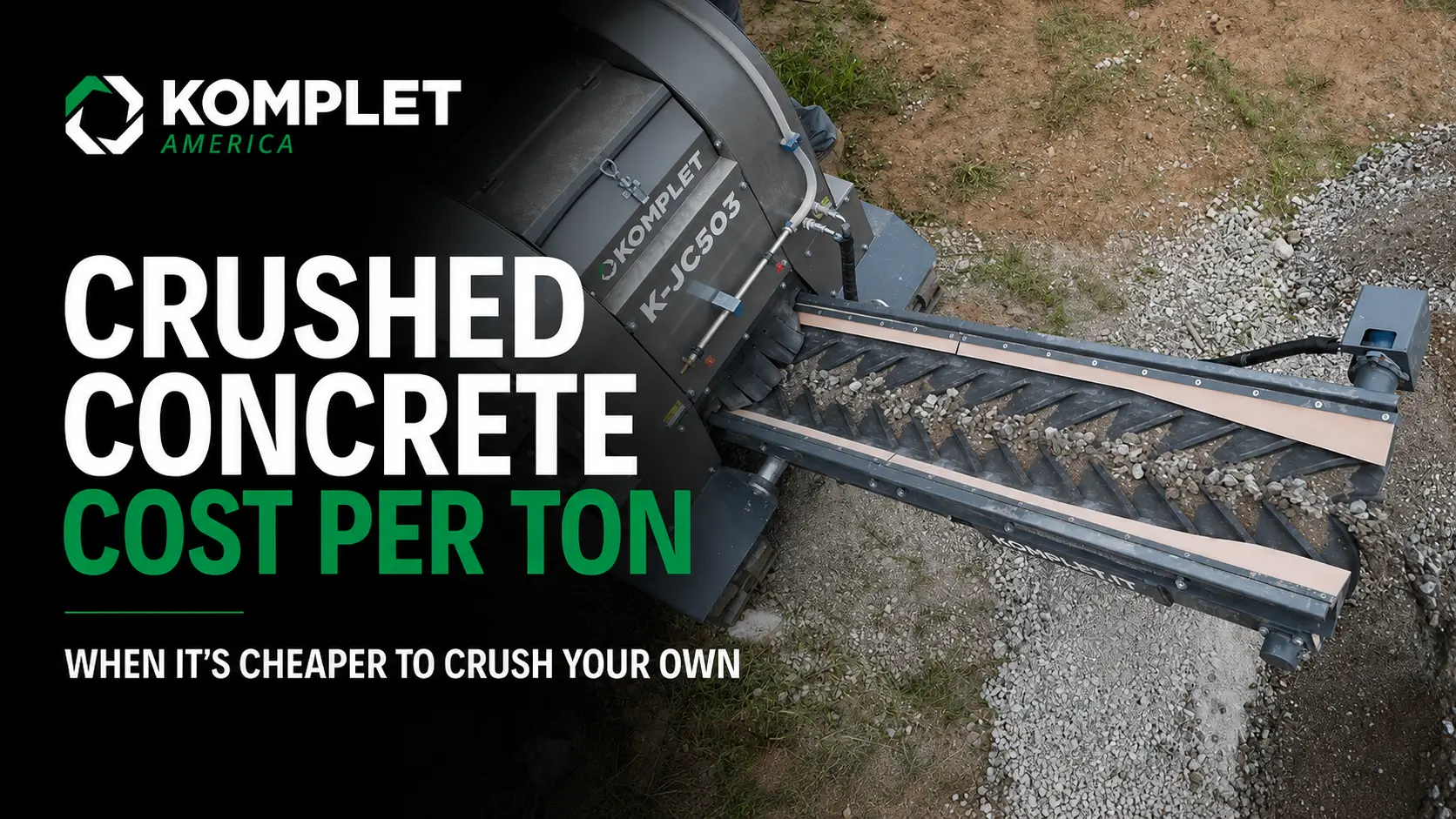
Komplet’s jaw crusher lineup is the K-JC 503 (compact, 19″×12″ jaw, ~10″ max feed), K-JC 604 (mid-size, 23″×16″, ~14″ max feed), K-JC 704 PLUS (best-seller, 27″×16″, ~14″ max feed), and K-JC 805 (largest, 31″×21″, ~18″ max feed). All four feature hydraulic closed-side-setting (CSS) adjustment that changes output size in seconds without parts swaps.
Impact Crushers
Impact crushers reduce material through high-velocity impact rather than compression. A rotating rotor with replaceable blow bars strikes incoming material against fixed breaker plates inside the chamber. The repeated impacts shatter the rock along multiple weakness lines, producing a more cubical particle shape than jaw crushers typically deliver. Impact crushers excel at:
- Producing cubical-shape aggregate preferred for hot-mix asphalt and concrete batch plant feed
- Reclaimed asphalt pavement (RAP) reduction to spec aggregate
- Lower-abrasivity material (limestone, asphalt, recycled concrete)
- Higher reduction ratios per pass than typical jaw crushers
Komplet’s impact crusher lineup is the K-IC 70 — up to 90 US tph, Tier 4 Final diesel, factory-integrated dust suppression standard, engineered specifically for cubical aggregate, RAP, and DOT-spec applications.
Why Komplet’s Lineup Stops at Primary and Secondary
Komplet’s compact mobile positioning is engineered for primary and secondary reduction at contractor- and recycler-scale. Tertiary fine crushing (sub-3/4-inch primary product at sustained production) requires specialty cone crushers, gyratory crushers, or vertical-shaft impactors (VSI). These are real and important equipment categories — they’re not what Komplet sells. Operations needing tertiary fine output typically pair a Komplet primary/secondary crusher with specialty fine-crushing equipment from other manufacturers, or operate in a fixed-plant configuration with the appropriate specialty equipment.
The honest framing matters because equipment marketing tends to imply that any crusher does any reduction. It doesn’t. Match the equipment to the operating range it was engineered for.
Komplet’s Compact Mobile Crushing Lineup
K-JC 503 Mini Jaw Crusher
- Production: up to 34 US tph
- Jaw opening: 19″ × 12″; recommended max feed size approximately 10″
- Output range: 3/4″ to 3-1/4″ through hydraulic CSS adjustment
- Engine: 25 hp Tier 4 Final diesel
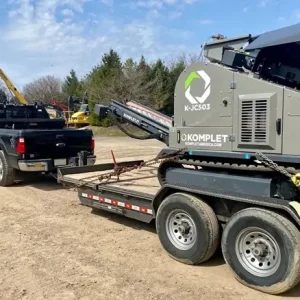
- Transport weight: 7,496 lb (towable behind heavy-duty pickup)
- Standard: factory dust suppression, wireless remote control
- Best fit: small contractors, residential demolition, urban tight-access work, hardscape and landscape contractors
K-JC 604 Mobile Jaw Crusher
- Production: up to 55 US tph
- Jaw opening: 23″ × 16″; recommended max feed size approximately 14″
- Engine: 55 hp Tier 4 Final diesel
- Standard: factory dust suppression, wireless remote control
- Best fit: mid-size contractors, civil road and bridge work, mid-volume demolition recycling
K-JC 704 PLUS Portable Jaw Crusher (Komplet’s Best-Seller)
- Production: up to 90 US tph
- Jaw opening: 27″ × 16″; recommended max feed size approximately 14″
- Engine: 74 hp Tier 4 Final diesel
- Standard: factory dust suppression, wireless remote control, Komplet Connect remote monitoring
- Best fit: standard for contractor- and recycler-scale civil, bridge, road, demolition, and yard recycling
K-JC 805 Mobile Jaw Crusher
- Production: up to 160 US tph
- Jaw opening: 31″ × 21″; recommended max feed size approximately 18″
- Engine: 130 hp Tier 4 Final diesel
- Standard: factory dust suppression, wireless remote control
- Best fit: high-volume regional aggregate yards, large recycling operations, small-quarry applications
K-IC 70 Compact Impact Crusher
- Production: up to 90 US tph
- Engine: 100 hp Tier 4 Final diesel
- Standard: factory dust suppression, wireless remote control
- Output: cubical-shape aggregate engineered for hot-mix asphalt, concrete batch plant feed, and DOT-spec applications
- Best fit: asphalt recyclers, contractors producing spec-graded aggregate, RAP processing operations
The full Komplet crushing lineup is available on the Komplet crushers page.
The Reduction Workflow: Rock to Spec-Graded Aggregate
A typical compact mobile crushing operation runs the rock-to-aggregate workflow through five steps:
Step 1: Material Acceptance and Sorting
Inbound material — virgin rock from blasted face, demolition concrete from teardown projects, asphalt from milled pavement, brick and masonry from demolition — gets sorted by waste stream. Hard mineral fraction goes to crushing; non-mineral material (wood, drywall, mixed C&D) goes to the Krokodile PLUS shredder or to disposal; oversized material that exceeds the crusher’s feed size capacity is broken down by hydraulic breaker before crushing.
Step 2: Primary Reduction
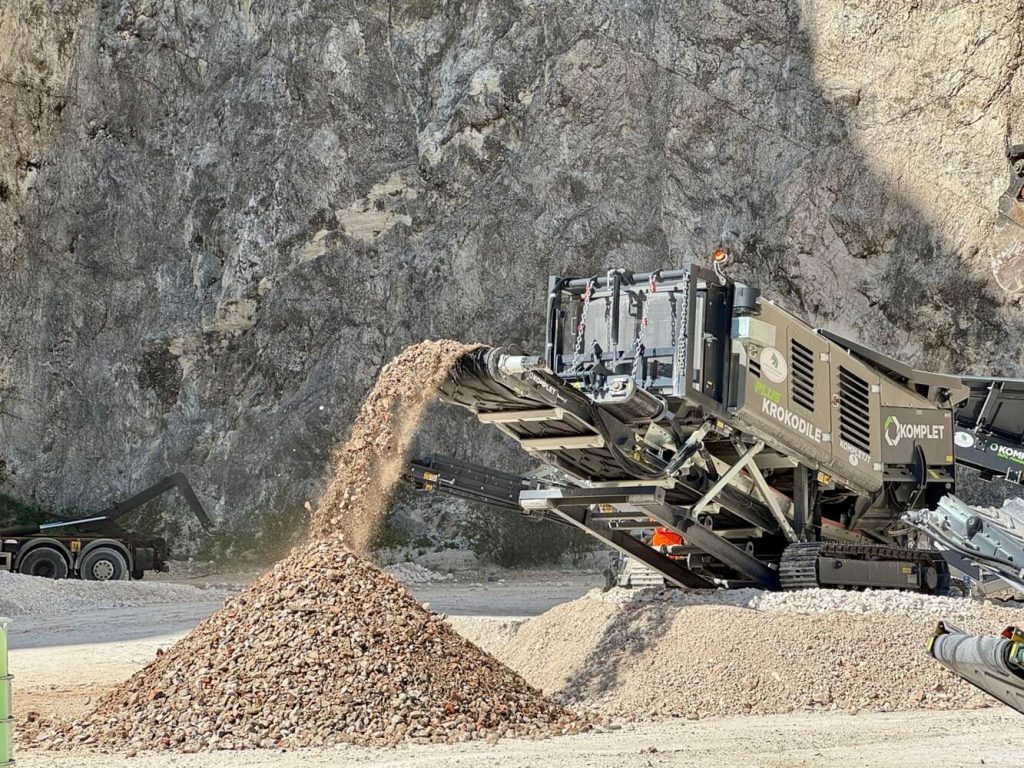
Hard mineral material feeds into the jaw crusher. The K-JC 704 PLUS at 27″×16″ handles standard demolition concrete and quarry rock at contractor scale; the K-JC 805 at 31″×21″ handles oversized feed at regional aggregate yards. Output drops from the chamber at the operator-set CSS through hydraulic adjustment — typically 3/4″ to 3-1/2″ depending on machine and setting.
Step 3: Screening to Product Cuts
Primary crusher output goes to a vibrating scalping screener — the Kompatto 5030 (280 US tph; Komplet’s best-selling screener) is the standard pairing for the K-JC 704 PLUS. Multi-deck screening separates primary output into product cuts: oversize material returns to the crusher, primary product (typically 2″ minus or 1-1/2″ minus) drops to one stockpile, and finer material (3/4″ minus or fines) drops to a secondary stockpile.
Step 4: Secondary Reduction (Optional)
Operations producing cubical-shape aggregate for spec applications (hot-mix asphalt, concrete batch plant feed) typically run a second-stage impact crusher on jaw output. The K-IC 70 compact impact crusher is engineered for this work, accepting jaw crusher output and producing cubical-shape product through high-velocity impact reduction. For operations producing only base, drainage, and fill applications, the secondary impact stage may not be necessary — jaw crusher output goes directly to the screener and final product cuts.
Step 5: Stockpile Management
The K-TC 460 tracked mobile conveyor (132 US tph, 15-foot pile height, 7,000 lb pickup-towable) builds discrete stockpiles for each product cut. Single-operator wireless control coordinates the conveyor alongside the crusher and screener from one position. Tall stockpiles maximize yard footprint efficiency and minimize the loader cycles needed for end-of-day cleanup.
Key Selection Considerations
Material Hardness and Abrasivity
Hard, abrasive rock (granite, basalt, hard limestone, traprock) requires jaw crushers — the compression-based reduction handles abrasive material with predictable wear-part service life. Lower-abrasivity material (limestone, asphalt, recycled concrete) can run through either jaw or impact crushers, but impact crushers deliver better cubical particle shape on this material with higher reduction ratios per pass. Highly abrasive material is typically not the right application for impact crushers — the blow bars wear quickly.
Target Output Size
Match the crusher to the target product size. Komplet jaw crushers produce 3/4-inch to 3-1/2-inch output through hydraulic CSS adjustment — the appropriate range for road base, drainage, fill, structural backfill, and most civil applications. The K-IC 70 impact crusher produces cubical aggregate in similar ranges with better particle shape for hot-mix asphalt and concrete batch plant feed. For specialty fine output (sub-3/4″ sand-grade product, agricultural lime fines, very fine cubical sand), specialty cone or VSI equipment outside Komplet’s lineup is typically the right answer.
Production Volume
Annual throughput drives capacity selection. An operation processing 5,000 tons per year is well-served by a K-JC 503 (34 US tph). 20,000 to 50,000 tons per year fits the K-JC 704 PLUS (90 US tph). 100,000+ tons per year fits the K-JC 805 (160 US tph). Sizing too small creates throughput bottlenecks and accelerated wear; sizing too large means idle financed capital. Komplet’s authorized dealer network provides capacity-sizing consultation as part of pre-purchase work.
Site Access and Mobility
Compact mobile equipment reaches jobsites that fixed plants and large industrial equipment cannot — residential demolition, urban tight-access sites, mid-size civil projects where the project’s debris volume doesn’t justify a fixed plant. The K-JC 503 at 7,496 lb transport weight tows behind a heavy-duty pickup; the K-TC 460 conveyor at 7,000 lb tows similarly. The larger Komplet machines transport on standard heavy-duty trailers without permit-and-escort logistics.
Budget and Total Cost of Ownership
Komplet jaw crushers list prices on each product page. Beyond sticker price, total cost of ownership includes fuel, wear parts (jaw plates, V-belts, filters, hydraulic fluids, DEF on Tier 4 SCR), scheduled maintenance labor, unplanned downtime cost, and end-of-life resale value. The stone crusher price factors guide covers the full TCO framework. Komplet Capital offers 100 percent financing with 24-hour approvals; certified pre-owned through Komplet’s pre-owned program delivers 40-70 percent capital savings. Section 179 tax deduction allows up to $2,560,000 in qualifying equipment expensed in the first year for tax years beginning in 2026.
Honest Framing: What the Original Marketing Often Gets Wrong
“Stone crusher” content in equipment marketing tends to lump every crusher category into one bucket. It shouldn’t. Several distinctions matter:
- Cone crushers, gyratory crushers, and HPGR equipment are not in Komplet’s lineup. These are real and important equipment categories — cone crushers for secondary/tertiary fine reduction, gyratory crushers for industrial primary reduction at fixed-plant scale, HPGR (high-pressure grinding rolls) for specialty fine product. They are not what compact mobile contractor- and recycler-scale equipment is. Don’t expect a Komplet crusher to do the work specialty equipment does.
- Komplet equipment is not engineered for industrial mining. Quarry and small-recycling work at the K-JC 805 size class and below is in scope. Industrial ore extraction, mining-scale primary crushing at million-ton-per-year volumes, and fixed-plant high-throughput operations are outside scope and require different equipment categories.
- Tertiary and quaternary fine crushing requires specialty equipment. The original blog walked through four crushing stages as if compact mobile crushers do all of them. They don’t. Komplet equipment is primary and secondary reduction; tertiary and finer reduction requires specialty cone, gyratory, VSI, or HPGR equipment outside Komplet’s lineup.
- Specialty industrial mineral processing is a separate category. Glass cullet recycling, ceramic feedstock processing, agricultural lime fines, and specialty industrial mineral product all require purpose-built equipment for those specific applications. Komplet handles construction-relevant rock and recycled C&D streams; specialty industrial mineral processing is a different equipment category entirely.
Within its actual scope — compact mobile primary and secondary reduction of construction-relevant rock and demolition material to spec-graded aggregate at contractor- and recycler-scale — Komplet equipment delivers reliable, well-engineered performance. Outside that scope, the right answer is appropriate specialty equipment, not stretching the wrong tool past its design envelope.
Frequently Asked Questions
What does a stone crusher do?
A stone crusher reduces large rocks, demolition concrete, asphalt, brick, and similar mineral material into smaller pieces suitable for construction-aggregate applications — road base, drainage, fill, concrete batch plant feed, asphalt mix, decorative landscape, and similar uses. Compact mobile crushers (Komplet’s lineup) handle primary and secondary reduction to typical 3/4-inch to 3-1/2-inch output sizes.
What is the difference between primary and secondary crushing?
Primary crushing reduces the largest feed material (boulders, demolition slabs, oversized rock) to manageable sizes — typically 2-inch to 6-inch product. Secondary crushing reduces primary output to spec-graded product sizes — typically 3/4-inch to 1-1/2-inch product. Komplet jaw crushers handle primary reduction; the K-IC 70 impact crusher handles secondary cubical-shape reduction. Tertiary and quaternary fine crushing (sub-3/4″ specialty product) requires specialty equipment outside Komplet’s lineup.
Does Komplet make cone crushers, gyratory crushers, or HPGR equipment?
No. Komplet’s lineup is compact mobile primary and secondary crushers — four jaw crushers (K-JC 503, K-JC 604, K-JC 704 PLUS, K-JC 805) and one compact impact crusher (K-IC 70). Cone crushers, gyratory crushers, vertical shaft impactors (VSI), and high-pressure grinding rolls (HPGR) are real and important equipment categories engineered for different applications and scales — they’re not what Komplet sells. Operations needing tertiary fine crushing typically pair a Komplet primary/secondary crusher with specialty equipment from other manufacturers.
What size aggregate does a Komplet jaw crusher produce?
Komplet jaw crushers produce 3/4-inch to 3-1/2-inch output through hydraulic closed-side-setting (CSS) adjustment — the operator changes the gap between jaws in seconds without parts swaps. The K-JC 503 produces 3/4″ to 3-1/4″ output; the larger K-JC 604, K-JC 704 PLUS, and K-JC 805 offer proportionally scaled output ranges. For specialty fine output (sub-3/4″ sand-grade product), specialty cone or VSI equipment outside Komplet’s lineup is typically the right answer.
When should I use an impact crusher instead of a jaw crusher?
Impact crushers (Komplet’s K-IC 70) deliver better cubical particle shape than jaw crushers — preferred for hot-mix asphalt and concrete batch plant feed, where particle shape affects mix performance. Impact crushers also deliver higher reduction ratios per pass, useful for operations producing finer aggregate from primary feed. The tradeoff: impact crushers wear faster on highly abrasive material. For hard, abrasive rock (granite, basalt, traprock), a jaw crusher is typically the better primary reduction tool. For lower-abrasivity material (limestone, asphalt, recycled concrete) where cubical shape or higher reduction matters, impact crushers fit.
Can a Komplet crusher handle large boulders?
Up to the recommended maximum feed size for the specific machine. The K-JC 503 handles feed up to approximately 10 inches; the K-JC 604 up to 14 inches; the K-JC 704 PLUS up to 14 inches; the K-JC 805 up to 18 inches. Material exceeding the recommended max feed must be broken down by hydraulic breaker (or other primary reduction equipment) before going through the crusher. Forcing oversized feed through the crusher creates jamming, accelerated wear, and potential structural damage to the machine.
How do I produce fine aggregate or sand?
True fine aggregate (#4 sieve and finer, sand-grade product) typically requires specialty equipment beyond compact mobile primary/secondary crushing. Vertical shaft impactors (VSI) produce cubical fine sand; cone crushers produce graded fine aggregate; specialty fine-grinding equipment produces very fine industrial mineral product. Komplet equipment produces road-base-grade and structural-fill-grade aggregate (typically 3/4″ minus and coarser); for genuinely fine product, pair Komplet primary/secondary equipment with specialty fine-crushing equipment from other manufacturers, or operate in a fixed-plant configuration with appropriate specialty equipment.
Can compact mobile crushers handle industrial mining work?
No. Komplet’s positioning is contractor- and recycler-scale work — civil, demolition, recycling, small aggregate yards, and small-quarry applications at the K-JC 805 size class and below. Industrial mining (ore extraction, primary crushing at million-ton-per-year throughput, fixed-plant high-volume operations) requires fixed-plant industrial-mining equipment outside the compact mobile category.
How much does a Komplet jaw crusher cost?
List prices on the current Komplet jaw crusher lineup can be found on each product page. Pricing is subject to change based on dealer location, configuration, and availability — confirm current pricing with Komplet America at 908-369-3340 or your authorized Komplet dealer.
Final Thoughts
“Transforming large rocks into crushed stone” is the core technical work of compact mobile crushing — but the honest version of that work has limits. Komplet’s lineup handles primary and secondary reduction of construction-relevant rock and recycled C&D material to spec-graded aggregate, typically in the 3/4-inch to 3-1/2-inch output range, at contractor- and recycler-scale production volumes. Tertiary fine crushing, industrial mining, specialty industrial mineral processing, and very fine sand or aggregate production all require equipment categories outside Komplet’s compact mobile positioning. Match the equipment to the actual work — including being honest about what specific work category each piece of equipment is engineered for.
Within its actual scope, the Komplet lineup covers the full range from small-contractor work (K-JC 503 at 34 US tph) through contractor- and recycler-scale (K-JC 704 PLUS at 90 US tph) to high-volume regional operations (K-JC 805 at 160 US tph), with the K-IC 70 covering cubical-aggregate applications across the same scale range. Pair the right crusher with the right Kompatto screener and K-TC 460 conveyor, and the result is a complete rock-to-aggregate workflow that produces saleable construction product on jobsites and yards across North and Central America.
Komplet America builds compact crushers, screeners, the Krokodile PLUS slow-speed shredder, and the K-TC 460 tracked mobile conveyor for contractors who need real production in tight footprints. To see the full lineup, explore the crusher, screener, shredder, and conveyor categories. To talk financing, sizing, configuration, or pricing, contact Komplet Capital, visit the contact page, or call 908-369-3340.
Ready to talk rock-to-aggregate equipment?
- Browse the full Komplet crusher lineup — K-JC 503, K-JC 604, K-JC 704 PLUS, K-JC 805 jaw crushers; K-IC 70 compact impact crusher.
- Pair the crusher with a Kompatto vibrating screener and K-TC 460 tracked mobile conveyor for a complete processing spread.
- Talk to Komplet Capital about 100 percent financing, 24-hour approvals, and Section 179 tax deduction eligibility for 2026.
- Save 40–70 percent with certified pre-owned Komplet equipment — same engineered features at lower capital outlay.
- Find your local Komplet dealer for capacity-sizing consultation, rental availability, and pre-purchase inspection.
Never enough.
Disclaimer: All operating, maintenance, and service guidance in this article is general in nature. Always refer to the official Komplet operator’s manual for the specific machine model and serial number, and follow OEM intervals and procedures. For warranty-protected work, contact Komplet America at 908-369-3340 or your authorized Komplet dealer. Improper service or non-OEM parts may void warranty coverage and create safety hazards.
Disclaimer: Production figures (“up to” tph), feed size recommendations, output size ranges, and equipment specifications shown above are general guidance based on current Komplet product configurations as of publication. “Up to” production figures describe best-case throughput on optimal feed material; actual production depends on material composition, hardness, abrasivity, moisture content, operator efficiency, and feed cycle pacing. Output size ranges depend on operator-set CSS, screen media specifications, and material characteristics. Komplet America makes no guarantee of specific production rates or output specifications for any specific application. Engineers and project specifiers should verify aggregate spec acceptability for any specific project specification before relying on substitution or recycled-product use.
Disclaimer: Tax-related figures in this article — including Section 179 deduction limits ($2,560,000 maximum for tax years beginning in 2026) — are based on current U.S. Internal Revenue Code provisions as of publication. Tax laws change; actual tax treatment depends on the buyer’s entity structure, taxable income, equipment classification, and other factors. Consult a qualified tax advisor or CPA to confirm Section 179 eligibility for any specific equipment purchase. Komplet America does not provide tax advice.
Equipment prices are subject to change based on dealer location, availability, and any additional features or customizations. Prices do not include taxes, shipping, or installation fees, which may apply depending on your region. Contact Komplet America at 908-369-3340 or visit kompletamerica.com for current pricing.