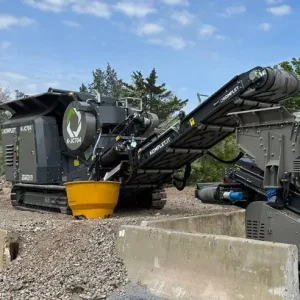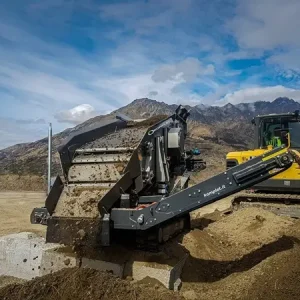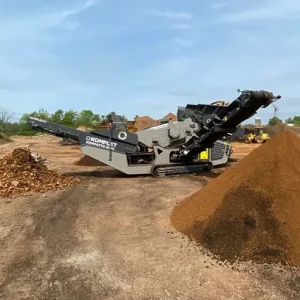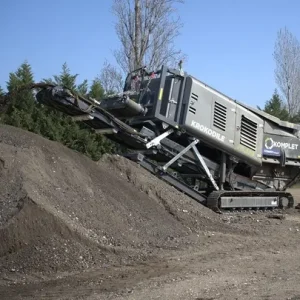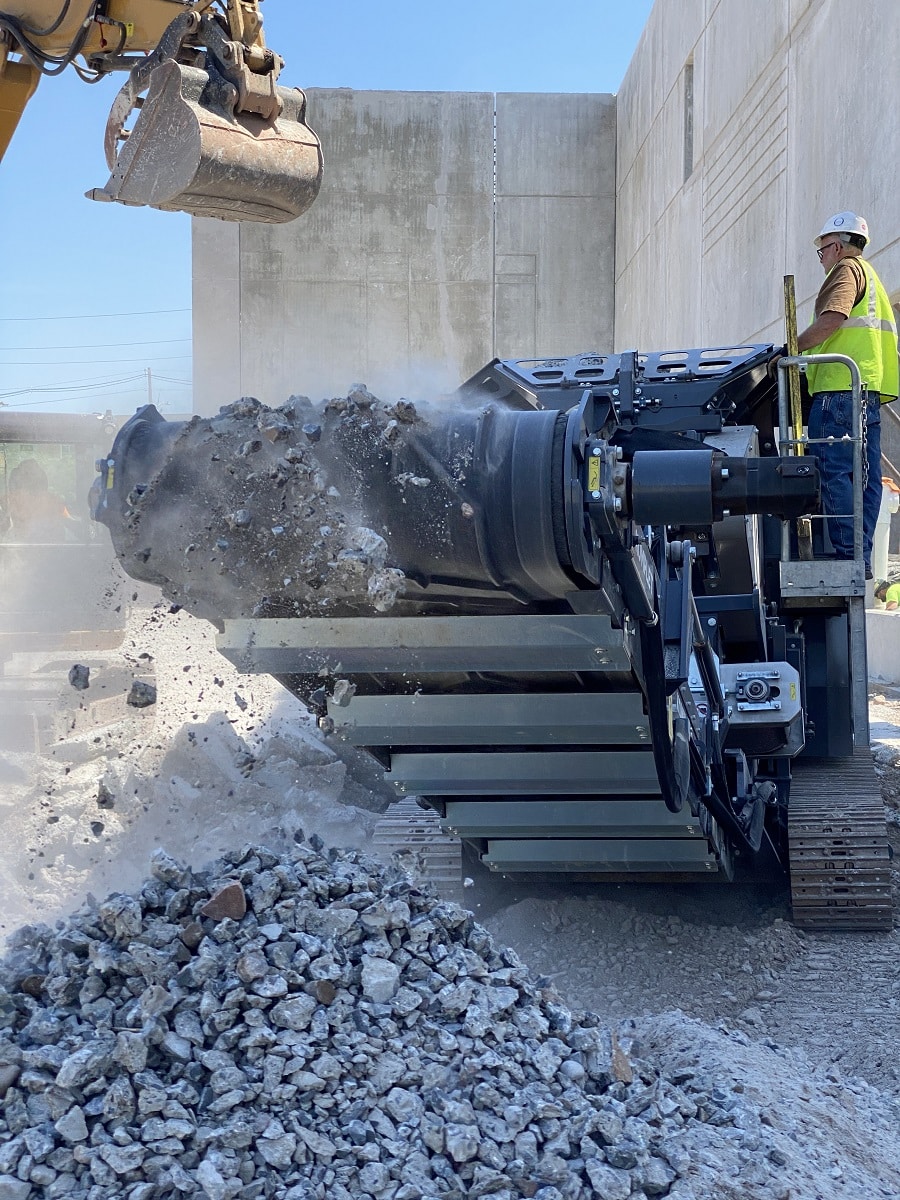

Jaw crushers are the workhorses of compact mobile crushing equipment — and for most contractor-scale, demolition, and recycling operations, they’re the right choice for primary crushing applications. But “right choice” only makes sense in comparison to the alternatives, and contractors evaluating crusher purchases routinely compare jaw crushers against impact crushers, cone crushers, and roll crushers without a clear framework for which type fits which application. The selection decision matters because the wrong crusher type produces the wrong output, wears prematurely on inappropriate material, or fails to handle the feed conditions the operation actually faces.
This guide answers the practical question: why choose a jaw crusher specifically? The answer rests on five fundamental advantages — the compression mechanism that handles hard and abrasive material, the ability to process demolition concrete with embedded rebar cleanly, the simplicity that supports operator training and field maintenance, the cost-effectiveness compared to alternative crusher types, and the versatility across material types that defines compact mobile applications. Each advantage has limits, and this guide covers those too — the situations where a jaw crusher isn’t the right answer and what to choose instead.
What a Jaw Crusher Actually Is
A jaw crusher is a compression-action crusher that uses two opposing jaw plates to break material between them. One jaw plate is fixed (called the fixed jaw), and the other oscillates back and forth (called the swing jaw or movable jaw). Material enters the V-shaped crushing chamber at the top opening (called the gape), gets compressed between the jaws as the swing jaw closes, fractures along its weakest internal stress lines, and falls through the bottom opening (called the closed-side setting or CSS) once it’s small enough to pass.
The compression principle is fundamentally different from impact crushing (where rotating blow bars strike the material), cone crushing (where material is compressed between a moving cone and a stationary bowl liner), or roll crushing (where material passes between rotating cylinders). Each mechanism has different strengths, different wear patterns, and different output characteristics — and the jaw crusher’s compression approach has specific advantages that make it the dominant choice for primary crushing and for compact mobile applications.
For a deeper explanation of the actual mechanics inside a crusher — what’s happening at the moment material breaks, how the geometry shapes the output, and why operators care about the difference — see the broader how crushers work guide. This post focuses specifically on the case for jaw crushers as a category and how Komplet’s lineup serves that case.
Five Reasons to Choose a Jaw Crusher
Reason 1: Compression Action Handles Hard, Abrasive Material
Compressive force concentrates directly on the material rather than relying on impact energy. This matters for hard, abrasive materials — granite, basalt, quartzite, iron ore, hard limestone — where impact crushers experience accelerated wear because the rotating blow bars contact the material at high speed and high stress. Jaw crushers compress material between fixed jaw plates that wear gradually rather than getting battered by high-velocity impact.
The practical consequence: jaw crusher wear parts (jaw plates) typically last longer on hard abrasive material than impact crusher wear parts (blow bars and impact aprons) on the same material. Operators processing granite, basalt, quartz, or hard sedimentary rock at scale generally come out ahead with jaw crushers — both in operating cost per ton and in equipment longevity. For applications dominated by hard abrasive material, the jaw crusher is the structural choice.
Reason 2: Demolition Concrete with Rebar Processes Cleanly
This is the dominant use case for compact mobile jaw crushers in the U.S. market. Demolition concrete typically contains embedded rebar — steel reinforcement that has to either pass through the crusher or get separated out somewhere in the processing line. Jaw crushers handle rebar-embedded concrete in a structurally clean way: compression action breaks the concrete away from the rebar (rather than impact crushers’ blow bars wrapping around rebar or tangling with it), and the rebar typically passes through the crushing chamber to be captured by integrated magnetic separators on the discharge side.
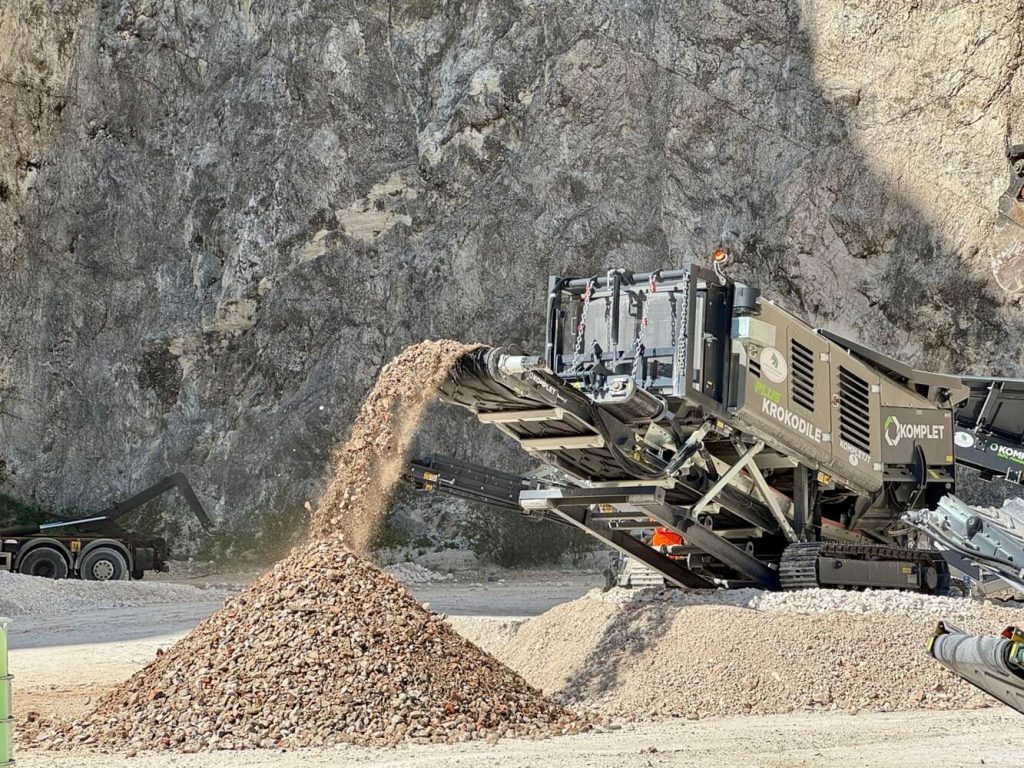
All current Komplet jaw crushers (K-JC 503, K-JC 604, K-JC 704 PLUS, K-JC 805) include integrated magnetic separation as standard or near-universal option. The result on a typical demolition project: feed mixed demolition concrete with rebar into the jaw crusher, get clean recycled concrete aggregate (RCA) suitable for base course or fill out one discharge belt, and get separated ferrous metal collected for scrap sale out the other. The same workflow on impact crushers requires more pre-processing of the rebar or downstream separation that the jaw crusher handles inline.
Reason 3: Simple Mechanical Design Supports Operator Training and Field Maintenance
Jaw crushers use a fundamentally simple mechanism — two jaw plates, a moving plate driven by an eccentric shaft and flywheel, hydraulic CSS adjustment for output sizing, and a feed hopper with vibrating feeder. The design has fewer moving parts than impact crushers (which add high-speed rotor and blow bar assemblies) or cone crushers (which add complex bowl liner geometry, hydraulic pressure relief systems, and tighter tolerance requirements). Fewer moving parts means fewer potential failure points, simpler operator training, and faster field maintenance when issues arise.
For compact mobile equipment used by single operators on project sites — the dominant Komplet customer profile — this simplicity matters substantially. Operators can learn jaw crusher operation in days rather than weeks; routine maintenance (jaw plate inspection, lubrication, fluid checks) can be performed by the operator without specialized technician support; failure diagnosis is typically straightforward because the failure modes are limited and well-understood. The mechanical simplicity translates directly to lower total cost of ownership across operational life.
Reason 4: Lower Capital Cost Than Comparable Alternatives
Per ton of throughput capacity, jaw crushers typically cost less to purchase than impact crushers, cone crushers, or roll crushers in equivalent throughput ranges. The cost differential reflects the simpler mechanical design, smaller parts inventory, and lower precision tolerance requirements. For contractor-scale and recycler-scale operations where capital deployment matters, jaw crushers produce more crushing capacity per dollar of equipment purchase than the alternatives.
Indicative 2026 Komplet’s compact mobile jaw crusher lineup:
- K-JC 503 (25 hp; 19″×12″ jaw; 34 tph)
- K-JC 604 (55 hp; 23″×16″ jaw; 55 tph)
- K-JC 704 PLUS (74 hp; 27″×16″ jaw; 90 tph)
- K-JC 805 (130 hp; 31″×21″ jaw; 160 tph)
Compared to a comparable-throughput compact impact crusher like the K-IC 70 (100 hp; 90 tph), the K-JC 704 PLUS jaw crusher offers similar throughput at meaningfully lower capital cost — and for the dominant demolition and primary crushing applications, the K-JC 704 PLUS is also the better technical fit. Used certified pre-owned units from Komplet’s pre-owned inventory typically price 30-50 percent below new equivalents for buyers wanting lower capital deployment.
Reason 5: Versatility Across Material Types
The same jaw crusher handles multiple material types within its design envelope. A K-JC 704 PLUS purchased for demolition concrete also processes asphalt, brick, masonry, natural rock (limestone, sandstone, granite, basalt within reasonable abrasiveness limits), and mixed C&D feed without reconfiguration. The hydraulic CSS adjustment lets operators change output sizing on-the-fly to match different downstream requirements; the integrated magnetic separator captures ferrous metal from any feed that contains it.
For contractors with varied project pipelines — demolition this month, civil work next month, recycling yard processing the month after — the jaw crusher’s versatility means one piece of equipment serves the full range. This contrasts with specialized equipment (cone crushers for tertiary crushing, impact crushers for cubical aggregate) that excel at narrower applications. For compact mobile operations, the breadth of jaw crusher applicability is one of its strongest practical advantages.
Jaw Crusher vs Impact Crusher: When Each Wins
The most common decision contractors actually face is jaw crusher versus impact crusher. Both categories serve the compact mobile market, both produce primary or secondary crushing capability, and both have distinct strengths. The decision framework:
Choose a Jaw Crusher When…
- Material contains rebar, embedded steel, or other ferrous content (demolition concrete, reinforced asphalt) — compression action handles rebar cleanly
- Material is hard and abrasive (granite, basalt, quartzite, iron ore) — compression wear is more durable than impact wear on these materials
- Application is primary crushing — taking large feed material down to manageable downstream feed size
- Capital cost matters — jaw crushers typically cost less per ton of throughput capacity
- Output shape isn’t critical — jaw crushers produce angular output suitable for most base course and fill applications
- Operator skill is moderate — jaw crusher operation is straightforward and field maintenance is approachable
Choose an Impact Crusher When…
- Output shape needs to be cubical — paving aggregates, decorative landscape stone, DOT-spec material
- Material is recycled asphalt pavement (RAP) — impact crushers produce uniform RAP suitable for asphalt mix
- Material is softer and non-abrasive (limestone, sandstone, low-abrasion concrete) — impact wear is acceptable on these materials
- Reduction ratio needs to be high — impact crushers typically achieve higher reduction ratios than jaw crushers in a single pass
- Application is secondary or tertiary crushing — finishing crushed product to final spec sizing
Komplet’s lineup spans both categories — the K-JC series jaw crushers cover compression-mechanism applications, and the K-IC 70 impact crusher covers cubical-output applications. For operations needing both capabilities (most aggregate and recycling yard operations), running both crusher types in series — jaw for primary, impact for finishing — is a common configuration. For contractor-scale operations that need to choose one, the jaw crusher is typically the right starting point because the dominant customer applications (demolition concrete recycling, on-site primary crushing) favor compression mechanics. See the full Komplet crusher lineup for both jaw and impact options.
How a Jaw Crusher Actually Works
A practical operational summary of jaw crusher mechanics:
- Material loading: Excavator, loader, or feed hopper delivers feed material to the top of the jaw crusher’s intake. Maximum feed size is determined by the jaw opening dimensions — material larger than the gape must be pre-broken before processing.
- Feed control: Modern compact jaw crushers (including the Komplet K-JC series) include integrated vibrating feeders and ultrasonic sensors that automatically meter material into the crushing chamber to prevent overfeeding and jamming.
- Crushing chamber: Material falls into the V-shaped chamber between the fixed jaw plate and the swing jaw plate. The swing jaw oscillates toward the fixed jaw (driven by an eccentric shaft and flywheel system), compressing the material against the fixed jaw with substantial force.
- Material fracture: Compressive force concentrates on the material’s internal stress lines and weak points; material fractures along these lines into smaller pieces. The fracture is structural rather than abrasive — material breaks because the compression exceeds its compressive strength, not because it’s worn down by friction.
- Discharge: Material that’s small enough to pass the bottom CSS opening falls out of the chamber onto the discharge belt. Material that’s still too large stays in the chamber for additional compression cycles until it reduces enough to pass.
- Magnetic separation: On equipment with integrated magnetic separation (standard or near-universal on current Komplet jaw crushers), the discharge belt passes under a magnet that captures ferrous metal — rebar, structural steel, etc. — before the crushed product reaches the stockpile.
- CSS adjustment: Operator adjusts the closed-side setting hydraulically (on Komplet equipment, via remote control) to change output sizing — wider CSS produces larger output for base course; narrower CSS produces finer output for fill or saleable spec product.
The compression mechanism is what defines the jaw crusher and what gives it the structural advantages described above. Operators who understand the mechanism in operational terms are better-equipped to optimize feed material, maintain wear parts, and identify developing issues before they become equipment failures.
Limits of Jaw Crushers
Jaw crushers aren’t the right answer for every application. Specific situations where alternatives win:
Cubical Aggregate Output
Jaw crushers produce angular, slabby output by the nature of the compression mechanism. For applications requiring cubical output — DOT-spec paving aggregate, decorative landscape stone, premium concrete aggregate — impact crushers produce a better-shaped product. Operations focused on producing cubical aggregate typically use impact crushers (K-IC 70 in Komplet’s lineup) either alone or as a secondary stage after primary jaw crushing.
RAP Production
Recycled asphalt pavement (RAP) requires uniform sizing and consistent shape for downstream asphalt mix applications. Impact crushers produce better RAP than jaw crushers because the impact mechanism reduces material more uniformly than compression. Operations producing RAP at scale typically use impact crushers as their primary RAP processing equipment.
Very High Reduction Ratios
Jaw crushers typically achieve reduction ratios of about 6:1 in a single pass, and up to 8:1 in some configurations — meaning material entering at 16″ might exit at 2-3″ at typical operating CSS. For applications requiring much higher single-stage reduction, impact crushers (10:1 to 15:1) or multi-stage processing lines produce a better result than running material through a jaw crusher repeatedly.
Very Soft, Cohesive, or Wet Material
Compression action requires material with sufficient compressive strength to fracture rather than deform. Very soft material (some shales, weathered rock) may simply compact rather than fracture. Cohesive material (wet clay, sticky soil) can bind up the crushing chamber. For these material types, screeners (especially trommel screeners for cohesive material) or shredders may be more appropriate than crushers.
Tertiary Sizing for Premium Spec Output
For final-stage tertiary sizing where output spec is critical and consistent — premium aggregate fractions, manufactured sand, specialty crushed stone — cone crushers typically produce better consistency than jaw crushers. Most operations needing this level of output spec run cone crushers as a finishing stage after primary jaw crushing.
These limits don’t argue against jaw crushers as a category — they argue for matching equipment to application. For the dominant compact mobile applications (demolition recycling, on-site processing, primary crushing of concrete and rock), jaw crushers remain the right choice.
The Komplet Jaw Crusher Lineup
Komplet’s compact mobile jaw crusher lineup spans the full operational range from small contractor work to compact-scale quarry operations:
K-JC 503 — Entry-Level Mini Jaw Crusher
25 hp Tier 4 Final diesel; 19″×12″ jaw with hydraulic CSS adjustment; up to 34 US tph; 7,496 lb transport weight; output range ¾″ to 3¼″; integrated ultrasonic feed control; wireless remote operation. Designed for small contractors, residential remodelers, basement waterproofing firms, pool installers, and limited-access urban work where larger equipment can’t physically operate.
K-JC 604 — Mid-Size Mobile Jaw Crusher
55 hp Tier 4 Final; 23″×16″ jaw; up to 55 US tph; integrated vibrating feeder; magnetic separation; wireless remote. Mid-size workhorse for site contractors and municipal yards.
K-JC 704 PLUS — Komplet’s Best-Selling Jaw Crusher
74 hp Deutz Tier 4 Final; 27″×16″ jaw; up to 90 US tph; output range ¾″ to 3¼″; maximum feed 14″ minus; approximately 26,455 lb transport weight; integrated magnetic separator; ultrasonic feed control; dust suppression; Komplet Connect remote monitoring. The dominant choice for general demolition contractors, civil operators, recyclers, and mid-volume aggregate work — the productivity-versus-capital sweet spot for most contractor operations.
K-JC 805 — Largest Jaw in the Lineup
130 hp Tier 4 Final; 31″×21″ jaw; up to 160 US tph; approximately 49,600 lb transport weight; integrated magnetic separator; Komplet Connect monitoring. Compact-scale quarry, large civil projects, high-volume recycling yards, and operations that have outgrown the K-JC 704 PLUS.
All current Komplet jaw crushers are tracked, mobile, single-operator (via wireless remote), Tier 4 Final compliant, and supported by Komplet America’s parts pipeline and authorized service network across the U.S. Full specifications and configuration options are at the Komplet crusher lineup.
Financing and Section 179 Tax Treatment
Compact mobile jaw crushers qualify for Section 179 tax treatment. For tax year 2026, the maximum Section 179 deduction is $2,560,000, with phase-out beginning at $4,090,000. The One Big Beautiful Bill Act of 2025 substantially raised these limits and restored 100 percent bonus depreciation for qualifying property placed in service after January 19, 2025. The full purchase price of qualifying jaw crusher equipment can typically be deducted in the year placed in service, dramatically improving after-tax payback. For a deeper discussion, see the Section 179 guide. Confirm specific eligibility with a qualified CPA.
Financing is available through Komplet Capital financing — 100 percent financing for qualified buyers, 24-hour approvals, no-down-payment options, and 36/48/60/72-month term structures. The financing structure often produces monthly payments below the operational savings the equipment generates — meaning the equipment effectively pays for itself from the first month of operation.
Frequently Asked Questions
What’s the main advantage of a jaw crusher over an impact crusher?
Compression mechanics. Jaw crushers handle hard abrasive material and rebar-embedded concrete more durably than impact crushers because the compression action concentrates force on the material rather than relying on high-velocity impact. For demolition concrete with rebar specifically — the dominant compact mobile application in the U.S. market — jaw crushers are the structural choice.
Can a jaw crusher handle concrete with rebar?
Yes — that’s one of its strongest applications. Compression action breaks concrete away from rebar without wrapping or tangling, and integrated magnetic separators on Komplet jaw crushers capture the rebar after crushing. The result is clean recycled concrete aggregate (RCA) and separated ferrous scrap on a single processing line.
How big is the smallest viable jaw crusher purchase?
The K-JC 503 mini jaw crusher at 25 hp, 19″×12″ jaw, up to 34 US tph, 7,496 lb transport weight. Designed for small contractors and limited-access work. For lower capital deployment, certified pre-owned units typically price 30-50 percent below new equivalents.
How much material can a compact jaw crusher process?
Komplet’s lineup spans 34 tph (K-JC 503) to 160 tph (K-JC 805) under ideal conditions. The “up to” production rating reflects best-case scenarios — consistent feed material (size, hardness, moisture), skilled operator use, proper setup, and minimal downtime. Plan for typical, not maximum, in budget and schedule modeling.
Does a jaw crusher need a screener too?
Depends on output requirements. For projects using crusher output directly (base course, fill, on-site reuse), a jaw crusher alone often suffices. For operations producing multiple spec products for sale or downstream use, a screener after the crusher separates the output into spec-graded products. See the Komplet screener lineup for screening options that pair with the K-JC series jaw crushers.
How long does jaw plate wear life last?
Highly variable based on material, throughput, operator practices, and operating environment. Jaw plates in compact mobile jaw crushers typically last 500-3,000+ operating hours. Hard abrasive virgin rock at the lower end; clean recycled concrete at the upper end. Monitor wear during operation and replace before significant performance degradation. For maintenance specifics, see the comprehensive maintenance checklist guide on the Komplet blog.
How does jaw crusher pricing compare to alternatives?
Per ton of throughput capacity, jaw crushers typically cost less than impact crushers, cone crushers, or roll crushers in equivalent throughput ranges. The Komplet K-JC 704 PLUS at up to 90 tph compares favorably against impact crushers in the same throughput range. The capital differential reflects the simpler mechanical design and lower precision tolerance requirements.
Can I finance a jaw crusher with no money down?
Yes — Komplet Capital financing offers 100 percent financing for qualified buyers, 24-hour approvals, no-down-payment options, and standard term structures. For most contractor-scale operations, the monthly payment lands below the recovery economics the equipment generates.
Final Thoughts
Choosing a jaw crusher isn’t just a brand or product decision — it’s a decision about which crushing mechanism fits your operation’s actual material, applications, and capital structure. For the dominant compact mobile applications — demolition concrete recycling, on-site primary crushing, hard rock and abrasive material processing, contractor-scale and recycler-scale work — jaw crushers are the structural choice for clear technical reasons: compression handles rebar and hard material durably, mechanical simplicity supports operator training and field maintenance, capital cost is lower per ton than alternatives, and versatility spans the variable feed conditions real projects produce. Operations with different needs (cubical output, RAP production, very high reduction ratios, premium tertiary spec) match different equipment categories — and Komplet’s lineup includes both jaw and impact crusher options to fit those varying needs. For decision frameworks beyond crusher type alone — budget evaluation, mobility profile, financing structure — see the broader buying equipment guide.
The Conti family construction legacy that informs Komplet America’s approach to equipment dates to 1906, and the equipment-selection lesson from that lineage is straightforward: don’t pick equipment based on what it can do in theory — pick it based on what it does well in your specific application. Jaw crushers do specific things well, and for the contractors, recyclers, and demolition operators who match those things, the jaw crusher purchase decision produces operational economics that compound across years of reliable service. The K-JC series has been at the center of Komplet America’s lineup since the company’s founding for that reason — it’s the equipment category that solves the dominant customer problem for the customers Komplet America serves.
To explore current Komplet jaw crushers, the full Komplet crusher lineup is online with detailed specs and pricing. Pre-owned options are at Komplet’s pre-owned inventory. For Komplet Capital financing structures, including 100 percent financing options for qualified buyers. To find a Find Your Komplet Dealer in your territory. Or call Komplet America directly at (908) 369-3340.
Ready to Choose the Right Jaw Crusher for Your Operation?
- Map your operation’s actual material and applications — feed material type, throughput requirements, project pipeline. The right crusher type follows directly from this analysis.
- Call Komplet America at (908) 369-3340 to discuss specific applications and which K-JC series jaw crusher fits your operational profile. The team can match equipment to your project mix.
- Discuss financing through Komplet Capital financing — 100% financing, 24-hour approvals, no down payment options.
- Talk to your CPA about Section 179 — for tax year 2026, the maximum deduction is $2,560,000.
- Find your local Find Your Komplet Dealer for in-person K-JC series evaluation, or browse Komplet’s pre-owned inventory for lower-capital entry points.
Never enough.
Disclaimer: ROI figures, payback timelines, project economics examples, throughput rates, jaw plate wear life, and pricing references shown above are illustrative only based on sample assumptions about material, operator skill, operating conditions, and other factors. Actual results vary by region, project, equipment configuration, and other factors. Komplet America makes no guarantee of specific financial returns or operational outcomes.
Disclaimer: Equipment pricing is subject to change based on dealer location, configuration, and additional features. Prices do not include taxes, shipping, or installation fees. Contact Komplet America at (908) 369-3340 for current pricing.
Disclaimer: Section 179 limits are 2026 figures based on the One Big Beautiful Bill Act of 2025 and adjust annually. Komplet America is an equipment distributor, not a tax advisor. Consult a qualified CPA before making decisions based on tax treatment.
Disclaimer: Komplet equipment standard warranty coverage is 1 year / 1,000 hours, subject to terms and conditions. Warranty coverage requires compliance with operator’s manual maintenance requirements. Confirm specific warranty terms at time of purchase.
All operating, maintenance, and service guidance is general in nature. Always refer to the official Komplet operator’s manual for the specific machine model and serial number, and follow OEM intervals and procedures. For warranty-protected work, contact Komplet America at (908) 369-3340 or your authorized Komplet dealer.