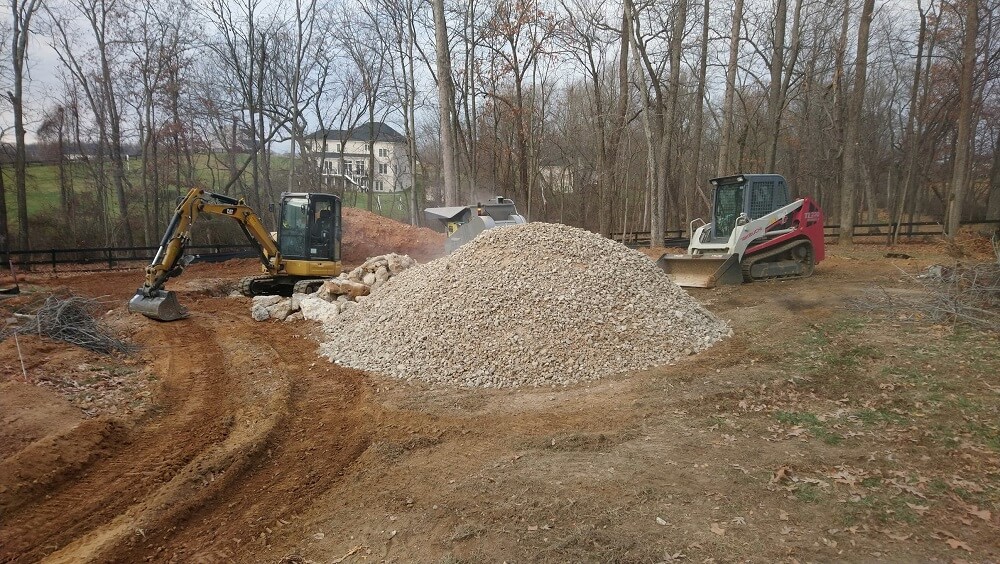

Equipment dealers and rental houses operate in a market where customer expectations have shifted dramatically over the past decade. Contractors who used to think of demolition concrete and asphalt as waste now think of it as raw material. Recyclers who used to focus on bulk handling now focus on producing spec-graded products. Civil contractors who used to budget heavy disposal costs now ask whether disposal can be eliminated entirely. The common thread: customers across construction, demolition, and recycling are increasingly looking for on-site recycling solutions, and the dealers and rental houses positioned to offer those solutions are capturing structural advantage in their markets.
This guide walks through the case for dealers and rental houses to offer on-site recycling solutions to their customers — the customer-side economics driving the demand, the dealer/rental-house revenue and retention benefits of carrying the right equipment, the specific Komplet equipment that addresses the dominant on-site recycling applications, and the competitive positioning advantages that come from being the partner customers turn to when they’re ready to add on-site recycling capability. Throughout: practical guidance grounded in the actual mechanics of what makes on-site recycling solutions sell, work, and compound revenue across the dealer-customer relationship.
Why Customer Demand for On-Site Recycling Is Growing
The structural drivers behind on-site recycling demand are not temporary trends — they’re long-term shifts in the economics and regulatory environment of construction and demolition. Understanding why customers are asking for on-site recycling solutions is the foundation of selling those solutions effectively:
Tipping Fee Pressure
Concrete tipping fees in major U.S. metros typically run $50-$100+/ton. Asphalt similar ranges. Mixed C&D commonly $40-$80+/ton. Available landfill capacity has been declining for decades, and tipping fees rise year over year in most markets. Customers exposed to this cost category face structural cost growth that on-site recycling eliminates. The dealer or rental house that solves this problem for the customer captures a high-value sale or rental.
Mandatory C&D Diversion Requirements
Many state, county, and municipal jurisdictions mandate minimum C&D waste diversion percentages on commercial construction and demolition projects — typically 50-75 percent diversion. On-site processing produces measurable, documented diversion that contributes to compliance. Failure to meet diversion requirements can result in permit complications, fees, project delays, or rejected certificates of occupancy. Customers who need diversion documentation are direct candidates for on-site recycling equipment that produces it automatically.
LEED v4 Materials and Resources Credits
LEED v4 awards Materials and Resources credits for documented C&D waste diversion AND for recycled content use in new construction. Operations with on-site material recovery capture both — diversion credits for the recycled demolition material plus recycled content credits when that material gets used in subsequent project work. Sustainable building certification programs influence general contractor and owner equipment specifications, which in turn influence customer equipment purchase decisions.
Section 179 Tax Treatment Driving Equipment Purchases
For tax year 2026, the Section 179 maximum deduction is $2,560,000, with phase-out beginning at $4,090,000. The One Big Beautiful Bill Act of 2025 substantially raised these limits and restored 100 percent bonus depreciation for qualifying property placed in service after January 19, 2025. The tax environment dramatically favors equipment purchases right now, and customers aware of the tax structure are actively looking for qualifying equipment to deploy capital before year-end.
Competitive Pressure From Operators Already Running On-Site Processing
In every regional market, some demolition contractors, civil contractors, and recyclers are already running on-site processing equipment. Their competitive advantages — lower bid pricing, faster project schedules, diversification revenue, sustainability positioning — show up across project bids and create competitive pressure on operators who haven’t yet adopted the workflow. Customers losing bids to on-site-processing competitors are direct candidates for the equipment that closes the competitive gap.
The Revenue and Retention Benefits for Dealers and Rental Houses
Offering on-site recycling solutions to your customers isn’t just about responding to customer demand — it’s about capturing structural revenue and retention advantages that compound across the customer relationship:
Direct Equipment Sales Revenue
Each on-site recycling equipment sale produces direct dealer revenue at the point of transaction. Dealer margins on equipment sales generate immediate revenue, and dealer financing through Komplet Capital often closes deals where customer financing alone wouldn’t have.
Recurring Aftermarket Parts and Service Revenue
Equipment sales are the start of a multi-year customer relationship, not the end of one. Compact mobile crushing equipment requires regular wear part replacement (jaw plates, screens, blow bars), routine maintenance parts and consumables, and periodic technical service support. Each piece of equipment placed in your territory becomes a recurring aftermarket revenue stream — typically 15-25 percent of equipment purchase price annually across operational life. Across a dealer’s installed base, aftermarket revenue often becomes the largest single profit category.
Cross-Sell Across the Equipment Lineup
Customers who purchase one piece of compact mobile equipment are typically high-conversion candidates for additional equipment over time. A demolition contractor who buys a K-JC 704 PLUS jaw crusher often adds a K-TC 460 conveyor within 12 months and a Kompatto 5030 screener within 24 months. The cross-sell economics across the Komplet lineup compound — each new customer becomes a multi-year revenue relationship rather than a single transaction.
Rental Revenue Stream (For Rental Houses)
Komplet America does not rent direct to end users — instead, the company sets up authorized rental house relationships across the country. Rental houses purchasing Komplet equipment for their fleet capture the rental revenue stream from contractors needing compact crushing or screening capacity for specific projects. Rental utilization on compact mobile crushing equipment typically runs strong because rental customers — smaller contractors, one-off project needs, supplemental capacity — consistently need what they don’t own. The rental house captures recurring rental revenue without requiring its customers to make capital purchase decisions.
Customer Retention Through High-Value Solutions
Customers solved by your dealership or rental house tend to stay with your dealership or rental house. Compact mobile recycling equipment is high-value capital — customers don’t switch dealers casually after making this kind of investment. Each on-site recycling solution placed builds a long-term customer relationship that produces additional equipment sales, parts and service revenue, and referral business across years.
Competitive Differentiation in Your Territory
Most equipment dealerships in any given territory don’t offer compact mobile recycling equipment — the major-brand crusher lines focus on larger plant equipment, and smaller dealers typically don’t carry processing equipment at all. Adding the Komplet line positions your dealership as the partner customers turn to when they’re ready to add on-site recycling capability. The differentiation captures customers who would otherwise go to out-of-territory specialty dealers — and those captured customers become long-term territory revenue.
Komplet Equipment for Specific On-Site Recycling Applications
The right on-site recycling equipment depends on the customer’s specific application. Komplet’s lineup spans the dominant on-site recycling use cases:
Demolition Concrete and Asphalt — Jaw Crushers
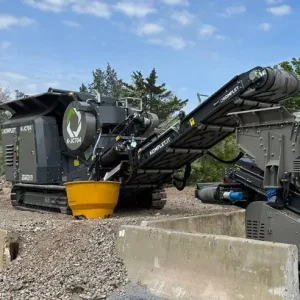
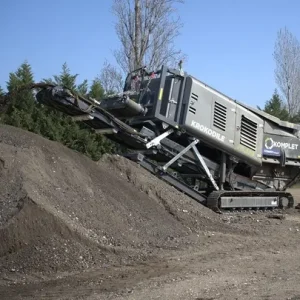
The K-JC series jaw crushers handle demolition concrete with rebar, asphalt, mixed C&D, brick, and natural rock. Compression action breaks concrete away from rebar (captured by integrated magnetic separator), produces RCA suitable for base course and fill, and handles the variable feed conditions typical of demolition work. Lineup:
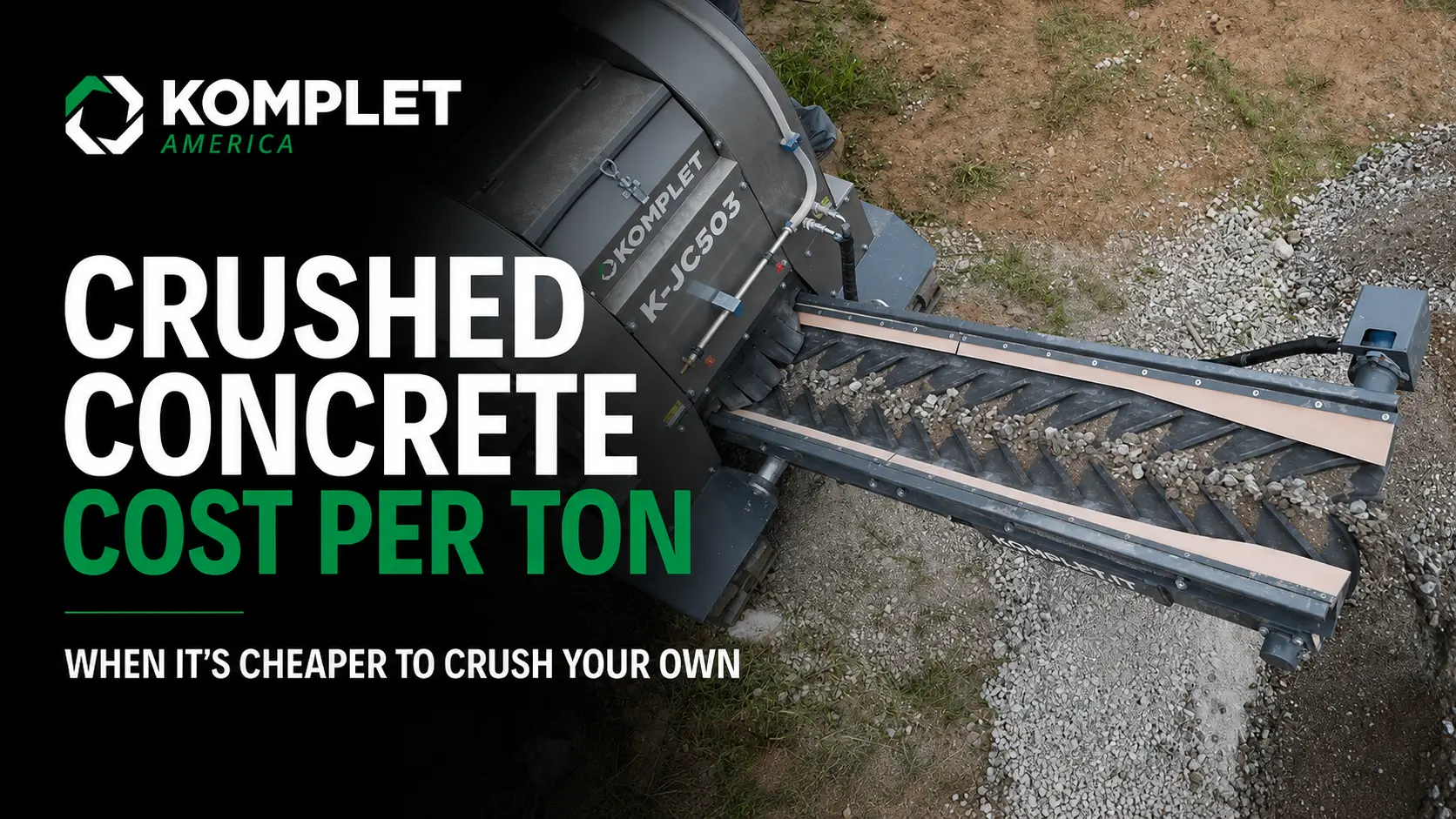
- K-JC 503 (25 hp; 19″×12″ jaw; 34 tph) — entry-level for small demolition contractors and residential remodelers
- K-JC 604 (55 hp; 23″×16″ jaw; 55 tph) — mid-size for site contractors
- K-JC 704 PLUS (74 hp; 27″×16″ jaw; 90 tph) — best-selling jaw, dominant choice for general demolition contractors
- K-JC 805 (130 hp; 31″×21″ jaw; 160 tph) — largest jaw, high-volume recycling and compact-scale quarry
RAP and Cubical Aggregate — Impact Crushers
The K-IC 70 impact crusher (100 hp; 90 tph) produces cubical aggregate suitable for paving applications, DOT-spec material, and decorative landscape applications. Customers producing reclaimed asphalt pavement (RAP), recycled aggregate for paving, or cubical landscape material gravitate to the impact crusher option.
Material Separation — Vibrating Screeners
The Kompatto vibrating screener lineup separates crushed material into spec-graded products for sale or downstream use. Most operations producing recycled aggregate for sale need screening capability after crushing:
- Kompatto 221 (25 hp; 90 tph; double-deck) — entry-level for limited-access sites
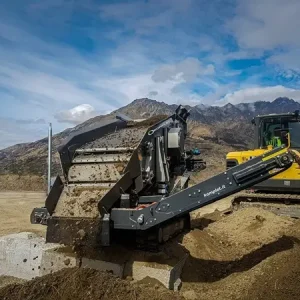
- Kompatto 5030 (45 hp; 280 tph; double-deck) — best-selling screener, dominant choice for recycling yards
- Kompatto 124 (75 hp; 350 tph) — largest scalping screen for high-throughput operations
Cohesive Material — Trommel Screeners
The K-TS series trommel screeners handle compost, topsoil, mulch, and other cohesive or organic material that doesn’t size cleanly through vibrating screens. Customers in landscape supply, composting, organic recycling, and disaster recovery use trommel screeners specifically:
- K-TS 30 (23 kW genset) — compact trommel for compost, topsoil, green material
- K-TS 40 (40 kW genset; 120 tph) — larger trommel for higher-volume operations
Soft Waste and Mixed C&D — Slow-Speed Shredders
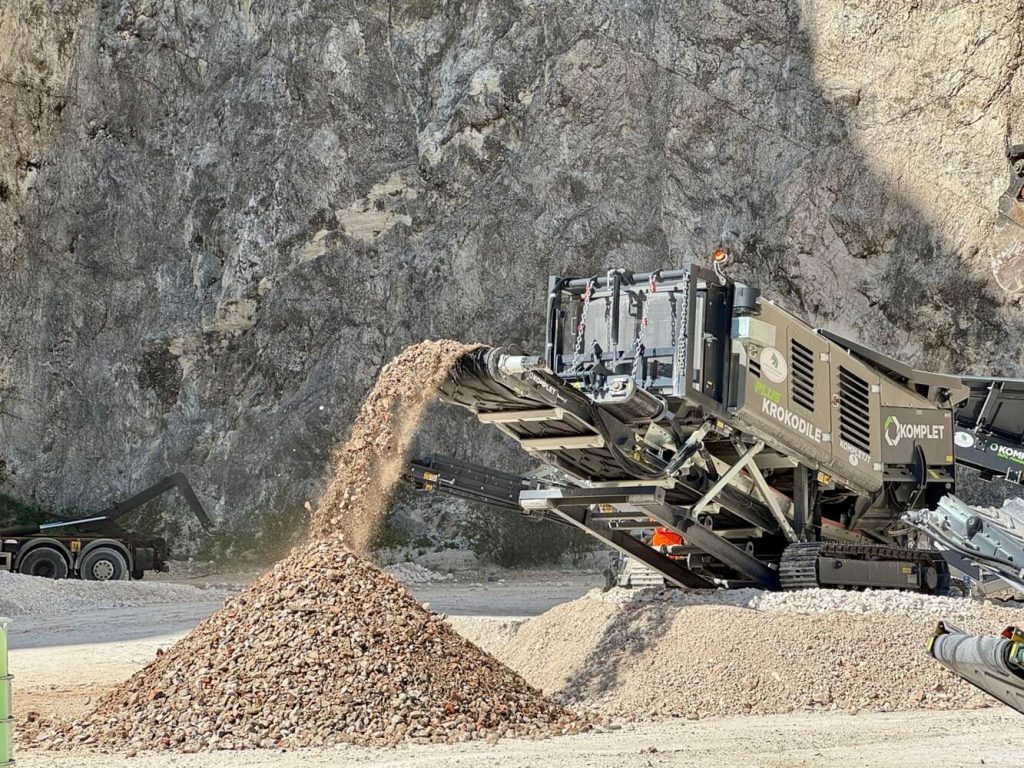
The Krokodile PLUS slow-speed shredder (220 hp Volvo Penta; 60″ shaft) handles wood, drywall, mixed soft waste, and C&D recycling streams that crushers can’t process. The dual-shaft system (C&D shaft for hard rubble, wood/lightweight shaft for soft material) handles both waste types in a single machine — particularly valuable for customers processing mixed waste streams or running disaster recovery operations.
Material Movement — Tracked Mobile Conveyors
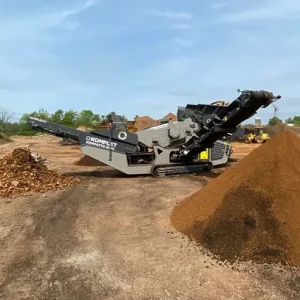
The K-TC 460 tracked mobile conveyor (132 tph; 25 hp Tier 4 Final) connects crushers and screeners into integrated processing lines, eliminates loader cycles for material handling, and increases stockpile capacity. Often the lowest-capital piece of equipment in a customer’s lineup, and frequently the first add-on after an initial crusher purchase.
How to Position On-Site Recycling Solutions in Customer Conversations
Selling on-site recycling solutions is fundamentally about helping customers see the economic case clearly enough to commit to the equipment investment. Effective conversation patterns:
Lead With Customer Project Economics, Not Equipment Specs
Customers buy outcomes, not equipment. Start by understanding the customer’s specific project pipeline — annual demolition tonnage, current tipping fees, current aggregate purchase costs, current hauling costs. The combined addressable cost number is typically larger than customers expect. Once the customer sees the addressable cost, the conversation shifts from “can I afford the equipment” to “how quickly can I deploy the equipment to capture the savings.”
Frame Equipment Cost as Monthly Payment vs. Monthly Recovery Economics
Komplet Capital financing structures monthly payments that often align with the recovery economics the equipment generates. A K-JC 704 PLUS financed over 60 months produces approximately $5,100/month payment. For a customer processing 4,000 tons/month in a $75/ton tipping market, avoided tipping alone is $300,000/month — the equipment payment is less than 2 percent of the recovery economics. Walking the customer through this math closes deals that pure capital cost conversations never close. Always reference Komplet Capital financing structures specifically.
Reference Section 179 Tax Treatment
For customers in the right position to use it, Section 179 dramatically improves after-tax economics. Frame the conversation as: “For tax year 2026, the maximum Section 179 deduction is $2,560,000. The K-JC 704 PLUS deducted in full in the year of placement reduces taxable income by the full purchase price. Combined with 100 percent bonus depreciation restored by the OBBBA, after-tax payback is dramatically faster than the gross calculation suggests. Worth a 15-minute conversation with your CPA before committing.” Always direct customers to consult a qualified CPA for specific eligibility.
Document the Specific Recovery Economics for the Specific Customer
Generic sales materials work for general awareness; specific deal closure requires customer-specific economics. Build a one-page recovery economics document for the specific customer’s specific project mix — current tipping costs, current aggregate purchase costs, equipment configuration recommendation, monthly payment structure, expected payback timeline, and net annual savings. The document becomes the artifact the customer references in board approvals, partner conversations, and CFO discussions. Komplet America’s team can support dealer-customer conversations with specific economics modeling for complex deals.
Coordinate Demonstrations and Site Visits
For customers on the fence, an in-person demonstration at the Komplet Hillsborough yard or at an authorized dealer’s facility removes most remaining questions. Customers see the equipment operating, talk to operators, ask technical questions, and develop confidence in the purchase. Komplet America coordinates demonstrations with dealer-supported customers and supports dealer-led demonstrations with technical resources.
Frequently Asked Questions
How quickly do customers typically commit after first conversation?
Highly variable. Some customers commit within weeks once they see the recovery economics; others take 6-12 months from first conversation to purchase as they evaluate the workflow change, secure financing, plan project timing, and develop internal commitment. Most customer purchases close inside 90 days from first serious conversation if the dealer provides specific recovery economics, financing options, and demonstration access.
What’s the typical first equipment purchase for a new on-site recycling customer?
The K-JC 704 PLUS jaw crusher is the most common first purchase. Mid-size, versatile, handles the dominant feed materials (concrete, asphalt, mixed C&D), and fits the capital range that most contractor-scale customers can support. Smaller customers sometimes start with the K-JC 503 at the entry-level; larger customers sometimes start with the K-JC 805 for higher throughput. Conveyors (K-TC 460) and screeners (Kompatto 5030) are common second purchases within 12-24 months.
Should I sell or rent for first-time customers?
Depends on customer utilization. Customers with 30+ operating days per year typically come out ahead with ownership; customers below that threshold typically benefit from renting through authorized rental houses. The conversation often resolves into a hybrid path: customer rents initially to validate the workflow, then purchases once the recovery economics are proven. Both paths produce dealer or rental-house revenue, just on different time scales.
How does the Komplet support team interact with customers?
Komplet America’s team supports dealer-customer relationships rather than replacing them. The dealer remains the primary customer relationship; Komplet America provides technical support, application analysis, complex deal structure assistance, and warranty coordination. The customer experiences a unified team with the dealer in front and Komplet America providing depth-of-resources behind.
What about financing for customers who can’t qualify with their bank?
Komplet Capital financing routinely qualifies customers who can’t qualify with traditional banks — 100 percent financing for qualified buyers, 24-hour approvals, no-down-payment options, and 36/48/60/72-month term structures. Details at Komplet Capital financing. The financing flexibility closes deals that would otherwise stall on customer-side capital constraints.
How does this work for customers wanting pre-owned equipment?
Komplet’s certified pre-owned program (referenced through Komplet’s pre-owned inventory) inspects and refurbishes used units to meet operational standards, with documented service history. Pre-owned equipment typically prices 30-50 percent below new equivalents and qualifies for Section 179 the same as new equipment. For customers wanting lower capital deployment, pre-owned is often the right entry point — and the dealer handles the customer relationship the same as for new equipment sales.
What support is available for customer demonstrations?
Komplet America coordinates demonstrations at the Hillsborough, NJ yard or at authorized dealer facilities. Dealer customers can be brought in for in-person demonstrations with technical support from the Komplet team. Pre-owned demos are also available for customers considering pre-owned equipment. Demonstration coordination is one of the highest-leverage activities for closing complex deals.
What’s the typical revenue trajectory for a dealer adding the Komplet line?
Variable based on territory, customer base, and dealer activity, but typical patterns: $500K-$1.5M in equipment revenue in year 1 as the line ramps up, growing to $2M-$5M+ in years 3-5 as the installed base develops and aftermarket revenue compounds. The aftermarket revenue often becomes the largest single profit category as the installed base matures. Specific dealer outcomes depend heavily on dealer effort and territory characteristics.
Final Thoughts
On-site recycling solutions represent one of the highest-growth segments of compact equipment sales — driven by tipping fee pressure, mandatory diversion requirements, LEED credit programs, favorable Section 179 tax treatment, and competitive pressure from on-site-processing operators in every regional market. Customers across construction, demolition, civil, and recycling are looking for equipment partners that can solve the on-site processing problem efficiently and economically. The dealers and rental houses positioned to offer those solutions are capturing structural advantage that compounds across years of customer relationships, aftermarket revenue, and territory development.
The Conti family construction legacy that informs Komplet America’s approach to equipment dates to 1906, and the dealer-customer lesson from that lineage is straightforward: solve the customer’s actual problem, not the problem the manufacturer wishes the customer had. On-site recycling solutions solve real customer problems — tipping fee exposure, hauling cost growth, aggregate purchase costs, project schedule risk from disposal logistics, regulatory diversion compliance — and the dealers and rental houses who help customers solve those problems build durable, multi-year relationships that produce revenue across the full operational life of the equipment. The Komplet lineup is built for that purpose, the support infrastructure is structured to back dealer-customer relationships, and the partnership philosophy treats dealer success as the foundation of manufacturer success.
To explore the Komplet equipment lineup that supports your dealer or rental house in offering on-site recycling solutions to your customers, see the Komplet equipment lineup. For dealer program details and applications, see Become a Komplet Dealer. To find existing Komplet dealer territory and locator information, see Find Your Komplet Dealer. For Komplet Capital financing structures supporting customer purchases. Or call Komplet America directly at (908) 369-3340 to discuss specific customer applications, dealer-customer support, and the on-site recycling solution opportunity in your territory.
Ready to Add On-Site Recycling Solutions to Your Customer Offerings?
- Identify customers in your territory currently exposed to tipping fees, hauling costs, or aggregate purchases — these are direct candidates for on-site recycling equipment.
- Call Komplet America at (908) 369-3340 to discuss specific customer applications, equipment configurations, and dealer-customer support resources for your territory.
- Apply to become a Komplet equipment dealer or rental house through Become a Komplet Dealer — protected territories, training, marketing support, and parts pipeline.
- Browse the Komplet equipment lineup — review the equipment your dealership would carry and the customer applications each piece serves.
- Review Komplet Capital financing — one of the strongest sales tools available to Komplet dealers and worth understanding before customer conversations begin.
Never enough.
Disclaimer: ROI figures, payback timelines, project economics examples, tipping fee references, and dealer revenue illustrations shown above are illustrative only based on sample assumptions. Actual results vary by region, project, equipment utilization, financing terms, dealer effort, territory characteristics, and other factors. Komplet America makes no guarantee of specific financial returns.
Disclaimer: Equipment pricing is subject to change based on dealer location, configuration, and additional features. Prices do not include taxes, shipping, or installation fees. Contact Komplet America at (908) 369-3340 for current pricing.
Disclaimer: Section 179 limits are 2026 figures based on the One Big Beautiful Bill Act of 2025 and adjust annually. Komplet America is an equipment distributor, not a tax advisor. Always direct customers to consult a qualified CPA before basing purchase decisions on tax treatment.
Disclaimer: Dealer program terms, territory definitions, stocking commitments, training schedules, and partnership economics are general descriptions only and may vary by territory and dealer capacity. Specific program terms are documented in dealer agreements.
All operating, maintenance, and service guidance is general in nature. Always refer to the official Komplet operator’s manual for the specific machine model and serial number, and follow OEM intervals and procedures.