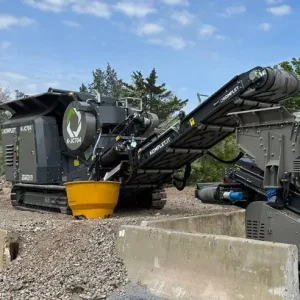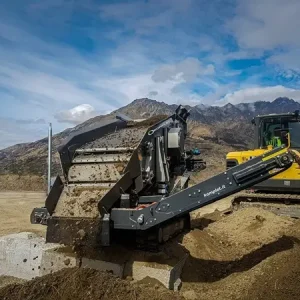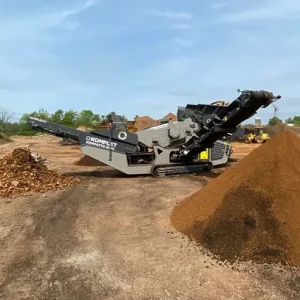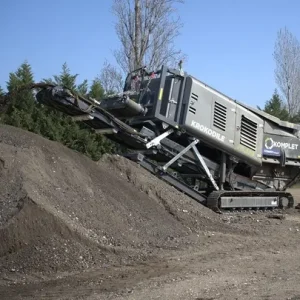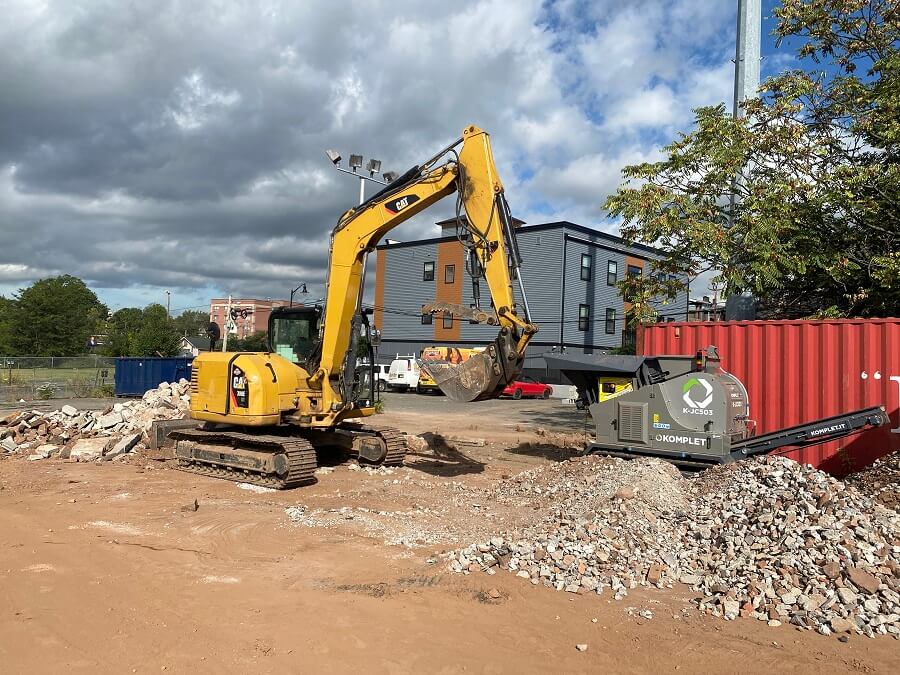

The way construction and demolition contractors process material on U.S. jobsites is shifting. Fixed crushing plants and trucked-off-site processing are giving ground to compact, mobile, single-operator machines that bring the crusher to the material instead of the other way around. The reasons are practical: lower hauling costs, faster project timelines, less dependence on third-party processors, and the ability to turn demolition debris into usable aggregate on the same site that produced it.
This article looks at why mini mobile crushers are gaining ground on U.S. jobsites, what makes them different from larger fixed equipment, the production rates contractors can realistically expect, and how Komplet America’s compact crusher lineup fits into the trend.
How a Jaw Crusher Reduces Material
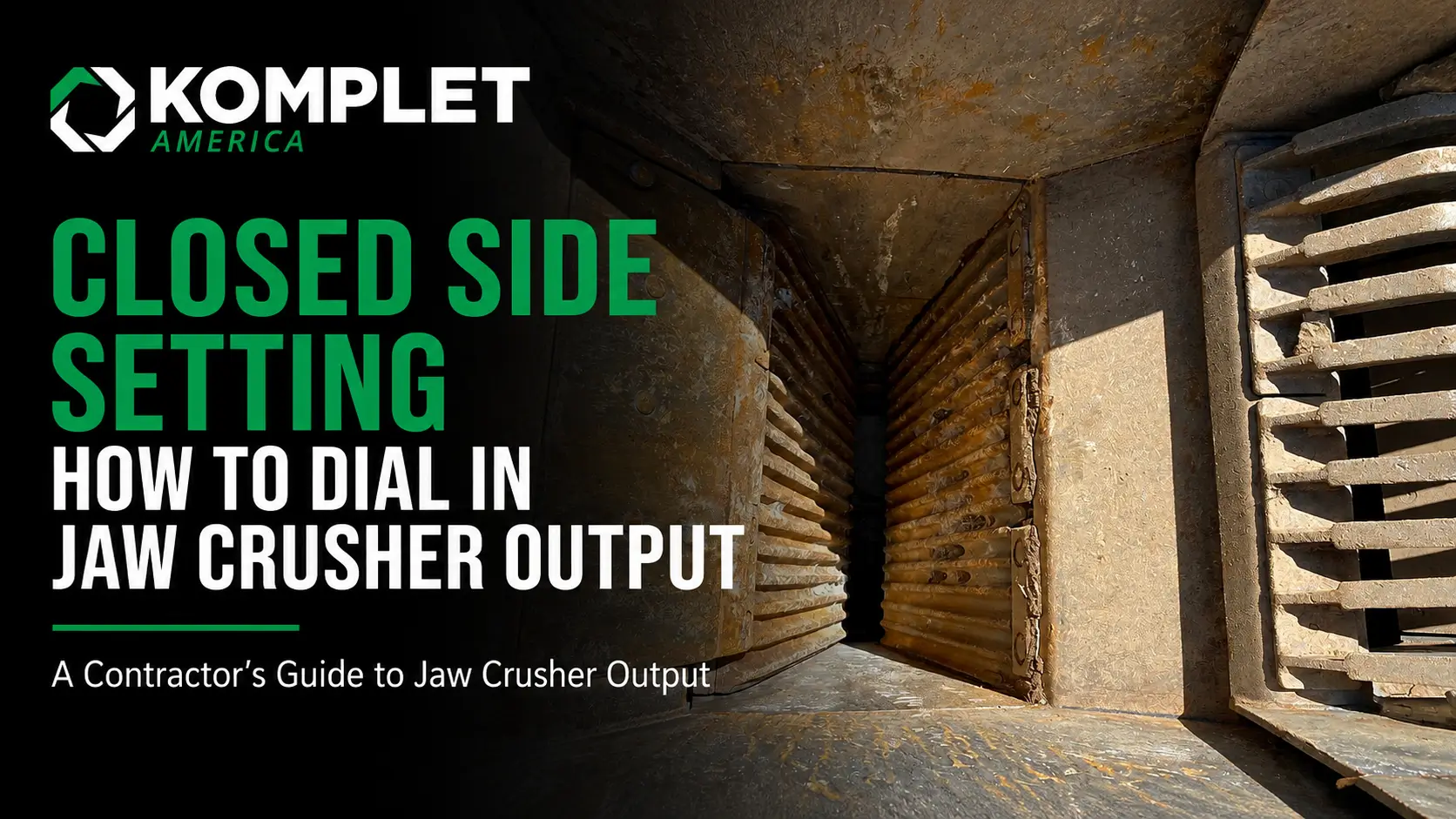
A jaw crusher reduces hard material through compressive force. The machine has two crushing plates: one fixed, one moving. Material drops between them; the moving plate squeezes the material against the fixed plate; the broken pieces fall through to a discharge belt. The closed-side setting (the gap between the plates at their closest point) determines the output size; the inlet opening sets the maximum input size, which should run about 80% of the jaw gape.
In practice, jaw crushers are the workhorse for hard, abrasive material — reinforced concrete, natural rock, brick, granite. They produce angular output that’s well-suited for base aggregate, structural fill, and a range of construction reuse. The key advantage of a mini mobile jaw crusher: the machine is small enough to bring to the material, but strong enough to handle the same hard demolition feed that a much larger fixed crusher would handle at a permanent installation.
Hard Material Processing on the Jobsite
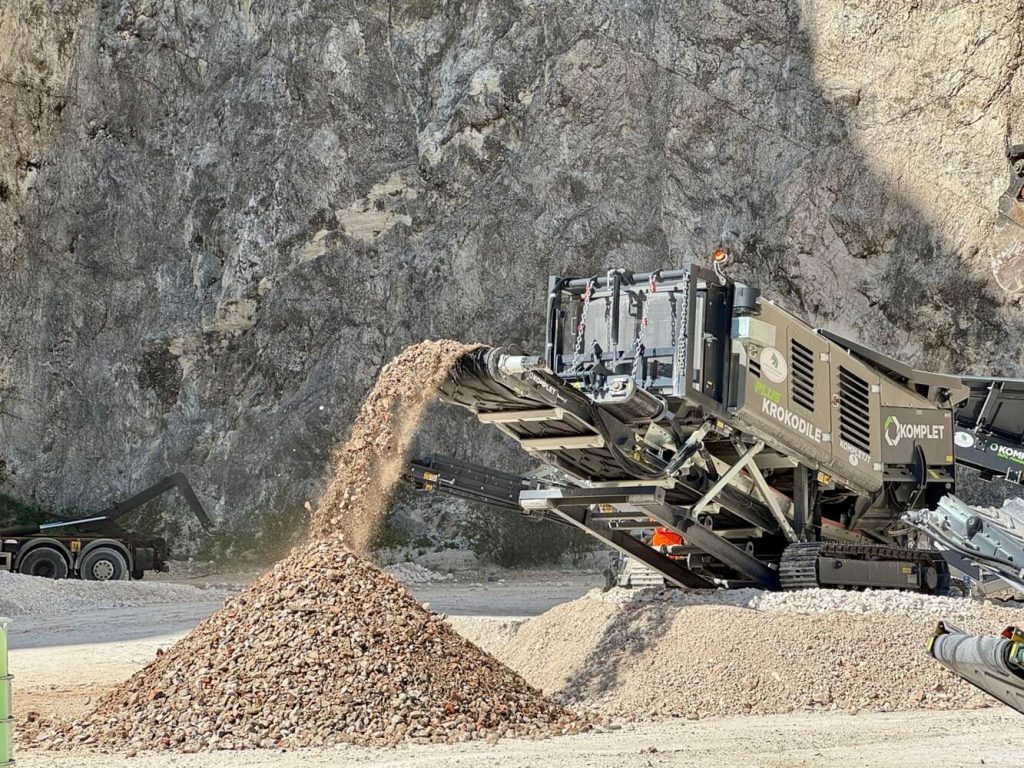
Mini mobile jaw crushers are well-suited for the kind of hard material most demolition contractors deal with daily — broken concrete slabs, foundation rubble, brick and block, asphalt chunks, natural rock from excavation. They reduce that material on-site into reusable aggregate without the cost of trucking it to a fixed processing facility.
A note on crusher types in general: jaw crushers, impact crushers, and cone crushers are three different machine categories used in different situations. Jaw crushers handle hard, abrasive material across a wide range of demolition and recycling work. Impact crushers (like the Komplet K-IC 70) are stronger on softer concrete and asphalt, producing more cubical aggregate. Cone crushers are typically used at fixed quarry or aggregate-production facilities for secondary or tertiary crushing of hard rock — they’re not a category that competes with mini mobile crushers in the on-site recycling space, and they’re not used for processing scrap metal or steel.
Production Rates Across the Komplet Mini Mobile Crusher Lineup
The Komplet America compact crusher lineup spans from the smallest unit suitable for paving repairs and small foundation work, up to the largest model rated for steady commercial demolition flow. Verified production rates:
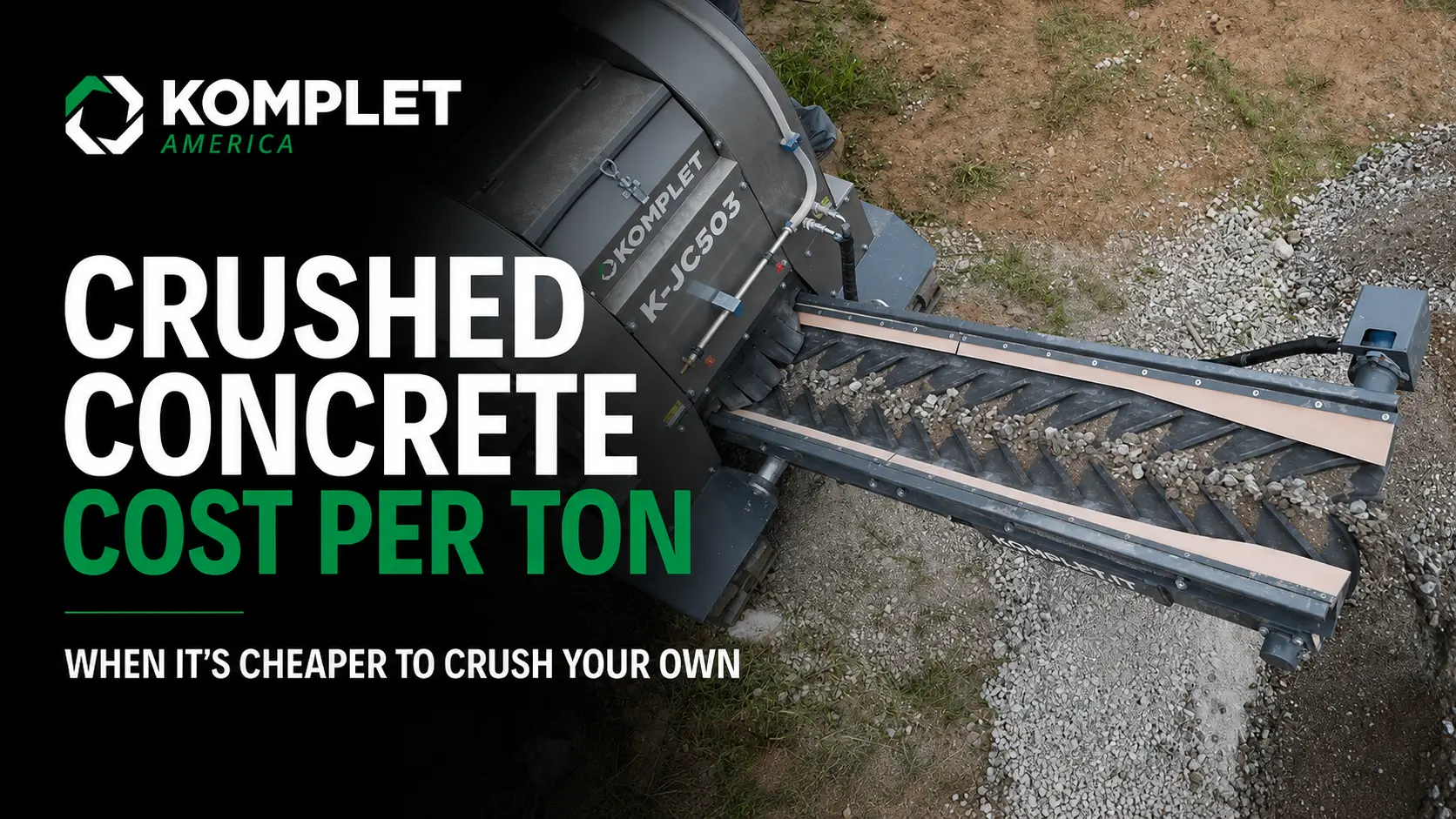
- K-JC 503 — 25 hp, 19″ × 12″ jaw, up to 34 US tph
- K-JC 604 — 55 hp, 23″ × 16″ jaw, mid-range mobile production
- K-JC 704 PLUS — 74 hp, 27″ × 16″ jaw, up to 90 US tph
- K-JC 805 — 130 hp, 31″ × 21″ jaw, up to 160 US tph
- K-IC 70 — 100 hp impact crusher, 25″ × 20″ inlet, complementary to the jaw range
Across the full lineup, mobile crushers from Komplet America produce roughly 34 to 160 US tons per hour depending on the model selected, the feed material, and operating conditions. The right model is the smallest one that handles the largest piece of typical feed material and the highest typical daily production target — with some headroom, not running at the spec ceiling.
Saving Time on Site Preparation and Demolition
When demolition or excavation work depends on a fixed crusher — whether on-site or at a processing facility miles away — the project timeline compresses around that bottleneck. Material has to be staged, loaded, hauled, processed, and either returned or replaced with purchased aggregate. Each step adds time, fuel, labor, and coordination overhead.
A mini mobile crusher eliminates most of that. Material that comes out of the demolition or excavation goes directly into the crusher’s hopper. Crushed output goes onto a discharge belt and is stockpiled or loaded out on the same site. The loader and excavator that produced the material can keep working while the crusher processes alongside them, instead of waiting for trucks to clear the staging area.
Each Komplet mini mobile crusher is rated for a specific tons-per-hour throughput, which lets contractors plan jobsite operations against a known production rate — schedule excavator and loader cycles to keep the crusher fed without backing up, project the day’s output, and time-stamp project milestones with realistic accuracy.
Mobility Without Special Permits
A primary advantage of the Komplet mini mobile crusher lineup is transport simplicity. The smaller models travel on standard equipment trailers; even the largest unit transports on a heavy-haul trailer without specialized over-dimension permits in most U.S. jurisdictions. Tracked mobility means the crusher can reposition on-site under its own power — across rough demolition surfaces, around staged material, or between sequential work zones.
Remote control is standard across the lineup. A single operator runs the crusher from outside the active zone using a remote interface, which both improves operator safety and reduces the head-count required to run the equipment. On most jobsites, one operator handles the crusher while a loader or excavator operator handles the feed.
Built for Daily Heavy-Duty Use
Mini mobile crushers from Komplet America are built around the same engineering principles as the larger Komplet SpA equipment — high-strength steel construction, robust core components, OEM-grade wear parts, and field-proven hydraulic systems. The mainframe, swing jaw, flywheel, and eccentric shaft are all engineered for daily heavy-duty use, not occasional light operation.
Komplet America stocks all wear parts and a wide range of specialty components for every model, with U.S.-based parts inventory and a service-provider network. See the parts and support page for current details.
Why a Mini Mobile Crusher Is Cost-Effective
The financial case for a mini mobile crusher rests on three cost categories that on-site crushing affects simultaneously:
- Hauling and disposal cost reduction — instead of trucking demolition rubble off-site at $8–$15 per ton, the material stays on-site as crushed aggregate.
- Tipping fee elimination — instead of paying $40–$85 per ton at the landfill or transfer station (regional, EREF national averages), tipping is largely avoided.
- Replacement aggregate avoidance — instead of purchasing 60–80% of the project’s aggregate needs at $12–$25 per ton, the crushed output replaces purchased aggregate.
On a contractor processing 5,000 tons per year of demolition output, those three categories combined typically expose the operation to several hundred thousand dollars per year in avoidable cost. Against the list price of a mid-range mini mobile crusher, the illustrative payback period frequently lands inside the first 12–18 months for contractors with steady demolition flow.
Pre-owned and financed entry paths can shorten the payback further. Komplet America’s pre-owned equipment inventory periodically includes returned and traded units at meaningful savings off new pricing, and financing options include traditional purchase, lease, and rent-to-own structures.
Where Mini Mobile Crushers Fit — and Where They Don’t
Mini mobile crushers are a strong fit for:
- Demolition contractors processing concrete, brick, asphalt, and mixed C&D rubble on active jobsites
- Excavation contractors who hit rock and want to size it on-site instead of hauling and replacing
- Site development and paving contractors producing their own base material
- Recycling operations producing salable aggregate from C&D streams
- Rental houses serving contractor customers who need short-term crushing capability
- Municipalities and public works producing road base from infrastructure replacement projects
They’re not the right fit for:
- Industrial-scale aggregate production at fixed quarries (different equipment category)
- Manufactured sand production (specialty equipment)
- Asphalt cold-planing or full-depth reclamation (different machine type entirely)
- Hot-mix asphalt production (HMA plants are stationary processing facilities, not crushers)
- Hazardous or regulated waste streams (require licensed disposal, not crushing)
Frequently Asked Questions
What’s the production rate of a mini mobile crusher?
Production rates vary by model. The Komplet K-JC 503 produces up to 34 US tph, the K-JC 704 PLUS up to 90 US tph, and the K-JC 805 up to 160 US tph. Actual production depends on feed material, operating conditions, and how consistently the loader keeps the hopper fed.
Can a mini mobile crusher handle reinforced concrete?
Yes. All Komplet jaw crushers are engineered for reinforced concrete with normal demolition-grade rebar contamination. The reverse jaw function on the larger models lets operators clear sticky or jammed material without manual intervention. Heavily reinforced material (closely spaced or oversized rebar bundles) processes more reliably with a slow-speed shredder upstream.
What’s the difference between a jaw crusher and an impact crusher?
A jaw crusher reduces material through compressive force — squeezing it between two plates. An impact crusher uses high-speed impact against breaker bars and an anvil. Jaw crushers handle hard, abrasive material more efficiently and at lower wear cost; impact crushers produce more cubical aggregate from softer concrete and asphalt. The Komplet lineup includes both: jaw crushers (K-JC series) and one impact crusher (K-IC 70).
Do mini mobile crushers require special transport permits?
Generally no. Smaller Komplet models travel on standard equipment trailers; even the largest unit transports on a heavy-haul trailer without over-dimension permits in most U.S. jurisdictions. Verify requirements with your local jurisdiction for any specific transport scenario.
How many operators does a mini mobile crusher need?
One operator on the crusher itself, working remotely from outside the active zone, plus a loader or excavator operator feeding the hopper from upstream. The Komplet remote-control system means the crusher operator does not need to be in a cab on the machine.
Can a contractor produce salable aggregate from on-site crushing?
Yes. Demolition contractors regularly produce base aggregate, structural fill, and construction-grade product from on-site crushing for use on the same project or for resale to other contractors. Pairing a crusher with a vibrating screener (such as the Komplet Kompatto 5030) refines the output into multiple aggregate grades.
How quickly does a mini mobile crusher pay for itself?
Payback depends on regional hauling and tipping rates, demolition volume, and replacement-aggregate costs. For contractors with steady demolition flow processing several thousand tons per year, illustrative payback periods often land inside the first 12–18 months. Specifics vary widely by region and operation; perform your own analysis based on local conditions.
What’s the smallest project that justifies a mini mobile crusher?
That depends on the contractor’s overall project mix, not any single project. A mini mobile crusher pays back across an annual workload — not a single job. Contractors with consistent demolition flow, even at modest volumes, typically build a faster payback than contractors with infrequent large jobs. Pre-owned and rental options shorten the threshold further for smaller operations.
Final Thoughts
Mini mobile crushers are gaining ground on U.S. jobsites because they fit the practical realities of how demolition and construction work actually happens — in motion, on tight timelines, with mixed material that has to be reduced and reused without long off-site processing detours. The Komplet America lineup is built around exactly that work, with five compact crusher models and a complementary impact crusher that span from small-contractor entry to commercial-scale demolition production.
If you’re evaluating whether a mini mobile crusher fits your operation, the practical next step is a conversation about your typical feed mix, daily production targets, and transport patterns. Start with the Komplet crusher lineup or the full Komplet equipment range to see how each model is configured.
Komplet America is the official U.S. distributor of Komplet SpA crushing, screening, and shredding equipment. The compact crusher lineup includes the K-JC 503, K-JC 604, K-JC 704 PLUS, K-JC 805, and K-IC 70, supported by U.S.-based parts inventory and service network. Reach out via the contact page or find your local Komplet dealer to start a conversation.
Ready to Bring On-Site Crushing to Your Operation?
- Browse the full crusher lineup to compare specs side by side
- Check pre-owned inventory for cost-effective entry options
- Explore financing structures that match your tax and balance-sheet position
- Contact Komplet America for a quote tailored to your operation
- Find your local Komplet dealer for rental availability and demo opportunities
Never enough — that’s how we approach service, support, and helping operations get the most from their compact crushing, screening, and shredding equipment.
Disclaimer: Any ROI figures, payback timelines, or dollar-amount savings shown above are illustrative examples only. Actual results depend on jobsite material composition, local hauling and tipping rates, fuel and labor costs, equipment utilization, financing terms, regional regulatory requirements, and operator efficiency. Komplet America makes no guarantee of specific financial returns. Customers should perform their own analysis based on local market conditions before making purchase decisions.
Equipment prices are subject to change based on dealer location, availability, and any additional features or customizations. Prices do not include taxes, shipping, or installation fees, which may apply depending on your region. Contact Komplet America for current pricing.
Disclaimer: All operating, maintenance, and service guidance in this article is general in nature. Always refer to the official Komplet operator’s manual for the specific machine model and serial number, and follow OEM intervals and procedures. For warranty-protected work, contact Komplet America or your authorized Komplet dealer. Improper service or non-OEM parts may void warranty coverage and create safety hazards.