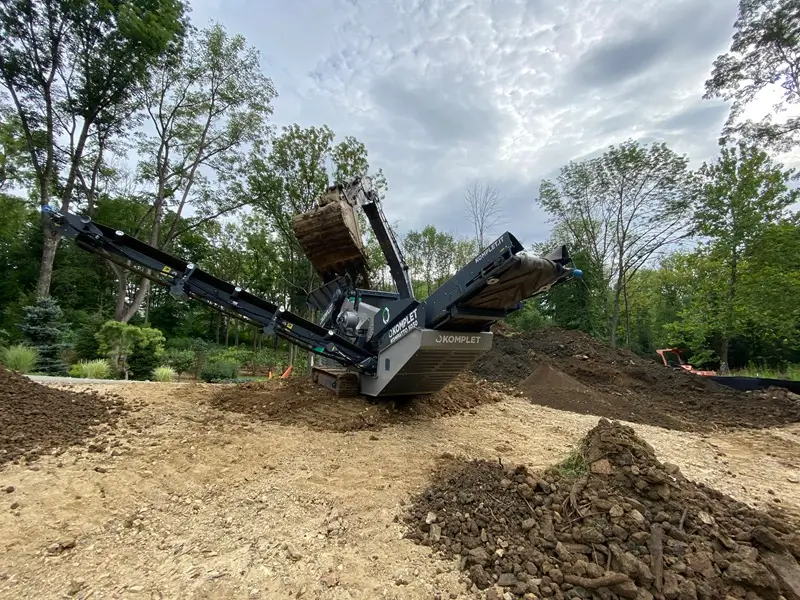

This guide covers industrial screening equipment for material processing operations — construction, demolition, aggregate production, C&D recycling, quarrying, and landscape supply. The screeners covered here separate crushed rock, recycled concrete (RCA), reclaimed asphalt (RAP), pit-run gravel, topsoil, and compost into spec-sized output streams that customers buy. This is not a guide to manufacturing process screening (food, pharmaceutical, plastics QC) — those applications use different equipment from a different industry. Komplet America serves the construction-material-processing market specifically.
In commercial aggregate, demolition recycling, and landscape supply operations, the screener is where the economic value is unlocked. Crushed material from a jaw crusher (or pit-run gravel from a quarry) enters as undifferentiated mixed sizes; the screener separates it into multiple spec-sized streams (3/4″ base, 1-1/2″ drainage, #57 stone, fines, oversize) that command different prices in different markets. The screener is what turns $5/ton crushed material into $15-$30/ton spec aggregate.
This guide walks through industrial screening equipment for construction-material processing — the two main technologies (vibrating scalping screens and trommel screeners), the features that matter at industrial scale, the full Komplet America lineup with specs, target operations for each model, and the ROI framework for industrial-scale screening investment.
Two Industrial Screening Technologies for Material Processing
Vibrating Scalping Screens
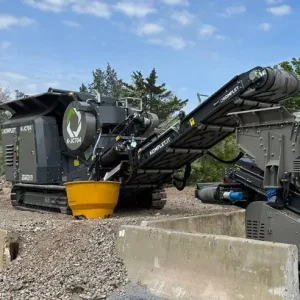
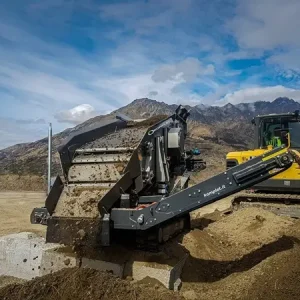
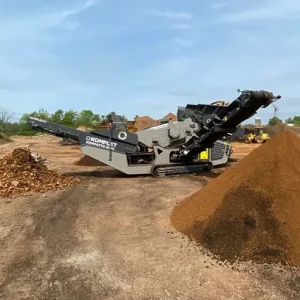
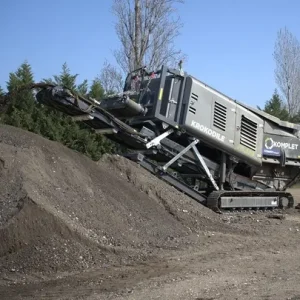
A vibrating scalping screen uses inclined decks (single, double, or triple) carrying mesh screens. Vibrator motors shake the deck at controlled stroke and frequency, causing material to bounce and travel down the inclined surface. Particles smaller than the mesh openings fall through to the next deck or onto a discharge conveyor; larger particles travel along the surface and exit at the deck end. Komplet’s Kompatto vibrating scalping lineup covers this technology — 221, 5030, and 124 models from compact to high-volume.
Vibrating scalping screens excel at:
- High-throughput dry aggregate — crushed rock, RCA, RAP, pit-run gravel, base material
- Multi-size separation in single pass — 2-deck and 3-deck designs produce multiple spec sizes simultaneously
- Self-cleaning mesh — the aggressive bouncing action helps prevent fines from packing into mesh openings
- Industrial throughput in compact mobile package — Komplet’s heavy-duty designs deliver up to 350 tph in tracked mobile units
Less ideal for: very wet, sticky, or high-organic-content material that plates out on the deck and reduces throughput.
Trommel Screeners
A trommel screener uses a slowly rotating perforated drum. Material enters at one end, tumbles through the drum as it rotates, and falls through perforations at the size where it matches the perforation pattern. Different drum zones have different perforation sizes for multi-stream separation. Komplet’s K-TS 30 and K-TS 40 trommel screeners cover this technology.
Trommel screeners excel at:
- Wet, sticky, or moisture-laden material — topsoil, compost, mulch, mixed C&D fines, organic-rich soil
- Gentle handling — preserves soil structure and organic content that aggressive vibrating screens would pulverize
- Resistance to blinding — the tumbling action and integrated cleaning brush keep perforations clear
- Mixed-feed flexibility — handles the variable composition typical of soil and compost operations
Less ideal for: high-volume dry aggregate production where vibrating screens deliver more tons per hour per square foot of screening area.
Quick Selection Guide
- Crushed stone, RCA, RAP, pit-run gravel, dry aggregate: Vibrating scalping screen (Kompatto lineup)
- Topsoil, compost, mulch, organic material: Trommel screener (K-TS lineup)
- Mixed C&D recycling fines: Trommel screener if wet/organic; vibrating screen if dry
- Operations with both material types: Many recyclers and contractors run both technologies for material flexibility
Industrial-Scale Features That Define Quality Screening Equipment
At industrial scale (sustained daily production, multi-shift operations, weather-exposed deployment), the difference between a quality screener and a limited-capability machine shows up in specific features. The features below separate serious commercial industrial screeners from light-duty alternatives.
1. Heavy-Duty Construction
Industrial-scale screening means continuous daily production, abrasive feed material, and operational stress that destroys light-duty equipment. The Kompatto 5030’s heavy-duty sloping double-deck screen box, the Kompatto 124’s 11.8′ x 3.7′ top deck, and the K-TS trommels’ robust drum bearings all reflect the engineering required for sustained industrial operation. Light-duty screeners that work for occasional rental use don’t survive the workload of industrial operations.
2. Multi-Deck Configuration with 2-Way / 3-Way Conversion
The Kompatto 5030 and Kompatto 124 both convert hydraulically between 2-way split (2 sized outputs + oversize) and 3-way split (3 sized outputs + oversize). This is rare in compact mobile screeners — most are factory-set for one configuration. The hydraulic conversion supports operations whose end-product mix changes by project, season, or customer requirement, without operational downtime.
3. Industrial Throughput Capacity
Kompatto 221: up to 90 US tph. Kompatto 5030: up to 280 US tph. Kompatto 124: up to 350 tph. K-TS 30: up to 80 tph. K-TS 40: up to 120 tph. The lineup spans from contractor-scale to high-volume aggregate production, with intentional throughput headroom in each model so the screener never bottlenecks the upstream crusher.
4. Self-Propelled Tracked Mobility
Tracked self-propelled mobility means the machine drives itself into position via wireless remote control. No specialized transport equipment, no crane work, no dedicated setup crew. Tracks deliver better stability than wheels on uneven job sites and don’t require tire pressure management. Setup time under 30 minutes from transport configuration to operating.
5. Hydraulically Folding Conveyors
Output conveyors fold hydraulically for transport via remote control — no manual disassembly, no overhead work, no specialized tools. On arrival at a new job site, deploy conveyors via the remote, run a brief warm-up, and start screening within minutes.
6. Wireless Remote Control
Every primary function — drive, deploy, start/stop, feeder rate, conveyor direction — is controlled remotely. One operator handles the full machine from a position with optimal visibility of the operation. Multi-operator setups become unnecessary, reducing labor cost.
7. Variable Feeder Speed
The vibrating loading hopper feeder is variable-speed, letting operators match feed rate to material characteristics and target output. Slower feed for materials requiring more retention time on the deck (wet material, fines-heavy feed); faster feed for clean dry aggregate at high throughput.
8. Adjustable Mesh and Perforation Sizes
Mesh changes (vibrating screens) and drum perforation sizes (trommels) determine the output gradations the machine produces. The Kompatto 5030 supports mesh from 1/4″ topsoil fines up to 5″ oversize. K-TS trommels support drum perforation patterns matching common landscape, compost, and aggregate spec sizes. Mesh and drum changes are accomplished during scheduled service.
9. Onboard Diesel Power
All Komplet portable screeners include onboard diesel engines (or dedicated genset packages on trommels) — no external power source required, no dependency on grid availability at remote job sites. Tier 4 Final emissions compliance on current models.
10. OEM Service Network and 12-Month Parts Inventory
Reliable service support is a feature, not a luxury. Komplet America’s parts inventory is forecasted 12 months in advance, supporting fast wear-part availability when service items are needed. Authorized dealers across North and Central America provide local service and rental support. Industrial-scale equipment that runs every day needs the supply chain to back it up.
Komplet America’s Industrial Screening Lineup
Kompatto Vibrating Scalping Screens (For Dry Aggregate)
- Kompatto 221 — up to 90 US tph, 7′ x 3.5′ two-deck, 25 HP, ~7,275 lb. Compact tracked screener for smaller operations and tight-access sites.
- Kompatto 5030 — up to 280 US tph, heavy-duty double-deck (8′ x 3’2″ top + 7′ x 3’2″ bottom), 45 HP Tier 4 Final, ~26,455 lb. Komplet’s best-selling screener with hydraulic conversion between 2-way and 3-way split.
- Kompatto 124 — up to 350 tph, 11.8′ x 3.7′ top deck, 75 HP, ~37,038 lb. Komplet America’s largest mobile scalping screen, for high-volume aggregate producers and rental fleets.
K-TS Trommel Screeners (For Wet/Organic Material)
- K-TS 30 — up to 80 tph, 68″ x 51″ or 103″ x 51″ drum (configurations available), ~8,818 lb, 23 kW genset. Compact tracked trommel for landscape supply, small compost operations, and topsoil producers.
- K-TS 40 — up to 120 tph, 126″ x 55″ or 171″ x 43″ drum, ~25,353 lb, 40 kW genset. Higher-capacity trommel for serious topsoil, compost, and mulch operations.
Industries and Applications
Aggregate Production
Quarries and aggregate producers use vibrating scalping screens to separate crusher output (or pit-run gravel) into multiple spec sizes — pea gravel, #57 stone, #67 stone, crusher run, riprap, fines. Multi-deck capability and 3-way split configurations let a single machine produce multiple spec sizes simultaneously. Kompatto 5030 or 124 paired with a K-JC 805 jaw crusher is the typical industrial-scale aggregate setup.
Demolition and C&D Recycling
Demolition contractors and C&D recyclers use vibrating scalping screens to convert crushed concrete (RCA) and demolition rubble into spec aggregate sizes for resale or on-site reuse. The Kompatto 5030 paired with a K-JC 704 PLUS jaw crusher is the workhorse contractor combination — produces 3/4″ base + 1-1/2″ drainage + oversize from a single pass.
Asphalt Recycling
Asphalt millings and crushed full-depth asphalt pavement screen into RAP spec sizes for sale to hot-mix asphalt plants, cold-patch material, or as base aggregate. The Kompatto 5030 handles the moderately moist character of asphalt feed without the gumming issues that plague some screening designs.
Topsoil and Landscape Supply
Landscape supply yards and topsoil producers use trommel screeners to remove rocks, roots, organic debris, and oversized material from raw soil. The K-TS 30 and K-TS 40 deliver clean screened topsoil suitable for sale to landscape contractors and homeowners.
Compost and Mulch Production
Compost facilities and mulch producers use trommel screeners to separate finished product from oversized contaminants and unfinished material. The gentle drum action preserves the structure of compost and mulch that aggressive vibrating screens would pulverize.
Excavation and Site Preparation
Excavation contractors use portable screening plants to convert excavated soil and rock into multiple useful streams — clean fill, base material, drainage stone, oversize for hauling. On-site screening eliminates much of the need to import aggregate while diverting excavated material from landfill disposal.
Rental Fleet Operations
Equipment rental operators serving construction, demolition, landscape supply, and aggregate customers benefit from compact mobile screeners that can be transported between rental customer sites without specialized rigging or extended setup time. Industrial-throughput capacity in compact mobile package supports premium rental rates.
ROI Framework for Industrial Screening Equipment
Avoided Aggregate Purchase Costs
Operations using on-site screening to produce their own base material, drainage stone, and aggregate eliminate aggregate purchase costs. For a contractor using 1,000+ tons of aggregate annually at $15-$30/ton, that’s $15,000-$30,000+ in avoided purchases. Multi-project contractors typically save dramatically more.
Aggregate Sales Revenue
Operations selling screened aggregate to other contractors, landscape supply yards, or end-customers generate revenue: $15-$30/ton for spec base material; $20-$40/ton for premium drainage stone or decorative aggregate; $5-$20/ton for RAP. Industrial-scale operations producing 5,000+ tons annually generate $75,000-$150,000+ in screening-enabled revenue.
Avoided Tipping Fees (For Recyclers)
C&D recyclers using on-site screening to produce saleable RCA from inbound concrete avoid the tipping fees they’d pay to ship the material to landfill. Rising tipping fees of $50-$100+/ton in major metros make on-site processing increasingly economic compared to disposal alternatives.
Equipment Financing
Komplet Capital offers 24-hour approval, 100% financing, and 3-6 year terms. New equipment qualifies for Section 179 tax deduction up to $1.22M (2024 limit).
How to Choose Industrial Screening Equipment
Six factors point to the right industrial screener:
- Material composition. Dry crushed aggregate, pit-run gravel, RCA, RAP: vibrating scalping. Wet/organic/compost/topsoil: trommel.
- Throughput target. Under 90 US tph: Kompatto 221 (vibrating) or K-TS 30 (trommel). 90-280 US tph: Kompatto 5030 (best-seller) or K-TS 40. 280+ US tph: Kompatto 124.
- Number of output sizes simultaneously. Two sizes (base + oversize): any 2-deck. Three sizes: Kompatto 5030 or 124 in 3-way split configuration.
- Mobility requirements. All Komplet screeners are self-propelled tracked with wireless remote and hydraulic conveyor folding. Single-site operations: any setup. Multiple sites: tracked self-propelled is essential.
- Service and parts support. Industrial-scale equipment running daily needs reliable parts and service. Komplet America’s parts inventory forecasted 12 months in advance plus authorized dealer network across North and Central America provides the support infrastructure.
- Capital and financing. Komplet Capital offers 24-hour approval, 100% financing, and 3-6 year terms. Section 179 tax deduction applies.
Frequently Asked Questions
What’s the difference between industrial screening and contractor-scale screening?
Industrial screening typically means sustained daily production, multi-shift operations, abrasive material handling, and integrated workflow with crushers and conveyors. Contractor-scale typically means project-based use, intermittent operation, and rental or owned-but-shared equipment. Komplet’s lineup spans both — Kompatto 221 fits contractor-scale; Kompatto 5030 and 124 fit industrial-scale. The features (heavy-duty construction, multi-deck capability, industrial throughput) are what distinguish industrial-scale equipment.
What’s the highest-throughput Komplet screener?
The Kompatto 124 — up to 350 tph, 11.8′ x 3.7′ top deck, 75 HP. Komplet America’s largest mobile scalping screen, positioned for high-volume aggregate producers, large recyclers, and premium rental fleets.
Can industrial screening equipment handle wet material?
Depends on the technology. Trommel screeners (K-TS 30, K-TS 40) handle wet material well — the rotating drum and integrated cleaning brush prevent perforation blinding. Vibrating scalping screens (Kompatto lineup) handle damp material fine but struggle with truly wet, sticky material. For wet or moisture-laden feed, trommels are the right choice. For damp-to-dry crushed aggregate, vibrating scalping is the better tool.
How long do industrial screeners last?
With proper maintenance and OEM parts, Komplet industrial screeners routinely operate productively for 10,000+ hours over many years of service. Wear parts (mesh, brushes, conveyor belts) are replaced periodically as consumables. Major components (engine, hydraulics, frame) typically last the working life of the machine with routine service per the OEM manual. The 12-month parts inventory forecast supports long-term ownership.
Do industrial screeners need a separate power source?
No. All Komplet Kompatto vibrating screeners include onboard diesel engines for self-contained operation. K-TS trommels use dedicated genset packages (23 kW for K-TS 30; 40 kW for K-TS 40). No external power, no grid dependency, no generator coordination — the machines arrive ready to run.
How does industrial screening fit into a complete material processing operation?
Most industrial-scale operations integrate screening with upstream crushing. The typical workflow: feed material (demolition concrete, quarry rock, asphalt millings) → Komplet jaw crusher → vibrating scalping screen → multiple spec-sized stockpiles. For premium cubical aggregate, add a K-IC 70 impact crusher between the jaw and the screener. For mixed C&D demolition with soft waste, add a Krokodile PLUS slow-speed shredder alongside the crusher-screener combination.
Can I rent an industrial screener?
Yes. Komplet works through a dealer and rental network across North and Central America. Find your local Komplet dealer or call (908) 369-3340 to connect with a rental partner. Many partners offer rent-to-own arrangements where rental payments credit toward eventual purchase.
How much does industrial screening equipment cost?
For current pricing, visit each product page on our website or call (908) 369-3340 to request a quote.
Final Thoughts
Industrial screening equipment is where construction-material processing operations unlock real economic value. The right industrial screener — sized for sustained throughput, configured for the spec sizes your end market actually buys, and built to handle daily abrasive operation — turns crushed material into multiple revenue streams from a single integrated workflow. The choice between vibrating scalping and trommel technology depends on material composition; the choice of capacity depends on throughput target and operational scale. Komplet America’s lineup covers both technologies and the full range of industrial-scale operations from contractor through high-volume aggregate production.
Browse the complete screener lineup — Kompatto 221, 5030, and 124 vibrating scalping screens plus K-TS 30 and K-TS 40 trommel screeners — to compare specs, or call us and we’ll help you spec the right combination of crushing and screening equipment for your operation.
Ready to Talk Industrial Screening?
- Call (908) 369-3340
- Email [email protected]
- Schedule a demo or request a quote
- Find your local Komplet dealer for rental availability
- Ask about our 1-year / 1,000-hour warranty and equipment financing options
Never enough — that’s how we approach service, support, and helping industrial-scale operations turn crushed material into spec aggregate revenue.
Disclaimer: All cost, pricing, ROI, and revenue figures in this article are illustrative examples based on sample assumptions about volume, regional pricing, material specifications, and market conditions. Actual results vary significantly by region, market, material type, equipment utilization, operator skill, financing terms, regulatory environment, and many other factors. Equipment pricing, aggregate pricing, tipping fees, fuel costs, and interest rates all change over time and by location. Komplet America makes no guarantee, warranty, or representation of specific financial performance, payback timelines, or business outcomes for any particular operation. For current pricing and a payback estimate based on your specific volume, material, and local market, contact us at (908) 369-3340 to speak with our team.