
Whether you’re crushing concrete on a tight demolition site, producing spec aggregate at a quarry, or recycling asphalt back into road base, the crusher you choose shapes your productivity, your margins, and your finished material. But with so many crusher types on the market — jaw, cone, impact, hammer, gyratory — it’s easy to get lost in the specs.
This guide breaks down the 10 most common types of crusher machines, how they fit into the primary, secondary, and tertiary crushing stages, and the pros and cons of each. By the end, you’ll have a clear picture of which crusher is right for the material you’re working with.
Brief History of Crushers
Stone crushers have shaped American infrastructure since the 1800s. Before mechanized crushing, road construction relied on workers breaking rock by hand with hammers — a slow, expensive, and punishing job. Early crusher designs were patented in the 1830s and 1840s, but none made it to market.
The breakthrough came from Eli Whitney Blake — the nephew of cotton gin inventor Eli Whitney — who was granted U.S. Patent No. 20,542 on June 15, 1858, for a “machine for crushing stone.” Blake was inspired in 1851 while serving on a New Haven, Connecticut town committee overseeing the construction of a two-mile macadam road to Westville. Watching workers break stone by hand, he set out to mechanize the process.
Blake’s design paired a fixed jaw with a movable jaw driven by a toggle linkage, using mechanical leverage to crush rock efficiently. He later formed the Blake Rock Crusher Company, and by 1879 more than 500 of his machines were in use across the United States. Blake was eventually inducted into the National Inventors Hall of Fame, and today every modern jaw crusher traces its lineage back to his 1858 design.
How Crushers Are Categorized: The Three Stages of Crushing
Before we dive into specific crusher machines, it helps to understand that crushers don’t work alone — they work in stages. Each stage reduces material progressively, moving from large chunks to a finished, spec product.
Primary Crushers
Primary crushers handle the first reduction. They take raw material straight from blasting, demolition, or excavation and reduce it to a manageable size — typically from boulders down to 6–12 inches. Primary crushers are built for durability and high crushing ratios, not for producing a finished product.
Common primary crushers include jaw crushers, gyratory crushers, sizer crushers, and feeder-breakers.
Secondary Crushers
Secondary crushers take the output of the primary stage and reduce it further, usually to 1–3 inches. This is where shape and gradation start to matter — especially in aggregate production and recycling.
Common secondary crushers include cone crushers, impact crushers, hammermills, and roll crushers.
Tertiary Crushers
Tertiary crushers finish the job, producing fine material for concrete, asphalt, or specialty aggregate. Cone crushers and vertical shaft impactors (VSIs) are the most common tertiary machines. Screens and conveyors aren’t crushers themselves, but they’re essential for separating sized material and moving it between stages.
The 10 Main Types of Crusher Machines (With Pros and Cons)
1. Jaw Crushers
Jaw crushers squeeze material between a fixed jaw and a movable jaw. They’re the workhorse of the industry — used for primary crushing of concrete, asphalt, rock, and C&D debris.
Pros
- Simple, rugged design
- Easy to operate, inspect, and maintain
- Excellent for hard, abrasive materials
- Compact footprint (especially mobile track-mounted models)
- Reliable for on-site recycling
Cons
- Lower crushing ratio than cones
- Output shape is less consistent (more elongated particles)
- Higher vibration than some alternatives
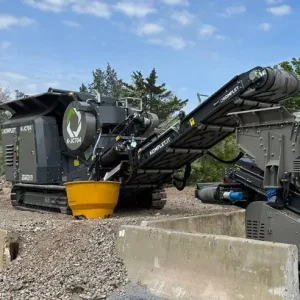
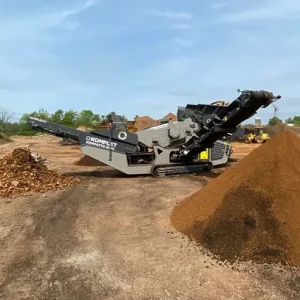
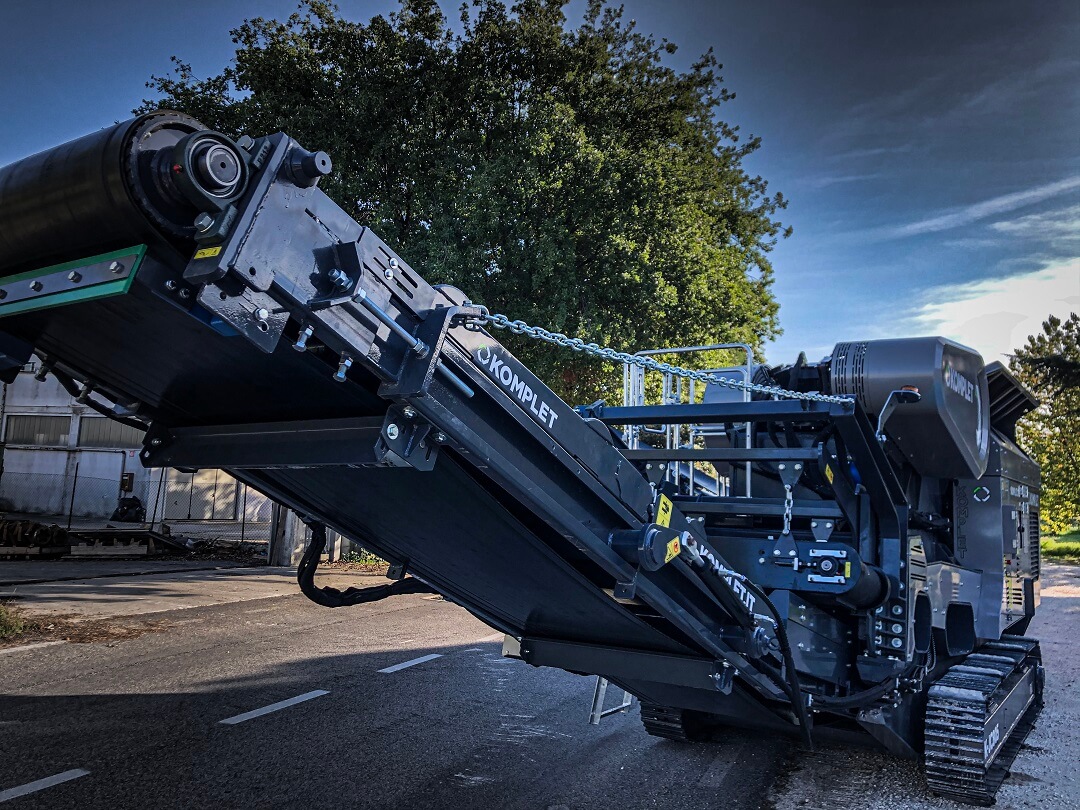
Komplet’s best-selling K-JC 704 Plus is a compact, track-mounted jaw crusher that processes concrete, asphalt, and rock — and it fits on a standard trailer for easy job-to-job moves.
2. Cone Crushers
Cone crushers use a rotating mantle inside a concave bowl to crush material through compression. They’re the go-to for secondary and tertiary crushing when cubical, well-shaped product matters.
Pros
- High crushing ratio
- Produces uniform, cubical product
- Lower vibration
- Energy efficient for the output
Cons
- Heavier and harder to move between sites
- More complex to configure and maintain
- Higher upfront and repair costs
- Not ideal for highly abrasive material without frequent liner changes
3. Impact Crushers (Horizontal Shaft Impactors – HSI)
Impact crushers use high-speed rotating blow bars to shatter material against fixed plates. HSIs are popular for asphalt recycling and softer rock because they produce excellent cubical shape.
Pros
- High reduction ratio in a single pass
- Cubical, spec-friendly product
- Simple design, easy to maintain
- Excellent for asphalt, concrete, and softer materials
Cons
- Noisier operation
- Faster wear on hard, abrasive stone
- Not ideal for extremely hard rock
Komplet’s K-IC 70 compact impact crusher is purpose-built for asphalt recycling and finer-output concrete work on tight job sites.
4. Hammer Crushers (Hammermills)
Hammermills use swinging hammers mounted on a rotor to pulverize material. They’re common in soft-rock quarries, coal processing, and some recycling applications.
Pros
- High throughput
- Excellent reduction ratio
- Relatively simple structure
- Produces uniform output
Cons
- Screens can clog with damp or sticky material
- Rapid wear on hard or abrasive stone
- Inspection and hammer replacement take time
5. Gyratory Crushers
Gyratory crushers look like giant cone crushers and are used for high-volume primary crushing in large mining and quarry operations. A conical head gyrates inside a fixed outer shell, crushing material continuously around the full circumference.
Pros
- Extremely high capacity
- Continuous crushing action (no idle stroke)
- Excellent for very large mining feeds
Cons
- Massive footprint and foundation requirements
- Not mobile — fixed installations only
- High capital cost
- Overkill for most contractors and recyclers
6. Vertical Shaft Impactors (VSI)
VSI crushers throw material at high speed against an anvil or a rock-lined chamber. They’re used in the tertiary stage when shape and fines control are critical — especially for manufactured sand.
Pros
- Produces highly cubical, spec product
- Excellent for manufactured sand and fine aggregate
- Good tertiary-stage pairing with cones
Cons
- High wear cost
- Lower reduction ratio than HSIs
- Requires consistent feed size
7. Roll Crushers
Roll crushers use two counter-rotating cylinders to compress material between them. Double-roll and triple-roll configurations are common in coal, soft rock, and specialty applications.
Pros
- Minimal fines generation
- Good for brittle or friable materials
- Simple to operate
Cons
- Low crushing ratio
- Not suitable for hard, abrasive rock
- Roll wear can be expensive
8. Sizer Crushers
Sizers use two rotating shafts with interlocking teeth to shear and crush material. They’re common in coal mining, soft ore processing, and bulk handling.
Pros
- Handles wet, sticky material without clogging
- Low headroom requirement
- Good for soft, friable feeds
Cons
- Not suited for hard rock or concrete
- Narrow application range
9. Feeder-Breakers
Feeder-breakers combine a heavy-duty apron feeder with a breaking mechanism, common at the face in underground mining. They both feed and reduce oversized material in one unit.
Pros
- Combines two functions in one machine
- Ideal for underground and confined operations
- High throughput
Cons
- Highly specialized — not for surface contractors or recyclers
- Fixed installation
10. Shredders (Slow-Speed)
While not always classified as crushers, slow-speed shredders are increasingly paired with crushers on recycling job sites — especially for wood waste, green waste, and mixed C&D debris. They prepare material before it ever reaches the crusher.
Pros
- Handles mixed, bulky material
- Reduces wear on downstream crushers
- Essential for green waste and wood recycling
Cons
- Adds capital cost
- Requires a separate operator or workflow
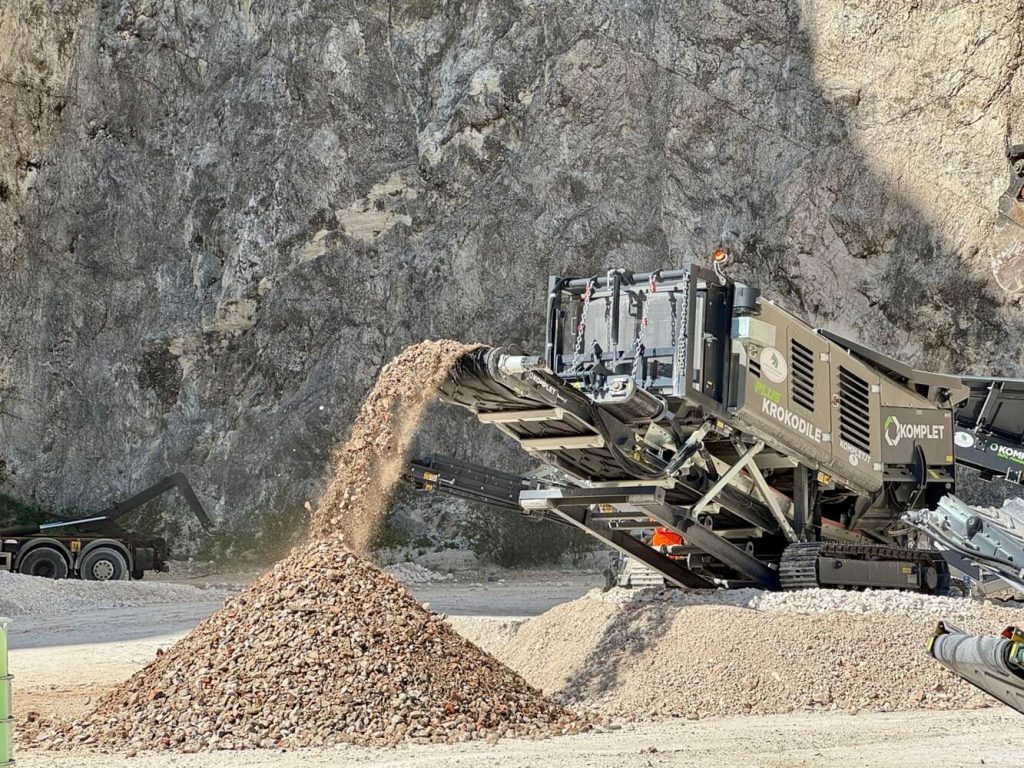
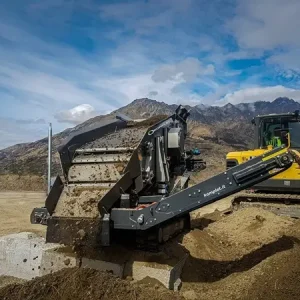
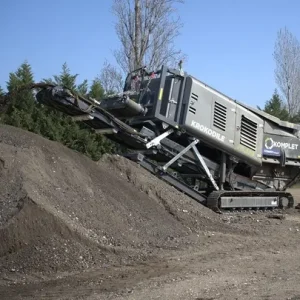
Komplet’s Krokodile Plus slow-speed shredder pairs beautifully with the Kompatto 5030 screener — our most popular shredder-screener combination for C&D and green waste recyclers.
Choosing the Right Crusher for Your Project
The right crusher comes down to five questions:
- What material are you crushing? Concrete, asphalt, natural rock, and C&D debris each favor different crusher types.
- What’s your feed size? Bigger input means you need a primary crusher first.
- What’s your target output size? Finer output usually requires a secondary (and sometimes tertiary) stage.
- What’s your volume? Tons-per-hour requirements drive machine size.
- How mobile do you need to be? On-site recyclers and contractors with multiple job sites benefit hugely from compact, track-mounted crushers that move on a trailer.
For most contractors, demolition companies, and concrete recyclers, a compact track-mounted jaw crusher like the K-JC 704 Plus — paired with a mobile scalping screener like the Kompatto 221 (compact) or Kompatto 5030 (best-selling) — handles most real-world jobs while eliminating dump fees and creating a saleable product. For higher-throughput operators and rental fleets, the Kompatto 124 — Komplet America’s largest scalping screen at up to 350 tph — delivers serious production capacity in a still trailer-portable package.
Browse our full lineup of compact crushing, screening, and shredding equipment to see what fits your operation.
Frequently Asked Questions
What is the difference between primary, secondary, and tertiary crushers?
Primary crushers handle the first, largest reduction (boulders to 6–12 inches). Secondary crushers reduce further (to 1–3 inches). Tertiary crushers finish the job, producing fine, spec material.
What is the most common type of crusher?
The jaw crusher is the most widely used primary crusher, especially for concrete, asphalt, and rock. Every modern jaw crusher traces back to Eli Whitney Blake’s 1858 design.
Which crusher is best for recycling concrete?
A mobile, track-mounted jaw crusher is typically the best fit. It produces usable aggregate on-site, eliminates dump fees, and moves between jobs easily.
What’s the difference between an impact crusher and a jaw crusher?
Jaw crushers compress material between two jaws and excel at hard, abrasive rock. Impact crushers use high-speed blow bars to shatter material and produce better shape — ideal for asphalt and softer concrete recycling.
Do I need both a crusher and a screener?
If you need spec-sized, saleable product, yes. A crusher reduces the material; a screener separates it into the sizes your buyers want.
Final Thoughts
There are many types of crusher machines, and each has its place. For quarries and mining, large gyratory and cone crushers dominate. For contractors, demolition crews, and recyclers, compact mobile jaw and impact crushers deliver the best mix of portability, productivity, and ROI.
At Komplet America, we specialize in compact, track-mounted crushers, screeners, and shredders built to turn waste into revenue — right on your job site. Our machines are designed for operators who need to move fast, work in tight spaces, and stop paying for dump fees and imported fill.
Ready to see a compact crusher in action?
- Call us at 908-369-3340
- Email [email protected]
- Schedule an in-person demo or request a quote
- Ask about our 1-year / 1,000-hour warranty and equipment financing options
Never enough — that’s how we approach service, support, and helping you get the right machine for the job.