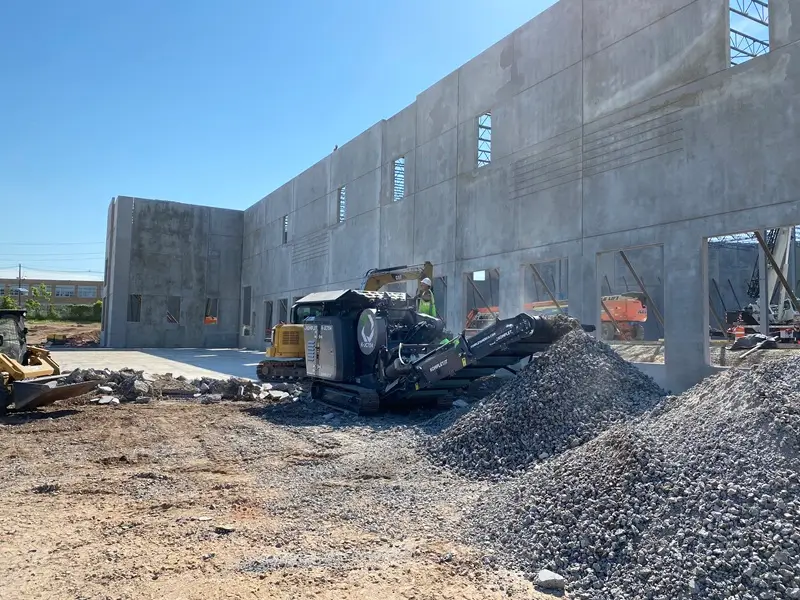

Recycled concrete aggregate (RCA) is one of the most widely used construction aggregates in North America. Demolition concrete that would otherwise go to a landfill at meaningful tipping cost gets crushed on-site or at a recycler’s yard into spec-grade aggregate that substitutes for virgin crushed stone across most non-structural construction applications — at lower cost than virgin material, with measurable sustainability benefits, and with strong market acceptance for the right end uses.
This guide walks through where RCA actually gets used (and where it does not), the spec requirements for each application, and how Komplet America’s compact mobile crusher and screener lineup produces the right RCA cuts for each end market. Whether you are a demolition contractor producing RCA from your own jobsite work, a dedicated recycler supplying contractor customers, or an aggregate yard adding an RCA product line alongside virgin material, the application targets are the same — match the cut to the customer spec.
Where RCA Comes From
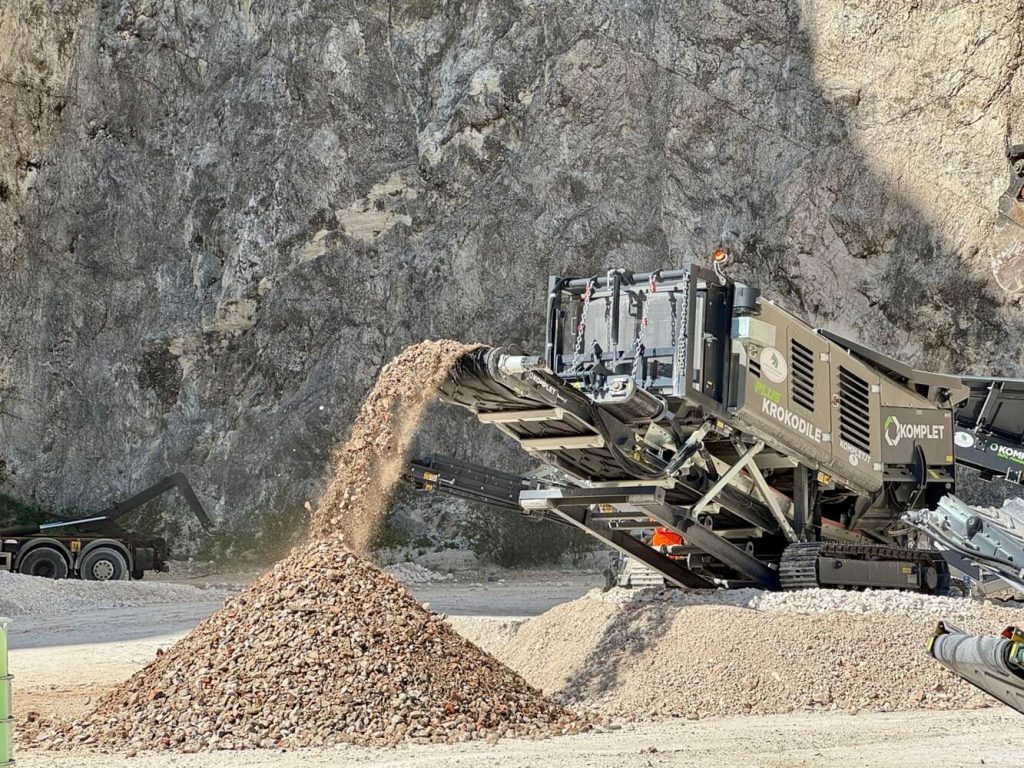
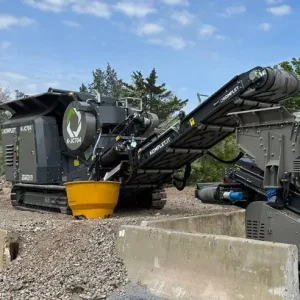
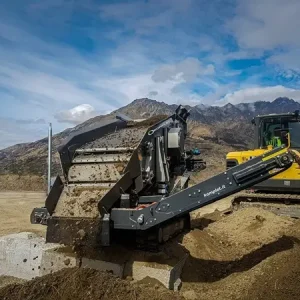
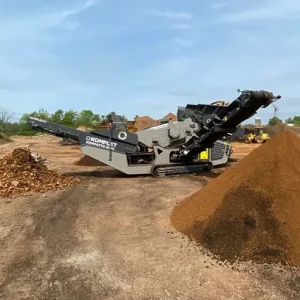
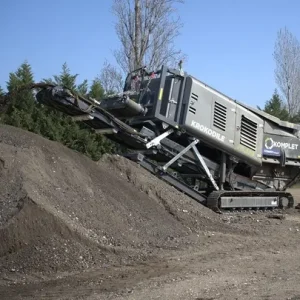
RCA is produced from demolition concrete — slabs, foundations, structural pieces, sidewalks, parking lots, runways, and similar. The material runs through a primary jaw crusher that reduces it from boulder size to manageable spec sizes, with magnetic separation lifting embedded rebar, ties, and ferrous fasteners off the discharge stream during crushing. The crushed output runs through a vibrating scalping screener that separates the material into spec cuts (3/4″ base, 1-1/2″ drainage, fines, oversize) for stockpiling or direct sale.
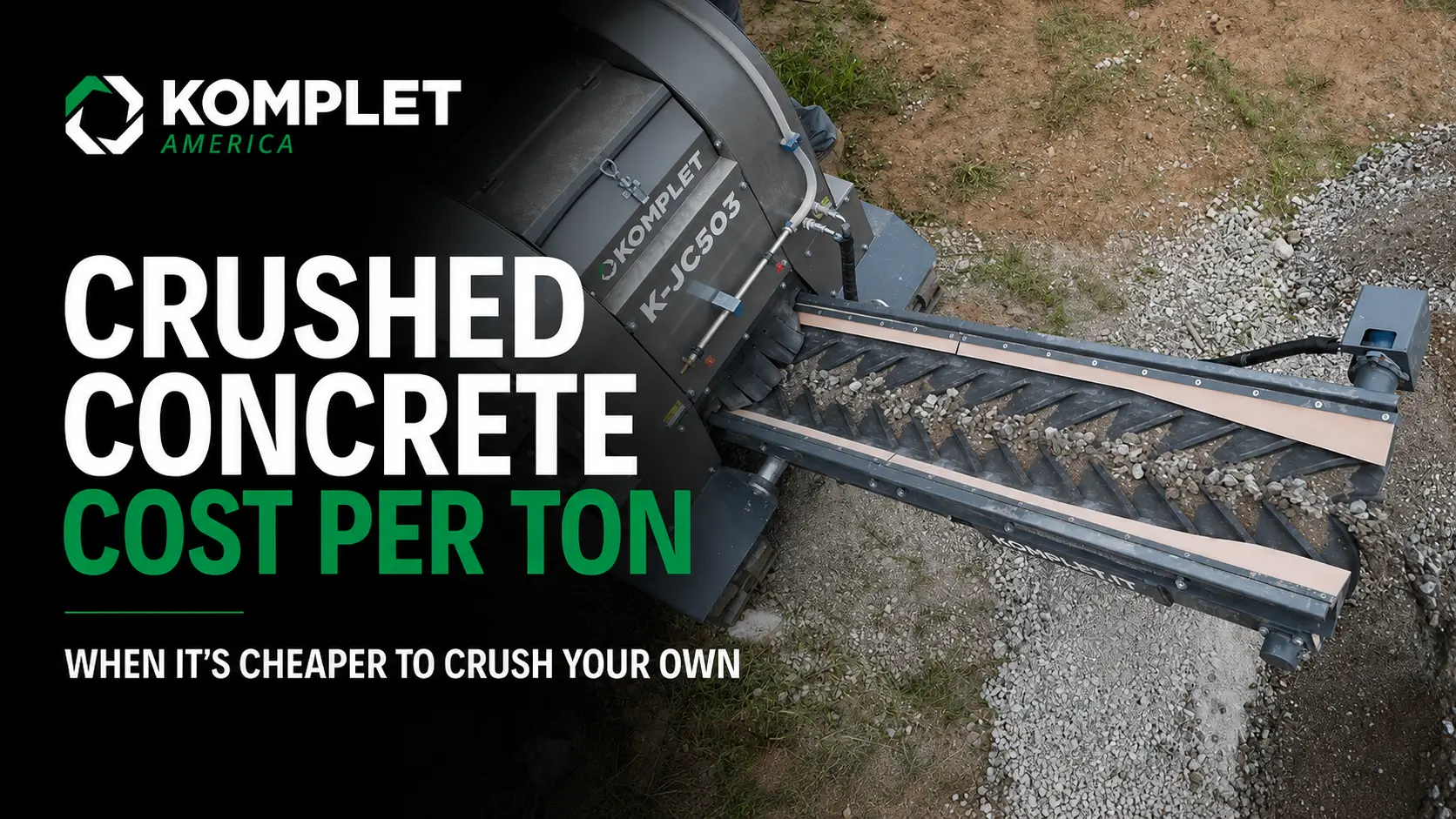
Komplet America’s jaw crusher lineup — the K-JC 503 (up to 34 US tph), K-JC 604 (up to 55 US tph), K-JC 704 PLUS (up to 90 US tph; Komplet’s best-selling crusher), and K-JC 805 (up to 160 US tph) — handles demolition concrete across the full contractor and small-recycler scale, with magnetic separation standard on every model. The K-IC 70 compact impact crusher (up to 90 US tph) produces premium cubical aggregate ideal for end markets requiring spec cubical particle shape (hot-mix asphalt plant feed, concrete batch plant aggregate). The Kompatto 221, Kompatto 5030, and Kompatto 124 vibrating scalping screeners separate crusher output into multiple spec cuts in a single pass; the K-TC 460 tracked mobile conveyor builds clean stockpiles.
Where RCA Actually Gets Used
1. Road Base and Sub-Base for Asphalt Pavement
The most common RCA application — and the largest by volume in most markets. Road base sits beneath asphalt pavement and provides the structural foundation that supports vehicle loads, distributes stress, and keeps the surface course level over time. Most state DOTs allow RCA for non-structural pavement layers within specified limits, and many specifically encourage RCA for sustainability and cost reasons. Typical specs run 3/4″ minus to 1-1/2″ minus depending on the layer (base, sub-base, shoulder).
Equipment fit: any Komplet jaw crusher producing crusher run output, paired with a Kompatto scalping screener to separate the spec cut. The K-JC 704 PLUS or K-JC 805 with the Kompatto 5030 is the most common configuration for contractor-scale road-base RCA production. Sample testing and quality documentation are typically required for state DOT-spec base material approval.
2. Parking Lot, Industrial Pad, and Commercial Site Base
Commercial parking lots and industrial pads use RCA extensively as base material. The same RCA cut that serves DOT road base typically serves parking-lot base — 3/4″ minus crusher run is the workhorse spec. RCA’s compaction behavior and load-distribution characteristics are well-suited to commercial paved surfaces, and the cost savings versus virgin crushed stone compound across the substantial tonnages large commercial sites require.
Equipment fit: any Komplet jaw crusher with a Kompatto screener delivers parking-lot-spec RCA. For higher-volume commercial site work, the K-JC 704 PLUS or K-JC 805 paired with the Kompatto 5030 covers the throughput.
3. Drainage Aggregate and French Drains
RCA produces excellent drainage aggregate. The angular particle shape that comes from jaw crushing creates void space between particles that allows water to move freely through the aggregate matrix — essential for French drains, foundation perimeter drainage, septic field stone, retaining wall drainage, and roof-drain dry wells. Typical specs run 1-1/2″ to 2-1/2″ clean (washed or screened to remove fines), with the wider gradation favoring high-flow drainage applications.
Equipment fit: jaw crusher with the jaw setting opened wider for larger output, screener configured to wash out the fines into a separate cut. The Kompatto two-deck screening separates the drainage spec from the fines and crusher run in a single pass.
4. Structural Fill and Trench Backfill
RCA serves as structural fill under buildings, embankment fill, retaining wall backfill, and trench backfill for buried utilities (water, sewer, gas, electrical, communications). Trench backfill specs typically call for crusher run gradation (well-graded mix from fines through 1″ to 1-1/2″ maximum) that compacts well around utility lines. Embankment fill and structural fill specs vary by jurisdiction and project, but RCA typically meets the requirements for non-structural fill applications.
Equipment fit: jaw crusher producing crusher run, with the screener configured to remove oversize material that does not meet the spec. Confirm specific fill spec requirements with the project engineer before delivery.
5. Driveways, Walkways, and Utility Access Roads
Commercial driveways, residential gravel driveways, walkways, utility access roads, farm roads, and similar low-traffic surfaces use RCA as both base and surface material. Specs typically run from 3/4″ minus crusher run for driveway base through dense-graded base course (DGBC) for surface applications. RCA’s angular particle shape locks together under traffic, providing a stable surface that compacts and holds shape well.
Equipment fit: any Komplet jaw crusher with a screener. For contractor and landscape-supply operations producing driveway-spec RCA at moderate volumes, the K-JC 503 or K-JC 604 with the Kompatto 221 fits the scale.
6. Cement-Treated Base (CTB) and Stabilized Base
Some state DOTs specifically prefer RCA for cement-treated base (CTB) and stabilized-base applications because the angular particle shape from jaw crushing supports better cement bonding than the rounder particles from some natural aggregates. CTB applications typically use 3/4″ minus crusher run RCA mixed with a small percentage of cement and water; the result is a high-strength stabilized base layer for heavy-duty pavement applications.
Equipment fit: jaw crusher producing 3/4″ minus crusher run, screener configured for tight spec control. CTB specs are stricter than general road-base specs; sample testing and quality documentation are typically required.
7. Hot-Mix Asphalt Plant Feed and Concrete Batch Plant Aggregate
Hot-mix asphalt (HMA) plants and concrete batch plants prefer cubical particle shape because cubical aggregate locks and bonds better than the more elongated particles a typical jaw crusher produces. Operations supplying spec aggregate for HMA or concrete batch plant feed often run a Komplet jaw crusher for primary reduction and the K-IC 70 compact impact crusher for secondary reduction — the impact stage produces the cubical shape spec applications require. RCA cubical aggregate from the K-IC 70 secondary stage is particularly well-suited for asphalt plant feed where the particle shape advantage matters meaningfully.
Equipment fit: Komplet jaw crusher → K-IC 70 → Kompatto 5030 → K-TC 460. Operations producing aggregate for non-cubical applications (road base, drainage, fill) typically do not need the secondary impact stage.
8. Landscape Decoration, Hardscape, and Riprap
RCA serves several landscape and decorative applications: crushed concrete driveways with a weathered aesthetic, footpaths and garden paths, decorative aggregate around plants, retaining wall backfill, and (with appropriately sized oversize cuts) shoreline riprap and erosion-control armoring. RCA’s weathered appearance — different from the cleaner look of new concrete or quarried stone — is sometimes specifically preferred for rustic, naturalistic, or sustainability-themed landscape projects.
Equipment fit: jaw crusher with screener configured for the relevant landscape spec; for shoreline riprap and erosion control, the largest crusher with the widest jaw setting produces the oversize material those applications require. Confirm specific riprap specs with the project engineer or shoreline regulatory authority before delivery.
Where RCA Is NOT Typically Used
RCA serves most non-structural construction applications well, but it is not the right material for every aggregate use. Operations producing RCA should be honest with customers about the applications where virgin crushed stone or specialty aggregate is the better answer:
- Premium structural concrete — high-strength concrete for bridges, high-rise buildings, and similar structural applications typically uses virgin aggregate with documented mix design qualification. RCA in structural concrete requires specific RCA mix design qualification that varies by jurisdiction and project; it is not a routine substitution.
- Concrete batch plants without RCA mix design qualification — not all concrete batch plants accept RCA. Operations supplying RCA to batch plants should confirm acceptance and any RCA-specific mix design requirements before delivery.
- Premium decorative landscape applications where appearance matters — decorative landscape stone, ornamental aggregates, and similar applications where uniform appearance and color matter typically prefer virgin quarried stone over RCA.
- Heavy rail track ballast — primary track ballast for heavy rail typically requires specialty crushed stone meeting strict spec requirements (durability, particle shape, cleanliness, gradation). RCA can serve some railway-related applications (sub-ballast, certain base layers, access roads) but is not typically used as primary ballast for heavy rail. Confirm specific railway aggregate specs with the railway authority before specifying.
- Filter media applications — water filtration, septic system filter media, and similar applications requiring specific clean aggregate gradations typically use virgin specialty aggregate, not RCA.
Match the RCA cut to the customer spec, and be honest about where RCA fits and where it does not. That honesty builds repeat customer relationships; overselling RCA into applications it does not match builds returns and complaints.
Producing Spec-Grade RCA: Equipment, Workflow, and Quality
Producing saleable spec-grade RCA requires more than just running concrete through a crusher. Operations that consistently deliver clean, customer-acceptable RCA share a few practical workflow disciplines:
Pre-Process Oversized Demolition Material
Demolition concrete arrives at the crusher as irregular pieces — broken slab sections, foundation chunks, structural elements with embedded rebar. As a practical operating rule, maximum feed size should run approximately 80 percent of the jaw gape opening. Excavator-mounted hydraulic breakers and pulverizers are the right tools for breaking oversized material to crusher-feed size before crushing.
Engage Magnetic Separation on Every Shift
Magnetic separation is standard on every Komplet crusher (the K-JC 503’s published price reflects the unit plus magnetic attachment together). The integrated magnetic system lifts ferrous metal off the discharge stream during crushing, separating rebar, ties, and embedded steel into a clean ferrous stockpile while keeping crushed RCA output clean. Operators who do not engage the magnetic separator workflow end up with contaminated RCA that customers will not accept and lost ferrous-scrap revenue that should have offset operating cost.
Match Jaw Setting to Output Spec
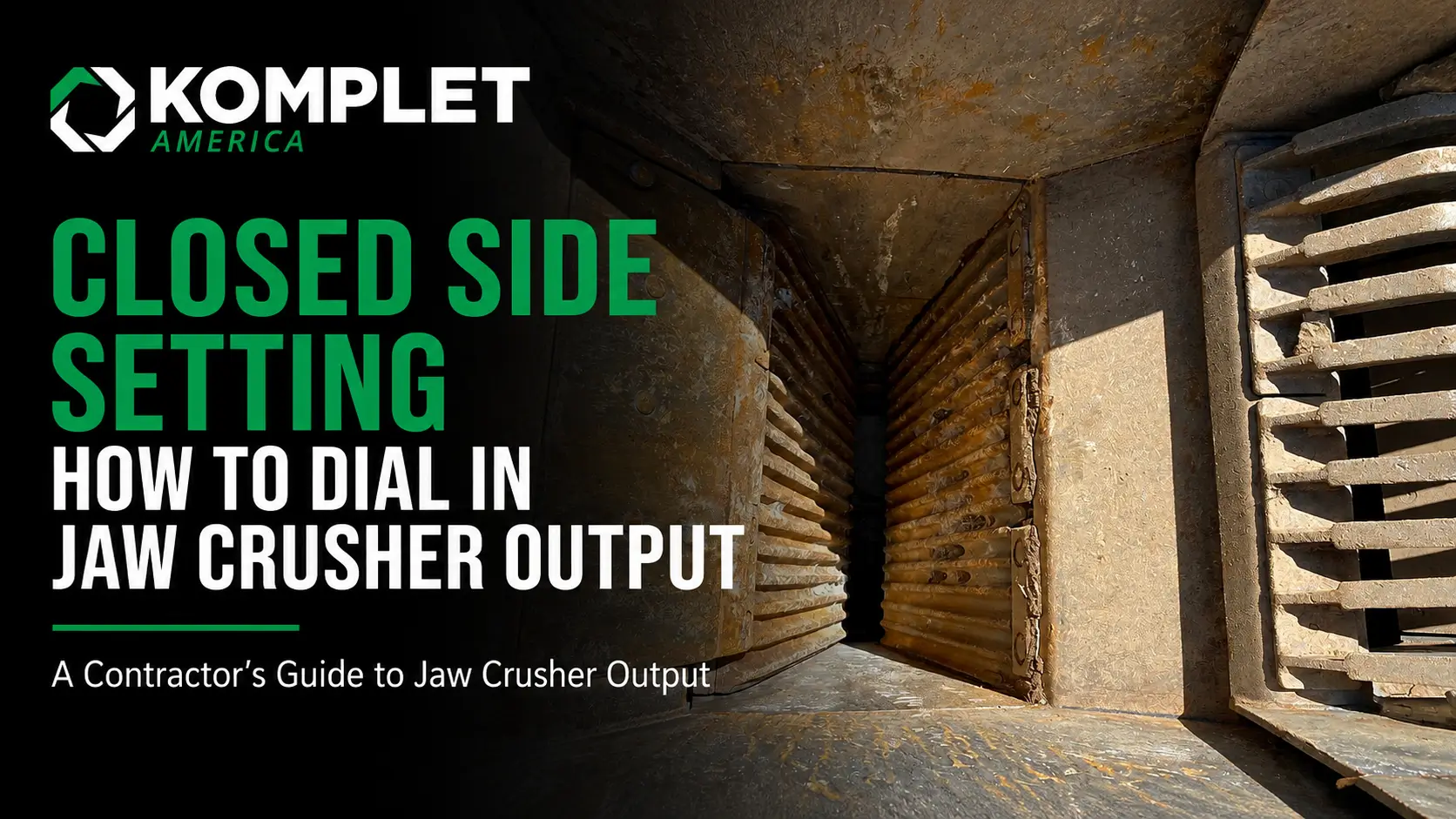
Komplet jaw crushers feature hydraulically adjustable jaw setting (closed-side setting, or CSS) operated from the wireless remote. Adjust the jaw setting to match the target output spec for the end market — moderate setting for crusher run and dense-graded base, tighter setting for 3/4″ minus, wider setting for drainage and riprap. Match the output to customer spec rather than producing one size and trying to sell what you have.
Pair the Crusher with a Screener
A jaw crusher running standalone produces a single output stream. Operations selling multiple spec sizes or supplying customers expecting clean spec stockpiles need a vibrating scalping screener that separates crusher output into multiple cuts in a single pass — oversize, mid-fraction, fines. Oversize returns to the crusher for additional reduction; spec sizes go to dedicated stockpiles for resale or on-site reuse.
Manage Stockpiles for Quality Control
Separate stockpiles by spec size — never mix different specs; cross-contamination ruins both stockpiles for premium customer applications. Cover or shelter when possible. Use FIFO rotation so oldest RCA gets used first. Periodic sample testing supports state DOT base material approvals and premium customer relationships. Site separation from active demolition prevents cross-contamination with new debris being processed.
Komplet Equipment for RCA Production
All Komplet crushers, screeners, and conveyors are tracked, self-propelled, EPA Tier 4 Final compliant, and operated by wireless remote. Magnetic separation is standard on every crusher. Verified pricing and specs:
Jaw Crushers
- K-JC 503 — up to 34 US tph, 19″ × 12″ jaw, 25 hp Tier 4F diesel, ~7,496 lb. Tight-access urban demolition and contractor-scale RCA production. Dust suppression standard.
- K-JC 604 — up to 55 US tph, 23″ × 16″ jaw, 55 hp Tier 4F diesel, ~19,400 lb. Mid-range demolition and recycling.
- K-JC 704 PLUS — up to 90 US tph, 27″ × 16″ jaw, 74 hp Tier 4F Deutz diesel, ~26,455 lb. Komplet America’s best-selling crusher; the workhorse for typical contractor demolition and on-site RCA production. Komplet Connect remote monitoring standard.
- K-JC 805 — up to 160 US tph, 31″ × 21″ jaw, 130 hp Tier 4F diesel, ~49,600 lb. Largest jaw crusher in the lineup; for higher-volume contractor and small commercial RCA production. Komplet Connect standard.
Compact Impact Crusher (Optional Secondary)
- K-IC 70 — up to 90 US tph, 25″ × 20″ inlet, 100 hp Tier 4F diesel, ~28,600 lb. Premium cubical aggregate output ideal for RAP reduction and DOT-spec material; typically deployed as optional secondary reduction behind a Komplet jaw crusher for spec cubical aggregate. Magnetic separator and dust suppression standard.
Vibrating Scalping Screeners
- Kompatto 221 — up to 90 US tph, two-deck 7′ × 3.5′ screen, ~7,275 lb. Komplet’s smallest self-propelled scalper. Pairs naturally with the K-JC 503 or K-JC 604.
- Kompatto 5030 — up to 280 US tph, two-deck 8′ × 3’2″ upper / 7′ × 3’2″ lower decks, ~26,455 lb. Komplet America’s best-selling screener.
- Kompatto 124 — up to 350 tph, two-deck 11.8′ × 3.7′ upper / 10.8′ × 3.7′ lower decks, ~37,038 lb. The largest mobile scalping screen in the Komplet lineup.
Tracked Mobile Conveyor
- K-TC 460 — tracked mobile conveyor that extends reach from the screener and builds clean spec stockpiles. Walks itself into position and integrates with any Komplet crusher and screener combination.
Frequently Asked Questions
Is RCA approved for state DOT road base?
Many state DOTs allow RCA for non-structural pavement layers (base, sub-base, shoulder construction, embankment fill) within specified limits, and some specifically encourage RCA for sustainability and cost reasons. Specifications vary by state; check with the relevant DOT for current allowances on your projects. Sample testing and quality documentation are typically required for state DOT-spec base material approval.
Can RCA be used in new concrete mixes?
Sometimes, with caveats. RCA can replace a portion of virgin aggregate in some concrete mixes, but RCA in structural concrete typically requires specific RCA mix design qualification that varies by jurisdiction and project. Many concrete batch plants accept RCA for non-structural mixes (light-duty paving, fill concrete, certain non-load-bearing applications) but not for premium structural concrete (high-strength bridge concrete, high-rise structural concrete). If your end customer is a concrete batch plant, confirm acceptance and any RCA-specific mix design requirements before delivery.
How much can I save using RCA versus virgin aggregate?
RCA pricing typically runs at a meaningful discount to virgin crushed stone, though the exact discount varies by region, market, spec, and quantity. The savings stack across two cost categories simultaneously: avoided disposal cost on the demolition concrete that becomes RCA, plus avoided virgin aggregate purchase on the same tonnage of base material the project would otherwise buy. Verify current local RCA and virgin aggregate pricing with regional suppliers for your specific project.
Does RCA need to be screened to multiple sizes, or can I sell crusher run?
Crusher run (the unscreened jaw crusher output) is a saleable RCA product on its own — well-graded mix from fines through the maximum spec size, used for road base, parking lot base, and trench backfill. For operations producing only crusher run, a jaw crusher running standalone delivers what the customer needs. For operations producing multiple spec sizes simultaneously (3/4″ base + 1-1/2″ drainage + fines + oversize), pair the crusher with a Kompatto vibrating scalping screener to separate the cuts in a single pass.
What about asphalt? Can the same equipment process RAP?
Yes. Komplet jaw crushers process recycled asphalt pavement (RAP) into base material, and the K-IC 70 compact impact crusher produces premium cubical aggregate ideal for spec RAP applications. The Krokodile PLUS slow-speed shredder also handles asphalt feedstock through its C&D / asphalt shaft configuration. Many operations process both concrete and asphalt with the same equipment fleet — different feedstocks running through the same workflow.
Do I need to remove rebar before crushing?
Generally no. Magnetic separation is standard on every Komplet jaw crusher and the K-IC 70 impact crusher. The integrated magnetic system separates rebar from crushed output during crushing, producing clean RCA and a separate ferrous-scrap stockpile that goes to scrap recyclers as additional revenue. Oversized rebar bundles, intact structural steel, and other large ferrous items should still be removed manually before feeding — they are uncrushable feed, not normal contamination.
What is the right Komplet equipment combination for RCA production?
The most common contractor configuration is the K-JC 704 PLUS (Komplet’s best-selling crusher) paired with the Kompatto 5030 (Komplet’s best-selling screener) and a K-TC 460 tracked mobile conveyor for stockpile management. The combination handles a wide range of contractor-scale RCA production with two-deck screening of crusher output. Smaller operations fit the K-JC 503 or K-JC 604 with the Kompatto 221; higher-volume operations fit the K-JC 805 with the Kompatto 5030 or Kompatto 124.
Where can I see Komplet equipment running on actual concrete?
Demos take place at Komplet America’s yard in Hillsborough, NJ or through authorized dealers across North and Central America. Komplet America does not transport equipment to prospect sites for demos. Contact your local authorized Komplet dealer to schedule a demo at the dealer’s location, or call Komplet America at (908) 369-3340 to schedule a yard visit. Demo material includes concrete demolition material specifically for prospects evaluating RCA production workflows.
Final Thoughts
RCA is a real construction material with real markets — road base, parking lot base, drainage, structural fill, driveway base, cement-treated base, asphalt and concrete batch plant feed (when properly produced for cubical spec), and landscape applications. Operations producing RCA correctly (right equipment, right workflow, right quality control) deliver a saleable product that competes meaningfully against virgin crushed stone on cost and carries growing market acceptance for sustainability reasons. Operations producing RCA incorrectly — wrong cut for the customer, contaminated discharge, mismatched stockpiles — produce material customers will not accept.
Match the cut to the customer spec, engage the magnetic separator on every shift, manage stockpiles for quality, and be honest with customers about where RCA fits and where virgin crushed stone is the better answer. Komplet America’s compact mobile lineup covers the equipment side; the operational discipline is up to the operator.
Browse Komplet America’s compact mobile crusher lineup and vibrating scalping screeners, review the K-TC 460 tracked mobile conveyor, explore Komplet Capital financing, check certified pre-owned inventory, or contact Komplet America directly to discuss the right equipment configuration for your specific RCA production goals.
Ready to Produce Spec-Grade RCA?
- Call Komplet America at (908) 369-3340 to discuss your project pipeline, target output specs, and equipment options
- Email [email protected] for spec sheets, demo scheduling, or dealer connections
- Visit our crushing equipment lineup and certified pre-owned inventory for current availability
- Explore Komplet Capital financing — 100% financing, 24-hour approval, multi-year terms, and our 1-year / 1,000-hour factory warranty
- Find your local Komplet dealer for rental availability
Never enough.
Disclaimer: Equipment prices are subject to change based on dealer location, availability, and any additional features or customizations. Prices do not include taxes, shipping, or installation fees, which may apply depending on your region. Contact Komplet America at (908) 369-3340 or visit kompletamerica.com for current pricing.
Disclaimer: Any RCA pricing, virgin aggregate pricing, scrap metal value, savings, or recovery rate figures shown above are illustrative examples only. Actual results vary significantly by region, market, material type, equipment utilization, operator skill, financing terms, regulatory environment, and many other factors. RCA market pricing, virgin aggregate pricing, scrap metal pricing, fuel costs, and labor rates all change over time and by location. Komplet America makes no guarantee, warranty, or representation of specific financial performance, payback timelines, or business outcomes for any particular operation.
Disclaimer: All operating, maintenance, feed-size, jaw setting, and quality-control guidance in this article is general in nature. The 80 percent maximum feed rule is general operating guidelines, not absolute equipment limits. Always refer to the official Komplet operator’s manual for the specific machine model and serial number, and follow OEM intervals and procedures. RCA spec requirements vary by application, jurisdiction, customer, and project — confirm specific spec requirements with the relevant state DOT, project engineer, or customer before delivery. State DOT base material approvals, concrete batch plant RCA acceptance, structural concrete RCA mix design qualification, and railway aggregate specs vary by jurisdiction and authority. For warranty-protected work, contact Komplet America at (908) 369-3340 or your authorized Komplet dealer. Improper service or non-OEM parts may void warranty coverage and create safety hazards.