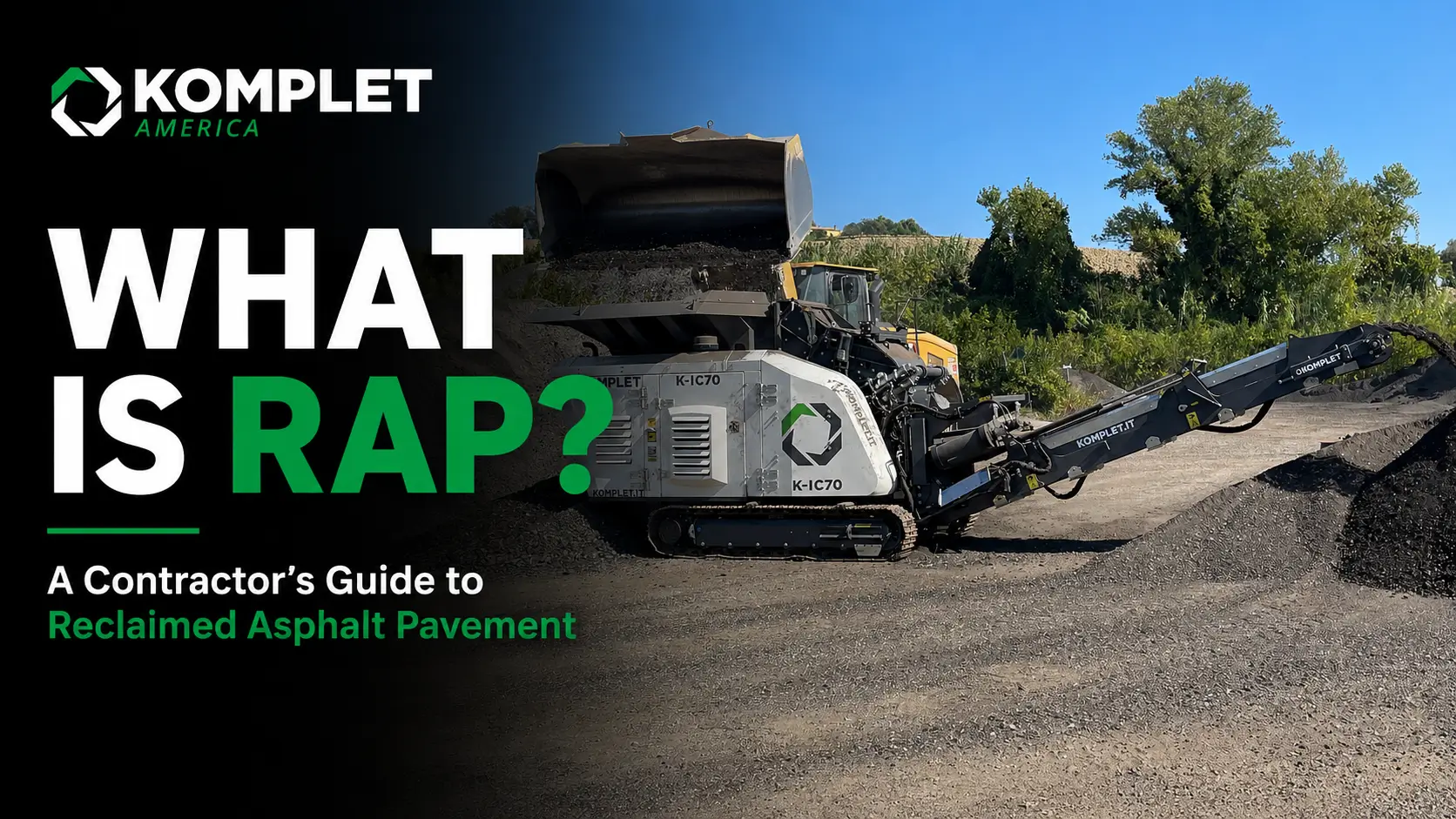

Asphalt pavement is the most recycled material in the United States. In 2024, the National Asphalt Pavement Association documented 101.4 million tons of reclaimed asphalt pavement reused in new asphalt mixtures and other civil engineering applications — a 47 percent increase from 2009, and a near-100 percent recycling rate. The use of recycled materials saved an estimated $4.7 billion in 2024 alone, replaced 96 million tons of virgin aggregate, and conserved 5.1 million tons of asphalt binder. The scale is striking: asphalt pavement recycles at a higher rate by percentage and by total tonnage than concrete, glass, metals, paper, or plastic. Most contractors handle the material routinely without thinking about how integrated RAP has become in U.S. pavement construction.
That integration runs deeper than most outside observers realize. State DOTs broadly accept RAP in new hot mix asphalt under defined conditions. The Federal Highway Administration’s Long-Term Pavement Performance program has documented that pavements with up to 30 percent RAP content perform comparably to pavements built with virgin materials. Caltrans, FDOT, NJDOT, PennDOT, and most other state DOTs publish detailed specifications for RAP processing, gradation, and use. NAPA’s annual industry survey, conducted in partnership with FHWA since 2009, is the authoritative data source. NCAT (the National Center for Asphalt Technology at Auburn University) is the research authority. The technical literature is mature, the regulatory framework is established, and the economic case is compelling.
For contractors and recyclers entering or expanding into RAP production, the threshold question is not whether RAP is acceptable — it is, almost universally. The threshold questions are: how is RAP produced from removed pavement, what are the technical and operational distinctions between unprocessed millings and crushed and screened RAP, what gradation does the application require, what state DOT or specification framework applies, and what equipment configuration matches the operation’s volume and product mix. This guide is the contractor’s reference for answering those questions.
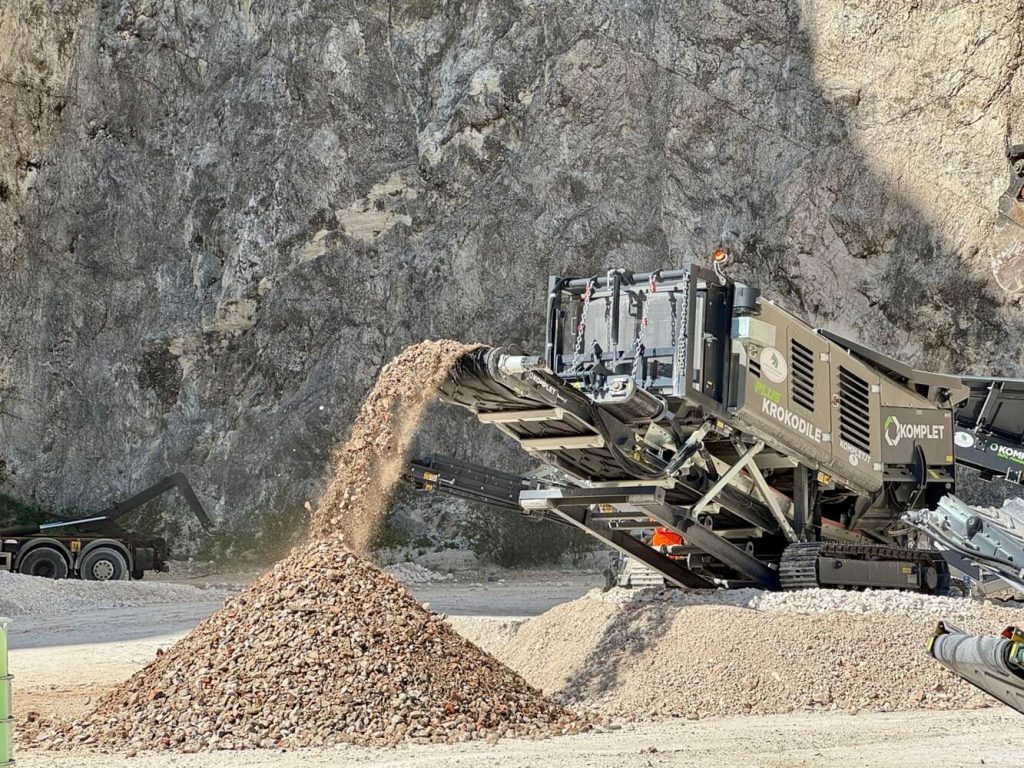
Komplet America has been the U.S. distributor of Komplet S.p.A. compact crushers, screeners, and shredders since 2018, and the Conti family construction legacy behind Komplet America stretches back to 1906. Asphalt recycling is one of the natural use cases for compact crushing and screening equipment — RAP feeds well, crushes consistently, and screens cleanly when the operation is configured correctly. Many of our customers running concrete recycling on a Komplet platform also process asphalt millings on the same equipment with different screen mesh configurations. There are real differences in wear and handling between the two materials, and this guide covers them. The detail below is the broader framework for those operations.
The Quick Answer
For contractors who don’t need the full reference:
- RAP (reclaimed asphalt pavement) is the term given to removed and/or reprocessed pavement materials containing aged asphalt binder and aggregate, per FHWA’s foundational reference, FHWA-RD-97-148.
- RAP is generated when asphalt pavements are milled, reconstructed, resurfaced, or removed for utility access. The two generation methods are milling, which removes the top 1 to 6 inches of pavement using a milling machine, and full-depth removal, which takes out the entire pavement section using excavators, ripping equipment, or breakers. Crushing and screening is the secondary processing step that turns full-depth removal material into a graded product.
- RAP is the most-recycled material in the U.S. by tonnage. NAPA reported 101.4 million tons of RAP recycled in 2024, with a near-100 percent recycle rate. Asphalt recycling outperforms concrete, metals, paper, glass, and plastics on a percentage basis.
- Properly produced RAP consists of high-quality aggregate coated with residual asphalt binder, typically processed to three-quarter-inch or smaller top size through crushing and screening. Untreated millings often arrive at three-quarter-inch top size from the milling operation itself.
- RAP is reused in five primary categories: new hot mix asphalt (HMA), cold mix asphalt, cold in-place recycling (CIR) and full-depth reclamation (FDR), base course and subbase aggregate, and shoulder and embankment fill. The largest single application is new HMA, accounting for the majority of RAP utilization.
- AASHTO M 323 governs binder selection and grading for HMA containing RAP. Most state DOTs accept RAP content up to 15 to 25 percent in HMA mix designs without modification; higher RAP percentages require binder grade adjustment and qualification testing.
- RAP processing typically uses a jaw crusher for size reduction and a vibrating screener for gradation control — the same compact equipment used for concrete recycling, with different operational considerations specific to the asphalt binder content. RAP is harder on wear parts than concrete, and the wear plan should reflect that.
FHWA Definitions and Federal Framework
The U.S. Federal Highway Administration provides the authoritative federal definitions and technical framework for RAP. Two FHWA publications anchor the federal-level guidance:
- FHWA-RD-97-148, “User Guidelines for Waste and Byproduct Materials in Pavement Construction,” with specific sections on RAP material description (Section 46) and asphalt concrete hot recycling (Section 47). This is the foundational federal reference for RAP definitions, properties, and applications.
- FHWA-HRT-11-021, “Reclaimed Asphalt Pavement in Asphalt Mixtures: State of the Practice,” published April 2011. This is the more recent comprehensive synthesis covering RAP usage in HMA, binder selection (referencing AASHTO M 323), state-by-state acceptance patterns, and Long-Term Pavement Performance findings.
FHWA’s Definition of RAP
Per FHWA-RD-97-148, reclaimed asphalt pavement is the term given to removed or reprocessed pavement materials containing asphalt and aggregates. Those materials are generated when asphalt pavements are removed for reconstruction, resurfacing, or to reach buried utilities. When properly crushed and screened, RAP consists of high-quality, well-graded aggregates coated by asphalt cement.
The definition is important for two reasons. First, RAP is defined functionally rather than by source — material that meets the definition qualifies as RAP regardless of whether it came from highway demolition, parking lot reconstruction, or driveway resurfacing. Second, the definition explicitly includes the aggregate plus the residual binder; RAP is not simply old aggregate from asphalt pavements, it is the integrated combination that gives RAP both its economic value and its specific technical characteristics.
AASHTO and ASTM Standards
Several AASHTO and ASTM standards govern RAP testing, processing, and acceptance:
- AASHTO M 323: Superpave Volumetric Design for Asphalt Mixtures — governs binder grade selection for HMA mixtures containing RAP. The standard provides binder grade adjustment guidelines for mixtures in the 15 to 25 percent RAP range and above 25 percent, with the higher RAP percentages requiring softer virgin binder grades to compensate for the aged binder in the RAP.
- AASHTO T 308: Standard test for determining the asphalt binder content of HMA by the ignition method. Used in RAP characterization to determine binder content of incoming RAP stockpiles.
- AASHTO T 27: Sieve analysis of fine and coarse aggregates. Used for RAP gradation testing after extraction of binder.
- AASHTO R 35: Standard practice for Superpave volumetric design for asphalt mixtures. References RAP usage and incorporation.
- ASTM D5404: Standard practice for recovery of asphalt from solution using the rotary evaporator. Used for binder extraction during RAP characterization.
- ASTM D6307: Asphalt content of asphalt mixture by ignition method. ASTM equivalent of AASHTO T 308.
How RAP Is Generated and Processed
RAP reaches a usable state through two generation methods and one secondary processing step. Each produces material with distinct characteristics that affect downstream processing and end use.
Method 1: Milling
Milling is the dominant RAP generation method for routine pavement maintenance and rehabilitation. A milling machine — a specialized piece of road construction equipment — grinds away the top 1 to 6 inches of existing pavement, pickup-loads the milled material directly into haul trucks, and leaves a textured surface ready to receive a new asphalt overlay.
The milling operation produces what’s called asphalt millings — RAP at the millings-grade processing stage. Characteristics:
- Particle size typically three-quarter-inch top size or smaller, produced naturally by the milling teeth and rotation speed.
- Visible aggregate coated with residual asphalt binder.
- Higher fines content (passing the #200 sieve) than virgin aggregate, often 5 to 10 percent.
- Material is hot when it leaves the milling head and cools during haul; thermal characteristics affect stockpile behavior in the first day.
- Generally homogeneous within a single project — same pavement, same binder, same aggregate source. FHWA-HRT-11-021 notes that millings from large jobs can often be used in new mixes without further crushing or screening, because of this within-project consistency.
Unprocessed millings are the cleanest form of RAP and command the highest value when reincorporated into the same project or stockpiled for project-specific reuse. Most state DOT specifications recognize unprocessed millings as a distinct material class from processed RAP.
Method 2: Full-Depth Removal
Full-depth removal is the generation method for pavement reconstruction rather than maintenance, and for utility access and demolition work. The entire pavement section — surface course, binder course, and base course — is removed using excavators with hydraulic breakers, rippers, or impact attachments. The material arrives in larger chunks ranging from a few inches to several feet across, often with embedded structural elements such as reinforcing mesh, joint sealants, and steel picked up from adjacent structures.
Characteristics of full-depth removal RAP:
- Variable particle size requiring crushing and screening before use in most applications.
- Mixed material content possibly including base aggregate from below the pavement section, surface treatments, and contaminants picked up during removal.
- Lower cost per ton at the source than milling — excavator removal is faster and uses simpler equipment than a milling machine.
- Higher downstream processing cost — full-depth removal RAP almost always requires crushing and screening to produce a usable product.
- Suitable for applications that don’t require uniform gradation: structural fill, base course with crushing, and aggregate component in CIR or FDR operations.
The Secondary Step: Crushing and Reprocessing
Crushing and reprocessing turns full-depth-removal RAP — or aged stockpile millings that have agglomerated — into properly graded RAP product. This is where compact crushing and screening equipment plays the dominant role for contractor-scale and recycler-scale operations. The crushing step reduces oversized chunks to a manageable top size; the screening step separates the output into gradation envelopes appropriate for the end use.
Characteristics:
- Top size typically reduced to three-quarter-inch or smaller for compatibility with downstream mixing equipment and HMA mix design requirements.
- Magnetic separation removes embedded ferrous metal during crushing.
- Screening produces sized fractions — fine RAP, coarse RAP, oversize — for application-specific use.
- Operationally similar to concrete crushing using the same Komplet jaw crusher plus vibrating screener configurations, with key differences in wear planning and handling discipline: RAP stockpile height limits, moisture management, agglomeration prevention, and faster wear-part consumption.
RAP Properties: What the Material Actually Is
RAP is fundamentally a composite material — aggregate plus aged asphalt binder, in proportions reflecting the original pavement mix design. Understanding the typical composition is the foundation for understanding both how to process RAP and how to reincorporate it into new mixtures.
Typical RAP Composition
- Aggregate content: typically 92 to 95 percent by weight. Same aggregate that was specified for the original pavement — usually crushed limestone, granite, trap rock, or natural gravel meeting state DOT specifications at the time of original construction.
- Asphalt binder content: typically 5 to 8 percent by weight, depending on the original pavement mix design. The binder is aged — exposed to UV, oxidation, and temperature cycling over years or decades of service — and has measurably different rheological properties than virgin binder.
- Fines content: typically 5 to 10 percent passing the #200 sieve, higher than virgin aggregate of equivalent gradation. The fines come from the milling or crushing operation breaking down aggregate edges and producing dust.
Physical Properties Compared to Virgin Aggregate
- Specific gravity: lower than virgin aggregate because of the binder coating. Typical RAP bulk specific gravity runs 2.35 to 2.45 against 2.50 to 2.75 for virgin aggregate.
- Absorption: the binder coating reduces water access to the aggregate pores, so measured absorption on RAP typically tests at or below the range for the same aggregate uncoated. The effect varies with binder content and coating uniformity.
- LA Abrasion resistance: similar to virgin aggregate, since the underlying aggregate is the same. The binder coating does not meaningfully affect abrasion test results.
- Aggregate hardness and silica content: the stone inside a pavement mix was originally selected for skid resistance and durability, which usually means hard, high-silica rock. That matters for wear planning downstream — see the crushing section below.
- Color: dark gray to black because of the binder. Visual appearance is the most obvious distinguishing feature from virgin aggregate.
- Density: in stockpile, typically 95 to 105 pounds per cubic foot, or roughly 1.3 to 1.4 tons per cubic yard compacted, similar to virgin crushed stone of equivalent gradation.
The Aged Binder Question
The single most important technical characteristic distinguishing RAP from virgin aggregate is the aged binder. When asphalt pavement is in service, the binder oxidizes over time — UV exposure, thermal cycling, and atmospheric oxygen react with the binder molecules, producing a stiffer, more brittle product. RAP binder is harder, less flexible, and has a higher Performance Grade than the same binder when it was originally placed.
This matters because when RAP is reincorporated into new HMA, the aged RAP binder contributes to the overall binder properties of the new mix. AASHTO M 323 addresses this through binder grade selection rules: mixtures with 15 percent RAP or less can typically use the same virgin binder grade as a no-RAP mix; mixtures in the 15 to 25 percent range may require a one-grade-softer virgin binder; mixtures above 25 percent typically require a binder grade adjustment based on the recovered binder grade of the specific RAP source.
For non-HMA applications — RAP as base course, structural fill, cold mix, or in CIR and FDR projects — the aged binder is less consequential because the RAP binder is not contributing structural function to a new bound mixture. In these applications, RAP performs essentially as a coarse aggregate with some residual binder providing modest cohesion to the unbound layer.
Applications: Where RAP Goes
RAP utilization in the United States falls into five primary application categories, ordered by tonnage.
Application 1: New Hot Mix Asphalt (HMA)
The dominant application. The 2024 NAPA survey documented that more than 96 percent of reclaimed asphalt pavement went back into new asphalt pavements, with the remaining share going to other civil engineering applications such as unbound aggregate bases. Average RAP content in U.S. HMA mixes reached 22.9 percent in 2024, up from 15.6 percent in 2009, with the upward trend driven by both economic pressure and state DOT specification updates.
- Low-percentage RAP (under 15 percent): broadly accepted across all U.S. state DOTs without binder grade adjustment. Easy to incorporate in existing mix design infrastructure.
- Mid-percentage RAP (15 to 25 percent): generally accepted across U.S. state DOTs, with binder grade adjustment per AASHTO M 323. Most state DOTs have established mix design procedures for this RAP content range.
- High-percentage RAP (above 25 percent): accepted by a growing number of state DOTs under qualification testing and engineering review. NAPA is urging Congress to increase the federal share for projects that exceed 25 percent RAP usage in the next federal surface transportation reauthorization.
Application 2: Cold Mix Asphalt
Cold mix asphalt is asphalt mixture produced and placed at ambient temperatures rather than the elevated temperatures of HMA, which typically runs 275 to 325 degrees Fahrenheit. Cold mix uses cutback asphalt or emulsified asphalt binders that are fluid at ambient temperature and cure or set after placement. RAP fits cold mix particularly well because the existing aged binder contributes to the mix without requiring the heat input that virgin binder would need.
- Used for patch material, pothole repair, low-volume road surfacing, shoulder repair, driveway resurfacing, and other applications where the production economics of cold mix justify the somewhat lower performance compared to HMA.
- Production typically uses 50 to 100 percent RAP content blended with virgin binder emulsion and minimal virgin aggregate. The economic case for cold mix using high-RAP content is strong in most U.S. markets.
- State DOT acceptance for cold mix in maintenance applications is broad; engineering for new construction with cold mix as the structural surface is rare in mainstream highway work.
Application 3: Cold In-Place Recycling (CIR) and Full-Depth Reclamation (FDR)
CIR and FDR are pavement reconstruction methods that recycle the existing pavement in place. The milled or pulverized material is blended with a stabilizing agent — asphalt emulsion, foamed asphalt, cement, lime, or combinations — and recompacted in place. The result is a new pavement layer using 95 to 100 percent RAP content with minimal trucking, no off-site disposal, and significant cost and time savings compared to mill-and-fill construction.
- CIR (Cold In-place Recycling): milling the top 2 to 6 inches of existing pavement, mixing with stabilizing agent, and placing the recycled material as a new pavement layer. Typically followed by an asphalt overlay.
- FDR (Full-Depth Reclamation): pulverizing the entire pavement section along with a portion of the underlying base, commonly to a depth of 4 to 12 inches and sometimes deeper, stabilizing with cement or asphalt emulsion, and recompacting as a new base layer. Used for severely distressed pavements where the underlying structure also needs rehabilitation.
- Both CIR and FDR are increasingly specified by state DOTs as part of pavement preservation and rehabilitation programs. The cost savings against traditional mill-and-fill are substantial, and the environmental benefits — no off-site hauling, reduced virgin material consumption — are documented in FHWA literature.
CIR and FDR are performed by specialized in-place recycling trains. Komplet equipment does not perform this work; the connection for a compact operator is on the supply side, where crushed and screened RAP can serve as a blend component, and on the cleanup side, where localized removal still has to be processed.
Application 4: Base Course, Subbase, and Structural Fill
Properly processed RAP — crushed and screened to specification — can serve as base course, subbase, or structural fill in road, parking lot, and site construction. State DOT acceptance varies by application and by state:
- RAP-only base course: accepted by some state DOTs for lower-volume road applications. Generally requires blending with virgin aggregate to achieve adequate bearing capacity for higher-traffic applications.
- Blended RAP and virgin aggregate base: more widely accepted across state DOTs. Typical blends run 30 to 50 percent RAP with virgin aggregate, providing the cost benefit of RAP with the structural performance of virgin material.
- RAP as structural fill: accepted for embankment and general site fill in most state DOT and engineered project specifications. RAP performs comparably to virgin granular fill in unbound applications.
- RAP as shoulder material: accepted for shoulder construction in most jurisdictions, providing a cost-effective alternative to virgin aggregate for non-traffic-bearing shoulder sections.
Application 5: Specialty and Non-Pavement
Smaller-volume but operationally important applications:
- Driveway and parking lot surfacing for private commercial and residential work — the recycled asphalt driveway market that continues to grow.
- Construction site entrance and stabilization — RAP as a temporary surface for haul roads, equipment laydown areas, and construction entrances. The binder content provides modest cohesion and dust suppression.
- Pipe bedding for utility installations where engineering specifications allow.
- Trench backfill in pavement-adjacent applications where the RAP material can compact alongside the surrounding base material.
How RAP Is Processed: The Production Workflow
The production workflow for RAP shares the basic structure of concrete recycling — crush, screen, stockpile, document — but with operational specifics driven by the asphalt binder content and by the abrasive nature of the aggregate inside the mix. Three differences from concrete matter most:
- RAP is harder on wear parts than recycled concrete. The aggregate in a pavement mix is hard, high-silica stone chosen for skid resistance and durability, and the thin binder film does little to soften contact with jaw plates or blow bars. Budget for faster wear-part consumption than a concrete operation of comparable tonnage.
- RAP stockpiles need height limits and moisture management to prevent agglomeration. The Asphalt Institute recommends a maximum stockpile height of 10 feet, per FHWA-RD-97-148. Temperature and moisture can cause RAP particles to bond together over time, particularly in warmer climates or warm-month operations.
- Source segregation is more important for RAP than for RCA. Many state DOT specifications require that RAP from a particular project not be blended or commingled with RAP from other projects, because binder properties and aggregate sources vary by source. Dedicated stockpiles by project or by source are common practice in spec-driven RAP production.
Production Step 1: Feed Acceptance and Source Documentation
- Identification of the source: highway demolition, parking lot reconstruction, milling project, driveway tear-out. Source affects acceptable applications and downstream pricing.
- Inspection for contamination: excess granular material, surface treatments, joint sealant, embedded structural elements, mixed pavement types. FHWA-RD-97-148 emphasizes the importance of contamination control at the source.
- Documentation of binder content where the source project has on-record asphalt content data. Some state DOT specifications use source binder content as positive identification of RAP for state-supply acceptance.
- Segregation of source streams as appropriate for downstream use. State DOT spec-driven production typically requires single-source RAP stockpiles; general construction supply can blend multiple sources within defined limits.
Production Step 2: Pre-Reduction (For Full-Depth Removal Feed)
Full-depth removal RAP arrives with oversize chunks larger than the crusher’s recommended max feed size, which runs about 80% of the jaw gape. Pre-reduction methods:
- Excavator-mounted hydraulic breaker: the standard pre-reduction tool. Breaks oversize chunks to a feed size compatible with the primary crusher.
- Excavator-mounted ripper or pulverizer attachment: alternative pre-reduction approach for larger-scale operations.
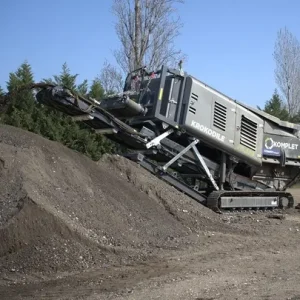
- Krokodile PLUS slow-speed shredder: handles oversize chunks with the C&D and asphalt teeth and shaft configuration, where a dedicated pre-reduction machine is justified by operation scale.
- Milling-source RAP generally does not require pre-reduction — the milling head produces material already at appropriate feed size for downstream crushing or direct use.
Production Step 3: Primary Crushing
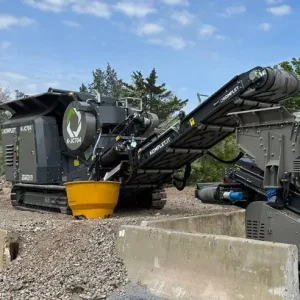
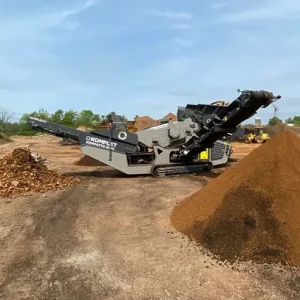
Compact jaw crushers handle RAP feed effectively when the operation is configured correctly. The same Komplet jaw crushers used for concrete recycling — K-JC 503, K-JC 604, K-JC 704 PLUS, and K-JC 805 — take RAP feed, with attention to the operational specifics that asphalt introduces.
- Closed-side setting (CSS) for RAP production is typically set tighter than for concrete recycling. A three-quarter-inch CSS is common for HMA-bound RAP production on the K-JC 503, K-JC 604, and K-JC 704 PLUS, which all produce output in the three-quarter-inch to three-and-a-quarter-inch range. The K-JC 805 produces a coarser output, roughly 1.2 inches to 4.7 inches, so operations running the 805 on HMA-bound RAP should plan on a second reduction stage or a screening circuit with recirculation rather than expecting a three-quarter-inch product in one pass.
- Magnetic separation is standard on every Komplet crusher, and it removes embedded ferrous metal during crushing — important for RAP from highway projects where mesh reinforcement may be present. The hardware differs by model. The K-JC 503 uses a magnetic roller attachment that discharges metal underneath the main extraction belt, away from the end product. The K-JC 604 uses a crossband magnetic belt with manual adjustment, factory-set to accommodate most output sizes, discharging metal off the left side of the machine as you face the discharge end. The K-JC 704 PLUS, K-JC 805, and K-IC 70 use hydraulically adjustable crossband magnetic belts discharging off the right side.
- Operating temperature considerations: warm RAP feed straight off a milling operation behaves differently than cooled stockpile RAP. Warm feed is more plastic and tends to coat the surfaces of the crushing chamber; cool feed is more brittle and crushes cleanly. Most production operations work with cooled RAP feed.
- Wear part considerations: RAP is more abrasive on jaw plates than recycled concrete, not less. The aggregate inside a pavement mix is hard, high-silica stone selected for skid resistance, and the thin binder film does little to soften the contact. Plan for faster jaw plate wear than a concrete operation of the same tonnage. RAP is also prone to binder buildup on contact surfaces, so periodic cleanup of binder accumulation in the crushing chamber belongs in the routine. Concrete wears differently rather than less: the dominant risk there is impact and breakage from rebar and tramp steel, not abrasion.
Production Step 4: Impact Crushing for Cubical Product
Where a state DOT specification or an engineer calls for particle shape control, the K-IC 70 compact impact crusher produces a more cubical product than jaw crushing alone. Reduction of RAP to fine material for new asphalt production is one of its core applications.
Blow bar selection is where RAP economics are won or lost on an impact crusher. RAP is the classic high-chrome blow bar application: high chrome trades impact toughness for abrasion resistance, which is the right trade on clean, de-reinforced RAP with controlled feed size. It is the wrong trade on raw demolition concrete, where tramp steel will crack a chrome bar — that work calls for a tougher martensitic or low-chrome bar. Ceramic-matrix versions of either alloy extend wear life further at higher cost. The practical rule for a mixed operation: feed the impact crusher clean RAP and keep the contaminated concrete on the jaw.
Production Step 5: Screening
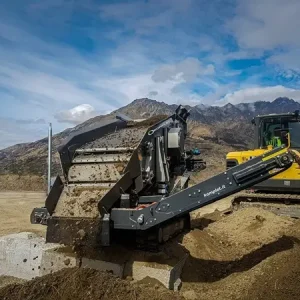
Vibrating screeners separate crushed RAP into target gradation envelopes. The Kompatto 5030 heavy-duty vibrating screener and Kompatto 221 both handle RAP feed at rates matched to typical compact recycling operations.
- Screen mesh selection: both the Kompatto 221 and the Kompatto 5030 are two-deck machines, which gives a three-way split — oversize, mid-size, and fines — in a single pass. For RAP production to typical HMA mix design specifications, a three-quarter-inch top deck sends oversize to a return stockpile or back to the crusher, while the bottom deck separates coarse RAP from the fine fraction.
- Screen mesh cleaning: RAP fines and binder accumulation can blind screen meshes more aggressively than virgin aggregate fines. Periodic mesh cleaning belongs in the routine on any RAP screening operation.
- Fractionation: some operations produce fractionated RAP — coarse and fine RAP as separate stockpiles — for HMA mix design flexibility. Fractionation allows the mix designer to incorporate higher RAP percentages by controlling each fraction independently. On a two-deck screener, this is done by running the material through with a mesh configuration matched to the fraction split the mix designer needs.
Production Step 6: Stockpile Management
RAP stockpile management has operational specifics not shared with concrete recycling:
- Stockpile height limited to 10 feet per Asphalt Institute recommendation. Taller stockpiles compress at the base and risk agglomeration of binder-coated particles.
- Moisture management: RAP stockpiles should be sloped to drain. Excessive moisture in a stockpile can cause clumping and complicate downstream handling.
- Stockpile age limit: RAP is best used within six to twelve months of production. Older stockpiles experience progressive agglomeration and may require re-screening or limited re-crushing before use.
- Source segregation: state DOT spec-driven RAP production typically requires dedicated stockpiles by source project. Cross-blending of sources is generally prohibited or restricted to defined limits.
- Operational integration with conveyors: the K-TC 460 tracked mobile conveyor extends stockpile reach and supports source-segregated stockpile management. It repositions under its own power on rubber tracks, which matters when an operation is maintaining several separate source piles in one yard.
RAP vs RCA: How the Two Recycled Materials Compare
For contractors and recyclers familiar with concrete recycling, the practical comparison between RAP and RCA (recycled concrete aggregate) is useful framing. Both materials share the basic production model — crush, screen, stockpile — and the basic regulatory framework of state DOT acceptance under defined conditions with FHWA federal-level guidance. The differences:
- Recycle rate: RAP recycles at nearly 100 percent in the U.S. per NAPA’s 2024 survey. RCA recycles at a substantially lower rate — much demolition concrete still goes to landfill or downcycled fill applications.
- Total tonnage: RAP moved 101.4 million tons in 2024. Industry estimates put annual concrete recycling volume higher than that in raw tonnage, though the two figures are collected differently and are not directly comparable. RAP carries higher per-ton value because of the binder content.
- Primary application: RAP goes primarily into new HMA mixtures, where the binder carries economic value. RCA goes primarily into base course, subbase, and structural fill, where only the aggregate value applies.
- Binder content: RAP has 5 to 8 percent residual aged asphalt binder. RCA has effectively none — the cementitious component of concrete is fully cured and not reactive in downstream applications.
- Wear on equipment: RAP is the more abrasive of the two and consumes jaw plates and blow bars faster. RCA is the more contaminated of the two and carries the tramp steel risk. Different wear modes, different wear-part strategy — and both are budgeted, not avoided.
- Production equipment: largely overlapping. The same Komplet jaw crushers and vibrating screeners handle both materials. Operational specifics differ — RAP stockpile height limits, source segregation, agglomeration prevention — but the equipment platform is consistent.
- State DOT specifications: both materials are accepted in defined applications. RAP is more broadly accepted in new bound mixtures such as HMA; RCA is more broadly accepted in unbound applications like base, subbase, and fill. The detailed state-by-state framework for RCA is covered in State DOT Specs for Recycled Concrete Aggregate: A Contractor’s Reference.
- Economic value: RAP commands higher per-ton value than RCA in most markets because of the binder content and the binder savings when incorporated into new HMA. Typical RAP pricing sits in the same range as virgin aggregate; RCA typically trades 15 to 50 percent below virgin equivalent.
Equipment Configuration by Operation Scale
For contractors and recyclers entering RAP production, equipment configuration matches operation scale in much the same way it does for concrete recycling. The same Komplet lineup handles both materials with appropriate operational adjustments.
Small Operations (Under Roughly 5,000 Tons a Year)
Typical operator: pavement maintenance contractor, small asphalt paving company, driveway and parking lot contractor. Generates millings or full-depth removal RAP from its own pavement maintenance and tear-out work.
- K-JC 503 mini jaw crusher — 19-inch by 12-inch jaw, up to 34 US tph, output three-quarter-inch to three-and-a-quarter-inch. Entry-level production machine, and light enough to be pulled behind a pickup. Magnetic separation is standard, using a magnetic roller attachment. Pairs with the Kompatto 221 vibrating screener for sized aggregate production. Adequate for processing a contractor’s own millings and full-depth removal RAP for reuse or limited resale.
- Pre-owned configuration typically saves 40 to 70 percent of capital against new. For small operations with episodic RAP volume, pre-owned equipment substantially improves the economics.
- Operational focus: a simple workflow producing one or two grades of RAP — typically fine RAP for cold mix or driveway surfacing, coarse RAP for base course applications.
Medium Operations (5,000 to 25,000 Tons a Year)
Typical operator: asphalt paving contractor with internal RAP production for its own HMA plant supply, medium-volume pavement recycler, regional driveway contractor with high seasonal RAP volume. Generates RAP from multiple project sources and may supply other operators or feed a paving operation directly.
- K-JC 604 — 23-inch by 16-inch jaw, up to 55 US tph — or K-JC 704 PLUS — 27-inch by 16-inch jaw, up to 90 US tph. Both are production-grade jaw crushers with crossband magnetic belts, manually adjustable on the 604 and hydraulically adjustable on the 704 PLUS.
- K-IC 70 compact impact crusher — 25-inch by 20-inch inlet, up to 90 US tph — where the operation supplies cubical spec material or reduces clean RAP to fine material for new asphalt production.
- Kompatto 5030 heavy-duty vibrating screener — two decks producing a three-way split of sized RAP in one pass. Pairs naturally with the K-JC 704 PLUS.
- K-TC 460 tracked mobile conveyor for stockpile management with source segregation.
- Operational focus: source-segregated stockpile management, gradation documentation for spec-driven supply, and multi-fraction RAP production supporting HMA mix design flexibility.
Larger Operations (Above 25,000 Tons a Year)
Typical operator: dedicated asphalt recycler, large paving contractor with its own RAP production line, in-yard production for state DOT supply. RAP volume justifies a dedicated production line with an operator and a full equipment complement.
- K-JC 704 PLUS or K-JC 805 — the 805 runs a 31-inch by 21-inch jaw at up to 160 US tph and is the largest jaw crusher in the lineup. Used as a primary, it feeds a second reduction or screening stage rather than producing HMA-bound top size on its own.
- K-IC 70 compact impact crusher for cubical aggregate production where state DOT or engineering specifications require particle shape control. Run it on clean, de-reinforced feed with high-chrome blow bars for the best wear economics on RAP.
- Kompatto 124 mobile screener — the largest scalping screen in the lineup, at up to 350 tph, for multi-fraction RAP production.
- Krokodile PLUS slow-speed shredder for pre-reduction of full-depth removal feed and mixed C&D streams, with the C&D and asphalt shaft installed.
- Multiple K-TC 460 conveyors for source-segregated stockpile management.
- Operational focus: full QC documentation for state DOT supply, multiple fractions including fractionated RAP for high-percentage HMA mixes, and integration with an HMA plant or paving operation.
Common Mistakes Contractors Make
Assuming RAP Is Easy on Wear Parts Because It’s Easy to Crush
Asphalt is low in hardness and breaks readily under compression, which leads operators to assume it is gentle on the machine. The opposite is true on the wear side. The aggregate inside the mix is hard, high-silica stone, and abrasion is driven by silica content rather than by how easily the material fractures. Operators who budget RAP wear parts at concrete rates run short. On an impact crusher, the mismatch is more expensive still — running a medium-chrome or low-chrome bar on RAP because it worked on concrete burns through bars at a rate that erases the savings.
Stockpiling RAP Like Virgin Aggregate
RAP stockpile management has rules that don’t apply to virgin aggregate or RCA. The Asphalt Institute recommends a maximum stockpile height of 10 feet to prevent agglomeration at the base. Many operations stockpile RAP at heights that would be normal for crushed stone, 15 to 25 feet, and discover the agglomeration problem when material won’t flow out of the bottom of the pile. The consequence is re-crushing or re-screening of agglomerated material at additional cost.
Commingling RAP from Different Sources
State DOT specifications generally require that RAP from a particular project not be blended or commingled with RAP from other projects, because binder properties and aggregate sources vary by source. Producers who treat RAP as a single homogeneous stockpile lose the ability to supply state DOT spec-driven projects, where source documentation is part of the qualification process. Maintain dedicated stockpiles by source project for spec-driven supply. Commingled RAP can serve general construction supply, but it loses the higher-value spec market.
Ignoring the Aged Binder in Mix Design
For HMA producers incorporating RAP into new mixtures, the aged binder in the RAP contributes to the overall binder properties of the new mix. AASHTO M 323 provides explicit binder grade adjustment rules for mixtures at various RAP percentages. Producers who incorporate RAP without binder adjustment can produce HMA mixes that are too stiff, showing excessive cracking, or that fail specification when extracted-binder properties are tested. The mix design step is where the aged binder matters most.
Underestimating RAP’s Real Value
RAP commands higher per-ton value than RCA in most markets because of the binder content and the binder savings when incorporated into new HMA. Producers who sell RAP at RCA pricing, without accounting for the binder value, are leaving margin on the table. Typical RAP pricing tracks closer to virgin aggregate than to RCA in mature regional markets.
Treating Asphalt Millings the Same as Crushed RAP
Unprocessed millings and processed RAP are distinct products with different applications and different pricing. Millings command premium pricing because of within-project consistency and the ability to use them directly in new mixes without further processing. Processed RAP from full-depth removal is more variable and typically priced lower. State DOT specifications often recognize the two as distinct material classes, and producers should price and document accordingly.
Frequently Asked Questions
What is RAP?
Reclaimed asphalt pavement (RAP) is removed and reprocessed pavement material containing aged asphalt binder and aggregate, per the foundational FHWA definition in Publication FHWA-RD-97-148. RAP is generated when asphalt pavements are milled, reconstructed, resurfaced, or removed for utility access. Properly produced RAP consists of high-quality aggregate coated with residual asphalt binder, typically at 5 to 8 percent binder by weight and 92 to 95 percent aggregate by weight. RAP is the most-recycled material in the United States by tonnage — 101.4 million tons in 2024 per NAPA.
How is RAP produced?
RAP is generated two ways and processed a third. Milling removes the top 1 to 6 inches of pavement using a specialized milling machine and produces material at three-quarter-inch top size or smaller naturally. Full-depth removal takes out the entire pavement section using excavators with hydraulic breakers, rippers, or impact attachments, and produces oversize chunks requiring downstream crushing. Crushing and reprocessing then uses a jaw crusher and vibrating screener to reduce full-depth removal feed, or aged stockpile material, to specification-compliant gradation. Milling produces the cleanest form of RAP and commands the highest market value.
What is RAP used for?
RAP is used in five primary applications: new hot mix asphalt, which is the dominant use and accounts for the majority of RAP utilization; cold mix asphalt for patch material, pothole repair, and low-volume road surfacing; cold in-place recycling and full-depth reclamation for pavement rehabilitation; base course, subbase, and structural fill for road and site construction; and specialty applications including driveway and parking lot surfacing, construction site stabilization, pipe bedding, and trench backfill.
What’s the difference between asphalt millings and RAP?
Asphalt millings are RAP at the milling stage — material removed by a milling machine and ready for use or further processing. Processed RAP is millings that have been crushed and screened to specification, or material from full-depth removal that has been processed to specification. The distinction matters because state DOT specifications often recognize the two as distinct material classes, and millings command premium pricing because of within-project consistency and the ability to use them directly in new mixes without further processing.
Can RAP be used in new asphalt pavement?
Yes, and this is the dominant application for RAP in the United States. The 2024 NAPA survey documented 101.4 million tons of RAP recycled, with more than 96 percent going back into new asphalt pavements. AASHTO M 323 governs binder selection for HMA with RAP content. Most state DOTs accept RAP content up to 15 to 25 percent in HMA mix designs without modification, with higher RAP percentages requiring binder grade adjustment and qualification testing. FHWA’s Long-Term Pavement Performance program has documented that pavements with up to 30 percent RAP perform comparably to virgin-material pavements.
How much RAP can be used in HMA?
Most state DOTs accept RAP content up to 15 to 25 percent in HMA mix designs without binder grade adjustment. Higher RAP percentages, from 25 to 50 percent or more, require binder grade adjustment per AASHTO M 323 and engineering qualification. A growing number of state DOTs accept high-percentage RAP mixtures under qualification testing. NAPA is urging Congress to increase the federal share for projects that exceed 25 percent RAP usage in the next federal surface transportation reauthorization.
Is RAP harder on crushing equipment than concrete?
On abrasion, yes. The aggregate inside a pavement mix is hard, high-silica stone selected for skid resistance and durability, and the residual binder film does little to protect the wear surfaces. Jaw plates wear faster on RAP than on recycled concrete at comparable tonnage, and blow bars wear faster still. Recycled concrete is harder on equipment in a different way: rebar and tramp steel create impact and breakage risk rather than abrasive wear. The practical result is that the two materials call for different wear-part selections. On an impact crusher, RAP calls for high-chrome blow bars for abrasion resistance, while contaminated demolition concrete calls for tougher martensitic or low-chrome bars that tolerate steel strikes. RAP also leaves binder buildup on contact surfaces, so chamber cleanup belongs in the maintenance routine.
What equipment is used to process RAP?
RAP processing typically uses a jaw crusher for size reduction and a vibrating screener for gradation control — the same compact equipment used for concrete recycling, with operational adjustments for the asphalt binder content and for faster wear-part consumption. For compact contractor and recycler operations, Komplet’s K-JC 503, K-JC 604, K-JC 704 PLUS, and K-JC 805 jaw crushers handle RAP feed, and the Kompatto 221, Kompatto 5030, and Kompatto 124 vibrating screeners produce sized RAP fractions. The K-IC 70 compact impact crusher provides cubical aggregate where particle shape is a binding requirement. Magnetic separation is standard on every Komplet crusher and removes embedded ferrous metal during crushing, with the extraction hardware varying by model.
Is RAP cheaper than virgin aggregate?
Per-ton pricing for RAP varies by region and market, but RAP typically commands higher per-ton value than RCA because of the binder content. Typical RAP pricing tracks closer to virgin aggregate than to RCA in mature regional markets. The economic case for RAP comes primarily from binder savings when incorporated into new HMA — every ton of RAP incorporated into new HMA replaces both aggregate and virgin asphalt binder. NAPA documented $4.7 billion in savings from recycled materials use in 2024 alone.
What standards govern RAP use?
At the federal level, FHWA-RD-97-148, “User Guidelines for Waste and Byproduct Materials in Pavement Construction,” provides the foundational definitions and technical framework, and FHWA-HRT-11-021, “Reclaimed Asphalt Pavement in Asphalt Mixtures: State of the Practice,” provides the comprehensive synthesis for HMA usage. The relevant AASHTO standards are M 323 for binder selection in HMA with RAP, T 308 for asphalt binder content by ignition method, T 27 for sieve analysis, and R 35 for Superpave volumetric design. State DOT specifications add state-specific requirements for gradation, contamination limits, source documentation, and application limits. We will cover the state-by-state framework in detail in a companion piece on state DOT RAP specifications.
Final Thoughts
RAP is the most-recycled material in the United States by tonnage, and the integration of RAP into U.S. pavement construction runs deeper than most outside observers realize. State DOT acceptance is broad, the federal technical framework is mature, and the economic case is compelling. For contractors and recyclers handling pavement maintenance, reconstruction, or demolition work, RAP production is a natural use case for compact crushing and screening equipment — the same Komplet platform that handles concrete recycling handles RAP with operational adjustments specific to the binder content and to the material’s abrasiveness.
The case for owning compact RAP production capability has been strengthening for over a decade. NAPA documents 47 percent growth in RAP utilization since 2009. The Federal Highway Administration is actively pushing for higher RAP percentages in HMA mixtures through advocacy and research. The Road Forward initiative aligns the asphalt pavement industry toward net-zero carbon production by 2050, with RAP utilization as a primary lever. State DOT specifications continue to expand RAP acceptance across applications. The market signals are consistent: more RAP, higher percentages, broader acceptance.
For Komplet customers already running concrete recycling on a compact platform, adding RAP production is mostly a matter of configuration — same equipment, different screen mesh, tighter stockpile discipline, and a wear-part plan that accounts for a more abrasive material. For contractors entering the recycling business through the asphalt door, the same platform handles both materials and provides the operational flexibility to serve whichever recycling stream the local market demands. Our specialists are happy to talk through the equipment configuration that fits a specific operation’s volume, project mix, and regional market, for either material or both.
For the broader context across our cluster, see our companion articles: Crushed Stone Grades: A Komplet Basic Guide to Aggregate Size and Use Cases, Recycled Concrete Aggregate vs Virgin Stone: A Contractor’s Guide, State DOT Specs for Recycled Concrete Aggregate, Construction & Demolition Tipping Fees by Region, and Concrete Disposal Costs: Haul Away or Crush On Site?.
Ready to Set Up Your RAP Production Operation?
- Talk to a Komplet specialist about pairing the right crusher and screener configuration for RAP production at your operation scale. Call 908-369-3340 or visit kompletamerica.com/contact-us.
- Browse the full Komplet equipment lineup — crushers, impact crushers, screeners, conveyors, and shredders sized for compact contractor and recycling operations.
- Explore equipment financing through Komplet Capital — 24-hour approvals, terms from 36 to 72 months, 100% financing available.
- Consider a pre-owned Komplet machine — typical capital savings of 40 to 70 percent versus new, factory-supported by the same Komplet America service network.
- Find your local Komplet dealer for demo scheduling and rental availability.
Never enough.
Disclaimer: NAPA recycling data, FHWA technical framework references, AASHTO standards, and state DOT specifications are current as of late 2025 and early 2026. Standards change over time; the binding spec for any project is the version current at the regulatory agency, engineer of record, or project owner. NAPA 2024 figures are drawn from the 15th Annual Asphalt Pavement Industry Survey on Recycled Materials and Warm-Mix Asphalt Usage. FHWA references include FHWA-RD-97-148 (foundational user guidelines) and FHWA-HRT-11-021 (state of the practice in RAP). AASHTO M 323, T 308, T 27, R 35 references should be verified against current published versions for any specific project use. RAP material specifications, gradation requirements, and acceptance criteria vary by state DOT and by project. Cost ranges, payback timelines, and economic comparisons are illustrative and based on industry patterns; actual results vary significantly by region, market, project specifications, equipment utilization, operator skill, financing terms, and many other factors. Wear-part life and material abrasiveness vary with aggregate source, feed size, contamination, and crusher settings. Operating, maintenance, and service guidance is general in nature. Always refer to the official Komplet operator’s manual for the specific machine model and serial number, and follow OEM intervals and procedures. For warranty-protected work, contact Komplet America at 908-369-3340 or your authorized Komplet dealer. Improper service or non-OEM parts may void warranty coverage and create safety hazards.